Your US divorce decree is essentially a piece of paper with no legal standing in Israel until the local court system formally adopts it. Many expats and international families mistakenly assume that a final judgment from a court in New York or California settles their affairs globally. It’s understandable to feel a sense of dread when considering the Israeli Rabbinical court system or the strict five-year deadline for enforcement. You’ve already navigated one legal marathon, and the thought of risking your assets or custody arrangements due to a procedural oversight is daunting.
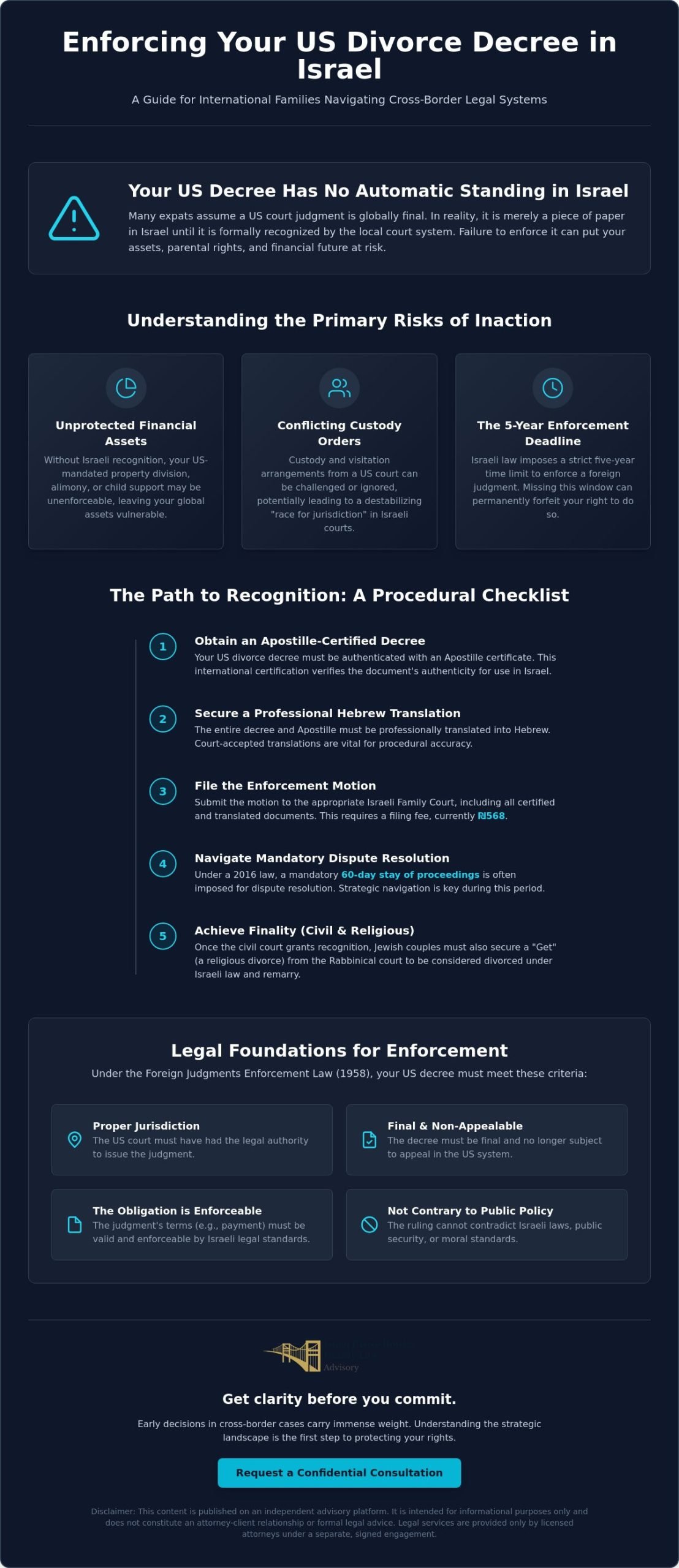
This guide provides the clarity you need for enforcing US divorce decree in Israel while protecting your financial interests and parental rights. You’ll learn about the mandatory ₪568 filing fees, the strategic implications of the 2016 Mandatory Dispute Resolution Law, and how to navigate the “race for jurisdiction” between civil and religious courts. We will walk through the essential procedural steps, from obtaining an Apostille to securing a religious “Get,” so you can achieve finality without the stress of conflicting legal orders.
Key Takeaways
- Understand the specific legal criteria under the Foreign Judgments Enforcement Law that determine if a foreign order is valid within the Israeli system.
- Learn the essential procedural steps for enforcing US divorce decree in Israel, including the impact of the mandatory 60-day stay of proceedings.
- Identify the strategic risks involving the “race for jurisdiction” and how to balance the requirements of both civil and religious courts.
- Discover why documentation like Apostille-certified decrees and professional Hebrew translations are vital for protecting your global financial assets.
- Gain a clear roadmap for navigating the ₪568 filing process while adhering to the strict five-year enforcement deadline.
Who is Yael Avitan Adv.? A Specialized Approach to US-Israel Enforcement
Yael Avitan Adv. serves as a specialized advisor for individuals caught between the legal requirements of the United States and the specific mandates of the State of Israel. For many Anglos, expats, and international families, the process of enforcing US divorce decree in Israel is not a simple administrative task; it is a complex strategic maneuver. Yael’s philosophy is built on providing calm, authoritative guidance to those who find the Israeli legal system unfamiliar or intimidating. Her role is to act as a steady guide, ensuring that the transition of legal rights from one country to another is handled with precision. It’s vital to recognize that this content is published on an independent advisory platform and does not constitute an attorney-client relationship; formal legal representation is only established through a separate, signed engagement.
To better understand the complexities of legal recognition, watch this helpful video:
Professional Background and Jurisdictional Focus
Yael’s professional background is defined by her experience in managing the intricate details of multi-jurisdictional family and corporate law matters. She understands that English-speaking clients require more than just a translation of laws; they need a translation of the entire legal culture. By focusing on transparent communication, she removes the jargon that often clouds cross-border cases. Her commitment to strategic risk assessment means that clients receive an honest evaluation of their situation before any legal filings are made. This proactive approach is detailed further on the about-the-advisory page, where the focus remains on established expertise and a deep understanding of the local market.
The Role of an International Legal Advisor
Core Requirements: Enforcing a US Divorce Decree under Israeli Law
The foundation for enforcing US divorce decree in Israel rests upon the Foreign Judgments Enforcement Law of 5718-1958. This statute dictates the specific conditions under which a domestic court will recognize a ruling issued by a foreign tribunal. Recognition isn’t an automatic right. Instead, it’s a rigorous validation process that ensures the foreign decree aligns with the standards of the Israeli judiciary. Understanding these requirements is the first step toward securing your rights across borders. If you ignore these prerequisites, you risk a situation where your US rights simply don’t exist under Israeli law.
According to U.S. government guidance, several distinct criteria must be met for a judgment to be declared enforceable. First, the US court must have held proper jurisdiction over the parties and the subject matter. If the defendant wasn’t properly served or had no connection to the US state, the Israeli court may refuse recognition. Second, the judgment must be final. Temporary orders or decrees still subject to appeal in the US cannot be enforced here. Third, the decree must be enforceable in its country of origin and must not contradict Israeli public policy. Finally, the principle of reciprocity requires that the US state where the decree was issued would similarly recognize an Israeli judgment.
The 5-Year Statute of Limitations
Timing is a critical factor that many expats overlook. Under Israeli law, an application for enforcement must generally be submitted within five years of the date the US judgment became final. While exceptions exist, they are rare and often difficult to achieve. Delaying this process creates significant risks, especially if your former spouse chooses to challenge the decree’s validity once assets or children are physically in Israel. You can learn how our advisory works to help you manage these timelines effectively. Acting early prevents the loss of enforcement rights due to the passage of time.
Public Policy and Reciprocity
The concept of “Public Policy” (Takant HaTzibur) acts as a safeguard for the Israeli legal system. If a US decree contains clauses that fundamentally clash with Israeli values or legal principles, a judge might refuse to enforce those specific sections. This often surfaces in complex custody or asset distribution cases where US laws diverge from local norms. Proving reciprocity is equally vital. In 2026, Israeli courts continue to look for evidence that US state courts maintain a cooperative legal relationship with Israel. Navigating these nuances requires a strategic approach that addresses both the letter of the law and the cultural expectations of the court. If you are unsure about your decree’s status, it’s wise to seek professional clarity on your specific case.
The Cross-Border Advantage: Navigating Jurisdictional Risks
The process of moving a divorce decree across the Atlantic involves more than just a physical transfer of documents. When enforcing US divorce decree in Israel, the primary challenge often lies in the conceptual gap between two very different legal cultures. A US decree is born from a common law tradition. The Israeli system, however, is a complex hybrid of common law, civil law, and religious statutes. This bridge philosophy is essential because a standard clause in a California or New York decree might not have a direct equivalent in the local Family Court. Without a practitioner who understands both sides, your rights can easily vanish during the transition.
Relying on advice that doesn’t account for this duality can lead to significant “lost in translation” errors. For instance, a US judge might order an asset split that triggers unforeseen tax liabilities or religious complications in Israel. By coordinating with your US-based legal team, we ensure a unified global strategy that protects your interests in both jurisdictions. This prevents the nightmare scenario of having two courts in two different countries issuing conflicting orders regarding the same bank account or child. According to U.S. Government Guidance on Israel Case Processing, the reciprocal relationship between the countries provides a framework, but the execution depends on how well these differences are managed at the start.
Bridging Legal Systems and Cultures
The differences between the US and Israeli legal frameworks are profound. In the US, the civil court is typically the sole authority for all aspects of a divorce. In Israel, the Rabbinical Court holds exclusive jurisdiction over the actual marriage dissolution for Jewish citizens, even if the Family Court handles the financial division. Cultural misunderstandings here can derail even the most amicable property settlements. Our advisory is specifically designed for expats and foreign nationals in Israel who need to navigate these distinct waters without losing their legal footing.
Strategic Risk Management
Managing jurisdictional risk requires an honest assessment of what can and cannot be achieved. We don’t provide exaggerated guarantees about preventing Rabbinical court intervention, as the law is clear on their authority. Instead, we focus on managing multi-jurisdictional disputes by prioritizing your commercial and personal goals. Seeking clarity before signing any Israeli “Financial Agreement” is vital. These local contracts can unintentionally override your US decree if not drafted with a cross-border perspective. Every early decision, from the first document filed to the choice of court, carries immense weight for your global standing.
Procedural Methodology: How We Validate Foreign Orders in Israel
Validating a foreign order requires a methodical approach that respects both US standards and Israeli procedural law. When enforcing US divorce decree in Israel, success depends on a four-step methodology designed to mitigate risk before a single document reaches the judge’s desk. This structured process ensures that the transition of legal authority is seamless and that your rights are not compromised by procedural errors. It’s not just about filing paperwork; it’s about translating your legal status into a framework that the local courts recognize and respect.
- Step 1: Initial Confidential Case Review. This foundational phase establishes jurisdictional facts and the current status of the US decree to determine the most viable path forward.
- Step 2: Strategic Planning. We focus on the multi-jurisdictional implications of the decree, including potential tax liabilities and the impact on child custody.
- Step 3: Documentation and Authentication. This involves securing the necessary Apostille seals and professional Hebrew translations, which typically range from ₪500 to ₪2,000 for standard documents.
- Step 4: Formal Application. The final step is the submission of the enforcement claim to the Israeli Family Court or District Court, accompanied by the mandatory ₪568 filing fee.
The Confidential Case Review Process
Your first interaction with Yael Avitan Adv. centers on clarity. Unlike traditional litigation models that favor immediate, aggressive action, our methodology prioritizes strategy and informed decision-making. We examine the weight of early decisions, such as the timing of your filing, which can trigger a mandatory 60-day stay of proceedings under the 2016 Mandatory Dispute Resolution Law. This review allows you to understand the inherent complexity of your case before making any long-term commitments to the Israeli system. To begin this strategic assessment, you can request a confidential case review today.
Documentation and Service of Process
A critical component of enforcement is proving that the defendant was properly served in the US, satisfying both American and Israeli due process requirements. Procedural rigidity is a hallmark of the Israeli courts; any error in service can jeopardize the entire application. It’s also vital to distinguish between advisory strategy and formal legal representation. While our advisory platform provides the strategic roadmap, formal legal services are only provided by licensed attorneys under a separate engagement. For a detailed breakdown of the costs involved in this process, you may review our cross-border legal pricing. Ensuring that every document is Apostille-certified and accurately translated is the only way to protect your global assets from unnecessary legal challenges.
Getting Clarity: Next Steps for Your US-Israel Legal Matter
Time is a critical variable when your interests span two continents. If your financial assets or children are currently located in Israel, delaying the process of enforcing US divorce decree in Israel can lead to irreversible legal complications. As previously noted, the five-year statute of limitations is a firm boundary that requires decisive action. Beyond this window, you risk a situation where a former spouse could initiate local proceedings that fundamentally contradict your US judgment. Proactive management is the only reliable way to ensure that your international life remains legally sound and that your rights are recognized by local authorities.
The first step toward clarity involves gathering your essential records. You’ll need a certified copy of your US divorce decree, which must be authenticated with an Apostille seal from the Secretary of State in the state where it was issued. Service records are equally important; you must be able to prove the other party was properly notified of the US proceedings to satisfy Israeli due process requirements. For those seeking a deeper understanding of these mechanics, the Israel Family Law YouTube channel provides a wealth of educational content specifically tailored for the Anglo community and international families.
Preparing for Your Consultation
A successful advisory session depends on the quality and organization of the information you provide. Before your initial review, you should prepare a comprehensive list of all Israeli assets, including real estate holdings, bank accounts, and pension funds, alongside your final US decree. Our approach goes beyond basic family law by considering the broader implications of the US-Israel tax treaty. We also analyze how asset redistribution might affect corporate interests or complex M&A activities. This high-level strategic oversight is a core part of our methodology, as detailed in the About the Advisory section.
Conclusion: Proactive Legal Strategy
Yael Avitan Adv. provides the specialized, calm, and authoritative guidance necessary to bridge the gap between two divergent legal systems. We understand that the prospect of entering the Israeli court system is daunting for many expats and foreign nationals. However, this complexity is manageable when you have a strategic guide who understands both your commercial goals and the local legal landscape. Our focus remains on protecting your global future through established expertise and a deep connection to the local market. Get clarity before you commit. Request a confidential consultation to discuss the specific details of your case.
Securing Your Global Rights Across Jurisdictions
Navigating the intersection of American and Israeli law is a sophisticated endeavor that demands a high degree of strategic foresight. By understanding the core requirements of the Foreign Judgments Enforcement Law and adhering to strict procedural timelines, you can effectively manage the risks associated with enforcing US divorce decree in Israel. Our advisory focus is specifically tailored for English-speaking expats and Anglos who require a nuanced understanding of multi-jurisdictional litigation and regulatory compliance. We provide the steady, knowledgeable guidance needed to bridge the gap between divergent legal systems while protecting your commercial and personal interests.
It’s vital to address these matters proactively to avoid the pitfalls of conflicting court orders or the expiration of enforcement rights. With a practitioner who understands the weight of early decisions, you can move forward with confidence. Get clarity before you commit. Request a confidential consultation. Taking the first step toward legal recognition today ensures that your family’s future remains stable and secure under both legal frameworks.
Frequently Asked Questions
Is Yael Avitan Adv. licensed to practice in both the US and Israel?
Yael Avitan Adv. is a cross-cultural practitioner with a deep understanding of divergent legal systems and international frameworks. While the advisory specializes in the strategic intersection of US and Israeli law, legal services are provided through licensed attorneys in their respective jurisdictions. This ensures that every case benefits from a nuanced understanding of both American common law and the hybrid Israeli system, providing the steady guidance necessary for complex cross-border matters.
What types of cross-border cases does Adv. Avitan typically handle?
The advisory handles a wide range of multi-jurisdictional matters, including cross-border divorce, international child custody, and estate planning. Beyond standard family law, the focus extends to advisory for international families with complex asset portfolios and corporate interests. This includes cases involving the 2016 Mandatory Dispute Resolution Law and the strategic translation of US rights into the Israeli framework to ensure long-term stability.
Can Yael Avitan Adv. help with enforcing a US child support order in Israel?
Yes, the advisory provides strategic guidance for enforcing US child support orders within the Israeli system. This involves navigating the reciprocal agreements between the two nations and ensuring that the US order meets the specific criteria of the Foreign Judgments Enforcement Law of 5718-1958. We help clients understand the procedural steps required to make these orders legally binding while protecting their financial interests across borders.
How does the advisory process work for clients living outside of Israel?
The advisory process is designed to accommodate clients globally through secure digital communication and remote consultations. We manage the initial strategic planning and documentation review regardless of your physical location. This allows expats and international families to secure their Israeli interests without the immediate need for travel, providing a steady guide through the complexities of the local system from anywhere in the world.
Does Yael Avitan Adv. provide services for US companies entering the Israeli market?
The advisory specifically focuses on family and estate matters, which often involve international corporate asset portfolios. While we don’t handle general corporate market entry, we provide specialized guidance on how international family law and estate planning impact cross-border business ownership and succession. This ensures that personal legal matters don’t compromise your commercial objectives or equity holdings within the Israeli market.
Are US divorce decrees regarding property split always enforced in Israel?
Not every clause in a US decree is automatically enforceable in local courts. Israeli judges review property splits to ensure they don’t violate local “Public Policy” (Takant HaTzibur). For example, if a US order contradicts fundamental Israeli legal principles, a judge may refuse to recognize that specific portion. Success in enforcing US divorce decree in Israel depends on demonstrating that the judgment is final, enforceable in the US, and reciprocal.
What is the first step to engaging Yael Avitan Adv. for a legal matter?
The first step is to request a confidential case review through our advisory platform. This initial phase is dedicated to establishing jurisdictional facts and identifying potential risks before any formal legal commitments are made. It provides the clarity needed to decide on a strategic path forward, ensuring that you understand the weight of early decisions and the potential impact on your global assets.
How does Yael Avitan Adv. coordinate with my existing US lawyer?
We operate with a collaborative philosophy, acting as a bridge between your existing US legal team and the Israeli system. By working seamlessly with your current counsel, we ensure a unified global strategy for your assets and custody rights. This partnership prevents conflicting legal orders and ensures that the advice you receive in one jurisdiction doesn’t unintentionally damage your legal standing in the other.

Article by
Gabriel Lior
A Personal Journey That Became a Mission
The advisory was founded by an American father Gabriel Lior, LLB, MBA , global entrepreneur, and cross-border advisor who spent more than a decade navigating the Israeli family court system firsthand and now lives in Singapore with his son.
As a divorced parent in a cross-border family, Gabriel faced nearly every legal challenge a foreign parent can encounter in Israel — including child custody disputes, child support proceedings, property matters in Israel and abroad, false accusations, and complex immigration and relocation proceedings.
Over the years, he learned the hard way how difficult it is for non-Israeli parents to understand the system, identify the right legal strategy, and choose the right legal representation — especially when language, culture, and jurisdictional differences are involved. He also witnessed how foreign parents and new immigrants are often disadvantaged or taken advantage of by service providers and institutions simply because they lack local knowledge or fluency.
From Client to Advisor
To truly understand — and survive — the system, Gabriel pursued formal legal education in Israel, completing two Israeli law degrees, alongside a BA and MBA earned in the United States. This was never about becoming a practicing attorney, but about gaining a deep, structural understanding of how the system works — and where it breaks down for foreign parents.
This rare combination of:
Firsthand client experience
Israeli legal and US business education
International business and negotiation training
Decades of commercial execution
created a unique perspective – one that understands both sides of the table.
After years of litigation, persistence, and at times self-representation, he ultimately succeeded in securing custody of his son and relocating abroad through a rare legal victory in the Israeli Supreme Court — becoming one of the first fathers in Israel to do so under these circumstances.
Disclaimer
Important Disclaimer:
The information provided on this website and in its content is for general informational and educational purposes only and does not constitute legal advice, legal opinion, or legal representation.
Gabriel Lior is not licensed to practice law in Israel (nor is he interested in doing so) and does not provide legal services, despite having completed 2 Law Degrees. The services offered are advisory in nature and are intended to provide general guidance, strategic insight, and information regarding cross-border family law considerations.
No attorney-client relationship is formed by accessing this website, reading its content, or communicating with us.
Any decisions made based on this information are at your own discretion and risk. For legal advice specific to your situation, you should consult a licensed attorney in the relevant jurisdiction.
Where appropriate, we may refer clients to independent, licensed attorneys or professionals. Such referrals do not constitute legal representation and no liability is assumed for services provided by third parties.