Imagine discovering that a DNA test you took at home in New York carries zero legal weight in an Israeli courtroom. For many international families, the process of establishing paternity internationally begins with this exact realization, where local assumptions often collide with foreign statutes. It’s natural to feel uncertain about which country holds jurisdiction or how a decision made in one region might trigger unintended financial consequences in another.
You aren’t alone in this confusion. The legal distance between the US and Israel can often feel much wider than the physical miles between them, especially when parental rights, immigration status, or inheritance are at stake. This guide provides a strategic roadmap to help you navigate these complexities. We’ll show you how to secure your rights while managing child support or custody expectations with clarity and confidence.
We will examine the specific requirements of the Israeli Family Court, the process for enforcing foreign judgments, and the critical role of court-ordered genetic testing. Please note that this content is published on an independent advisory platform and is intended for informational and strategic purposes only. It doesn’t constitute legal representation or formal legal advice; legal services are only provided by licensed attorneys under a separate engagement.
Key Takeaways
- Understand why establishing paternity internationally requires a dual-track approach that separates biological evidence from formal legal recognition.
- Learn why Israeli courts don’t accept private DNA test results and how to navigate the mandatory court-ordered genetic testing process.
- Discover the process used to validate US court orders within the Israeli civil system to ensure cross-border enforcement.
- Identify how a paternity declaration triggers automatic strategic shifts in child support obligations and inheritance rights across both countries.
- Gain a clear roadmap for mitigating legal risks in dual-citizenship cases before you commit to any formal agreements or acknowledgments.
The Complexity of Establishing Paternity Internationally between the US and Israel
Establishing paternity internationally isn’t a single event. It’s a dual-track legal process that involves proving a biological link and securing a legal status that both nations recognize. While DNA provides the biological truth, legal parentage is a separate construction of paternity law that varies significantly between the United States and Israel. In cross-border cases, a father’s rights aren’t always portable. What’s accepted in a US state court might not satisfy the requirements of an Israeli family court, creating a gap that can leave families in legal limbo.
Many parents assume a US birth certificate is sufficient evidence for Israeli authorities. However, Israel often views foreign administrative documents as secondary to their own judicial findings. This is especially true for children born out of wedlock, where the Israeli Ministry of Interior typically requires a court-ordered declaratory judgment before updating the population registry. Relying on a birth certificate alone can lead to significant delays in securing passports, inheritance rights, or residency status.
To better understand this concept, watch this helpful video:
For the Anglo expat community in 2026, the choice of where to initiate these proceedings is a strategic decision. Jurisdictional choices are no longer just about convenience; they’re about which legal system will better protect the child’s long-term interests and the parents’ future mobility. Understanding the nuances of legal frameworks for expats and foreign nationals is essential before making any formal commitments.
Understanding the Jurisdictional Conflict
Courts determine jurisdiction by looking for the child’s “closest connection.” This usually centers on habitual residence, which is the place where the child’s life is primarily centered. Conflicts often arise because US state laws frequently allow for voluntary acknowledgments of paternity at the hospital. In contrast, Israeli civil law remains more rigid, requiring judicial oversight to ensure the child’s welfare is protected. These differing standards can create friction when one parent is in the US and the other is in Israel.
Why the Expat Experience Requires Specialized Guidance
Navigating the Israeli legal system as a non-Hebrew speaker adds a layer of difficulty to an already complex situation. The Israeli family court system operates with a different cultural and procedural rhythm than US courts. Early decisions, such as which court to approach first, carry immense weight. These choices can dictate future outcomes for international relocation or custody arrangements. It’s vital to seek clarity on how these systems interact before filing any paperwork that could permanently bind you to a specific jurisdiction’s rules.
Legal Mechanisms for Proving Parentage Across Borders
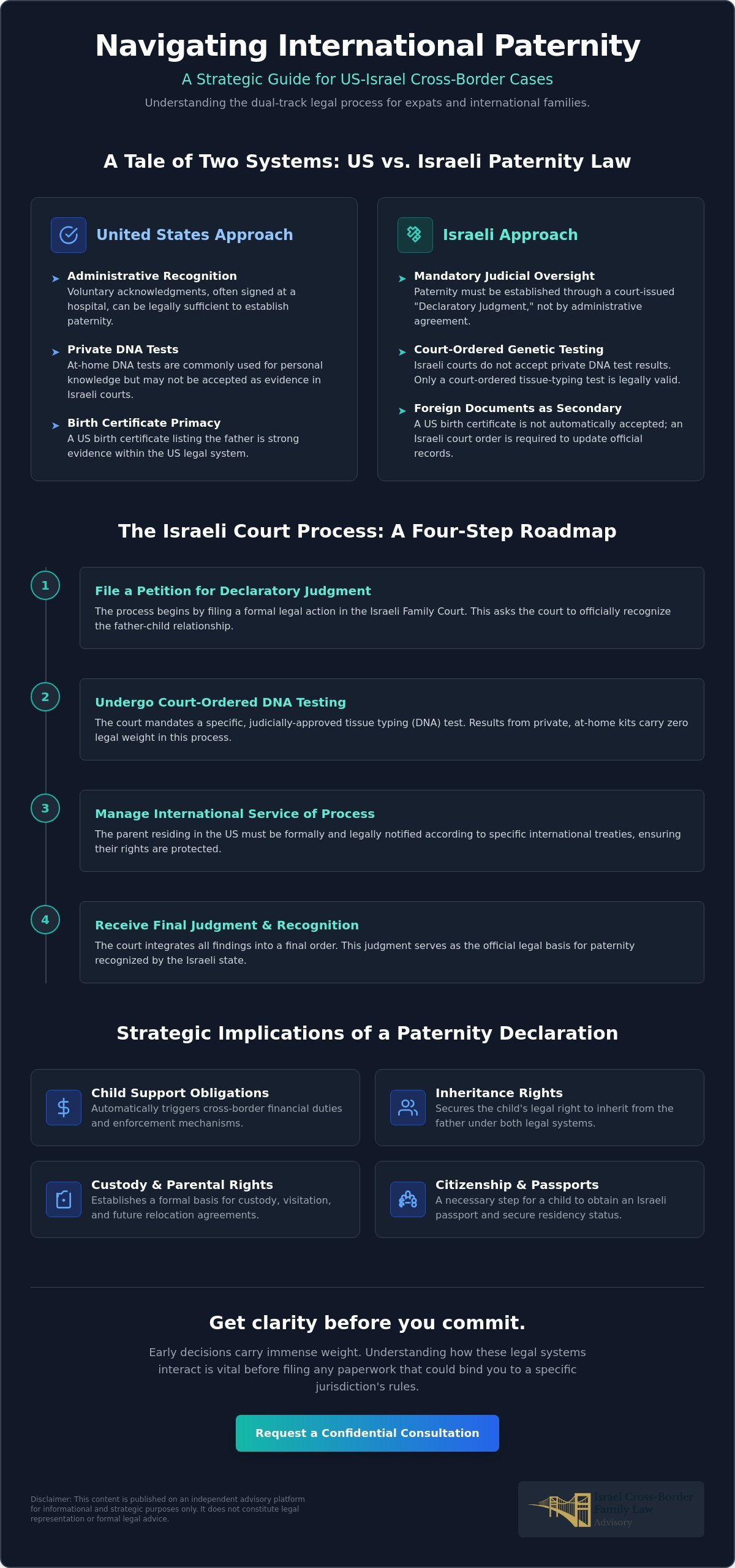
When you’re establishing paternity internationally, the process follows a strict judicial sequence designed to protect the rights of all parties involved. It’s not a matter of simply filling out a form at a consulate. Instead, it typically begins with filing a petition for a “Declaratory Judgment” in the Israeli Family Court. This legal action asks the court to formally recognize the father-child relationship, which then serves as the basis for all subsequent rights, from residency to inheritance.
The process involves four primary stages. First, the filing of the petition itself. Second, the court usually mandates a tissue typing (DNA) test. Third, you must manage the service of process on the parent residing in the United States, which requires adherence to specific international treaties. Finally, the court integrates these findings into a single recognized status. For those navigating this for the first time, it’s helpful to understand how the advisory process works before initiating litigation.
DNA Testing and the Israeli Family Court
In Israel, private or “at-home” DNA kits are generally inadmissible in court. The legal system prioritizes a strict chain of custody and laboratory accreditation. The Israeli Family Court must order the test, and the Attorney General is a mandatory party to these proceedings to ensure the child’s best interests are upheld. As of 2026, the verified fee for a court-ordered paternity test is 2,597 ILS for local residents. If a parent is located abroad, this fee increases to 3,811 ILS. These tests must be performed at one of the few accredited forensic labs in Israel, such as the one at Tel Hashomer. When a parent is in the US, the court coordinates with the local US consulate or a specific lab to collect samples under strict supervision, as detailed in the Caseworker’s Guide to Israel Paternity Cases.
Voluntary Acknowledgments vs. Judicial Decrees
The United States often uses a Voluntary Acknowledgment of Paternity (VAP), which is a simple administrative document. While a VAP is powerful within the US, it’s often insufficient for Israeli authorities or for complex immigration matters. For example, obtaining a Consular Report of Birth Abroad (CRBA) for a child born in Israel to a US citizen father often requires more than just a signature. It requires clear evidence of a biological link that meets high evidentiary standards. A judicial decree from an Israeli court provides a higher level of certainty. This is especially important when you need to secure a child’s right to inherit or ensure they are eligible for US citizenship. Before you sign any documents that could have long-term consequences, you may want to request a confidential case review to assess your specific situation.
Recognition of Foreign Paternity Orders in Israel
A common misconception among international families is that a paternity order issued by a US state court is automatically valid in Israel. In reality, while Israel respects foreign judicial decisions, these orders must undergo a formal recognition process known as “Exequatur” before they carry legal weight. This procedure ensures that the foreign judgment aligns with the Israeli Enforcement of Foreign Judgments Law. When you’re establishing paternity internationally, securing a US order is often only the first half of the journey; the second half involves petitioning an Israeli court to “enforce” or “recognize” that specific decree.
For an Israeli court to validate a US paternity judgment, several criteria must be met. The court will verify that the US proceedings provided both parents with due process and that the judgment doesn’t contradict Israeli public policy. Currently, the court filing fee for a motion to enforce a foreign judgment in Israel is approximately $350. It’s also vital to act within the five-year statute of limitations for filing for enforcement. If this window is missed, the process becomes significantly more complex and may require starting a fresh paternity claim within the Israeli system.
Documentation is the backbone of this process. Every US court document must bear an Apostille certification to be recognized by Israeli authorities. Additionally, these documents require notarized translations into Hebrew. Without these specific certifications, the Israeli court or the Ministry of Interior will likely reject the application. Managing these bureaucratic steps correctly from the start prevents costly delays and ensures your parental rights are protected in both jurisdictions.
Validating US State Court Orders
Israeli courts examine whether the US court had the proper jurisdiction to hear the case according to Israeli standards. They typically look for a “closest connection” between the child and the state where the order was issued. Another critical requirement is finality; the judgment must no longer be appealable in its home state. Strategic timing is essential here. In some cases, it might be more efficient to initiate a new proceeding in Israel rather than seeking recognition of an older or contested US order, especially if the original proceedings didn’t meet strict Israeli evidentiary standards.
The Role of the Ministry of Interior (Misrad HaPnim)
Once the Israeli Family Court recognizes the foreign paternity order, the next step is updating the Israeli population registry. This is managed by the Ministry of Interior (Misrad HaPnim). This update is what allows a child to receive an Israeli passport or identity card and formalizes their status as a legal heir. For foreign national parents, this stage often involves navigating significant bureaucratic hurdles. Having a clear understanding of how these systems work for expats can help you manage expectations and avoid common filing errors. Please remember that this content is published on an independent advisory platform and provides strategic guidance rather than formal legal representation.
Strategic Implications for Child Support and Inheritance
Establishing paternity internationally serves as the legal foundation for a child’s financial and personal security. It’s the critical step that transforms a biological reality into an enforceable set of rights and responsibilities. Once a court recognizes the relationship, it triggers automatic child support obligations that are often enforceable across the Atlantic. This legal clarity also provides the parent with the standing necessary to seek custody or visitation, ensuring that the child’s connection to both parents is protected by the state.
Securing this status is also a primary defense against the risk of international child abduction. By having a clear, court-ordered paternity decree, parents can better utilize the protections offered by international treaties. Without this formal recognition, a parent may lack the standing required to prevent a child from being moved across borders without their consent. It’s a strategic move that provides peace of mind for families living between two different legal cultures.
Financial Obligations and Cross-Border Enforcement
The United States and Israel maintain a Memorandum of Understanding that facilitates the reciprocal enforcement of support orders. This means that a child support order issued in a US state can often be processed and collected through the Israeli Enforcement and Collection Authority. Conversely, Israeli orders can be sent to US state agencies for enforcement against a parent residing there. This system ensures that children receive the support they’re entitled to, regardless of where their parents live. For a deeper look at the mechanics of this process, you can read more about child support cross-border enforcement.
Securing Inheritance Rights
Legal paternity is a non-negotiable requirement for a child to be recognized as a natural heir under the Israeli Succession Law. The Israeli Succession Law of 1965 governs the distribution of an estate and mandates that a child must have a legally established paternal link to be considered a natural heir of a deceased father, regardless of the residency of the parties involved. Without this link, a child may be excluded from an estate unless specifically named in a valid will.
Beyond private estates, establishing paternity internationally impacts government-provided benefits. For instance, a child residing in Israel may only be eligible for US Social Security survivor benefits if their relationship to the American parent is legally documented. This documentation ensures that the child’s future isn’t compromised by bureaucratic gaps or a lack of formal recognition. If you’re concerned about how these laws might impact your family’s future, you can speak with an advisor to discuss your specific circumstances and the strategic steps you should take.
Navigating the Process: Risk Mitigation and Strategic Planning
Establishing paternity internationally is more than a biological verification; it’s a strategic decision that shapes the legal landscape for a child’s entire minority. Before you sign any voluntary acknowledgments or informal agreements, you must obtain complete legal clarity. Early commitments made without understanding the interplay between US and Israeli law can lead to unintended consequences regarding custody or financial liability. This content is published on an independent advisory platform, not a law firm, and focuses on strategy, risks, and decision-making guidance rather than a formal attorney-client relationship.
For dual-citizenship families, the timing of a paternity claim is critical. If a child is born in Israel to a US citizen father, the process for obtaining a Consular Report of Birth Abroad (CRBA) depends on a legally recognized link. If you delay this process, you might face bureaucratic hurdles when trying to secure a US passport for the child or establishing their eligibility for certain benefits. Strategic planning ensures that these administrative steps align with your long-term family goals, rather than becoming a source of stress during an already complex time.
The Weight of Early Decisions
Taking a “wait and see” approach often leads to the loss of significant jurisdictional advantages. In cross-border cases, the child’s habitual residence is a primary factor in determining which court has the power to make decisions about their life. If paternity isn’t established early, a father might find himself without the legal standing to participate in relocation discussions or Hague Convention disputes. Understanding how paternity impacts international custody and relocation is essential for any parent who envisions a life that spans across both the US and Israel.
How a Cross-Border Advisory Provides Clarity
There’s a significant difference between a local attorney and a cross-border strategist. While a local lawyer in Tel Aviv or New York understands their specific court’s rules, a strategist looks at how a decision in one country ripples into the legal system of the other. Our role is to bridge the gap between these two distinct environments, focusing on the long-term family dynamic rather than just the immediate filing. We help you identify potential pitfalls before they become permanent legal obstacles, allowing you to move forward with confidence.
Success in these matters requires a proactive mindset and an awareness of the cultural differences between the US and Israeli family court systems. By prioritizing strategy and risk mitigation today, you protect your rights and your child’s future for years to come. Get clarity before you commit. Request a confidential consultation.
Securing Your Family’s Legal Future Across Borders
Establishing paternity internationally demands a proactive strategy that looks beyond immediate needs toward long-term security. We’ve examined how the intersection of US and Israeli laws creates a complex environment where biological facts must be translated into recognized legal rights. Early decisions regarding jurisdiction and documentation can dictate the future of your child’s inheritance, support, and relocation rights for years to come.
Success in these matters relies on bridging the gap between two distinct legal cultures with precision and foresight. Our advisory platform for international families offers specialized US-Israel cross-border expertise authored by experienced practitioners in international family law. We focus on helping you navigate these risks with a clear roadmap designed for your specific situation. Please note that this information is advisory and doesn’t constitute formal legal representation.
Get clarity before you commit. Request a confidential consultation today to ensure your family’s rights are fully protected in both jurisdictions.
Frequently Asked Questions
Is a US birth certificate enough to prove paternity in Israel?
A US birth certificate is generally insufficient for the Israeli Ministry of Interior to establish legal parentage for children born to unmarried parents. While it serves as administrative evidence, Israeli authorities typically require a judicial decree from a Family Court to update the population registry. This process ensures the relationship is verified under Israeli legal standards rather than relying solely on foreign administrative records.
Can I use an at-home DNA kit for an Israeli paternity case?
You cannot use results from private, at-home DNA kits in an Israeli paternity case as they are legally inadmissible. The Israeli legal system only recognizes genetic tests performed at specific accredited forensic laboratories under a direct court order. This ensures a strict chain of custody, which is why establishing paternity internationally requires following formal judicial procedures rather than using private testing services.
How long does the international paternity establishment process take?
The timeline for establishing paternity internationally typically ranges from six months to over a year. Delays are often caused by the need for international service of process and the coordination of DNA testing at accredited facilities in different time zones. Each case’s complexity and the level of cooperation between the parties will ultimately determine the final duration of the proceedings.
What happens if the father refuses to cooperate with a DNA test abroad?
If a father refuses to cooperate with a court-ordered DNA test, the Israeli court has the power to draw an “adverse inference.” This means the judge may legally assume paternity based on the refusal itself. While the court cannot physically force a person residing in the US to provide a sample, the legal consequences of non-compliance are significant within the Israeli civil proceeding.
Does establishing paternity automatically grant the father custody rights in Israel?
Establishing paternity does not automatically grant a father custody or visitation rights in Israel. It simply creates the legal link necessary to apply for those rights in a separate proceeding. Custody and access are distinct legal issues determined by the court based exclusively on the “best interests of the child” standard rather than biological status alone.
Can a US child support order be enforced in Israel after paternity is established?
A US child support order can be enforced in Israel through a formal motion for enforcement in the Family Court once the paternal link is recognized. The Israeli Enforcement and Collection Authority can then assist in collecting payments from a parent residing in Israel. This process relies on reciprocal agreements between Israel and many US states regarding the cross-border collection of financial support.
What is the role of the Attorney General in Israeli paternity cases?
The Attorney General acts as a guardian of the public interest and is a mandatory party to every paternity case in Israel. Their role is to ensure that the child’s rights and welfare are protected throughout the litigation process. They review all evidence and DNA results before the court issues a final declaratory judgment to ensure the outcome serves the child’s best interests.
Are there specific time limits for establishing paternity in Israel?
There is generally no time limit for a child to seek a paternity declaration in Israel; however, procedural limits do apply to other aspects of the case. For example, a five-year statute of limitations typically applies when seeking to recognize and enforce a foreign US judgment. It’s best to seek strategic clarity early to avoid missing these procedural windows or losing important jurisdictional advantages.

Article by
Gabriel Lior
A Personal Journey That Became a Mission
The advisory was founded by an American father Gabriel Lior, LLB, MBA , global entrepreneur, and cross-border advisor who spent more than a decade navigating the Israeli family court system firsthand and now lives in Singapore with his son.
As a divorced parent in a cross-border family, Gabriel faced nearly every legal challenge a foreign parent can encounter in Israel — including child custody disputes, child support proceedings, property matters in Israel and abroad, false accusations, and complex immigration and relocation proceedings.
Over the years, he learned the hard way how difficult it is for non-Israeli parents to understand the system, identify the right legal strategy, and choose the right legal representation — especially when language, culture, and jurisdictional differences are involved. He also witnessed how foreign parents and new immigrants are often disadvantaged or taken advantage of by service providers and institutions simply because they lack local knowledge or fluency.
From Client to Advisor
To truly understand — and survive — the system, Gabriel pursued formal legal education in Israel, completing two Israeli law degrees, alongside a BA and MBA earned in the United States. This was never about becoming a practicing attorney, but about gaining a deep, structural understanding of how the system works — and where it breaks down for foreign parents.
This rare combination of:
Firsthand client experience
Israeli legal and US business education
International business and negotiation training
Decades of commercial execution
created a unique perspective – one that understands both sides of the table.
After years of litigation, persistence, and at times self-representation, he ultimately succeeded in securing custody of his son and relocating abroad through a rare legal victory in the Israeli Supreme Court — becoming one of the first fathers in Israel to do so under these circumstances.
Disclaimer
Important Disclaimer:
The information provided on this website and in its content is for general informational and educational purposes only and does not constitute legal advice, legal opinion, or legal representation.
Gabriel Lior is not licensed to practice law in Israel (nor is he interested in doing so) and does not provide legal services, despite having completed 2 Law Degrees. The services offered are advisory in nature and are intended to provide general guidance, strategic insight, and information regarding cross-border family law considerations.
No attorney-client relationship is formed by accessing this website, reading its content, or communicating with us.
Any decisions made based on this information are at your own discretion and risk. For legal advice specific to your situation, you should consult a licensed attorney in the relevant jurisdiction.
Where appropriate, we may refer clients to independent, licensed attorneys or professionals. Such referrals do not constitute legal representation and no liability is assumed for services provided by third parties.