Your business might be your life’s work, but in the eyes of an IL judge, it’s often treated as a shared marital project. For international entrepreneurs, the process of dividing business assets in israeli divorce can be complex, especially when dealing with the Spouses’ Financial Relations Law of 1973. You likely believe that your professional achievements should remain separate from your personal life, yet the growth of your company during the marriage is generally subject to equal distribution. This is true even if the business was started before the wedding or operates primarily in the US.
We understand the anxiety that comes with managing cross-border assets while facing the dual-court system of Rabbinical and Family courts. This article provides a clear overview of how IL law treats business ownership and valuation methods to help you protect your professional future. You’ll learn about strategies for separating assets and how the 2026 reporting updates for foreign holdings impact your specific situation. This content is published on an independent advisory platform for informational purposes only; it’s not legal advice and doesn’t create an attorney-client relationship.
Key Takeaways
- Understand how the Resources Balancing Law separates pre-marital business value from the growth achieved during the marriage.
- Learn why the “jurisdiction race” between Family and Rabbinical courts is a critical strategic factor when dividing business assets in israeli divorce cases.
- Explore how neutral court-appointed accountants apply the Income Approach to determine the fair market value of profitable enterprises.
- Gain clarity on how IL courts can impact foreign entities, such as US-based LLCs, through orders directed at the business owner rather than the company itself.
- Discover strategic settlement options, including asset offsetting and monetary buyouts, designed to help you retain full control of your professional future.
What Constitutes a Marital Business Asset Under Israeli Law?
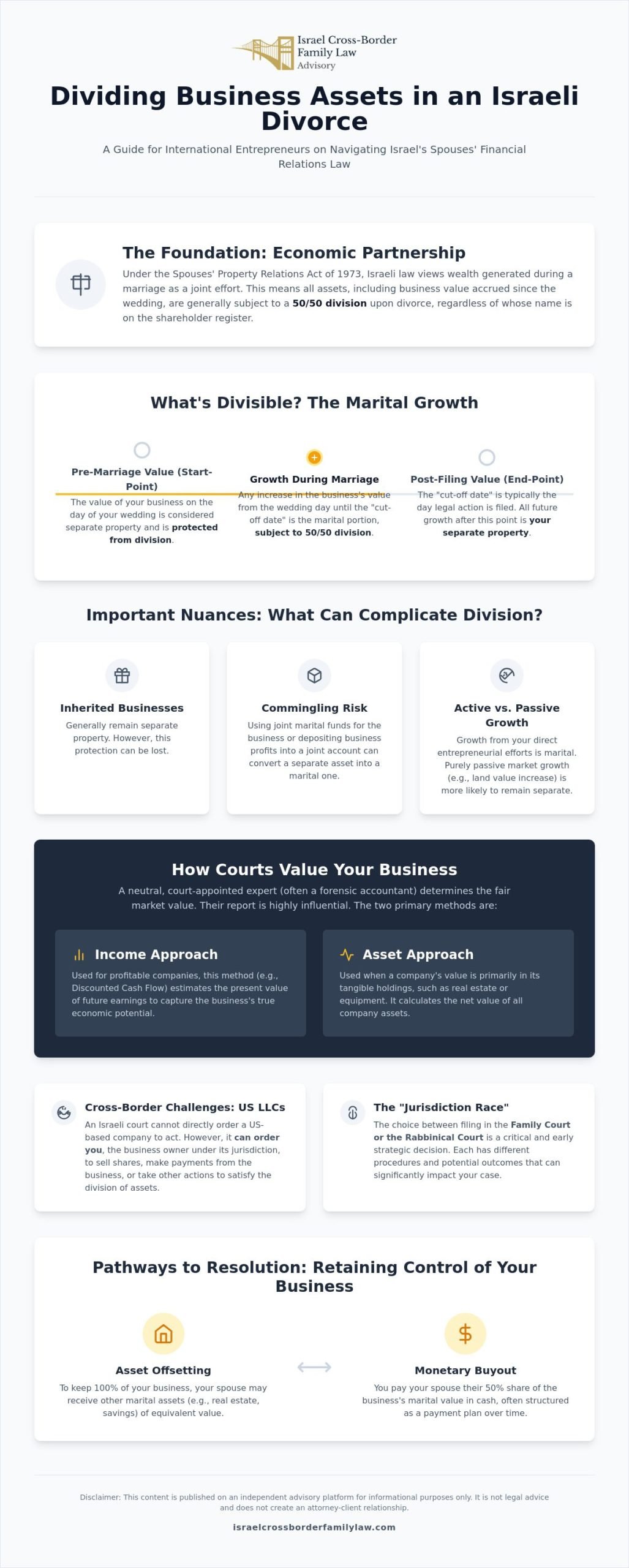
Israeli family law operates on the fundamental principle of “Economic Partnership.” This concept suggests that wealth generated during a marriage is the result of a joint effort, even if only one spouse manages the professional enterprise. Under the Spouses’ Property Relations Act of 1973, also known as the Resources Balancing Law, assets are generally split 50/50 upon dissolution. This framework applies to high-tech startups, private practices, and international corporations alike. The law creates an assumption that both partners contribute to the family’s success, whether through direct labor or by supporting the household.
Ownership titles on a shareholder register don’t provide the protection many entrepreneurs expect. When dividing business assets in israeli divorce, judges look past the name on the stock certificate to determine the true “marital” portion of the company’s value. It’s a shift from legal ownership to economic reality that often catches international business owners off guard. For those managing interests across borders, such as expats and foreign nationals, understanding these local nuances is essential for protecting a professional legacy. This system ensures that even if you’re the sole founder, your spouse may be entitled to half the value created since your wedding day.
To better understand how property division works in this context, watch this helpful video:
The “Start-Point” vs. The “End-Point”
Establishing the marital portion of a business requires a precise “start-point” valuation. If your business existed before you were married, its value on the day of the wedding is deducted from the final tally. The “cut-off date” then marks the conclusion of the joint economic venture. The cut-off date is the moment the economic partnership legally ends. Identifying this date early is vital, as it stops the clock on the accumulation of shared assets. Usually, this is the date one spouse files a formal legal action.
Gifts, Inheritances, and Passive Appreciation
Inherited businesses generally remain separate property unless the owner takes actions that blur the lines. If you deposit business dividends into a joint family account or use marital funds to upgrade business equipment, you may accidentally transform a separate asset into a marital one. Courts also look for “active effort.” If the business grew because of your daily entrepreneurial work during the marriage, that growth is almost always divisible. Purely passive growth, like an increase in the value of land owned by the business due to market trends, is more likely to remain yours alone.
How Israeli Courts Value a Business: Methods and Approaches
When dividing business assets in israeli divorce, the court seeks an objective financial reality rather than relying on the conflicting claims of either spouse. To achieve this, the judge typically appoints a neutral expert, often a forensic accountant or specialized appraiser, to conduct a comprehensive valuation. This expert, sometimes referred to in specific legal contexts as an agronomist or neutral evaluator, acts as an arm of the court. They examine financial statements, tax returns, and internal ledgers to determine the fair market value of the enterprise. Their report carries significant weight and often forms the basis for the final distribution of assets.
The methodology chosen depends heavily on the nature of the business. For established, profitable companies, the Income Approach using Discounted Cash Flow (DCF) is the primary standard. This method estimates the present value of future cash flows, providing a forward-looking perspective that captures the true economic potential of the firm. In contrast, the Asset Approach is used when a company’s value lies primarily in its physical or liquid holdings, such as real estate investment vehicles. If you’re uncertain about which method applies to your holdings, you can request a confidential review of your situation.
The Spouses (Property Relations) Law, 5733-1973 allows for flexibility in how these valuations are interpreted, especially when cross-border complexities arise. For entrepreneurs with global operations, the Market Approach may be employed to compare the business against recent Israeli startup exits or international industry benchmarks. This ensures the valuation reflects current market sentiment rather than just historical book value. This content is published on an independent advisory platform for informational purposes only and doesn’t constitute legal advice.
Valuing Startups and High-Tech Interests
High-tech ventures present unique challenges, particularly when they’re “pre-revenue.” In these cases, the court-appointed expert may use the valuation from the most recent investment round as a benchmark. Unvested stock options and Restricted Stock Units (RSUs) are also treated as marital property to the extent they were granted for work performed during the marriage. Valuation here often involves complex formulas that account for both the time worked before the divorce and the future vesting periods. It’s a technical process that requires a clear understanding of both IL law and global equity standards.
The Concept of Professional Goodwill
Israeli courts distinguish between personal goodwill, which belongs solely to the individual, and enterprise goodwill, which is divisible. Personal goodwill relates to the specific skills or reputation of a professional, like a surgeon or a lead developer, while enterprise goodwill stays with the brand. Professional reputation can be considered a distributable asset in Israel. This means the court might calculate the “earning capacity” built during the marriage. The high-earning spouse might be required to compensate the other for the future income potential developed while the partnership was intact.
The Jurisdiction Race: Family Court vs. Rabbinical Court
The dual legal system in Israel creates a unique strategic environment for international entrepreneurs. While the Rabbinical Court has exclusive authority over the act of divorce itself (the “get”), civil matters such as property division can be adjudicated in either the Rabbinical Court or the civil Family Court. This creates what is commonly known as the “Race for Jurisdiction.” The spouse who files first typically determines which court will oversee the division of marital property. When dividing business assets in israeli divorce, the choice of forum is not merely a procedural detail; it can significantly influence the methodology used for valuation and the eventual distribution of shares.
Family Courts are civil institutions. They are generally more accustomed to the complexities of modern business, including high-tech stock options, venture capital structures, and multi-jurisdictional corporate holdings. Judges in these courts frequently work with forensic accountants and are comfortable interpreting technical financial reports. In contrast, the Rabbinical Court, while legally required to apply the civil Resources Balancing Law, may approach the “balance of resources” through a more traditional lens. This difference in perspective can lead to variations in how “earning capacity” or “professional goodwill” is calculated. To understand the broader context of these procedures, you can learn more about how the cross-border process works within the Israeli legal framework.
For an expat or an international business owner, the strategic implications are profound. A business with significant US-based operations or complex intellectual property may find the Family Court’s structured discovery process more predictable. However, every case is unique, and the specific dynamics of the marriage and the business assets must be evaluated before a single document is filed. This content is published on an independent advisory platform for informational purposes only; it is not legal advice and does not create an attorney-client relationship.
The Risk of Inconsistent Rulings
The “principle of the first court” dictates that the system where a claim is first validly filed gains the authority to hear that specific matter. If one spouse files for property division in the Rabbinical Court while the other later files in the Family Court, the second filing is typically stayed or dismissed. This makes early strategic planning essential. Decisions made in the days before filing often carry more weight than months of subsequent litigation, as they lock in the judicial environment for the entire case.
Disclosure and Privacy
Entrepreneurs often worry about the exposure of proprietary business information or sensitive cap tables during a divorce. Both court systems allow for financial discovery, but the Family Court has more established protocols for protective orders. These orders can prevent the public disclosure of trade secrets or confidential investor agreements during the litigation process. Ensuring these protections are in place is a critical step in dividing business assets in israeli divorce without compromising the company’s competitive standing in the global market.
Cross-Border Challenges: US Companies and International Structures
A common concern for international entrepreneurs is whether an Israeli judge can reach assets held in a foreign entity. While an IL court lacks the direct authority to dissolve a Delaware LLC or a New York corporation, it can exert significant pressure through “In Personam” jurisdiction. This means the court issues orders directly to you as an individual. If the judge determines that dividing business assets in israeli divorce requires a payout, they may order you to transfer the equivalent cash value or sell your shares, regardless of where the company is registered. This content is published on an independent advisory platform for informational purposes only; it’s not legal advice and doesn’t create an attorney-client relationship.
Enforcement relies on the principle of “Comity,” where courts in different nations respect each other’s decisions. However, the practical difficulty of enforcing an Israeli family court order against a US-based entity shouldn’t be underestimated. US corporate privacy laws often clash with the broad disclosure requirements found in IL litigation. While an Israeli court can’t easily subpoena a US bank, it can penalize a spouse who refuses to provide records. If you’re navigating these complexities, request a confidential consultation to discuss the risks specific to your corporate structure.
US Real Estate and Holding Companies
Discovery for Expats
The disclosure process for expats often centers on US tax returns, particularly the 1040 and its various schedules. In an IL court, these documents are treated as high-weight evidence of your global financial standing. If your spouse claims you’re hiding assets abroad, the burden of proof often shifts to you to demonstrate transparency. Providing clear, authenticated records early can prevent the court from making “adverse inferences” that could inflate the valuation of your business interests when dividing business assets in israeli divorce. For more detailed support, see our guidance for expats and foreign nationals regarding property disclosure.
Strategic Resolution: Protecting Your Interests and Fair Settlements
Resolving the financial aspects of a marriage doesn’t always require a court-mandated sale of the company. In many cases, entrepreneurs find that a structured settlement is the most effective way of dividing business assets in israeli divorce while maintaining operational stability. This often involves a “Monetary Buyout,” where the business-owning spouse pays out the other’s interest in cash or other liquid assets. Alternatively, “Asset Offsetting” allows one party to retain full ownership of the business by giving up their share in other marital property, such as the family home or specific investment portfolios. These methods prioritize the continuity of the professional enterprise.
Prenuptial and postnuptial agreements serve as the primary defense against the complexities of the Resources Balancing Law. By clearly ring-fencing business growth or defining what constitutes separate property, these documents provide a roadmap that Israeli courts generally respect. For those already in the midst of a dispute, mediation offers a confidential alternative to litigation. It helps avoid the “death by valuation” scenario, where the high costs of forensic accounting and prolonged legal fees can significantly drain the resources of a small or mid-sized company. Choosing a collaborative path can often preserve the very value you’re seeking to divide.
Negotiating the Buyout
A successful buyout requires careful structuring to ensure the company remains solvent. Payouts can be scheduled over several years, allowing the business to fund the settlement through ongoing cash flow rather than a single, disruptive lump sum. When only a portion of the entity is considered marital property, “minority discounts” may be applied to reflect the lack of control or marketability of those specific shares. The ultimate goal is a “clean break,” ensuring that a former spouse doesn’t remain a shareholder or board member, which could complicate future funding rounds or an eventual exit strategy.
The Advisory Approach
A robust cross-border strategy must account for the tax implications in both IL and the US. Decisions made early in the process are often the most critical factor in preserving the integrity of your professional life. We recommend reviewing your corporate structure and personal financial goals before entering formal negotiations. To further explore these topics, you can watch our insights on the Israel Family Law YouTube channel. This content is published on an independent advisory platform for informational purposes only; it’s not legal advice and doesn’t create an attorney-client relationship. Legal services are only provided by licensed attorneys under a separate engagement.
Get clarity before you commit. Request a confidential consultation.
Securing Your Professional Legacy in a Cross-Border Divorce
Navigating the intersection of international corporate structures and local family law requires a precise, strategic approach. You’ve learned that the IL legal system treats business growth as a shared marital asset, necessitating expert valuation and a clear understanding of the jurisdiction race between Family and Rabbinical courts. Successfully dividing business assets in israeli divorce involves more than just splitting shares; it’s about protecting the operational integrity of your company through informed decision-making. Whether you’re managing a US-based LLC or an Israeli startup, early intervention and specialized guidance are your best tools for achieving a fair settlement.
This content is published on an independent advisory platform for informational purposes only. It isn’t legal advice and doesn’t create an attorney-client relationship. Our platform provides authoritative guidance for international business owners and entrepreneurs facing these multi-jurisdictional challenges. We offer specialized expertise in US-Israel cross-border family law to help you navigate this transition with confidence. We focus on providing the strategic clarity needed to protect your professional future while respecting the complexities of divergent legal cultures.
Get clarity before you commit. Request a confidential consultation. You don’t have to face these complex transitions alone.
Frequently Asked Questions
Is my business considered marital property if I started it before the marriage?
The initial value of a business started before the marriage is typically considered separate property, but any increase in value during the marriage is usually subject to division. Under the Resources Balancing Law, courts focus on the economic partnership that developed while you were together. This means your spouse may be entitled to half of the appreciation that occurred between the wedding date and the legal cut-off date.
Can an Israeli court value my US-based company?
Israeli courts have the authority to value your US-based company by exercising jurisdiction over you as an individual. While the judge cannot directly order a Delaware or New York entity to dissolve, they can order you to pay your spouse the equivalent cash value of their marital share. Valuation often involves forensic accountants who examine global financial records to determine a fair market price for your interest.
What happens if I cannot afford to buy out my spouse’s share of the business?
If a lump-sum buyout isn’t financially feasible, you may consider asset offsetting or a structured payout plan over time. You might choose to give up your share of the family home or other investments to retain full ownership of the business. Alternatively, settlements can be designed to pay out the spouse’s interest through company dividends or installments that don’t compromise the firm’s operational cash flow.
How does the court handle unvested stock options or RSUs in a divorce?
Unvested stock options and Restricted Stock Units (RSUs) are treated as marital property to the extent they were earned during the marriage. When dividing business assets in israeli divorce, courts often use a time-rule formula to determine the portion of the grant that belongs to the marital estate. This calculation accounts for the time worked during the marriage relative to the total vesting period required to receive the shares.
Will the court appoint an accountant to look at my company books?
The court will typically appoint a neutral forensic accountant to act as an objective evaluator of your business’s financial health. This expert has the authority to review tax returns, profit and loss statements, and internal ledgers to determine an accurate valuation. Their findings carry significant weight in the final distribution of assets, ensuring that both parties have a transparent view of the company’s true economic value.
Can I protect my business with a postnuptial agreement after filing for divorce?
A postnuptial agreement is generally used to protect assets before a conflict arises rather than after you’ve already filed for divorce. Once legal proceedings begin, the cut-off date is usually established, and the marital estate is locked for valuation purposes. While you can still reach a settlement through mediation, a postnuptial agreement at this stage wouldn’t retroactively ring-fence assets that are already part of the litigation.
Does it matter if my business is registered in the US or Israel?
The location of your business registration doesn’t change your spouse’s legal right to a share of the value created during the marriage. Whether your company is an Israeli Hevra Ba’am or a US LLC, the court focuses on your personal economic interest in the entity. However, registration in the US can create additional hurdles for financial discovery and the practical enforcement of Israeli court orders against foreign corporate structures.
What is the “Race for Jurisdiction” and how does it affect my business?
The Race for Jurisdiction refers to the competition between the Family Court and the Rabbinical Court to hear civil matters like property division. When dividing business assets in israeli divorce, the court where the first valid claim is filed gains authority over the case. This choice is critical because Family Courts often have more experience with complex corporate valuations and international assets than the more traditional Rabbinical system.

Article by
Gabriel Lior
A Personal Journey That Became a Mission
The advisory was founded by an American father Gabriel Lior, LLB, MBA , global entrepreneur, and cross-border advisor who spent more than a decade navigating the Israeli family court system firsthand and now lives in Singapore with his son.
As a divorced parent in a cross-border family, Gabriel faced nearly every legal challenge a foreign parent can encounter in Israel — including child custody disputes, child support proceedings, property matters in Israel and abroad, false accusations, and complex immigration and relocation proceedings.
Over the years, he learned the hard way how difficult it is for non-Israeli parents to understand the system, identify the right legal strategy, and choose the right legal representation — especially when language, culture, and jurisdictional differences are involved. He also witnessed how foreign parents and new immigrants are often disadvantaged or taken advantage of by service providers and institutions simply because they lack local knowledge or fluency.
From Client to Advisor
To truly understand — and survive — the system, Gabriel pursued formal legal education in Israel, completing two Israeli law degrees, alongside a BA and MBA earned in the United States. This was never about becoming a practicing attorney, but about gaining a deep, structural understanding of how the system works — and where it breaks down for foreign parents.
This rare combination of:
Firsthand client experience
Israeli legal and US business education
International business and negotiation training
Decades of commercial execution
created a unique perspective – one that understands both sides of the table.
After years of litigation, persistence, and at times self-representation, he ultimately succeeded in securing custody of his son and relocating abroad through a rare legal victory in the Israeli Supreme Court — becoming one of the first fathers in Israel to do so under these circumstances.
Disclaimer
Important Disclaimer:
The information provided on this website and in its content is for general informational and educational purposes only and does not constitute legal advice, legal opinion, or legal representation.
Gabriel Lior is not licensed to practice law in Israel (nor is he interested in doing so) and does not provide legal services, despite having completed 2 Law Degrees. The services offered are advisory in nature and are intended to provide general guidance, strategic insight, and information regarding cross-border family law considerations.
No attorney-client relationship is formed by accessing this website, reading its content, or communicating with us.
Any decisions made based on this information are at your own discretion and risk. For legal advice specific to your situation, you should consult a licensed attorney in the relevant jurisdiction.
Where appropriate, we may refer clients to independent, licensed attorneys or professionals. Such referrals do not constitute legal representation and no liability is assumed for services provided by third parties.