The decision to end a marriage is never simple, but when you’re living thousands of miles away, the process becomes a high-stakes strategic race where your first move can dictate the entire legal outcome. If you are researching how to file for divorce in israel from abroad, you’ve likely realized that timing and venue are everything. In the Israeli legal system, the spouse who files first often gains a significant advantage in determining whether civil matters like property division or child custody are heard in the Rabbinical Court or the civil Family Court.
It’s natural to feel concerned about logistical hurdles like signing documents or attending hearings from another country. You’re not alone in your confusion over the overlapping authorities of Israel’s dual court system. This guide provides the clarity you need by outlining the essential steps, jurisdictional rules, and remote logistics required to manage an Israeli divorce while overseas. You’ll learn how to establish if an Israeli court has the power to hear your case, how to file documents through a power of attorney or the consulate, and how to secure a strategic advantage before the process even begins. By understanding these complexities now, you can make informed decisions that protect your future interests.
Key Takeaways
- Identify the specific legal links, such as residency or asset ownership, required to establish jurisdiction in Israel while living overseas.
- Learn how to file for divorce in israel from abroad strategically to secure the most favorable court for matters of property and child support.
- Distinguish between the Rabbinical Court’s authority over religious divorce and the Family Court’s role in secular civil disputes.
- Understand the logistics of remote filing, including the use of a specialized Power of Attorney and identity verification at an Israeli Consulate.
- Assess cross-border risks related to the Hague Convention and international custody to protect your parental rights during the process.
This content is published on an independent advisory platform and is intended for informational purposes only. It does not constitute legal representation or formal legal advice. Legal services are only provided by licensed attorneys under a separate engagement.
Establishing Jurisdiction: Can You File in Israel from Abroad?
Determining whether you can initiate a case in an Israeli court while living in another country is the first hurdle in the process. This is a common concern for expats who want to know how to file for divorce in israel from abroad without necessarily being physically present in the country. The Israeli court system doesn’t accept every case that comes its way; it requires a specific legal foundation known as jurisdiction. This foundation is built upon a “link” between the parties and the State of Israel. Even if you haven’t lived in the country for years, you might still have the right to file there if certain criteria are met. Understanding these criteria is vital because making an incorrect assumption can lead to a case being dismissed, which wastes time and resources.
To better understand this concept, watch this helpful video:
The Requirement of a Substantial Connection
Proving a connection to Israel is necessary for the court to exercise its authority. This link is often established through Israeli citizenship or residency, but it can also be based on the location of your marriage or the presence of significant property within the country. A jurisdictional link is the specific legal connection, such as Israeli citizenship, habitual residency, or ownership of significant assets within the state, that empowers an Israeli court to adjudicate a family law matter. For many international families, Marriage and divorce in Israel involves navigating these rules to ensure the court recognizes their case. If you were married in Israel or are an Israeli citizen, the court may maintain jurisdiction even if you currently reside in the US or UK. It’s often possible to file even if your spouse is not an Israeli citizen, provided you can demonstrate that Israel is the most appropriate forum for the dispute.
The “Race for Jurisdiction” Strategy
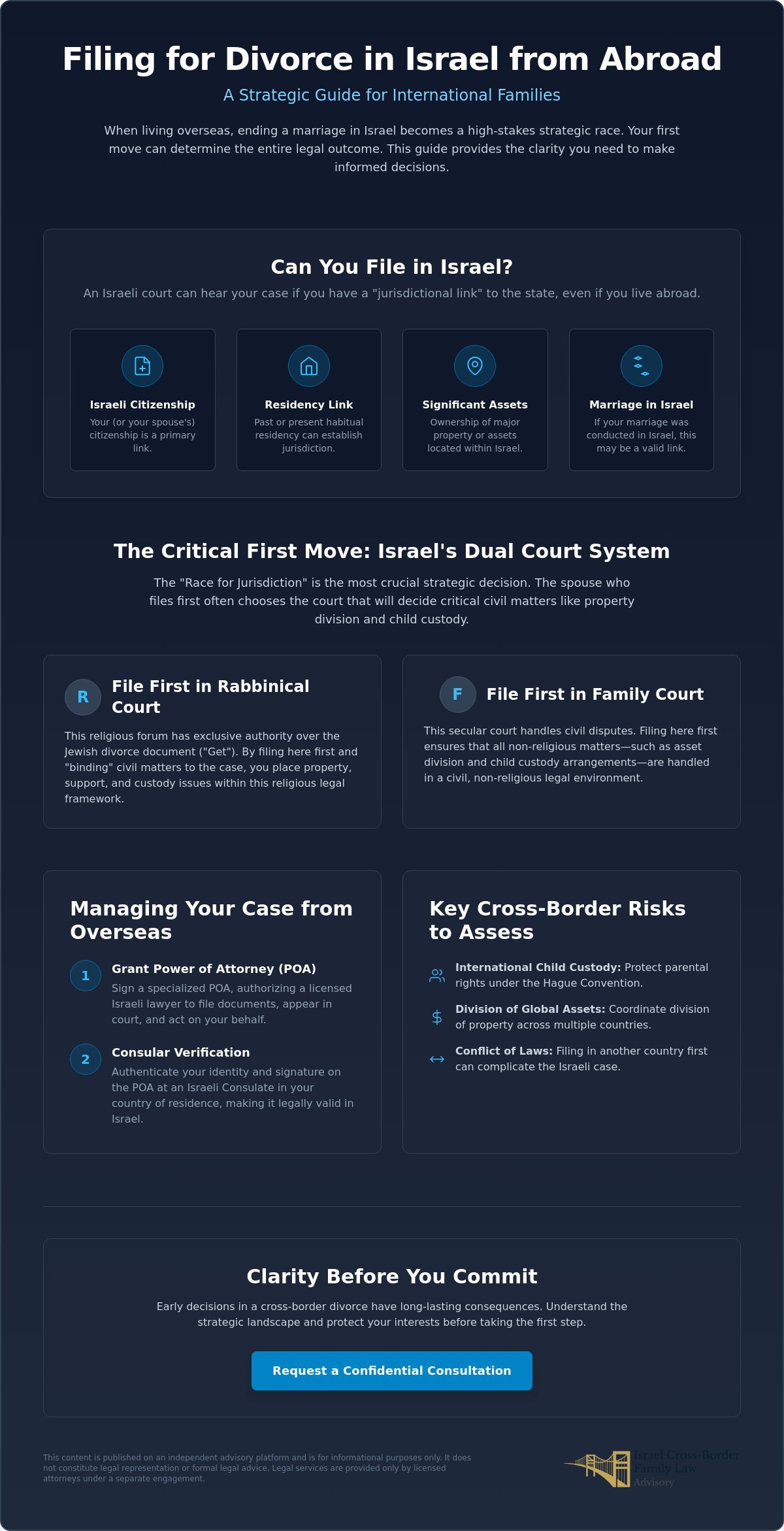
The timing of your filing is often the most critical decision in your entire case. Israel operates a dual court system where both the Rabbinical Court and the Family Court have parallel authority over civil matters like asset division and custody. The person who files first usually chooses the court that will hear these issues. This is known as the “Race for Jurisdiction.” If one spouse files in the Rabbinical court, they can “bind” civil matters to that religious forum. Conversely, filing first in the Family Court keeps these matters in a secular environment. For those considering how to file for divorce in israel from abroad, acting quickly is often necessary to prevent the other party from choosing a forum that might be less favorable to your specific goals. You must also consider that filing in a foreign country first can complicate your Israeli case, as it may create a conflict of laws that requires expert coordination to resolve. Strategic planning before notifying the other party is the only way to ensure you don’t lose this critical advantage.
Israel’s legal landscape for divorce is distinct because it operates under a dual court system where religious and secular authorities share power. While the secular Family Court handles most civil disputes, the Rabbinical Court maintains exclusive authority over the religious dissolution of Jewish marriages. For those learning how to file for divorce in israel from abroad, understanding this division is non-negotiable. Jewish Israelis must often navigate both systems simultaneously to ensure their divorce is recognized both civilly and religiously. Even if you live overseas, obtaining a religious decree is often necessary to remarry within the Jewish community or to update your status with the Israeli Population and Immigration Authority.
The Jewish Writ of Divorce (Get)
The “Get” is a religious document that a husband must give to his wife to finalize a Jewish divorce under halachic law. The Rabbinical Court is the only body with the power to oversee this ritual and issue the final decree. If one party refuses to participate while living abroad, the process can stall for years, leading to a state of legal and religious limbo. The 2026 legal landscape has seen an expansion of the Rabbinical Court’s powers to act as an arbitrator in certain civil matters, but its primary role remains the “Get.” Recent legislative updates have also refined the penalties for Get refusal, though enforcing these against a party living overseas remains a complex procedural challenge. Understanding the Logistics of Remote Filing is essential to ensure these religious requirements are met without requiring unnecessary travel.
Civil Matters in the Family Court
The Family Court provides a secular alternative for resolving disputes regarding child support, custody, and the division of assets. Many expats prefer this venue because it operates under civil law principles rather than religious doctrine. This court follows the Spousal Property Relations Law, which generally dictates an equal division of assets acquired during the marriage. This law can also apply to property located outside of Israel, provided the court accepts jurisdiction over the parties. For more detailed context on how these rules apply to those living outside the country, you may review our guide For Expats and Foreign Nationals. Because the “race for jurisdiction” dictates which court hears these civil matters, your first filing must be handled with extreme precision to protect your financial interests.
The complexity of these overlapping systems is one reason why international families often feel overwhelmed. If you are unsure which path serves your specific interests, seeking professional guidance can provide the clarity needed to move forward confidently.
This content is published on an independent advisory platform and is intended for informational purposes only. It does not constitute legal representation or formal legal advice. Legal services are only provided by licensed attorneys under a separate engagement.
Logistics of Remote Filing: How to Manage Your Case Overseas
Managing a divorce across borders requires a sophisticated understanding of both Israeli procedural law and the international treaties that govern document verification. When you are determining how to file for divorce in israel from abroad, the logistics of signing and submitting documents can often feel like a significant barrier. However, the Israeli legal system has increasingly modernized, allowing much of the process to be managed digitally through local representation. Success depends on the seamless coordination between your location overseas and the court system in Israel.
Step 1: Securing Local Representation
Attempting to file for divorce in Israel without a licensed attorney is rarely effective, especially when you are not physically present in the country. A local lawyer serves as your physical proxy, managing the digital filing system and receiving service of process on your behalf. It’s often beneficial to work with practitioners who understand the legal cultures of both Israel and your home country. This ensures that the strategy used in Israel doesn’t inadvertently damage your legal standing in your place of residence. For a detailed look at how we facilitate this coordination, you can review our advisory process.
Step 2: Consular Verification and Document Execution
To grant your attorney the power to act, you must execute a specialized Power of Attorney. If you are abroad, this usually happens at the nearest Israeli consulate or embassy, where a consular official performs identity verification. In countries that are members of the Hague Convention, an Apostille from your local government is often required for foreign-issued documents, such as marriage certificates or financial records, to be recognized by an Israeli court. Once a document is properly notarized by a consular official and submitted via the digital portal, the Israeli court system recognizes the signature as legally binding from the moment of execution, even if the physical original is still in transit.
While most administrative tasks are handled by your lawyer, you may still need to participate in hearings. Israeli judges have become more accustomed to Zoom hearings for parties living overseas, though this is not an automatic right. Your attorney must file a specific motion to allow remote testimony, explaining why travel to Israel is not feasible. If granted, these remote appearances allow you to participate in the proceedings from your home or office, maintaining the momentum of your case without the expense and disruption of international travel. This digital approach is a cornerstone of how to file for divorce in israel from abroad efficiently while protecting your rights from a distance.
This content is published on an independent advisory platform and is intended for informational purposes only. It does not constitute legal representation or formal legal advice. Legal services are only provided by licensed attorneys under a separate engagement.
Critical Cross-Border Issues: Children and Assets
Managing the dissolution of a marriage while residing overseas introduces significant complexities, particularly when children and global assets are involved. Understanding how to file for divorce in israel from abroad requires more than just administrative knowledge; it demands a proactive approach to protecting your parental rights and financial future. When parties are physically separated by international borders, the legal “habitual residence” of the children and the location of marital property become the primary drivers of your legal strategy. Mistakes made during the initial filing stage can lead to jurisdictional disputes that last for years and cost thousands in additional legal fees.
International Custody and Relocation
The most sensitive aspect of any cross-border divorce is the determination of child custody. Israeli courts prioritize the “best interests of the child,” but they must first establish whether they have the authority to rule on the matter. If your children have been living outside of Israel for an extended period, a spouse might argue that the foreign country is the child’s habitual residence. Filing for divorce in Israel while the children are in another country carries the risk of being accused of “wrongful retention” if you attempt to keep them in Israel after a visit. These situations are governed by the Hague Convention on Child Abduction, a treaty designed to return children to their country of habitual residence. You must ensure that your filing strategy accounts for these international protections to avoid severe legal repercussions.
Financial Support and Asset Division
Dividing assets and determining support becomes complicated when property is spread across multiple jurisdictions. Israeli courts generally apply the principle of equal division for assets acquired during the marriage, but enforcing these rulings on foreign real estate or international pensions requires specialized expertise. For example, an Israeli court order regarding a US-based 401k or a UK pension may not be automatically honored by foreign financial institutions without specific mirroring orders. Similarly, while Israeli courts can set child support amounts, the actual collection of those funds from a non-resident parent depends on international treaties. You can learn more about how these orders are managed in our guide to child support cross-border enforcement. Israeli judges often look at the global financial picture, including cost-of-living differences between Israel and your current country, when calculating these obligations.
The intersection of Israeli law and international treaties creates a landscape where early decisions carry immense weight. If you are managing assets in multiple countries or have concerns about your children’s residence, it is vital to seek a strategic review of your case before taking formal action.
This content is published on an independent advisory platform and is intended for informational purposes only. It does not constitute legal representation or formal legal advice. Legal services are only provided by licensed attorneys under a separate engagement.
Strategic Planning: Clarity Before You Commit
The process of determining how to file for divorce in israel from abroad is not merely a sequence of administrative tasks; it is a high-stakes strategic exercise where your initial decisions carry permanent weight. In cross-border family law, the first move often defines the legal landscape for years to come. Because Israeli law operates within a dual-court system that contrasts sharply with Western secular models, a “wait and see” approach can be a costly mistake. For expats living in the US, UK, or elsewhere, understanding the cultural and procedural nuances of the Israeli system is the only way to ensure your interests are protected across both jurisdictions.
The Weight of the First Filing
You should never initiate a case in Israel simply to test the waters or signal intent. In many Western systems, filing a petition is a preliminary step that can be amended or moved with relative ease. In Israel, the “race for jurisdiction” means that the moment a file is opened, the court’s authority over specific civil matters like property and support may be locked in. An ill-timed or poorly structured filing can inadvertently bind you to a court system that may not align with your financial or parental goals. Once a jurisdictional claim is formally established through the opening of a file, the decision is generally final and cannot be easily reversed or moved to a more favorable forum. This makes it essential to have a comprehensive strategy in place before you notify the other party of your intent to divorce.
Next Steps and Consultation
Before taking any formal action, you must gather the necessary documentation to support your claim and establish your jurisdictional link. This typically includes your Israeli marriage certificate, your Teudat Zehut (ID card), and any relevant foreign court documents or residency permits. Having these ready allows your representative to act quickly if the need for a strategic filing arises. If you are still in the early stages of consideration, educating yourself on the nuances of the system is a vital first step. You can find more in-depth discussions on these topics by visiting the Divorce in Israel YouTube Channel.
The complexity of international family law means that every case is unique. The interplay between your current country’s laws and the Israeli system requires a nuanced, expert-led approach to avoid unintended consequences. Get clarity before you commit. We invite you to request a confidential consultation to discuss the specific details of your situation and develop a strategy tailored to your needs.
This content is published on an independent advisory platform and is intended for informational purposes only. It does not constitute legal representation or formal legal advice. Legal services are only provided by licensed attorneys under a separate engagement.
Securing Your Future Across Borders
Navigating a divorce while living overseas is a complex undertaking that requires a deep understanding of two distinct legal systems. You’ve learned that establishing a jurisdictional link and acting quickly in the “race for jurisdiction” are the most critical steps in protecting your assets and parental rights. By utilizing digital filing systems and consular verification, it’s entirely possible to manage the process without frequent travel to Israel.
When you are deciding how to file for divorce in israel from abroad, the weight of your early decisions cannot be overstated. We specialize in US-Israel cross-border family law and bring decades of experience to multi-jurisdictional disputes. Our strategic advisory is designed specifically for Anglos and expats who need a steady, knowledgeable guide through these challenging transitions.
Get clarity before you commit. Request a confidential consultation. Taking the time to build a comprehensive strategy today will help you secure a more stable future for yourself and your family.
This content is published on an independent advisory platform and is intended for informational purposes only. It does not constitute legal representation or formal legal advice. Legal services are only provided by licensed attorneys under a separate engagement.
Frequently Asked Questions
Can I get divorced in Israel if I am not a citizen but my spouse is?
Yes, you can often initiate or respond to proceedings in Israel if your spouse is an Israeli citizen or resident. The court system establishes jurisdiction based on the “link” one or both parties have to the state. If your spouse maintains residency or citizenship, the Israeli courts may have the authority to adjudicate the marriage dissolution and related civil matters, even if you have never lived in the country yourself.
Do I have to travel to Israel to attend my divorce hearings?
Physical travel is not always a requirement in the modern Israeli legal system. While a judge maintains the discretion to request your presence, many courts now permit parties living overseas to participate via Zoom or other video conferencing platforms. Your attorney must file a formal motion to request remote testimony, explaining why international travel is not feasible or necessary for that specific stage of the case.
How long does a cross-border divorce in Israel typically take?
The timeline depends heavily on whether the parties have reached an agreement. An uncontested, agreed-upon divorce typically concludes within 3 to 6 months. In contrast, a contested divorce involving disputes over assets or custody is much more complex and often takes 2 to 4 years to reach a final judgment. Strategic planning and early negotiation can significantly impact these durations.
Is an Israeli divorce decree recognized in the United States or United Kingdom?
Yes, Israeli divorce decrees are generally recognized in the US and UK through the principle of legal comity or specific international treaties. To ensure recognition, the decree must be finalized correctly in Israel and usually requires an Apostille for international verification. It’s vital to ensure the process complies with the due process requirements of your home country to avoid future challenges to the decree’s validity.
What happens if my spouse files for divorce in Israel before I file in my current country?
This situation triggers the “race for jurisdiction,” which can significantly impact the outcome of your case. If the Israeli court accepts the filing first, it may claim exclusive authority over civil matters like property division and child support. This could prevent you from litigating those specific issues in your current country of residence, making it essential to understand how to file for divorce in israel from abroad quickly if you suspect your spouse is planning to act.
Can the Israeli Rabbinical court freeze my assets if they are located outside of Israel?
The Rabbinical court can issue orders regarding global assets, but enforcing those orders abroad is not automatic. While the court may order a freeze on bank accounts or real estate located in the US or Europe, you would typically need to bring that order to a local court in that jurisdiction to have it recognized and enforced. This process requires coordinated legal strategy between your Israeli and local counsel.
How much does it cost to file for divorce in Israel from abroad?
The cost includes mandatory government filing fees which are fixed by the state. As of June 2026, the fee for a divorce petition in the regional Rabbinical Courts is NIS 1,950. In the Family Court, a claim for property matters involves a fee of 1% of the amount claimed, with a minimum fee of NIS 357. These figures do not include the costs for consular services, translations, or professional advisory fees.
What is the role of the Israeli consulate in the divorce process?
The Israeli consulate serves as a critical administrative link for parties managing their cases from overseas. Its primary role is to verify your identity and notarize the specialized Power of Attorney that allows your Israeli lawyer to act on your behalf. Consular officials also witness the signing of other court-mandated documents, ensuring they meet the strict evidentiary requirements of the Israeli court system without requiring your physical presence in Israel.

Article by
Gabriel Lior
A Personal Journey That Became a Mission
The advisory was founded by an American father Gabriel Lior, LLB, MBA , global entrepreneur, and cross-border advisor who spent more than a decade navigating the Israeli family court system firsthand and now lives in Singapore with his son.
As a divorced parent in a cross-border family, Gabriel faced nearly every legal challenge a foreign parent can encounter in Israel — including child custody disputes, child support proceedings, property matters in Israel and abroad, false accusations, and complex immigration and relocation proceedings.
Over the years, he learned the hard way how difficult it is for non-Israeli parents to understand the system, identify the right legal strategy, and choose the right legal representation — especially when language, culture, and jurisdictional differences are involved. He also witnessed how foreign parents and new immigrants are often disadvantaged or taken advantage of by service providers and institutions simply because they lack local knowledge or fluency.
From Client to Advisor
To truly understand — and survive — the system, Gabriel pursued formal legal education in Israel, completing two Israeli law degrees, alongside a BA and MBA earned in the United States. This was never about becoming a practicing attorney, but about gaining a deep, structural understanding of how the system works — and where it breaks down for foreign parents.
This rare combination of:
Firsthand client experience
Israeli legal and US business education
International business and negotiation training
Decades of commercial execution
created a unique perspective – one that understands both sides of the table.
After years of litigation, persistence, and at times self-representation, he ultimately succeeded in securing custody of his son and relocating abroad through a rare legal victory in the Israeli Supreme Court — becoming one of the first fathers in Israel to do so under these circumstances.
Disclaimer
Important Disclaimer:
The information provided on this website and in its content is for general informational and educational purposes only and does not constitute legal advice, legal opinion, or legal representation.
Gabriel Lior is not licensed to practice law in Israel (nor is he interested in doing so) and does not provide legal services, despite having completed 2 Law Degrees. The services offered are advisory in nature and are intended to provide general guidance, strategic insight, and information regarding cross-border family law considerations.
No attorney-client relationship is formed by accessing this website, reading its content, or communicating with us.
Any decisions made based on this information are at your own discretion and risk. For legal advice specific to your situation, you should consult a licensed attorney in the relevant jurisdiction.
Where appropriate, we may refer clients to independent, licensed attorneys or professionals. Such referrals do not constitute legal representation and no liability is assumed for services provided by third parties.