The decision to name a guardian for your child is one of the most significant you will ever make. When that trusted individual resides in another country, such as Israel or the United States, this profound responsibility becomes a complex, cross-border legal challenge. The fear that a court might reject your choice, or that your child could be caught in a jurisdictional battle, is a valid and pressing concern for many international families. Successfully appointing an international guardian for my child requires more than a simple declaration; it demands a sophisticated understanding of two different legal, financial, and immigration systems. This comprehensive guide provides that crucial insight. We will navigate you through the essential legal steps, potential challenges, and strategic solutions required to secure your child’s future. You will gain the knowledge to create a legally resilient plan that will be upheld in both the U.S. and Israel, ensuring a stable, seamless transition and providing you with the ultimate peace of mind that your child will be cared for by the person you unequivocally trust.
The Core Question: Will a US or Israeli Court Uphold My Choice?
For parents engaged in complex, cross-border estate planning, the primary concern is unequivocal: will my designated guardian be honored by the courts? While a parent’s stated wishes are given immense weight and are considered paramount, they are not absolute. The ultimate authority in both United States and Israeli jurisdictions rests with the court, which is bound by a single, overarching principle that governs all decisions concerning minors. To further illuminate the legal framework surrounding guardianship, the following video provides a valuable overview:
Understanding the ‘Best Interests of the Child’ Standard
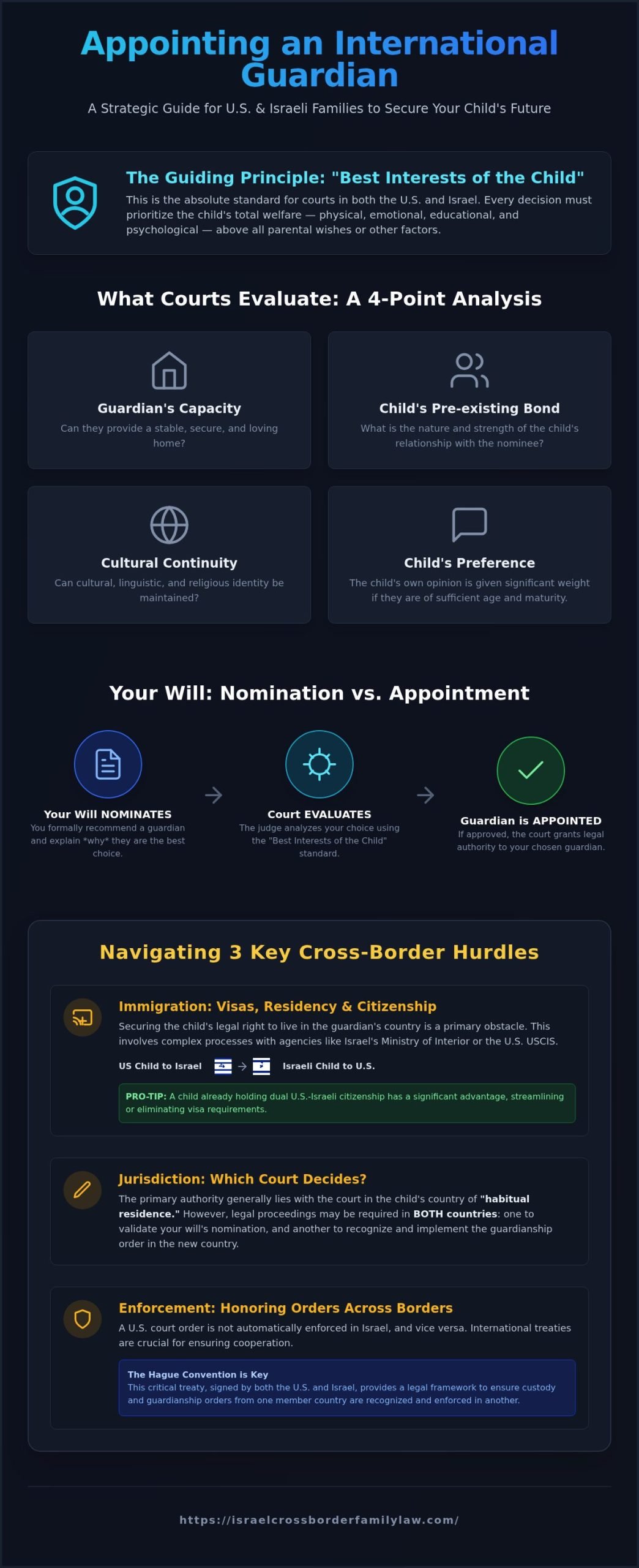
This universal legal doctrine mandates that any judicial decision regarding a child must prioritize their overall welfare above all other considerations. It is a multi-faceted standard, encompassing not just the child’s physical safety and health, but also their emotional, psychological, and educational well-being. A critical component of this evaluation involves maintaining stability in the child’s life, including preserving existing relationships with family and community, which is a significant factor in sophisticated international cases.
Key Factors Courts in the US and Israel Evaluate
When reviewing a petition for guardianship, particularly one involving an international move, judges in both the US and Israel will conduct a thorough analysis. The process of appointing an international guardian for my child is not a mere formality; it requires the court to be convinced the arrangement serves the child’s best interests. Key considerations include:
- The proposed guardian’s capacity to provide a stable, secure, and loving home environment.
- The nature and strength of the child’s pre-existing relationship and emotional bond with the nominee.
- The ability to maintain cultural, linguistic, and religious continuity for the child.
- The child’s own preference, given significant weight if they are of sufficient age and maturity to express a reasoned opinion.
The Role of Your Will in a Guardianship Decision
It is crucial to understand that your will makes a nomination for guardianship, not a final appointment. This nomination serves as your formal recommendation to the court. However, for that individual to gain the necessary authority, a court must formally appoint them as the child’s legal guardian. This is why a well-drafted will is so powerful. Simply naming a person is insufficient; you must also provide a clear and compelling explanation-a statement of intent-that substantiates why this specific individual is uniquely suited to care for your child, addressing the very factors the court will evaluate.
Key Legal & Logistical Hurdles in Cross-Border Guardianship
Understanding the necessity of an international guardian is the foundational step; executing this critical aspect of your estate plan involves navigating a sophisticated matrix of legal and logistical challenges. The process of appointing an international guardian for my child requires a proactive strategy that addresses multi-jurisdictional laws, particularly concerning immigration, court authority, and the enforcement of legal orders across sovereign borders.
Navigating Immigration: Visas, Residency, and Citizenship
A primary hurdle is securing the child’s legal right to reside with their guardian in a new country. For a U.S. citizen child moving to Israel, the guardian would need to initiate a process through the Ministry of Interior to obtain the appropriate visa and residency status. Conversely, an Israeli child moving to the U.S. would face a similarly complex U.S. Citizenship and Immigration Services (USCIS) process. A child who already holds dual U.S.-Israeli citizenship has a significant advantage, as this can streamline or even eliminate the need for long-term visas, though formal recognition of the guardianship is still required.
Jurisdictional Challenges: Which Court Decides?
A pivotal legal question is which nation’s court holds the authority to formalize and oversee the guardianship. International family law typically grants primary jurisdiction to the courts in the country of the child’s “habitual residence.” This is generally defined as the country where the child has established a stable and consistent life. However, when appointing an international guardian for my child, legal proceedings may be required in both your home country (to validate your appointment) and the guardian’s country (to have it legally recognized and implemented), creating a complex, dual-jurisdiction scenario.
Enforcing Guardianship Orders Across Borders
Ensuring a guardianship order from one country is honored in another is not automatic. This is where international treaties become paramount. The Hague Convention on the Civil Aspects of International Child Abduction is a critical international agreement designed to facilitate cooperation between member countries, including the U.S. and Israel. It provides a legal framework to ensure that custody and guardianship orders are recognized and enforced, offering a vital mechanism for resolving disputes and preventing wrongful retention. The principles of the Convention are central to addressing complex issues of International Parental Child Abduction and are equally relevant to enforcing guardianship. Learn more about how the Hague Convention applies to child abduction cases and its broader implications for cross-border family law.
A Practical Step-by-Step Guide to Appointing Your Guardian
The process of appointing an international guardian for my child requires meticulous, strategic planning that moves from personal deliberation to legally enforceable documentation. Navigating this multi-jurisdictional challenge demands a structured approach. This guide provides a clear, four-step framework designed to ensure your child’s security and a seamless transition, should the need ever arise. Following these steps provides a robust foundation for one of the most critical decisions you will make as a parent.
Step 1: Selecting and Speaking with Your Proposed Guardian
The selection of a guardian must extend beyond familial affection. It is a decision that requires a rigorous assessment of the candidate’s age, health, financial stability, and, critically, their alignment with your core parenting values and lifestyle. Once you have identified a suitable individual, you must engage in a frank and comprehensive discussion about the profound, lifelong commitment this role entails. It is imperative to receive their explicit and unequivocal confirmation that they are both willing and able to assume this significant responsibility.
Step 2: Documenting Your Choice in Your Estate Plan
Your nomination must be legally codified within your formal estate plan, primarily through a specific clause in your will (צוואה). We strongly advise clients to include a detailed explanation for their choice of guardian, as this can serve to preempt and defend against potential legal challenges from other parties. To further solidify your wishes, consider supplemental legal instruments such as a durable power of attorney for a minor, which can grant specific authorities and provide an additional layer of legal clarity during any transitional period.
Step 3: Creating a Comprehensive ‘Guardian’s Packet’
To facilitate a smooth transition, you should assemble a comprehensive “Guardian’s Packet.” This physical or digital folder is a critical resource, containing all essential documentation and information. It should include:
- Vital Documents: Copies of birth certificates, passports (דרכון), social security or identity numbers, and immigration papers.
- Key Information: Medical records, school details, and a list of important contacts (doctors, teachers, close friends).
- A Personal Letter: A letter from you outlining your hopes, values, daily routines, and wishes for your child’s upbringing.
Step 4: Appointing a Temporary or Backup Local Guardian
The logistical complexities of a cross-border guardianship transfer necessitate an immediate, local solution. Appointing a temporary guardian-a trusted individual based in your current country of residence-is a vital strategic measure. This person’s role is to provide immediate care for your child, preventing any intervention by state services (שירותי הרווחה) while managing the legal handover. This structured transition ensures stability and helps all parties navigate complex international laws, a subject well-documented by the U.S. State Department on International Child Abduction, to ensure a secure transfer of custody.
Managing Finances: Guardian of the Person vs. Guardian of the Estate
When planning for your child’s future, a critical distinction must be made between their daily care and the stewardship of their financial inheritance. This separation of duties is a sophisticated and essential component of the process, particularly when appointing an international guardian for my child. Overlooking this financial dimension can create significant, unforeseen complications for both the guardian and your child’s estate.
Defining the Roles: Who Cares for the Child vs. Who Manages the Money?
It is vital to understand the two distinct guardianship roles that must be filled. Think of these as separate, specialized functions designed to protect your child’s total well-being:
- The Guardian of the Person: This individual is the new parent figure, responsible for the child’s day-to-day care, upbringing, education, and healthcare decisions. Their primary focus is the child’s personal welfare.
- The Guardian of the Estate (or Trustee): This person or entity acts as the financial manager. They are legally responsible for protecting, investing, and distributing the child’s inheritance according to your instructions, ensuring funds are available for the child’s needs without granting the personal guardian direct control over the entire estate.
While a single trusted individual can be appointed to both roles, separating these duties can provide an invaluable system of checks and balances, especially across international borders.
Complexities of a Foreign Guardian Managing Israeli Assets
Assigning a guardian residing outside of Israel to manage assets located within Israel presents a formidable set of legal and logistical challenges. A foreign-based guardian may face immediate difficulties accessing Israeli bank accounts, managing real estate holdings, or liquidating investments. This process is further complicated by multi-jurisdictional regulatory compliance, including potential adverse tax consequences for the estate and the guardian, as well as stringent anti-money laundering (AML) protocols that can delay or freeze access to necessary funds.
Using Trusts to Simplify International Asset Management
A more robust and secure strategy involves establishing a trust to hold and administer your child’s inheritance. This legal structure effectively separates the assets from direct foreign management. By appointing a professional or an Israel-based co-trustee, you create a seamless and compliant mechanism for financial administration. This structure protects the core assets from cross-border complexities and ensures the Guardian of the Person has consistent, regulated access to funds for the child’s expenses, from school fees to living costs. The decision of appointing an international guardian for my child is fortified when supported by a sound financial framework. For guidance on structuring such sophisticated cross-border arrangements, it is essential to consult with legal counsel experienced in international family law.
How an Experienced US-Israel Law Firm Provides Critical Support
Navigating the legal intricacies of appointing a guardian across international borders presents a sophisticated challenge. The complexities of harmonizing US and Israeli family law, inheritance statutes, and immigration requirements demand more than just standard legal advice; they require a proactive, multi-jurisdictional strategy. An experienced cross-border law firm acts not merely as a drafter of documents, but as a strategic architect for your family’s future, anticipating potential conflicts and engineering a legal framework designed to withstand judicial scrutiny in both countries. The unique value of a firm with deep, integrated expertise in both US and Israeli law is its ability to provide a single, cohesive solution. This eliminates the risks and inefficiencies inherent in retaining separate legal counsel in each country, ensuring your plan is seamless, unified, and robust.
Coordinating a Unified Legal Strategy
A successful international guardianship designation hinges on legal instruments that are valid and enforceable in both the United States and Israel. Our firm specializes in drafting unified estate plans and guardianship nominations that are meticulously aligned with the legal codes of both jurisdictions. This integrated approach prevents the conflicting advice and jurisdictional gaps that can arise from uncoordinated counsel, ensuring a smooth and predictable transition of care should the need ever arise.
Guidance on Complex Relocation and Custody
Executing the plan is as critical as its creation. When appointing an international guardian for my child, the practicalities of relocation and custody transfer must be managed with precision. Our attorneys are adept at handling the necessary court petitions, immigration paperwork, and citizenship matters required to facilitate a child’s move. Our advisory’s approach to international custody and relocation is built on decades of successfully navigating these complex cross-border family law processes.
Ensuring Your Wishes Are Honored
The ultimate goal is to ensure your choice of guardian is respected and implemented without dispute. Properly drafted legal documents, which clearly articulate why your chosen guardian serves the child’s best interests, significantly minimize the risk of a court challenge from other relatives. We provide the strategic counsel needed to fortify your will and guardianship provisions, creating a legally unassailable expression of your intent. Secure your family’s future by beginning the planning process with a confidential case review today.
Navigating Cross-Border Guardianship with Confidence
Appointing a guardian across US and Israeli jurisdictions is a sophisticated process fraught with legal complexities, from ensuring your choice is upheld by courts in both nations to navigating the distinct responsibilities of a guardian of the person versus a guardian of the estate. The proactive decision of appointing an international guardian for my child is one of the most significant steps you can take, but it demands a robust, multi-jurisdictional legal strategy to ensure its validity and effectiveness. Our firm provides this critical support. With decades of experience in international estate planning and child custody, our bilingual and bicultural attorneys possess specialized expertise in both US and Israeli family law, uniquely positioning us to guide you through these complex systems. We are dedicated to ensuring your child’s future is protected, no matter the distance. Schedule a confidential consultation with our US-Israel family law experts to protect your child’s future. Take the definitive step today to secure their tomorrow.
Frequently Asked Questions
Can my child’s appointed guardian be a non-citizen of my country?
Yes, it is legally permissible to nominate a guardian who is not a citizen of Israel. However, this introduces significant multi-jurisdictional complexities. The process requires careful navigation of both Israeli family law and the immigration and guardianship laws of the guardian’s home country. Prudent planning is essential to ensure the designated guardian can legally reside in Israel or that the child can emigrate, a sophisticated process requiring experienced cross-border legal counsel to manage effectively.
What happens if I die without legally appointing a guardian in my will?
In the absence of a legally documented nomination in a will, the Israeli Family Court will intervene to appoint a guardian. The court’s decision is based solely on what it determines to be in the “best interests of the child.” This judicial process can be lengthy, costly, and may result in an appointment that does not align with your personal wishes or cultural values, underscoring the critical importance of proactive estate and guardianship planning.
How is international guardianship different from international adoption?
International guardianship and adoption are fundamentally distinct legal constructs. Guardianship is a legal authority granted to an individual to care for a minor and manage their affairs, typically until the age of majority, without terminating the biological parents’ rights. Conversely, international adoption is a permanent, irrevocable process that legally severs all ties with the biological parents and establishes a new, legally recognized parent-child relationship with the adoptive parents, transferring all rights and responsibilities.
Does the nominated guardian need to speak my child’s primary language?
While not an absolute legal requirement, the guardian’s ability to communicate effectively in the child’s primary language (e.g., Hebrew or English) is a heavily weighted factor for the court. A shared language is considered critical for the child’s emotional stability, well-being, and integration. The court will scrutinize the practicalities of the arrangement, and a significant language barrier could be grounds for challenging the suitability of the nominated guardian in a “best interests of the child” analysis.
What are the typical costs involved in an international guardianship case?
The costs involved in appointing an international guardian for my child are variable and depend on the case’s complexity. Initial legal fees in Israel for drafting the necessary testamentary documents typically range from ₪7,000 to over ₪25,000. Should court proceedings be required, costs escalate significantly, including court fees and potentially fees for legal counsel in the guardian’s jurisdiction. Comprehensive cross-border cases involving multiple legal systems represent a more substantial financial investment.
Can I name a couple as co-guardians for my child?
Yes, appointing a couple as co-guardians is a common and often advisable strategy. This provides stability and shared responsibility for the child’s upbringing. However, your legal instrument, such as a will, must be drafted with precision. It is imperative to include provisions that clearly articulate the course of action in the event of the co-guardians’ separation, divorce, or the death of one of the individuals, ensuring a seamless and secure plan for your child’s future.

Article by
Gabriel Lior
A Personal Journey That Became a Mission The advisory was founded by an American father Gabriel Lior, LLB, MBA , global entrepreneur, and cross-border advisor who spent more than a decade navigating the Israeli family court system firsthand and now lives in Singapore with his son.
As a divorced parent in a cross-border family, Gabriel faced nearly every legal challenge a foreign parent can encounter in Israel — including child custody disputes, child support proceedings, property matters in Israel and abroad, false accusations, and complex immigration and relocation proceedings. Over the years, he learned the hard way how difficult it is for non-Israeli parents to understand the system, identify the right legal strategy, and choose the right legal representation — especially when language, culture, and jurisdictional differences are involved. He also witnessed how foreign parents and new immigrants are often disadvantaged or taken advantage of by service providers and institutions simply because they lack local knowledge or fluency. From Client to Advisor To truly understand — and survive — the system, Gabriel pursued formal legal education in Israel, completing two Israeli law degrees, alongside a BA and MBA earned in the United States. This was never about becoming a practicing attorney, but about gaining a deep, structural understanding of how the system works — and where it breaks down for foreign parents. This rare combination of: Firsthand client experience Israeli legal and US business education International business and negotiation training Decades of commercial execution created a unique perspective – one that understands both sides of the table. After years of litigation, persistence, and at times self-representation, he ultimately succeeded in securing custody of his son and relocating abroad through a rare legal victory in the Israeli Supreme Court — becoming one of the first fathers in Israel to do so under these circumstances.
Disclaimer
Important Disclaimer: The information provided on this website and in its content is for general informational and educational purposes only and does not constitute legal advice, legal opinion, or legal representation. Gabriel Lior is not licensed to practice law in Israel (nor is he interested in doing so) and does not provide legal services, despite having completed 2 Law Degrees. The services offered are advisory in nature and are intended to provide general guidance, strategic insight, and information regarding cross-border family law considerations. No attorney-client relationship is formed by accessing this website, reading its content, or communicating with us. Any decisions made based on this information are at your own discretion and risk. For legal advice specific to your situation, you should consult a licensed attorney in the relevant jurisdiction. Where appropriate, we may refer clients to independent, licensed attorneys or professionals. Such referrals do not constitute legal representation and no liability is assumed for services provided by third parties.