The discovery that your child has been wrongfully removed to or retained in a foreign jurisdiction is a profoundly distressing event, leaving a parent feeling isolated and overwhelmed by a complex international legal system. When confronting a case of international child abduction to Israel, the fear of navigating an unfamiliar legal framework can be paralyzing. Questions surrounding jurisdiction, parental rights, and the correct legal protocol demand immediate, expert answers, and the terror of making a procedural misstep that could jeopardize your child’s future is a significant and valid concern.
This comprehensive guide is designed to provide clarity and a strategic path forward. We will navigate the intricate framework of the Hague Convention on the Civil Aspects of International Child Abduction as it applies within the Israeli legal system, providing you with a definitive understanding of your rights. Our objective is to equip you with the critical, immediate steps you must take to initiate legal action, secure sophisticated legal representation, and facilitate the prompt and safe return of your child.
Immediate Action: Your First 24 Hours After Suspecting Child Abduction
In the profoundly distressing event of a suspected international parental child abduction to Israel, the actions taken within the first 24 hours are of paramount importance. This is a time-sensitive crisis where swift, strategic, and well-documented steps are crucial for a successful outcome. The initial measures you implement will form the bedrock of your legal case and significantly influence the proceedings that follow. It is imperative to focus on gathering specific evidence and contacting the appropriate authorities immediately, while avoiding direct, confrontational communication with the other parent, which can escalate the situation and complicate legal remedies.
To better understand the complexities involved, the following video provides critical context on this issue:
Navigating the legal framework governing a parental child abduction to Israel requires a methodical and composed approach. Your immediate priority is to activate the correct legal and diplomatic channels to protect your parental rights and facilitate your child’s return.
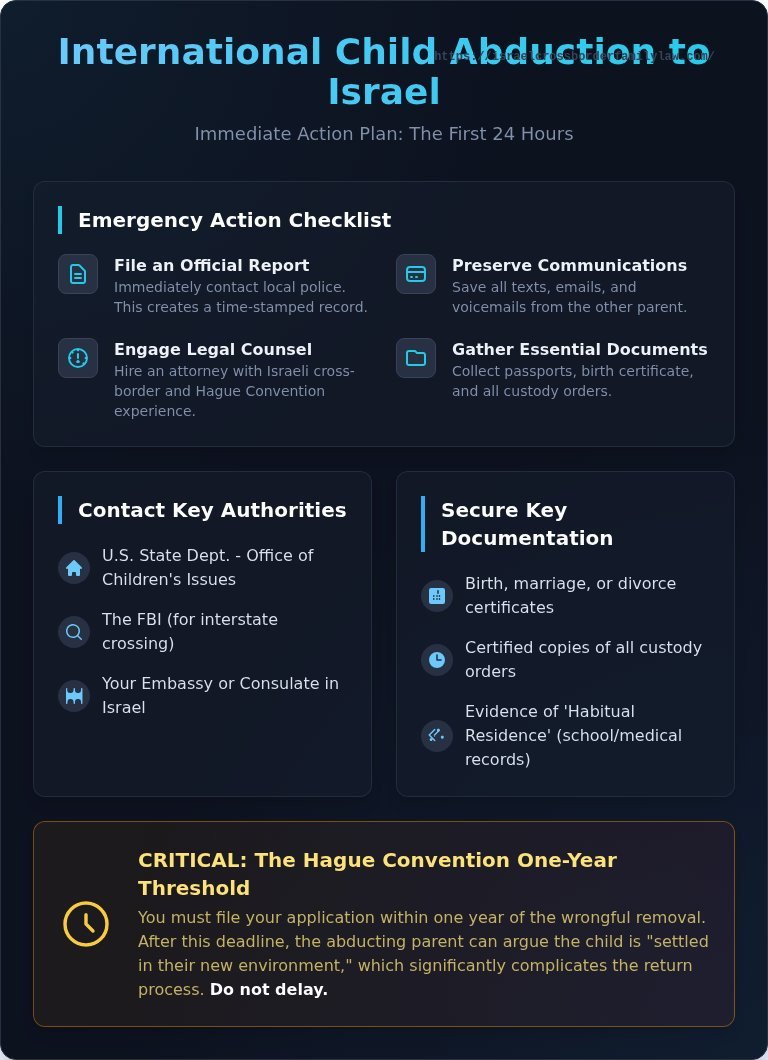
Emergency Action Checklist
Execute these steps with urgency to establish an official record and secure legal representation:
- File an Official Report: Contact your local police department immediately to file a missing person report. This creates a critical, time-stamped official record of the event.
- Engage Legal Counsel: Secure representation from an international family law attorney with demonstrable experience in Israeli cross-border custody disputes and Hague Convention cases.
- Gather Essential Documents: Collect your child’s passport (and your own), birth certificate, and copies of all existing custody orders or court-filed parenting agreements.
- Preserve All Communications: Do not delete any text messages, emails, social media messages, or voicemails from the other parent. This evidence can be vital.
Contacting Key Authorities
Mobilizing the correct governmental bodies is a non-negotiable step in this multi-jurisdictional process:
- U.S. State Department: The Office of Children’s Issues is your primary governmental resource. They provide guidance and act as a central authority for Hague Convention applications.
- The FBI: If the abduction involved crossing state lines before the international travel, the FBI may have jurisdiction under the International Parental Kidnapping Crime Act (IPKCA).
- Your Embassy in Israel: Your country’s embassy or consulate in Israel can provide on-the-ground support, including welfare checks and lists of local legal resources.
Essential Documentation to Secure
The strength of your legal case will rely heavily on comprehensive and organized documentation. Focus on securing:
- Your child’s birth certificate and any marriage or divorce certificates.
- Certified copies of all existing court orders pertaining to custody and visitation rights.
- Evidence establishing your child’s ‘habitual residence’-a critical legal concept under the Hague Convention on the Civil Aspects of International Child Abduction. This includes school records, doctor and dentist appointments, and affidavits from teachers and community members.
The Hague Convention: Your Primary Legal Tool for Child Return
When facing a case of international child abduction to Israel, the Hague Convention on the Civil Aspects of International Child Abduction is the primary international treaty governing the matter. As a signatory nation, Israel has a robust legal framework and a strong record of compliance with the Convention’s mandates. It is crucial to understand that the Convention’s objective is not to litigate custody rights; its sole purpose is the prompt and safe return of a child to their country of habitual residence. All legal proceedings under the Convention will take place in the Israeli court system, as this is where the child is currently located.
Key Concepts Explained: Habitual Residence and Wrongful Removal
The success of a Hague Convention application hinges on two foundational concepts. ‘Habitual Residence’ refers to the country where the child’s life was centered and established before they were taken. This is the single most critical factor the Israeli court will evaluate. ‘Wrongful Removal’ means the act of taking the child breached your established custody rights, whether granted by a court order or by operation of law.
How the Hague Convention Application Process Works
You can initiate a Hague Convention application through two primary channels: directly via the U.S. Central Authority (a function of the Department of State) or by retaining a private attorney with expertise in Israeli family law. Once prepared, your application is formally transmitted to the designated Israel Ministry of Justice’s Central Authority. This body then facilitates the filing of your case, which is heard on an expedited basis within the Israeli Family Court system.
Why Speed is Critical: The One-Year Threshold
Acting with urgency is paramount. The Convention strongly favors a return order if the application is filed within one year of the wrongful removal. After this one-year threshold passes, the abducting parent is permitted to raise the defense that the child is now “settled” in their new environment. While not an insurmountable obstacle, this defense significantly complicates the legal path to return following a child abduction to Israel and can prolong the proceedings. Do not delay in seeking expert legal counsel.
Navigating the Israeli Family Court System
When a child is wrongfully taken to Israel, the legal remedy is pursued under the Hague Convention on the Civil Aspects of International Child Abduction. In Israel, these sensitive and urgent cases are exclusively heard in specialized Family Courts. The Israeli judicial system recognizes the severe impact of a child abduction to Israel and has therefore designed a highly expedited process. The proceedings are structured to reach a conclusion swiftly, often within six to eight weeks from the initial filing.
It is critical to understand that the judge’s focus in a Hague Convention case is exceptionally narrow. The court is not conducting a comprehensive custody evaluation or determining who is the “better parent.” The central questions are precise: Was the child’s removal or retention in Israel wrongful under the terms of the Convention, and should the child be promptly returned to their country of habitual residence? All evidence and arguments are directed toward answering these specific points.
From Filing to Hearing: What to Expect
The legal process commences when your Israeli legal counsel files a petition for the child’s immediate return with the appropriate Family Court. The court treats these matters with the highest priority, typically scheduling an urgent initial hearing within a few days. The case proceeds rapidly, with key evidence submitted through sworn written statements (affidavits) and supporting documentation, such as birth certificates and proof of the child’s life in their home country. Oral testimony is often limited and strictly focused on the circumstances of the abduction itself.
The Role of Legal Representation in Israel
Navigating a complex case of international child abduction to Israel requires sophisticated legal counsel with specific experience in this domain. Retaining a lawyer well-versed in Israeli Family Court procedures and Hague Convention case law provides a significant strategic advantage. Your legal representative is responsible for meticulously preparing your petition, presenting your case persuasively before the judge, and cross-examining the abducting parent. They are your dedicated advocate, steering through local legal nuances and fiercely protecting your right to the return of your child.
Possible Outcomes: Return Orders and Enforcement
If your petition is successful, the court will issue a definitive and binding order for the child’s immediate return to their country of habitual residence. This is not a vague directive; the court order will specify a clear and structured plan for the return, including dates and logistical arrangements. These judicial orders are fully enforceable by Israeli authorities. Should the other parent fail to comply, the state provides mechanisms, including law enforcement, to ensure the court’s decision is executed and the child is returned.
Facing the Israeli court system can be daunting. Let our experts guide you.
Common Defenses Against Return and How to Overcome Them
When facing a case of international child abduction to Israel, it is crucial to understand the limited defenses available to the abducting parent under the Hague Convention. These defenses are interpreted very narrowly by Israeli courts, and the burden of proof rests entirely and heavily upon the parent who wrongfully removed or retained the child. The judicial system in Israel maintains a strong presumption in favor of the child’s prompt return to their country of habitual residence. A successful legal strategy, therefore, involves not only presenting your case for return but also proactively anticipating and systematically dismantling these potential defenses.
Defense 1: Grave Risk of Harm (Article 13b)
This is the most frequently attempted defense, yet it carries the highest evidentiary threshold. The abducting parent must demonstrate that returning the child would expose them to a grave risk of physical or psychological harm or otherwise place them in an intolerable situation. This standard far exceeds claims of a less comfortable lifestyle or general unhappiness. To effectively counter this, you must present robust evidence of a safe, stable, and nurturing home environment, including school records, medical reports, and affidavits from teachers or community members.
Defense 2: The Child’s Objection (Article 13)
The court may consider the objections of a child who has attained an age and degree of maturity at which it is appropriate to take account of their views. However, Israeli judges are highly skilled in assessing the authenticity of such objections. They will meticulously investigate whether the child’s stated preference is genuine or the result of undue influence or parental alienation by the abducting parent. The court’s primary concern remains the child’s long-term welfare, which is typically served by returning them to their established home.
Defense 3: Consent or Acquiescence (Article 13a)
An abducting parent may argue that you either consented to the child’s removal beforehand or acquiesced to it afterward. This defense is defeated by clear, contemporaneous evidence of your non-consent. Your most powerful tools are documented communications, such as emails, text messages, or legal letters, explicitly demanding the child’s immediate return. Furthermore, the swiftness of your actions-filing police reports, submitting a Hague application, and retaining legal counsel-serves as compelling proof that you never accepted the wrongful retention.
Successfully navigating these complex defenses requires sophisticated legal representation to build an undeniable case for your child’s return. For expert guidance on these multi-jurisdictional matters, it is essential to seek professional legal counsel.
Why Specialist Legal Counsel is Non-Negotiable
When facing the wrongful removal or retention of a child, the legal path forward is fraught with complexity. International child abduction is one of the most sophisticated and emotionally charged areas of family law, demanding a level of expertise that far exceeds standard domestic custody matters. While engaging with the Central Authority under the Hague Convention is a viable route, retaining dedicated private counsel offers significant advantages in speed, strategic focus, and personalized representation. Your choice of attorney is not merely a procedural step; it is the most critical decision you will make in the fight for your child’s return.
An experienced legal team can immediately begin navigating the intricate web of your home country’s laws and the specific procedures of the Israeli family court system. This proactive approach is essential in a situation where every day counts.
The Advantage of a Dual-Qualified Legal Team
Successfully resolving a case of child abduction to Israel requires a nuanced, multi-jurisdictional strategy. A legal team with deep expertise and qualifications in both U.S. and Israeli law provides a decisive advantage. These bicultural attorneys act as a seamless bridge, eliminating communication gaps and cultural misunderstandings that can derail a case. They are uniquely positioned to coordinate simultaneous legal actions in both countries, ensuring a cohesive and powerful approach to securing your child’s prompt return.
What to Ask a Potential Attorney
Vetting potential legal counsel is paramount. You need a firm with a proven track record in this specific, high-stakes arena. When consulting with an attorney, be prepared to ask direct and incisive questions:
- How many Hague Convention return applications involving Israel have you specifically handled, and what were their outcomes?
- Based on the details of my case, what is your initial strategic assessment for achieving a swift resolution within the Israeli courts?
- What is your firm’s protocol for client communication, and how will you keep me informed of every development throughout this time-sensitive process?
Securing Your Child’s Future
The immediate objective of a Hague Convention application is the expeditious return of your child to their country of habitual residence. It is crucial to understand that this proceeding does not determine long-term custody; it restores jurisdiction to the proper court in your home country. An expert cross-border family law attorney will not only manage the abduction case but also prepare you for the subsequent custody proceedings upon your child’s return, ensuring a comprehensive strategy for their long-term welfare. Your child’s future is at stake. Schedule an urgent, confidential consultation today.
Navigating Your Path to Resolution and Reunion
Facing the wrongful removal of a child is an immensely challenging ordeal. As this guide has outlined, your response must be both immediate and strategic, leveraging the full power of the Hague Convention and adeptly navigating the nuances of the Israeli Family Court system. Successfully resolving a case of child abduction to israel is not merely a legal process; it is a complex, multi-jurisdictional challenge that demands unparalleled expertise.
Our firm is uniquely positioned to provide that expertise. With extensive experience in Hague Convention cases involving Israel, our bilingual and bicultural attorneys-qualified in both the U.S. and Israel-offer the sophisticated counsel required to overcome common defenses. We have a proven track record of securing the prompt return of abducted children, and we are prepared to act decisively on your behalf.
If your child has been taken to Israel, time is of the essence. Contact our expert legal team for immediate assistance. While the journey ahead is difficult, remember that with a dedicated and experienced legal partner, securing your child’s safe return is achievable.
Frequently Asked Questions
How long does a Hague Convention case typically take in Israel?
The Hague Convention mandates an expeditious process, and Israeli courts are known for their efficiency in these matters. While the treaty sets a goal of six weeks for a decision, the timeline for a complex case can extend to several months. Factors such as the collection of international evidence and judicial schedules influence the final duration. Our role is to navigate the proceedings strategically to secure the swiftest possible resolution while protecting your parental rights.
Can the abducting parent be criminally charged for taking the child to Israel?
Yes. While the Hague Convention proceeding is a civil remedy focused on the child’s prompt return, parental kidnapping is a distinct and serious criminal offense under Israel’s Penal Law. The State Attorney’s Office may initiate a parallel criminal investigation against the abducting parent. These two legal tracks-civil return and criminal prosecution-are separate but can proceed concurrently, representing a multi-faceted legal challenge that requires sophisticated cross-border legal counsel to manage effectively.
Will I have to travel to Israel for the court hearings?
While not always legally mandated, our firm strongly advises clients to be physically present for key hearings in Israel. Your direct testimony and presence demonstrate a profound commitment to the court and can be a decisive factor. Although testimony via video conference is sometimes permitted, in-person participation often carries greater weight and allows for more effective engagement with your legal team and the judiciary. We will advise on the most strategic approach for your specific case.
What happens to the long-term custody arrangement after my child is returned?
It is critical to understand that a Hague Convention order is not a determination of custody; its sole purpose is to return the child to their country of habitual residence. Once your child is returned, the complex matter of long-term custodial rights is subsequently adjudicated by the competent courts in your home jurisdiction. The Israeli court’s decision is limited to the issue of wrongful removal and the immediate return of the child to their proper legal forum.
Can I recover my legal fees from the abducting parent in a Hague case?
Israeli family courts possess the discretionary authority to order the abducting parent to cover the petitioner’s costs. Such an award may encompass legal representation fees, international travel expenditures, and related disbursements, potentially amounting to significant sums in ILS (₪). While not guaranteed, securing an order for costs is a key objective in our litigation strategy, aiming to mitigate the substantial financial burden imposed by the abduction and subsequent legal proceedings.
What if my child was abducted to a country that is not part of the Hague Convention?
In the absence of the streamlined procedures afforded by the Hague Convention, a parent must navigate the complex domestic legal system of the foreign nation. This requires a different and often more challenging legal strategy, relying on local family laws, bilateral treaties if they exist, and diplomatic channels. This multi-jurisdictional scenario underscores the need for a global legal team with established experience in navigating intricate international custody disputes outside of conventional treaty frameworks.
How do Israeli courts view parental alienation in abduction cases?
Israeli courts demonstrate a sophisticated understanding of parental alienation, particularly when an abducting parent raises a defense based on the child’s objections to returning. The court will rigorously assess whether a child’s stated preferences are authentic or the product of undue influence. Effectively presenting evidence of alienation is a critical component in countering such defenses and is a nuanced aspect of litigation in cases of child abduction to Israel, requiring experienced and dedicated legal representation.

Article by
Gabriel Lior
A Personal Journey That Became a Mission
The advisory was founded by an American father Gabriel Lior, LLB, MBA , global entrepreneur, and cross-border advisor who spent more than a decade navigating the Israeli family court system firsthand and now lives in Singapore with his son.
As a divorced parent in a cross-border family, Gabriel faced nearly every legal challenge a foreign parent can encounter in Israel — including child custody disputes, child support proceedings, property matters in Israel and abroad, false accusations, and complex immigration and relocation proceedings.
Over the years, he learned the hard way how difficult it is for non-Israeli parents to understand the system, identify the right legal strategy, and choose the right legal representation — especially when language, culture, and jurisdictional differences are involved. He also witnessed how foreign parents and new immigrants are often disadvantaged or taken advantage of by service providers and institutions simply because they lack local knowledge or fluency.
From Client to Advisor
To truly understand — and survive — the system, Gabriel pursued formal legal education in Israel, completing two Israeli law degrees, alongside a BA and MBA earned in the United States. This was never about becoming a practicing attorney, but about gaining a deep, structural understanding of how the system works — and where it breaks down for foreign parents.
This rare combination of:
Firsthand client experience
Israeli legal and US business education
International business and negotiation training
Decades of commercial execution
created a unique perspective – one that understands both sides of the table.
After years of litigation, persistence, and at times self-representation, he ultimately succeeded in securing custody of his son and relocating abroad through a rare legal victory in the Israeli Supreme Court — becoming one of the first fathers in Israel to do so under these circumstances.
Disclaimer
Important Disclaimer:
The information provided on this website and in its content is for general informational and educational purposes only and does not constitute legal advice, legal opinion, or legal representation.
Gabriel Lior is not licensed to practice law in Israel (nor is he interested in doing so) and does not provide legal services, despite having completed 2 Law Degrees. The services offered are advisory in nature and are intended to provide general guidance, strategic insight, and information regarding cross-border family law considerations.
No attorney-client relationship is formed by accessing this website, reading its content, or communicating with us.
Any decisions made based on this information are at your own discretion and risk. For legal advice specific to your situation, you should consult a licensed attorney in the relevant jurisdiction.
Where appropriate, we may refer clients to independent, licensed attorneys or professionals. Such referrals do not constitute legal representation and no liability is assumed for services provided by third parties.