For couples navigating a complex, cross-border life between the United States and Israel, the legal standing of your relationship can be a source of profound uncertainty. The lack of a formal marriage certificate often raises critical questions: Is my partner’s immigration status secure? Are our shared assets and property protected if we separate? The core of this challenge lies in the fact that each country possesses a distinct legal framework for non-ceremonial unions. Understanding the critical differences in common law marriage recognition Israel vs US is therefore not merely an academic pursuit, but an essential step toward securing your family’s future. This definitive guide is engineered to provide clarity on this multi-jurisdictional issue. We will meticulously dissect the legal precedents and statutory requirements in both the U.S. and Israel, offering an authoritative comparison of your rights. By reading, you will gain a sophisticated understanding of the implications for immigration, inheritance, and property division, empowering you with the strategic knowledge needed to protect your relationship and assets across international lines.
Key Takeaways
- Understand that the U.S. concept of ‘common law marriage’ and Israel’s ‘Yeduim B’tzibur’ are not legally equivalent, creating significant cross-border complexities for partners.
- The legal framework for common law marriage recognition israel vs us is not reciprocal; a status established in one jurisdiction does not guarantee immigration or spousal rights in the other.
- Discover how differing legal definitions of your relationship status can place shared property, cross-border investments, and inheritance rights at considerable risk without formal planning.
- Learn which proactive legal instruments, such as cohabitation agreements, are essential for securing your rights and providing legal certainty for your family and assets across both nations.
Defining the Terms: What is Common Law Marriage in the U.S. and Israel?
Navigating multi-jurisdictional family law requires a precise understanding of legal terminology, as concepts that appear similar can carry vastly different implications across borders. The term ‘common law marriage’ is a prime example of this complexity. While a foundational understanding of what is common law marriage provides a general framework, its practical application and legal standing diverge significantly between the United States and Israel. The U.S. system is a vestige of English common law, recognized by a handful of states, whereas Israel’s equivalent arose from the modern necessity of providing rights to couples unable or unwilling to marry through the state-sanctioned religious authorities. Understanding these distinctions is the first critical step in addressing the challenges of common law marriage recognition israel vs us. For a visual overview of the core principles in the U.S. context, the following video offers a clear explanation:
Common Law Marriage in the United States
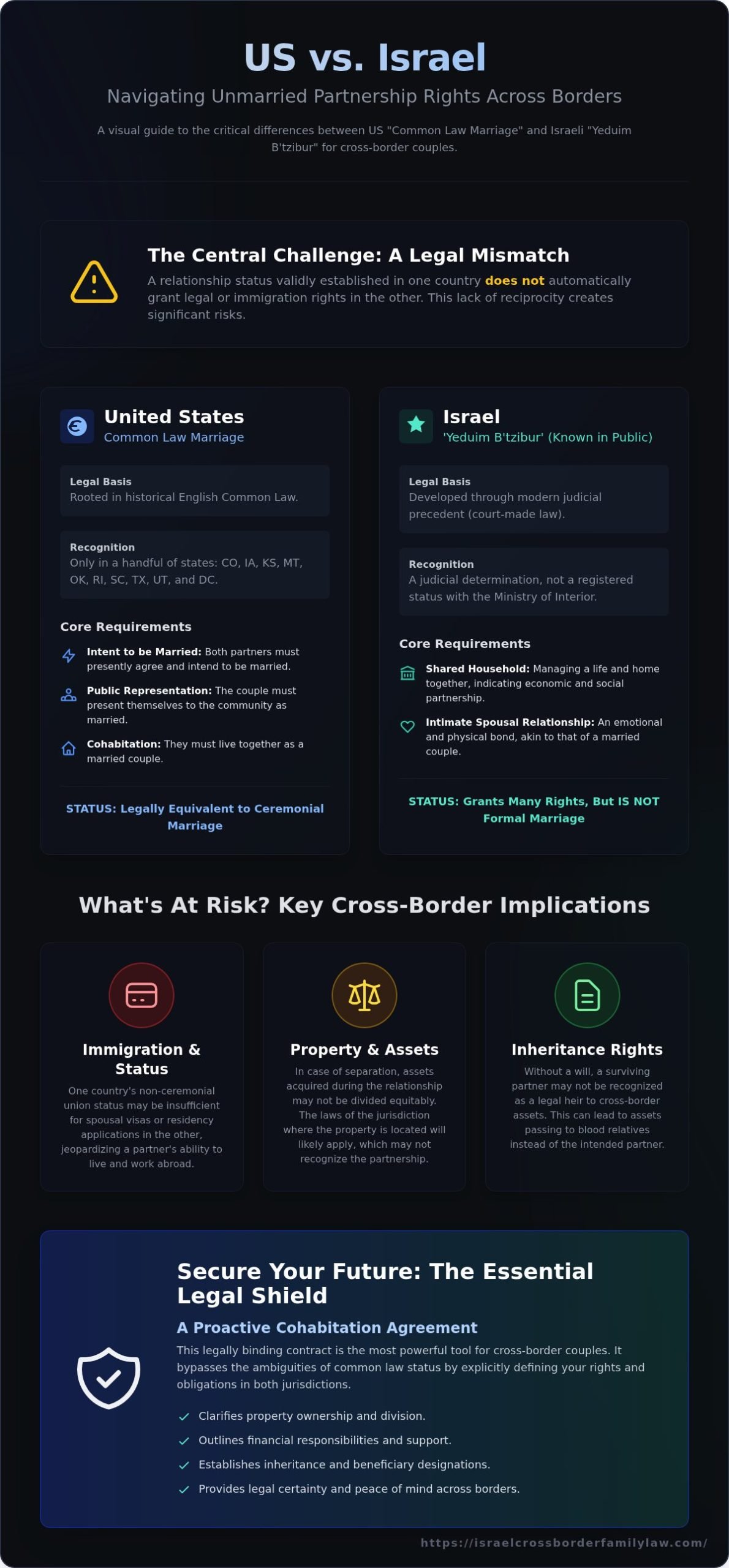
In the U.S., common law marriage is a state-level institution, not a federal one. It is only formally recognized in a small number of states, including Colorado, Iowa, Kansas, Montana, Oklahoma, Rhode Island, South Carolina, Texas, Utah, and the District of Columbia. To establish a valid common law marriage, a couple must typically satisfy three core requirements:
- Intent: Both partners must have the present intent to be married.
- Public Representation: They must present themselves to the public as a married couple (e.g., using the same last name, filing joint tax returns).
- Cohabitation: They must live together as spouses.
Once established, this union grants the same legal rights and responsibilities as a ceremonial marriage. Importantly, due to the principle of comity, a common law marriage validly formed in one state is generally recognized by all other U.S. states.
Known in Public (‘Yeduim B’tzibur’) in Israel
Israel’s counterpart, Yeduim B’tzibur (ידועים בציבור), originated from a unique legal landscape where civil marriage does not exist. This status was developed by the courts to grant rights to couples who cannot or choose not to marry through the official religious channels. The criteria are primarily twofold: managing a shared household and maintaining an intimate spousal relationship. While this status provides significant rights regarding social security, taxation, and inheritance within Israel, it is a judicial determination. It is not a registered status with the Ministry of Interior, a key distinction from formal marriage.
| Feature | United States | Israel |
|---|---|---|
| Legal Basis | Historical English Common Law | Modern Judicial Precedent (Court-made) |
| Core Requirements | Intent, Public Representation, Cohabitation | Shared Household, Intimate Relationship |
| Official Status | Legally equivalent to ceremonial marriage | Judicial status, not registered with the state |
The Core Conflict: Cross-Border Recognition for Immigration and Status
For international couples navigating the legal systems of both Israel and the United States, the central question is whether a common law marriage established in one jurisdiction is valid for immigration and status in the other. The answer is not reciprocal and hinges entirely on the direction of travel. The complexities of common law marriage recognition israel vs us arise from fundamentally different legal interpretations of what constitutes a marriage for immigration purposes. While one nation maintains a strict definition, the other allows for a more flexible, evidence-based approach.
U.S. View of Israeli Common Law Status for Immigration
The position of United States immigration law is unequivocal: the Israeli status of Yeduim B’tzibur (known in public as a couple) is not recognized as a legal marriage. U.S. Citizenship and Immigration Services (USCIS) and the U.S. Embassy in Israel require a formal marriage certificate for any spouse-based immigration petition. Consequently, an Israeli partner in a Yeduim B’tzibur relationship is ineligible to receive a spouse-based green card (Form I-130) or a derivative visa to accompany their partner to the U.S. A limited alternative exists in the form of a B-2 “cohabitating partner” visa, but this is a temporary, non-immigrant visa that does not provide a path to permanent residency or employment authorization.
Israeli View of U.S. Common Law Marriage
In contrast, the Israeli legal system demonstrates greater flexibility. Israel may recognize a U.S. common law marriage for the purposes of immigration and status, provided the relationship was validly established in a U.S. state that legally recognizes such unions. However, this recognition is not automatic and places a substantial evidentiary burden on the couple. To secure status with the Ministry of Interior (Misrad HaPnim), the couple must rigorously prove the authenticity and validity of their relationship. This process aligns with the broader legal framework governing Israel’s Recognition of Common Law Marriage for domestic purposes, which demands comprehensive proof. Required documentation often includes:
- Affidavits from friends and family attesting to the relationship.
- Evidence of a shared household and joint finances.
- Proof of presenting themselves to the public as a married couple.
Successfully navigating this complex and document-intensive process is crucial for obtaining legal status in Israel and almost always necessitates the guidance of experienced legal counsel specializing in cross-border family law.
Financial Implications: Property Rights and Inheritance Across Borders
While establishing legal status is a foundational step, the true test of recognition often arises when tangible assets and long-term financial security are at stake. The significant divergence in common law marriage recognition israel vs us frameworks creates a complex and often precarious financial landscape for international couples. Without meticulous legal planning, partners risk facing devastating disputes over shared property and inheritance, where the laws of one jurisdiction directly conflict with the other. Navigating these multi-jurisdictional challenges requires a sophisticated understanding of how assets are treated upon separation or death, particularly when property is held in both Israel and the United States.
Division of Property Upon Separation
In Israel, established Yadua B’tzibur relationships are subject to the Presumption of Joint Property Law. This means that assets accumulated during the relationship are generally presumed to be co-owned and are divided equally upon separation, mirroring the process for married couples. The United States, however, lacks a federal standard. In states that do not recognize common law marriage, assets are typically divided based on legal title. This can lead to a scenario where a property purchased in the U.S. and titled in one partner’s name may not be considered a joint asset, regardless of the relationship’s length or the other partner’s contributions. These cross-border conflicts are central to the complex issues of divorce and separation for international families.
Cross-Border Inheritance Rights
The financial risks are magnified in matters of inheritance, especially when a partner dies without a will (intestate). The legal protections afforded in each country differ dramatically.
- In Israel: A surviving Yadua B’tzibur is generally recognized as a legal heir under Israeli Inheritance Law, granting them rights comparable to those of a formally married spouse.
- In the U.S.: A surviving partner in a state that does not recognize common law marriage has no automatic inheritance rights. The deceased’s estate would pass to their legal next of kin, such as parents or siblings, potentially disinheriting the partner entirely.
This stark contrast in common law marriage recognition israel vs us inheritance law underscores a critical point: a professionally drafted, internationally valid will is not merely advisable-it is essential for protecting your partner’s financial future and ensuring your final wishes are honored across borders.
Navigating Separation: Child Custody, Relocation, and Support
When a relationship dissolves, matters involving children are invariably the most sensitive and legally complex. A crucial point to understand is that parental rights and responsibilities are established by parentage, not marital status. However, when parents separate, the legal framework for resolving disputes over custody and support differs significantly between jurisdictions. The complexities of common law marriage recognition israel vs us are magnified when children are involved, introducing multi-jurisdictional challenges governed by international treaties designed to protect their welfare.
Child Custody and Decision-Making
In both Israel and the U.S., courts determine custody arrangements based on the paramount principle of the “best interests of the child.” Both parents are presumed to have inherent rights and responsibilities. The primary legal challenge in a cross-border context is establishing jurisdiction. Deciding whether an Israeli Family Court or a U.S. state court has the authority to issue custody orders is a threshold question that requires sophisticated legal analysis of the child’s habitual residence and other critical connecting factors.
International Relocation and Child Abduction Risks
Relocating a child from Israel to the U.S., or vice versa, is a significant legal undertaking that cannot be executed unilaterally. A parent seeking to move must obtain either the explicit written consent of the other parent or a specific court order granting permission. Moving a child across international borders without such authorization is deemed parental kidnapping, carrying severe legal consequences under the Hague Convention on Child Abduction, a treaty to which both Israel and the U.S. are signatories.
Enforcing Child Support Orders Internationally
Securing a child support order in one country does not guarantee its automatic enforcement in another. While reciprocal agreements and international treaties exist to facilitate this process, navigating the procedural requirements can be formidable. For instance, an order from an Israeli court for child support must be properly registered and domesticated in the relevant U.S. state court to be effective. This often requires specialized legal assistance in both jurisdictions to achieve successful cross-border child support enforcement. The intersection of family law across Israeli and U.S. jurisdictions demands meticulous and strategic legal guidance. If you are facing these complex issues, our firm provides the experienced counsel necessary to protect your parental rights and your child’s best interests.
Proactive Legal Solutions to Protect Your Relationship
Navigating the intricate landscape of international relationship recognition requires more than just understanding the challenges; it demands proactive, strategic solutions. For unmarried international couples, particularly those dealing with the nuances of common law marriage recognition israel vs us, establishing legal certainty is not a luxury-it is the foundation of a secure future together. The following legal tools offer a spectrum of options, from foundational agreements to formal marriage, designed to protect your rights, assets, and relationship status across borders.
Drafting a Cohabitation or Financial Agreement
A meticulously drafted cohabitation or financial agreement serves as a private contract that defines the financial rights and obligations of the partners. This document is instrumental in clarifying the couple’s intent to live as a family unit without formal marriage, a critical element in many U.S. jurisdictions. It provides a clear framework for the division of property and assets should the relationship end, offering a powerful tool for asset protection. To be effective, this agreement must be structured to be valid and enforceable within both the Israeli and the relevant U.S. legal systems.
The Option of Ceremonial Marriage
For couples seeking the most unambiguous and universally accepted legal status, ceremonial marriage remains the most straightforward path. A marriage certificate from a jurisdiction where the union was legally performed is generally recognized in both Israel and the United States. For many in Israel, this involves a civil marriage in a nearby country like Cyprus or the Czech Republic, which is then registered and fully recognized by the Israeli state. This formal status provides the strongest and most direct basis for securing significant benefits, including U.S. immigration and spousal visas.
When to Consult a Cross-Border Family Lawyer
Engaging with experienced cross-border family law counsel is a critical step, best taken before major life events such as relocating to another country or acquiring significant joint assets. A specialized attorney provides indispensable guidance, ensuring that any agreements are structured for multi-jurisdictional enforceability. They can analyze the unique facts of your situation and develop a comprehensive legal strategy tailored to your specific long-term goals. The complexities of international family law demand precise legal navigation. To assess your circumstances and understand the most effective solutions for your relationship, we invite you to request a confidential case review.
Protecting Your International Union: Strategic Next Steps
Navigating the legal landscape of an international partnership requires a clear understanding of the fundamental distinctions between jurisdictions. The approach to common-law relationships in the United States versus Israel’s concept of yeduim b’tzibur presents significant challenges for couples with ties to both nations. The complexities surrounding common law marriage recognition Israel vs US can profoundly impact critical life events, including immigration, property division, and inheritance, leaving your relationship and assets vulnerable to conflicting interpretations across borders without formal legal protections. Proactive planning is paramount to securing your future. Our firm provides authoritative guidance on the intricate aspects of complex U.S.-Israel family law, specializing in drafting robust international prenuptial and cohabitation agreements and offering strategic advice for international relocation and immigration. Do not leave your family’s security to chance. We invite you to schedule a confidential case review to secure your family’s future and gain the clarity needed to move forward with confidence.
Frequently Asked Questions
Can my Israeli common-law partner get a U.S. green card based on our relationship?
U.S. federal immigration law does not recognize foreign common-law partnerships, including Israel’s ‘Yeduim B’tzibur’, for the purpose of spousal green card sponsorship. To qualify, a marriage must be legally registered and valid in the jurisdiction where it occurred. Therefore, an Israeli common-law status alone is insufficient to petition for a spousal visa, necessitating a formal, legal marriage to proceed with this specific U.S. immigration pathway.
Which U.S. states currently recognize common-law marriage?
A limited number of U.S. jurisdictions permit the formation of a common-law marriage within their borders. These currently include Colorado, Iowa, Kansas, Montana, Oklahoma, Rhode Island, South Carolina, Texas, Utah, and the District of Columbia. It is critical to note that New Hampshire recognizes such unions for inheritance purposes only. Each state has its own complex and specific statutory requirements that must be met to legally establish the marriage.
What is ‘Yeduim B’tzibur’ and how do you prove it in Israel?
‘Yeduim B’tzibur’ is the Israeli legal doctrine recognizing cohabiting couples, often translated as being “known in public” as a couple. Establishing this status requires proving two core elements: the existence of an intimate, spousal-like relationship and the management of a joint household. Substantial evidence is required, which may include joint bank account statements, shared property or lease agreements, witness affidavits, and other documentation demonstrating a shared life and financial interdependence.
If we have a U.S. common law marriage, will Israel recognize it for my partner to make Aliyah?
The Israeli Ministry of Interior may recognize a validly established U.S. common-law marriage for Aliyah under the Law of Return, although this process is complex and subject to discretionary review. The standards for common law marriage recognition israel vs us are distinct; you must provide substantial evidence that the union was legally formed in a U.S. state that permits it. This requires navigating a sophisticated documentary process to satisfy the Israeli authorities of the relationship’s validity.
Is a cohabitation agreement we signed in Israel enforceable in a U.S. court?
A cohabitation agreement validly executed in Israel may be enforceable in a U.S. court under the legal principle of comity, which gives deference to foreign legal acts. It is generally treated as a private contract governing the parties’ financial rights and obligations. Enforceability will depend on the specific state’s contract laws and whether the agreement’s terms violate local public policy. This is not an automatic process and often requires sophisticated legal guidance in the relevant U.S. jurisdiction.
Without being married, what are my rights to my partner’s Israeli pension if we separate?
In Israel, partners recognized as ‘Yeduim B’tzibur’ can possess significant rights to assets accumulated during the relationship, including pensions. Israeli courts often apply a presumption of joint property to such couples, treating assets as if they were married, unless a valid cohabitation agreement specifies otherwise. Consequently, you could be entitled to a share of the pension funds that accrued during your cohabitation, subject to a judicial or family court ruling.

Article by
Gabriel Lior
A Personal Journey That Became a Mission The advisory was founded by an American father Gabriel Lior, LLB, MBA , global entrepreneur, and cross-border advisor who spent more than a decade navigating the Israeli family court system firsthand and now lives in Singapore with his son.
As a divorced parent in a cross-border family, Gabriel faced nearly every legal challenge a foreign parent can encounter in Israel — including child custody disputes, child support proceedings, property matters in Israel and abroad, false accusations, and complex immigration and relocation proceedings. Over the years, he learned the hard way how difficult it is for non-Israeli parents to understand the system, identify the right legal strategy, and choose the right legal representation — especially when language, culture, and jurisdictional differences are involved. He also witnessed how foreign parents and new immigrants are often disadvantaged or taken advantage of by service providers and institutions simply because they lack local knowledge or fluency. From Client to Advisor To truly understand — and survive — the system, Gabriel pursued formal legal education in Israel, completing two Israeli law degrees, alongside a BA and MBA earned in the United States. This was never about becoming a practicing attorney, but about gaining a deep, structural understanding of how the system works — and where it breaks down for foreign parents. This rare combination of: Firsthand client experience Israeli legal and US business education International business and negotiation training Decades of commercial execution created a unique perspective – one that understands both sides of the table. After years of litigation, persistence, and at times self-representation, he ultimately succeeded in securing custody of his son and relocating abroad through a rare legal victory in the Israeli Supreme Court — becoming one of the first fathers in Israel to do so under these circumstances.
Disclaimer
Important Disclaimer: The information provided on this website and in its content is for general informational and educational purposes only and does not constitute legal advice, legal opinion, or legal representation. Gabriel Lior is not licensed to practice law in Israel (nor is he interested in doing so) and does not provide legal services, despite having completed 2 Law Degrees. The services offered are advisory in nature and are intended to provide general guidance, strategic insight, and information regarding cross-border family law considerations. No attorney-client relationship is formed by accessing this website, reading its content, or communicating with us. Any decisions made based on this information are at your own discretion and risk. For legal advice specific to your situation, you should consult a licensed attorney in the relevant jurisdiction. Where appropriate, we may refer clients to independent, licensed attorneys or professionals. Such referrals do not constitute legal representation and no liability is assumed for services provided by third parties.