This article is published on an independent advisory platform and does not imply an attorney-client relationship. Legal services are only provided by licensed attorneys under a separate engagement.
Does your foreign citizenship protect your global assets in an Israeli court, or does it actually complicate your legal standing during a separation? You likely feel that the intersection of two different legal cultures makes an already difficult process feel nearly impossible to manage. The divorce rate in israel, which the Central Bureau of Statistics recently reported at approximately 1.3 divorces per 1,000 people, remains a stable reality that international families must account for when planning their futures. It’s common to feel uncertain about how the dual court system treats your foreign status or your assets held in other countries.
This article offers a comprehensive analysis of divorce statistics and the specific legal hurdles facing international families in 2026. We will examine the risks of the “jurisdiction race” and provide a strategic framework for seeking legal clarity. For additional visual guidance on these topics, you can explore the resources at https://www.youtube.com/@IsraelFamilyLaw. Get clarity before you commit. Request a confidential consultation.
Key Takeaways
- Examine the latest 2026 data regarding the divorce rate in israel and how these local trends contrast with statistics in the US, UK, and EU.
- Understand how the dual court system in IL creates a “race for jurisdiction” that can significantly impact the legal and financial outcome of your case.
- Identify the unique stressors facing international families, including the “trailing spouse” dynamic and the high cost of living in ₪ (ILS).
- Learn why early strategic planning is essential to navigate the complexities of cross-border law and manage the risks of litigation in multiple countries.
- Discover how an advisory perspective provides the clarity needed to make informed decisions before committing to the formal legal process.
This article is published on an independent advisory platform and does not constitute legal representation or an attorney-client relationship. The content is informational and advisory only; legal services are provided solely by licensed attorneys under a separate engagement.
Current Trends: Analyzing the Divorce Rate in Israel in 2026
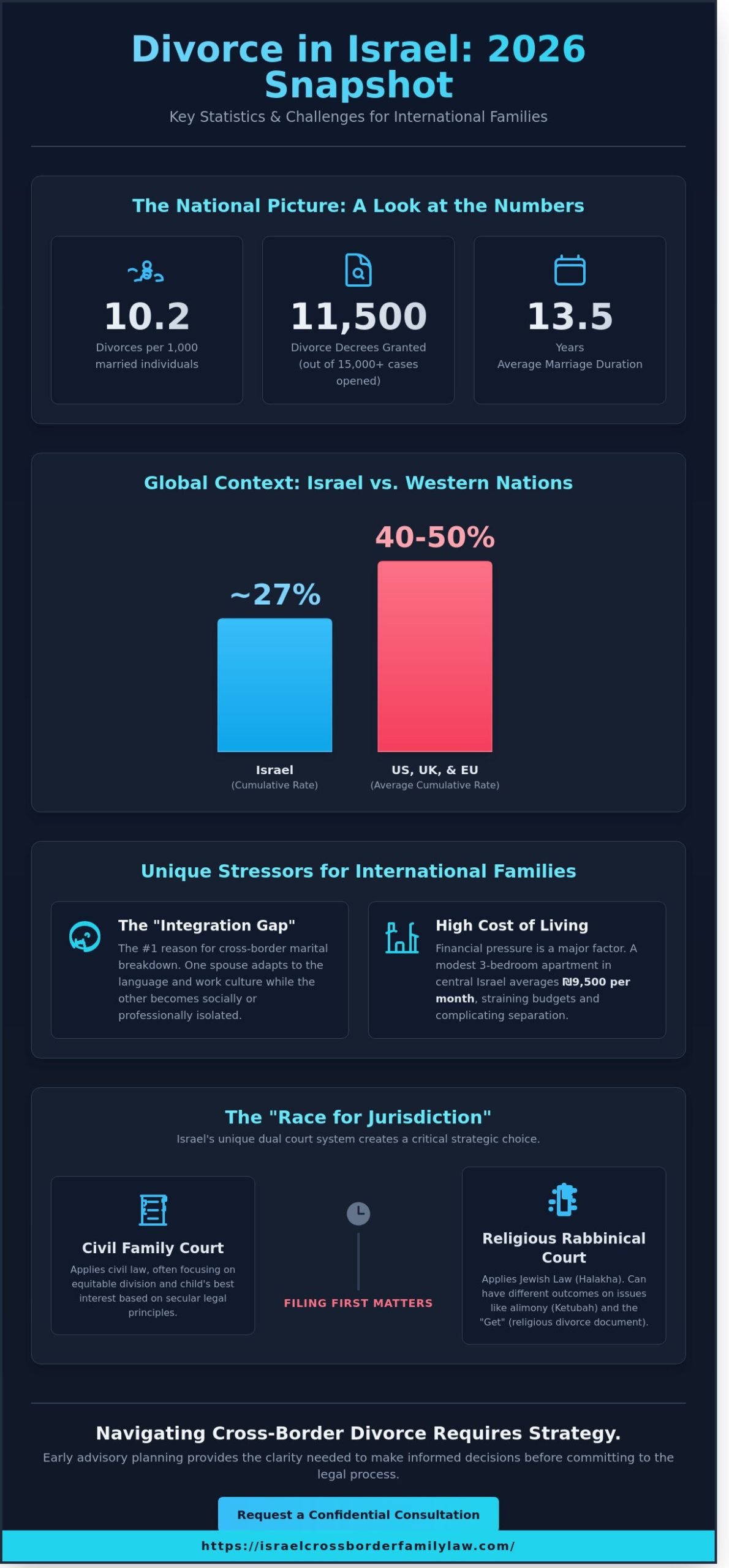
According to the Central Bureau of Statistics (CBS) reports for 2026, the divorce rate in Israel has shown a slight uptick, reaching approximately 10.2 divorces per 1,000 married individuals. While marriage remains a central pillar of Israeli society, the data indicates that 11,500 divorce decrees were granted in the last calendar year. This figure represents a shift from previous decades, reflecting broader societal changes and the evolving nature of Marriage and Divorce in Israel, which involves a complex interplay between civil and religious authorities.
To better understand this concept, watch this helpful video:
Israel’s divorce rate remains significantly lower than Western averages found in the United States, United Kingdom, or the European Union. In many Western nations, rates often fluctuate between 40% and 50% of all marriages, whereas Israel’s cumulative rate sits closer to 27%. Regional stability in 2026 and economic shifts within the “start-up nation” tech sector play a role in these trends. High living costs, where a modest three-bedroom apartment in central Israel averages ₪9,500 per month, create financial pressures that either strain marriages or make the cost of separation a significant hurdle for many families.
It’s vital to distinguish between “divorce cases opened” and “divorce decrees granted” within the Israeli system. In 2025, over 15,000 cases were initiated in the Rabbinical and Family Courts, but only a fraction resulted in a final decree within the same year. This gap often stems from the Mandatory Mediation Law, which requires couples to attend dispute resolution sessions before litigation proceeds, often slowing the formal conclusion of the process while encouraging settlement.
National Averages vs. Specific Demographics
Secular sectors in Tel Aviv and central regions show a higher divorce frequency, with rates approximately 15% above the national average. In contrast, religious sectors maintain lower figures, though 2026 data shows a 4% increase in filings within Haredi communities compared to 2020. Based on 2025-2026 projections, the average duration of marriage before divorce in Israel is approximately 13.5 years.
The ‘Anglo’ Factor: Divorce Among English-Speaking Expats
Statistics for international families frequently diverge from the national average due to the unique pressures of Aliyah. Relocating to a new country often removes the traditional support systems of extended family and familiar social networks. The #1 reason for cross-border marital breakdown in Israel is the “integration gap,” where one spouse adapts to the Hebrew-speaking environment and workforce while the other remains professionally or socially isolated. This imbalance creates a power dynamic shift that often leads to the divorce or separation of international families.
Get clarity before you commit. Request a confidential consultation.
The Dual Court System: How Jurisdiction Affects Divorce Outcomes
Israel’s legal framework for ending a marriage is unique. It operates through two parallel tracks: the civil Family Court and the religious Rabbinical Court. This duality creates a competitive environment often called the “race for jurisdiction.” The first spouse to file a comprehensive claim in one court typically locks in that court’s authority over specific issues like property division or alimony. Because each system applies different legal philosophies, your choice of venue can significantly influence your financial and parental future. Research into Recent Trends in Marriage and Divorce highlights how these institutional paths intersect with shifting demographics and the overall divorce rate in israel. Understanding which court will hear your case isn’t just a procedural step; it’s a strategic decision that defines the rules of the entire process.
Family Court: The Civil Approach
The Family Court operates under civil law principles. It focuses on equitable solutions for assets, child custody, and support. For international citizens or expats living in Israel, this court is often the preferred venue because it aligns more closely with Western legal standards. Judges here prioritize the “best interests of the child” and follow modern statutes regarding the equal distribution of marital property. Since 2016, Israeli law requires couples to attend mandatory mediation sessions before litigation begins. This shift aims to reduce conflict and stabilize the divorce rate in israel by encouraging amicable settlements. If you’re managing assets in multiple countries, you should understand how divorce and separation for international families works within this civil framework.
Rabbinical Court: Religious Jurisdiction
The Rabbinical Court holds exclusive authority over the marriage and divorce of all Jewish citizens and residents in Israel, including many expats. While civil courts can handle financial matters, only the Rabbinical Court can grant the “Get,” which is the religious divorce decree. Without this document, a Jewish person cannot legally remarry in Israel. For mixed-religion couples or non-Jewish expats, the process often involves the “dissolution of marriage” through civil channels, though religious authorities may still need to confirm there’s no religious barrier to the split. In cross-border cases, obtaining a Get is vital for finality. If one party refuses to give or receive it, the process can stall for years. This creates significant legal and personal limbo that complicates an already difficult transition.
The interplay between these two courts means that early decisions carry heavy weight. A strategy that works in the Family Court might face different hurdles in a religious setting. Get clarity before you commit. Request a confidential consultation.
This article is published on an independent advisory platform and does not constitute legal representation or legal advice. An attorney-client relationship is only established through a separate, signed engagement with a licensed attorney.
Unique Stressors for International Families and Expats in IL
International families face unique pressures that rarely affect local Israeli couples. While research such as the study on Recent Trends in Marriage and Divorce in Israel highlights shifts in the broader population, the divorce rate in israel among expats is often driven by the isolation of relocation. Many families arrive for high-tech opportunities but find the transition to a new culture more taxing than anticipated.
The “trailing spouse” syndrome is a major contributor to marital breakdown. This occurs when one partner moves for the other’s career, often sacrificing their own professional identity and social network. In Israel, the language barrier and slow recognition of foreign professional licenses can leave the trailing spouse feeling dependent and resentful. This power imbalance often creates friction that the marriage cannot survive.
Financial pressures also play a decisive role. Israel is consistently ranked among the most expensive countries in the world. As of 2024, a family of four in a central city like Tel Aviv or Ra’anana can expect to pay between ₪12,000 and ₪18,000 per month for a modest three-bedroom apartment. When compared to the cost of living in many parts of the US or UK, the lack of disposable income can lead to chronic stress.
Expats also lack the built-in support systems that locals enjoy. Without grandparents or long-term friends nearby to assist with childcare or emotional support, small disagreements can quickly escalate. Cultural differences in parenting also emerge; the Israeli emphasis on early independence and “free-range” parenting often clashes with the more structured expectations of Western expats.
Relocation and its Legal Consequences
When a cross-border marriage fails, one parent often feels a strong urge to return to their home country. This desire triggers complex legal battles. There is a documented rise in international custody disputes where the court must decide if a move is in the child’s best interest. Families should understand the specific risks involved in international custody and relocation before the situation reaches a crisis point. These cases are frequently governed by international treaties that prioritize the child’s habitual residence over a parent’s desire to go home.
The Impact of Dual Citizenship
Holding a US or foreign passport complicates the Israeli divorce process significantly. Courts must determine which jurisdiction has the authority to divide assets like foreign 401(k) accounts, properties in London, or stock options held in Delaware. To establish jurisdiction, Israeli courts evaluate a family’s “center of life” by examining where they pay social security taxes, where the children are enrolled in school, and where the couple maintains their primary residence. Managing these multi-jurisdictional assets requires a strategy that accounts for both Israeli law and the regulations of the home country.
Get clarity before you commit. Request a confidential consultation.
Navigating a Cross-Border Divorce: Strategy and Risk Management
Managing a divorce that spans two countries requires a level of tactical precision that local cases don’t demand. While the divorce rate in israel has stabilized in recent years, the complexity for international families remains high due to conflicting legal systems. Early strategic planning is the only way to avoid the pitfalls of “forum shopping.” This involves determining whether the Israeli Family Court or a court in the US or UK offers a more favorable outcome for your specific assets and custody goals. Decisions made in the first few weeks often dictate the financial outcome for the next decade.
Protecting Your Interests Early
The first 30 days of a divorce case are often the most critical. This period typically defines which court will maintain jurisdiction over your finances and children through the “race to court” or Meroz Samchuyot. For many international residents, the “Stay of Exit” order (Tsav Ikuv Yetzia) is a primary concern. This legal tool prevents a spouse or child from leaving Israel while proceedings are active. Courts may require a financial bond, sometimes exceeding ₪100,000, to lift these orders temporarily. You can find more specific guidance for expats and foreign nationals regarding these restrictions.
The Hague Convention and International Custody
When a parent moves a child across borders without the other parent’s written consent, the 1980 Hague Convention on the Civil Aspects of International Child Abduction applies. Israel is an active signatory to this treaty. Data from the Israeli Ministry of Justice shows that dozens of Hague cases are processed annually, involving both “incoming” and “outgoing” child abduction claims. Seeking clarity on child support enforcement is also vital. Israel maintains reciprocal agreements with many Western nations to ensure that ₪ payments are collected even if a parent relocates. These systems are designed to provide a safety net, but they require precise filing to be effective.
Protecting global assets like foreign real estate or high-tech options requires a prenuptial or postnuptial agreement. These documents mitigate the risks associated with the divorce rate in israel by defining property division before a conflict arises. Without a clear agreement, you may find your global assets subject to Israeli communal property laws. These laws might differ significantly from the equitable distribution or community property rules in your home jurisdiction. Strategy and risk management are not just about winning; they are about ensuring your future remains stable across all borders.
Moving Forward with Clarity: The Advisory Approach
Standard litigation often prioritizes immediate court victories. While winning a specific motion might feel productive, an advisory approach focuses on the trajectory of the family for the next five to ten years. For those dealing with divorce and separation, the divorce rate in israel, which remained near 27% according to 2022 Central Bureau of Statistics data, reflects a complex social reality that requires more than just aggressive filing. Advisory work centers on understanding the “why” behind every legal maneuver. It ensures that decisions made today don’t inadvertently trigger tax liabilities or custody complications in another jurisdiction.
International families must adopt a risk-based decision-making process. This means weighing the potential cost of a ₪50,000 legal battle against the long-term emotional and financial stability of the children. Strategy involves looking at the entire board; it’s about clarity, not just conflict. Decisions made in haste often lead to years of corrective legal work that could have been avoided with a structured initial plan.
The Importance of Specialized Guidance
A local lawyer might understand the nuances of the Rabbinical Court or the Family Court. However, they often lack the perspective needed for cross-border implications involving assets in the US or European residency rights. Bridging the gap between US and Israeli legal cultures requires a professional who understands both systems. To help visualize these differences, the YouTube channel Israel Family Law provides detailed explainers on how these jurisdictions interact. Understanding these cultural shifts prevents costly misunderstandings during the process. A bilingual approach ensures that no detail is lost in translation between two very different legal worlds.
Next Steps for International Families
Taking the first step doesn’t require an immediate commitment to a multi-year lawsuit. Engaging in a confidential case review allows families to assess their situation without the pressure of litigation. This is particularly vital for the Anglo community in IL, where resources tailored to English speakers are essential for navigating a Hebrew-dominant system. Specific guidance helps expats understand how local laws apply to their unique status.
Knowledge acts as the strongest defense against becoming another statistic in the divorce rate in israel. By prioritizing strategy over impulse, families can exit a marriage with their financial and parental rights intact. Making informed choices early on reduces the risk of prolonged legal exposure.
Get clarity before you commit. Request a confidential consultation.
Securing Your Path Through Cross-Border Complexity
The legal landscape for international families is evolving quickly. Recent 2026 reports from the Central Bureau of Statistics show that the divorce rate in israel remains a critical factor for the Anglo community. Navigating the “race for jurisdiction” between the Civil Family Court and the Rabbinical Court requires a strategic approach rather than an emotional one. Because Israeli law and US statutes often intersect, the decisions you make now will impact your financial standing across two different legal systems. It’s vital to assess these risks early to avoid unnecessary conflict.
Our advisory platform specializes in risk management and long-term strategy for international families. We focus on the bicultural nuances that affect English-speaking Israelis and expats living in IL. By prioritizing clarity, you can avoid the common pitfalls inherent in multi-jurisdictional cases. We provide the specialized support needed to bridge the gap between these systems with confidence. You don’t have to manage these complexities without a clear roadmap.
Get clarity before you commit. Request a confidential consultation.
Choosing to move forward with a well-defined strategy is the most effective way to protect your interests and your family’s future.
This article is published on an independent advisory platform and does not constitute legal advice or an attorney-client relationship. Legal services are only provided by licensed attorneys under a separate engagement.
Frequently Asked Questions
Is the divorce rate in Israel higher than in the United States?
The divorce rate in Israel is significantly lower than the rate found in the United States. According to the 2022 report from the Central Bureau of Statistics (CBS), Israel’s divorce rate is approximately 9.1 per 1,000 married individuals. In contrast, the US rate remains higher at roughly 14.5 per 1,000 married people based on 2021 CDC data. While the divorce rate in Israel has seen a 3% increase over the last decade, cultural and religious structures continue to influence these figures.
Can a US citizen get divorced in Israel if they were married abroad?
You can obtain a divorce in Israel as a US citizen even if your wedding took place in New York, London, or any other foreign city. Israeli courts determine jurisdiction based on where your “center of life” is located rather than the location of the original ceremony. If you’ve lived in Israel for at least 12 months or your spouse is a resident, the Family Court has the authority to dissolve the marriage. It’s important to understand how these local proceedings might impact your status back in the US.
What is the ‘jurisdiction race’ in Israeli divorce law?
The jurisdiction race is a unique procedural competition between the civil Family Court and the religious Rabbinical Court. In Israel, both systems have the power to hear cases regarding alimony, property, and child matters. The court where the first valid claim is filed usually gains the exclusive right to decide those specific issues. This creates a situation where acting quickly is often necessary to ensure your case is heard in the venue that best aligns with your strategic goals.
https://www.youtube.com/@IsraelFamilyLaw
How long does a typical divorce take in Israel for an expat couple?
An uncontested divorce for an expat couple generally takes between 4 to 7 months to complete. If the case involves complex disputes over international assets or child relocation, the process can extend to 18 months or longer. The timeline depends on your ability to reach a settlement agreement early in the process. Working with a team on the ground helps navigate the bureaucracy of the Ministry of Justice and the court schedules more efficiently.
What happens to assets located in the US during an Israeli divorce?
Israeli courts typically include global assets, such as US real estate, 401(k) plans, and brokerage accounts, in the division of marital property. Under the 1973 Spousal Property Relations Law, assets accumulated during the marriage are usually split 50/50 regardless of which country they’re held in. You’ll need to coordinate with professionals who understand cross-border enforcement to ensure an Israeli court order is recognized and implemented by US financial institutions.
Is child support in Israel higher or lower than in most US states?
Child support in Israel is often higher than in many US states because it includes a specific “Mador” component for housing expenses. A parent might pay between ₪2,200 and ₪3,600 per child each month, plus a percentage of rent or mortgage costs. Since the 2017 Supreme Court ruling 919/15, these amounts are calculated based on the actual income of both parents and the time the child spends in each home. It’s a complex calculation that requires a clear look at your total financial picture.
Do Israeli courts favor the mother in custody disputes involving foreigners?
Israeli law is shifting toward a more gender-neutral approach, though the “Tender Years Presumption” still suggests children under age 6 should stay with their mother. Recent data shows that joint custody is now granted in over 30% of cases, a significant rise from a decade ago. For international families, the court focuses heavily on the “Best Interests of the Child” and may appoint a social worker to evaluate the family’s specific bicultural needs before making a ruling.
What is a ‘Get’ and do I need one if I am not religious?
A Get is a religious divorce document required by the Rabbinical Court to end a Jewish marriage in Israel. Even if you don’t lead a religious lifestyle, the Rabbinical Court has exclusive jurisdiction over the marriage status of Jewish residents. Without this document, you’re considered still married under Israeli law and won’t be able to remarry within the country. It’s a critical step in the process that requires careful handling to avoid long-term legal complications for you and your children.
Get clarity before you commit. Request a confidential consultation.

Article by
Gabriel Lior
A Personal Journey That Became a Mission
The advisory was founded by an American father Gabriel Lior, LLB, MBA , global entrepreneur, and cross-border advisor who spent more than a decade navigating the Israeli family court system firsthand and now lives in Singapore with his son.
As a divorced parent in a cross-border family, Gabriel faced nearly every legal challenge a foreign parent can encounter in Israel — including child custody disputes, child support proceedings, property matters in Israel and abroad, false accusations, and complex immigration and relocation proceedings.
Over the years, he learned the hard way how difficult it is for non-Israeli parents to understand the system, identify the right legal strategy, and choose the right legal representation — especially when language, culture, and jurisdictional differences are involved. He also witnessed how foreign parents and new immigrants are often disadvantaged or taken advantage of by service providers and institutions simply because they lack local knowledge or fluency.
From Client to Advisor
To truly understand — and survive — the system, Gabriel pursued formal legal education in Israel, completing two Israeli law degrees, alongside a BA and MBA earned in the United States. This was never about becoming a practicing attorney, but about gaining a deep, structural understanding of how the system works — and where it breaks down for foreign parents.
This rare combination of:
Firsthand client experience
Israeli legal and US business education
International business and negotiation training
Decades of commercial execution
created a unique perspective – one that understands both sides of the table.
After years of litigation, persistence, and at times self-representation, he ultimately succeeded in securing custody of his son and relocating abroad through a rare legal victory in the Israeli Supreme Court — becoming one of the first fathers in Israel to do so under these circumstances.
Disclaimer
Important Disclaimer:
The information provided on this website and in its content is for general informational and educational purposes only and does not constitute legal advice, legal opinion, or legal representation.
Gabriel Lior is not licensed to practice law in Israel (nor is he interested in doing so) and does not provide legal services, despite having completed 2 Law Degrees. The services offered are advisory in nature and are intended to provide general guidance, strategic insight, and information regarding cross-border family law considerations.
No attorney-client relationship is formed by accessing this website, reading its content, or communicating with us.
Any decisions made based on this information are at your own discretion and risk. For legal advice specific to your situation, you should consult a licensed attorney in the relevant jurisdiction.
Where appropriate, we may refer clients to independent, licensed attorneys or professionals. Such referrals do not constitute legal representation and no liability is assumed for services provided by third parties.