Your spouse mentions a “short trip” abroad, but you find their passports missing from the drawer. For international families living in the south of Israel, this scenario represents a critical legal emergency that demands immediate intervention. Securing an emergency custody order Eilat is the most effective way to ensure your child remains within the jurisdiction and under the protection of the law. We understand that the Hebrew speaking court system and the nuances of cross-border jurisdiction can feel overwhelming, especially when you’re worried about your child’s safety.
This guide will teach you the critical steps to secure an emergency custody order in Eilat and protect your child’s safety within the Israeli legal system. It’s important to remember that early decisions carry significant weight in cross-border cases. We will walk you through the process of obtaining a “stay of exit” order, explain the local court procedures at 3 Yotam Road, and discuss how to manage jurisdictional risks effectively. For more visual guidance on these complex family matters, you can find helpful resources at https://www.youtube.com/@IsraelFamilyLaw. This information is provided by an independent advisory platform for educational purposes to help you find clarity before making life-altering legal commitments.
Key Takeaways
- Distinguish between standard custody disputes and genuine legal emergencies to ensure your petition meets the high threshold required by Eilat judges.
- Learn how to utilize the “Ex Parte” mechanism to request an emergency custody order Eilat without the other parent’s presence when immediate safety is at risk.
- Understand why a “Stay of Exit” order, known locally as Tsav Ikuv Yetsia, is a critical safeguard due to Eilat’s unique proximity to international borders.
- Identify the essential documentation and evidence needed to draft a compelling emergency petition that focuses on preventing immediate harm to the child.
- Recognize how early strategic decisions and an understanding of Israeli cultural nuances can dictate the long-term success of your cross-border custody case.
Understanding the Threshold for Emergency Custody in Eilat
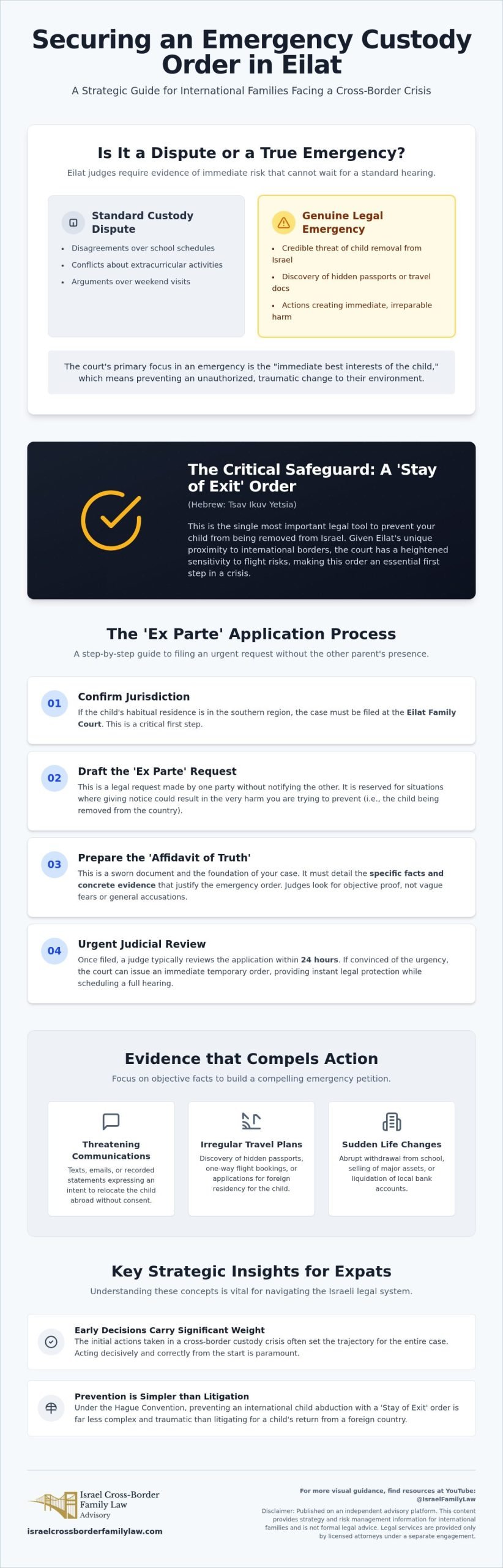
Judges in the Eilat Family Court distinguish sharply between a parent who is difficult and a situation that is objectively dangerous. A standard custody dispute involves disagreements over school schedules, extracurricular activities, or weekend visits. An emergency, however, requires evidence of immediate risk that cannot wait for a standard, weeks-long wait for a scheduled hearing. In the context of international families, this often involves the credible threat of a child being removed from Israel without the other parent’s consent. Because Eilat is a gateway city with unique geographic proximity to multiple borders, the court’s sensitivity to flight risks is particularly high.
The “best interests of the child” standard is the foundation of all family law in Israel. In an urgent hearing, the court focuses on the “immediate best interests,” which usually means maintaining the status quo or preventing a traumatic, unauthorized change in the child’s environment. This often leads to the issuance of an emergency custody order Eilat to stabilize the situation before the conflict escalates further.
The Immediate Risk Assessment
Red flags often include the sudden cancellation of school enrollment, the discovery of hidden travel documents, or explicit threats of relocation to a country that doesn’t recognize Israeli court orders. In 2026, emergency custody in Israel remains a temporary, ex parte judicial intervention designed to prevent immediate irreparable harm to a child’s physical or psychological welfare. When documenting evidence, families should focus on objective facts like airline bookings or communications regarding foreign residency. This is especially vital when dealing with the Hague Convention on International Child Abduction, as preventing a removal is far simpler than litigating a return from another country.
Legal Guardianship vs. Physical Custody
Under the Legal Capacity and Guardianship Law, both parents are natural guardians of their children. This means both have the right and duty to care for the child’s needs, including determining their place of residence. An emergency custody order Eilat is a specific legal tool used to temporarily limit these guardianship rights of one parent to protect the child. The Eilat Family Court, located at 3 Yotam Road, has the authority to issue temporary orders that define where a child must stay until a full hearing occurs. This process doesn’t permanently strip a parent of their rights but establishes a protective perimeter during a crisis. Understanding the difference between who has the child right now (physical custody) and who makes long-term decisions (guardianship) is essential for any expat navigating this system. These early strategic decisions often dictate the long-term trajectory of the case.
The Legal Process: Filing an Ex Parte Application in Israel
An ex parte application is a legal request made by one parent without the prior notification or presence of the other. In the Israeli Judicial Authority’s Family Courts, this mechanism is the primary tool for securing an emergency custody order Eilat. It’s utilized when the risk to a child is so immediate that waiting for a standard hearing would result in irreparable harm, such as an unauthorized departure from the country. Because of the high stakes, these applications are prioritized, and a judge will typically review the submission within a 24-hour window.
The foundation of any emergency filing is the “Affidavit of Truth.” This is a sworn document where you must detail the specific facts and evidence that justify bypassing the other parent’s right to be heard. Judges look for concrete indicators of risk rather than vague fears. If the court is convinced of the urgency, it can issue a temporary order immediately, providing instant legal protection while a full hearing is scheduled.
The Role of the Eilat Family Court
Jurisdiction is a critical first step. If your child’s habitual residence is in the southern region, your case must be filed at the Eilat Family Court located at 3 Yotam Road. The court operates with a specialized team, including court-appointed social workers known as Saa’d. These professionals may be asked to provide an immediate assessment of the child’s welfare. For international families, the language barrier is often the most stressful hurdle. All court filings must be in Hebrew, and any foreign evidence, such as emails or birth certificates, requires professional translation. If you’re navigating these requirements for the first time, you can reach out for strategic guidance to ensure your documentation meets the court’s standards.
When preparing your filing, ensure you have the following ready:
- The formal petition for emergency custody.
- A sworn Affidavit of Truth signed before an attorney or court official.
- Evidence of immediate risk, such as travel bookings or written threats.
- Proof of the child’s current residence within the Eilat jurisdiction.
The Preliminary Hearing
A temporary emergency custody order Eilat is not a final decision. By law, if an ex parte order is granted, the court must hold a follow-up hearing with both parents present, usually within seven days. During this preliminary hearing, the burden of proof remains on the parent who requested the order. You’ll need to demonstrate why the temporary measures should remain in place. The judge will balance the child’s immediate safety against the other parent’s right to maintain their legal guardianship roles. This is a pivotal moment where the initial strategy and the quality of evidence presented can determine the long-term direction of the custody case.
Cross-Border Risks: Eilat Jurisdiction and International Abduction
Eilat’s unique geographic location at the intersection of three countries creates specific risks for international families. Unlike central Israel, where international travel usually implies a flight from Ben Gurion Airport, families in Eilat must account for land crossings into Jordan via the Rabin Border or into Egypt via the Taba Border. This proximity to international boundaries significantly influences how judges view an application for an emergency custody order Eilat. When a parent demonstrates a credible risk of flight, the court’s primary defensive tool is the “Stay of Exit” order, known in Hebrew as Tsav Ikuv Yetsia. This order serves as a legal lock, preventing a child from leaving the country through any port of entry or exit until the court specifically lifts the restriction.
Understanding the interplay between local orders and international treaties is essential for parents navigating International Custody and Relocation issues. Israel is a signatory to the Hague Convention, which provides a framework for the return of children wrongfully removed from their country of habitual residence. However, the Hague process is often lengthy and emotionally taxing. Securing a preventative order in the Eilat Family Court is a far more effective strategy than attempting to litigate a return after a child has already crossed a border. The court treats these requests with high priority because the “habitual residence” of the child is the legal foundation for all future custody decisions.
Passport Control and Border Protection
Once an emergency custody order Eilat is granted, it is electronically transmitted to the Israeli Border Police. This system ensures that even if a parent possesses a child’s US and Israeli passports, the child’s name will trigger an alert at any border control station, including the small land crossings near Eilat. For families with dual citizenship, it’s a common misconception that a foreign passport allows for an exit despite an Israeli court order. The border system tracks the individual, not just the document. Parents should also consider requesting that the court hold the child’s passports in escrow as an additional layer of security during a high-conflict dispute.
US-Israel Jurisdictional Conflicts
International families often face the complexity of “forum shopping,” where one parent attempts to secure a more favorable ruling in a US court while the other seeks relief in Israel. If a US court order already exists, the Eilat Family Court will review it, but it doesn’t always grant automatic enforcement. The court must first determine if it has jurisdiction based on where the child actually lives. Navigating the Hague Convention and Child Abduction protocols requires a clear understanding of which legal system takes precedence. Early strategic planning is vital to ensure that your case is heard in the most appropriate jurisdiction and that existing foreign orders are properly recognized by the Israeli authorities.
Step-by-Step: Securing an Emergency Order in the Eilat Family Court
Navigating the filing day requires precision and a clear understanding of the Eilat Family Court’s operational schedule. Located at 3 Yotam Road, the court’s reception hours for emergency filings are strictly Sunday through Thursday, from 8:30 AM to 1:30 PM. To increase the likelihood of a same-day review, you should arrive at the clerk’s office as soon as the doors open. The clerk will review your emergency custody order Eilat application for administrative completeness before passing it to the duty judge. You must remain available at the court or by phone, as the judge may require immediate clarification on your affidavit before signing the temporary order.
Once the application is submitted, the process moves quickly. If the judge finds that the risk of immediate harm or abduction is credible, they can issue a temporary order without the other parent’s presence. This document provides the legal authority needed to stop a child from being moved or to involve law enforcement if the child is being withheld. After receiving the signed order, your next priority is ensuring it’s properly recorded with the relevant authorities and served to the other party.
Documenting the Emergency
Judges in Eilat prioritize objective, verifiable evidence over emotional pleas. When drafting your petition, focus on “exhibits” that prove a specific risk, such as airline booking confirmations, text messages detailing a plan to flee, or lease terminations. If there’s a history of domestic instability, police reports or social service records carry significant weight. All supporting documents, including foreign birth certificates or English emails, must be accompanied by a notarized Hebrew translation to be accepted by the court. High-quality documentation at this stage prevents delays that could put the child at further risk.
Serving the Order Safely
A signed order is only enforceable once it has been legally served to the other parent. In the Israeli legal system, “service of process” must be documented to prove the other party is aware of the court’s restrictions. In high-stakes cases where you fear a volatile reaction, you shouldn’t attempt service alone. You may need to involve the local police to accompany the hand-off, especially if the child needs to be physically moved from one residence to another. Maintaining a calm, non-confrontational demeanor is essential for the child’s emotional well-being during this transition. If you’re concerned about the logistics of service or the strength of your evidence, you can request a confidential case review to refine your approach.
- Arrive at 3 Yotam Road before 8:30 AM for priority processing.
- Ensure all foreign documents have certified Hebrew translations.
- Keep multiple copies of the signed order for the police and border authorities.
- Coordinate service through legal channels to ensure the order is enforceable.
Strategic Guidance for Expats Facing Custody Emergencies
The initial response to a family crisis often determines the jurisdictional outcome for years to come. For international families in the south of Israel, the decision to seek an emergency custody order Eilat isn’t just about immediate safety; it’s a strategic move to establish the child’s habitual residence within a stable legal framework. Expats often misjudge the speed of the Israeli system or assume it mirrors the common law procedures of their home countries. In reality, the weight of early judicial decisions is significant, as Israeli judges frequently prioritize the status quo established during the first few weeks of a dispute.
Understanding the cultural nuances of the Israeli family law system is vital for those accustomed to different legal environments. For instance, the mandatory mediation period required by the Settlement of Dispute Law applies to everyone, yet emergency petitions can bypass this stay of proceedings if the risk is documented correctly. Many Anglos miss the subtle shift from a “protective” stance to a “litigious” one, which can impact how court-appointed social workers view their level of cooperation. To navigate these complexities, it’s helpful to review specialized Guidance for Expats and Foreign Nationals to understand how your global family goals align with local Eilat requirements.
Seeking Clarity Before Commitment
Emotional concessions made during a crisis are notoriously difficult to reverse. In the heat of an emergency, a parent might agree to a “temporary” visitation schedule or a specific residence just to de-escalate the situation. However, these agreements can inadvertently create a new legal status quo that the court will be hesitant to change later. Evaluating the risks of different legal paths requires a cross-border perspective that accounts for both Israeli law and the potential impact on your rights in your home country. Strategic advisory helps you maintain a calm, authoritative presence in court, which judges in Eilat value highly when determining the child’s best interests.
Next Steps and Consultations
Once an emergency custody order Eilat is secured, the focus must shift from crisis management to long-term stability. This involves transitioning from a temporary protective order to a permanent parenting plan that addresses the child’s education, healthcare, and international travel rights. Families with ties to the US and Israel need counsel that understands multi-jurisdictional complexity and can bridge the gap between divergent legal cultures. Professional guidance ensures that your strategy remains proactive rather than reactive, protecting your parental rights across borders.
Securing Your Child’s Future in Israel
Navigating the intersection of Israeli family law and international jurisdiction requires a proactive and strategic approach. By understanding the specific thresholds for a legal emergency and the procedural requirements at the Eilat Family Court, you can effectively utilize an emergency custody order Eilat to protect your child from unauthorized removal. The proximity to land borders makes the “Stay of Exit” order a critical safeguard that shouldn’t be overlooked during a crisis.
As an advisory platform specializing in cross-border family strategy, we focus on the unique needs of Anglos and expats living in Israel. We provide the strategic guidance necessary to navigate Hague Convention complexities and international custody disputes with confidence. The weight of your early decisions will dictate the long-term outcome of your case; therefore, seeking clarity before making legal commitments is essential.
Get clarity before you commit. Request a confidential consultation. You have the power to stabilize your family’s situation through informed action and expert guidance.
Frequently Asked Questions
How long does an emergency custody order last in Israel?
An emergency custody order Eilat is a temporary judicial tool that remains in effect until the court holds a full hearing. If the order was granted ex parte, the judge must schedule this follow-up session within seven days to hear from both parents. Depending on the evidence, the court can then decide to extend the temporary measures into a long-term order or dissolve them entirely if the immediate risk has passed.
Can I get an emergency custody order in Eilat on a weekend or holiday?
Standard reception hours at 3 Yotam Road are Sunday through Thursday from 8:30 AM to 1:30 PM, but the judicial system provides an on-call judge for life-threatening emergencies. During weekends or holidays, urgent applications are usually processed through the national court hotline or the police in extreme cases. Most custody disputes are handled on the next business morning unless there’s a documented risk of immediate physical harm or international abduction.
What is a “Stay of Exit” order and how do I get one in Eilat?
A “Stay of Exit” order, or Tsav Ikuv Yetsia, is a legal directive that prevents a child from leaving Israel. To get one in Eilat, you must file an urgent motion with the Family Court demonstrating a credible flight risk. Once the judge signs the order, it’s electronically transmitted to all border control points, including the land crossings into Jordan and Egypt, ensuring the child is stopped at any exit port.
Do I need a lawyer to file for emergency custody in the Eilat Family Court?
You aren’t legally required to have a lawyer to submit a petition, but the procedural complexity makes professional guidance essential for international families. All court documents must be drafted in Hebrew and follow specific civil procedure rules. Navigating the court system without an understanding of local customs or the Hebrew language significantly increases the risk of your application being rejected for technical errors during a time-sensitive crisis.
Will the Israeli court recognize my US custody agreement in an emergency?
Israeli courts don’t automatically enforce foreign custody agreements, but they do give them significant weight as evidence of the established status quo. If an emergency custody order Eilat is requested, the judge will review the US agreement to understand the prior arrangements. However, the court’s primary focus remains the child’s immediate best interests and whether the child has become a “habitual resident” of Israel under the Hague Convention framework.
What happens if the other parent violates an emergency custody order?
Violating a court order is a serious offense that can lead to contempt of court charges, fines, or police intervention. If a parent ignores the restrictions set by the judge, the police can be called to enforce the order and return the child to the designated guardian. Such violations also heavily influence the court’s long-term decisions regarding the parent’s reliability and the permanent custody arrangements for the child.
How much does it cost to file for an emergency order in Eilat?
Filing for a case involves several administrative costs. In 2026, the mandatory Settlement of Dispute application costs 119 NIS, while a standard claim filing fee in the Family Court is 568 NIS. You should also budget for notarized translations of foreign documents, which can cost between 250 and 480 NIS per page. These fees are paid directly to the court and are separate from any strategic advisory costs or lawyer fees.
Can a grandparent or relative apply for emergency custody in Israel?
Yes, grandparents or other close relatives can apply for emergency custody if they can demonstrate that the child’s current environment poses an immediate risk to their welfare. The court prioritizes the “best interests of the child” and may grant temporary custody to a relative if both parents are deemed unfit or unavailable during a crisis. This process involves a rigorous assessment by court-appointed social workers to ensure the temporary placement is safe.

Article by
Gabriel Lior
A Personal Journey That Became a Mission
The advisory was founded by an American father Gabriel Lior, LLB, MBA , global entrepreneur, and cross-border advisor who spent more than a decade navigating the Israeli family court system firsthand and now lives in Singapore with his son.
As a divorced parent in a cross-border family, Gabriel faced nearly every legal challenge a foreign parent can encounter in Israel — including child custody disputes, child support proceedings, property matters in Israel and abroad, false accusations, and complex immigration and relocation proceedings.
Over the years, he learned the hard way how difficult it is for non-Israeli parents to understand the system, identify the right legal strategy, and choose the right legal representation — especially when language, culture, and jurisdictional differences are involved. He also witnessed how foreign parents and new immigrants are often disadvantaged or taken advantage of by service providers and institutions simply because they lack local knowledge or fluency.
From Client to Advisor
To truly understand — and survive — the system, Gabriel pursued formal legal education in Israel, completing two Israeli law degrees, alongside a BA and MBA earned in the United States. This was never about becoming a practicing attorney, but about gaining a deep, structural understanding of how the system works — and where it breaks down for foreign parents.
This rare combination of:
Firsthand client experience
Israeli legal and US business education
International business and negotiation training
Decades of commercial execution
created a unique perspective – one that understands both sides of the table.
After years of litigation, persistence, and at times self-representation, he ultimately succeeded in securing custody of his son and relocating abroad through a rare legal victory in the Israeli Supreme Court — becoming one of the first fathers in Israel to do so under these circumstances.
Disclaimer
Important Disclaimer:
The information provided on this website and in its content is for general informational and educational purposes only and does not constitute legal advice, legal opinion, or legal representation.
Gabriel Lior is not licensed to practice law in Israel (nor is he interested in doing so) and does not provide legal services, despite having completed 2 Law Degrees. The services offered are advisory in nature and are intended to provide general guidance, strategic insight, and information regarding cross-border family law considerations.
No attorney-client relationship is formed by accessing this website, reading its content, or communicating with us.
Any decisions made based on this information are at your own discretion and risk. For legal advice specific to your situation, you should consult a licensed attorney in the relevant jurisdiction.
Where appropriate, we may refer clients to independent, licensed attorneys or professionals. Such referrals do not constitute legal representation and no liability is assumed for services provided by third parties.