This article is published on an independent advisory platform and does not constitute an attorney-client relationship. The content is for informational and advisory purposes only and does not constitute legal representation or legal advice.
What if the border between your home country and Israel wasn’t an obstacle to your child’s financial security? Many parents find that having a valid judgment is only half the battle when the other party moves abroad. You’re likely concerned about the high costs of cross-border litigation and the difficulty of trying to enforce foreign child support Israel from a distance. It’s a common frustration to feel that your order has lost its power once it crosses the Mediterranean. This guide will help you understand the legal requirements, procedural steps, and strategic considerations for successfully recognizing a foreign judgment within the Israeli system. We’ll walk through the transition from a foreign paper order to active collection through the Israeli Enforcement and Collection Authority. You’ll gain clarity on the 2025 interest rate reforms, the specific timeline for filing, and the essential differences in how IL courts handle maintenance for children of different ages.
Key Takeaways
- Understand that foreign child support orders are not self-executing and must undergo a formal recognition process in the Israeli Family Court to become locally binding.
- Learn how to navigate the two-step procedure that moves your case from a judicial motion for enforcement to active recovery through the Israeli Enforcement and Collection Authority.
- Discover the specific legal criteria under the Foreign Judgments Enforcement Law that allow you to enforce foreign child support Israel based on the principle of reciprocity.
- Identify critical procedural hurdles, such as improper service of the original case, which can cause an enforcement motion to fail within the Israeli system.
- Gain strategic insights into coordinating a cross-border legal approach to ensure your decisions in one jurisdiction don’t negatively impact your collection rights in another.
This article is published on an independent advisory platform and does not constitute an attorney-client relationship. The content is for informational and advisory purposes only and does not constitute legal representation or legal advice.
The Reality of Enforcing Foreign Child Support in Israel
Many parents mistakenly believe that a child support order issued in New York, London, or Toronto carries immediate weight in Tel Aviv. It’s a common misconception that international treaties create a seamless, automatic bridge for payments. In reality, a foreign judgment has no inherent legal force within the borders of Israel until it has been formally recognized by a local court. This means your current order is essentially a “paper right” that requires specific legal activation to become an enforceable reality. Understanding how to enforce foreign child support Israel requires a shift in perspective; you must view your existing order as the foundation for a new local legal process rather than a final conclusion.
The process of enforcement of foreign judgments is rooted in the principle of national sovereignty. Israel, like most nations, maintains the right to review foreign orders to ensure they don’t conflict with local public policy or fundamental legal standards. To enforce foreign child support Israel, you must navigate a system that balances international cooperation with domestic judicial oversight. This oversight ensures that the rights of all parties were respected in the original jurisdiction before the Israeli state lends its power to collect funds.
To better understand this concept, watch this helpful video:
Why Foreign Orders Are Not Automatically Enforced
The Israeli Ministry of Justice and the Family Court system act as gatekeepers. They don’t simply “rubber stamp” foreign documents. Instead, they look for specific criteria, such as whether the defendant was given a fair chance to be heard in the original case and if the judgment is still final and valid. Without this vetting, the Israeli Enforcement and Collection Authority cannot act on your behalf. Relying on the hope of automatic compliance often leads to months of lost support and mounting arrears that become harder to collect over time.
The Anglo-Expat Perspective on Israeli Law
For expats from common law jurisdictions like the US or UK, the Israeli legal landscape can feel unfamiliar. It’s a hybrid system where civil law meets religious traditions in family matters, creating a unique environment for litigation. It’s also vital to remember that in these discussions, “IL” always refers to Israel. One of the biggest shifts for international families is dealing with the Enforcement and Collection Authority, known in Hebrew as Hotzaa L’Poal. This body has significant power to freeze bank accounts or block passports, but it only gains that power once the Family Court has “converted” your foreign order into an Israeli one. This transition requires a proactive cross-border enforcement strategy to ensure that decisions made in your home country don’t create unforeseen obstacles within the Israeli system.
The foundation for any attempt to enforce foreign child support Israel is the Foreign Judgments Enforcement Law (5718-1958). This statute sets the ground rules for how a decision made by a court in London or Los Angeles can be given legal teeth in Jerusalem. One of the most critical elements of this law is the principle of reciprocity. Essentially, the Israeli court asks whether the country that issued the order would enforce an equivalent order from Israel. Most Western nations, including the United States, United Kingdom, and Canada, meet this requirement. However, reciprocity isn’t just a broad diplomatic concept. It’s a technical legal hurdle that requires careful documentation before the local court will consider the merits of your case.
Timing is just as important as the law itself. Under the 1958 law, you generally have a five-year window from the date the judgment was issued to file your motion for enforcement in Israel. If you wait longer, the court may refuse to recognize the order unless there are exceptional circumstances. This statute of limitations highlights why early action is vital for international families. Once the court recognizes the order, it is treated as a domestic judgment. At that stage, you can engage Israel’s Enforcement and Collection Authority to begin the actual recovery of funds through liens or other local mechanisms.
Criteria for Enforcement in Israel
For a foreign child support order to be recognized, it must meet three primary tests. First, the court that issued the order must have had the legal authority, or jurisdiction, to do so. Second, the judgment must be final, meaning it is no longer subject to appeal in its home country. Finally, the order cannot contradict Israeli public policy or fundamental legal standards. While most standard support orders pass these tests easily, complex arrangements involving unconventional financial structures may require a more nuanced strategy. Ensuring your paperwork is in order before you start can save you from a costly dismissal.
The Role of International Comity
International comity is the legal principle of mutual respect between different judicial systems. Israeli courts generally respect orders from US state courts, such as those in New York or California, provided they follow standard due process. To demonstrate this validity, you must provide a certified copy of the judgment bearing an Apostille. This international certification proves the document’s authenticity and is non-negotiable in the Israeli court system. Without it, your case won’t even reach the judge’s desk. If you’re unsure about the current status of your documents, it is wise to seek a preliminary review of your case files before moving forward with a formal filing.
Establishing a successful mechanism to enforce foreign child support Israel requires navigating a distinct two-phase journey. Many parents mistakenly believe that a favorable court ruling on recognition is the final step. However, obtaining a declaration of enforceability is merely the judicial “green light.” The actual recovery of funds happens in a completely different arena. This separation between the judicial recognition and the administrative collection is a hallmark of the Israeli system that international families must understand to manage their expectations regarding timelines and outcomes.
Winning in the Family Court provides you with a legal document, but it doesn’t automatically put money in your bank account. The debtor parent may still refuse to pay, necessitating a transition to the state’s executive arm. This second phase is where the legal order meets the reality of financial tracking and asset seizure. By treating these as two separate strategic hurdles, you can better prepare for the specific requirements of each stage.
The Family Court Recognition Phase
The first step involves filing a formal ‘Motion for Enforcement’ in the Israeli Family Court. This phase is highly technical. You must provide notarized Hebrew translations of your original order and verify them with an Apostille. During the hearing, the court focuses on the validity of the foreign process rather than re-litigating the amount of support. The other parent may attempt to block recognition by claiming they were never served or that the order was obtained through fraud. Successfully navigating this phase requires a focus on the procedural integrity of your original foreign case. For more details on the preparatory steps, you can review our advisory process.
Collection through the Enforcement and Collection Authority (Rashut Ha’achifa)
Once the Family Court recognizes the order, you must open a file at the Rashut Ha’achifa Ve’hagviya. This authority acts as the state’s debt collector. It has access to powerful tools to ensure compliance from a parent living in Israel, including:
- Placing liens on Israeli bank accounts and savings.
- Issuing a “stay of exit” order to prevent the debtor from leaving the country.
- Suspending driving licenses or professional certifications.
- Placing liens on real estate or vehicles registered in Israel.
The authority tracks the debtor parent’s local assets and processes payments directly to the custodial parent. Because the system is centralized, it provides a level of oversight that is often more robust than administrative collection in other jurisdictions. However, staying proactive within this system is essential to ensure that the collection tools are being used effectively against the debtor’s specific financial profile.
This article is published on an independent advisory platform and does not constitute an attorney-client relationship. The content is for informational and advisory purposes only and does not constitute legal representation or legal advice.
Common Hurdles: Why Foreign Support Orders Fail in Israel
Even with a valid judgment from a reputable court abroad, many attempts to enforce foreign child support Israel stall due to avoidable procedural barriers. It’s not enough to present a signed document; that judgment must withstand the specific scrutiny of the Israeli Family Court. The court’s primary role is to ensure that the foreign process respected basic rights and aligns with local legal standards. When these criteria aren’t met, the court will refuse to grant the order local standing, leaving the custodial parent without a path to collection.
One of the most frequent hurdles is the “lack of proper service.” If the parent residing in Israel didn’t receive formal, verifiable notice of the original case abroad, the Israeli court will likely view the enforcement request as a violation of due process. This issue often arises with “Summary Judgments” or default orders issued when the defendant didn’t appear. If the method of service didn’t comply with international treaties or the specific laws of the issuing state, the Israeli judge won’t lend the state’s power to the order. This is why verifying the “service of process” history is a critical first step in any enforcement strategy.
Israeli courts also evaluate whether a foreign order contradicts local “public policy” or fundamental legal principles. While child support is a nearly universal obligation, specific financial structures or punitive elements in a foreign decree might be rejected. Additionally, if an Israeli court has already issued a ruling on the same matter, the local judgment typically takes precedence. This creates a jurisdictional conflict that requires a sophisticated approach to resolve. Throughout this process, the court maintains a focus on the “Best Interests of the Child,” which is the ultimate standard in IL family law. If enforcement is shown to significantly harm the child’s current welfare in a way the foreign court didn’t consider, the local court may pause the process.
Procedural Traps to Avoid
The specific wording of your foreign order can be a silent killer for your case. If the document is vague or doesn’t explicitly state that it is “Final and Non-Appealable,” it may not meet the threshold for recognition. Israeli judges require absolute clarity that the judicial process in the home country has concluded. You must ensure your paperwork is perfectly aligned with these requirements before you attempt to enforce foreign child support Israel, as an initial rejection can make future attempts much more difficult.
Addressing the Objection of High Costs
Many parents hesitate due to the perceived financial burden of dual-jurisdiction legal battles. While there are costs involved, the risk of doing nothing is often far greater. Unpaid support arrears accumulate, but without local recognition, you have no access to the debtor’s Israeli bank accounts, property, or income. Gaining a clear understanding of cross-border legal pricing allows you to set a realistic budget and prioritize the most effective collection tools. If you’re facing resistance or procedural delays, it’s often helpful to request a review of your current order to identify potential hurdles before they become active problems.
This article is published on an independent advisory platform and does not constitute an attorney-client relationship. The content is for informational and advisory purposes only and does not constitute legal representation or legal advice.
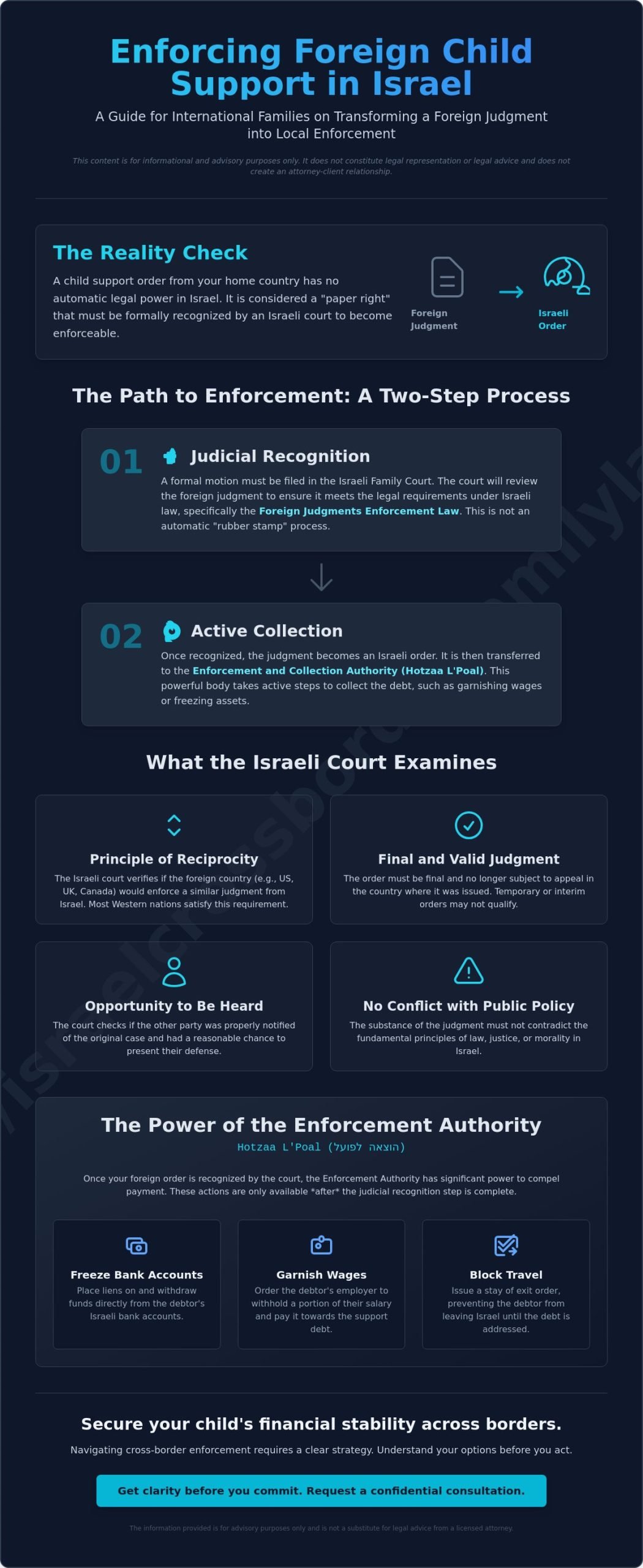
Strategic Guidance: Moving from an Order to Payment
Successfully attempting to enforce foreign child support Israel requires more than just judicial recognition; it demands a comprehensive cross-border strategy that bridges two different legal systems. A common mistake is treating the Israeli process as a separate, isolated event. In reality, every step taken in your home jurisdiction impacts your standing in the Israeli Family Court. Coordination between your local attorney and an Israeli advisory team ensures that documentation is prepared according to Israeli standards from the beginning, preventing the need for expensive, retroactive corrections. This collaborative approach is essential for international families who need to maintain pressure on a debtor parent while navigating the cultural and systemic differences of the Israeli legal landscape.
Before initiating the formal filing process, which involves a court filing fee of approximately $350, it is strategically sound to identify the debtor parent’s local assets. Knowing whether the parent in Israel holds real estate, maintains significant bank balances, or possesses professional licenses allows you to prioritize the most effective collection tools once the order is recognized. This proactive approach transforms a legal order into a practical financial recovery plan. It moves you closer to the goal of consistent support payments while accounting for the January 2025 reforms that reduced interest on arrears for those who adhere to payment plans.
Building Your Enforcement Roadmap
Your roadmap begins with a clear checklist of requirements tailored for the Israeli judiciary. This includes obtaining certified copies of your judgment with an Apostille and ensuring all affidavits are translated into Hebrew by a recognized professional. Seeking clarity on the timeline and potential costs before committing to full litigation is essential for managing your resources effectively. You can learn more about how the advisory process works to help you navigate these early decisions without the pressure of immediate legal representation. Taking the time to build this foundation helps avoid the procedural traps that often cause foreign orders to fail in IL courts.
Next Steps for International Families
Navigating the systemic differences of the Israeli legal landscape requires a steady, knowledgeable guide. For additional visual guidance on these procedures, you can watch our guide on International Child Support to see how these principles apply in real-world scenarios. An independent advisory platform serves as a critical bridge, helping you understand the impact of early decisions and the specific risks involved in cross-border enforcement. By focusing on strategy and decision-making guidance, you can make informed choices that protect your child’s future. This strategic oversight is the key to ensuring that a foreign support order actually results in local payments.
Get clarity before you commit. Request a confidential consultation.
Securing Financial Stability Across International Borders
Navigating the complexities of international family law requires a steady hand and a clear strategy. You’ve learned that a foreign order isn’t automatically valid in IL but serves as the foundation for a two-step judicial and administrative process. By focusing on proper service and the principle of reciprocity, you can successfully enforce foreign child support Israel and bridge the gap between a paper judgment and actual monthly payments. This process demands a nuanced understanding of both the original jurisdiction and the Israeli Enforcement and Collection Authority’s specific powers.
This advisory platform provides a specialized focus on US-Israel cross-border family law, offering tailored guidance for English-speaking expats and international families. We bring licensed expertise in multi-jurisdictional legal frameworks to help you avoid common procedural traps and identify assets effectively. This article is published on an independent advisory platform and does not imply an attorney-client relationship. Request a confidential case review to gain clarity before you commit. Taking the right steps today ensures your child’s financial security remains protected, regardless of where the other parent resides.
This article is published on an independent advisory platform and does not constitute an attorney-client relationship. The content is for informational and advisory purposes only and does not constitute legal representation or legal advice.
Frequently Asked Questions
Is a US child support order automatically valid in Israel?
No, a US child support order is not automatically valid in Israel. You must first have the judgment recognized by an Israeli Family Court through a formal motion for enforcement. Until this recognition occurs, the order remains a foreign document without local collection power.
What is an Apostille and why do I need one for my support order?
An Apostille is an international certification that verifies the authenticity of your legal documents for use in another country. You need one because Israeli courts will not accept foreign support orders or affidavits without this standardized proof of validity. It serves as the essential bridge between different national legal systems.
Can the Israeli court change the amount of child support set by a foreign court?
During the initial recognition phase, the court generally does not re-examine the specific dollar amount of the support. Its role is to determine if the order is enforceable under the Foreign Judgments Enforcement Law. However, once the order is recognized in Israel, either parent can technically file a local claim to modify the amount if there is a material change in circumstances.
How long does the enforcement process take in the Israeli Family Court?
The timeline to enforce foreign child support Israel typically ranges from six to twelve months. This duration depends heavily on whether the debtor parent contests the motion and how quickly service of process is completed. Contested cases involving complex asset searches or jurisdictional disputes can extend beyond a year.
What can I do if the parent in Israel has no visible income?
If the parent in Israel appears to have no income, the Enforcement and Collection Authority can still take aggressive measures. They have the power to freeze bank accounts, place liens on real estate, and issue “stay of exit” orders to prevent the debtor from leaving the country. The authority can also impute income based on the parent’s lifestyle and known expenses.
Do I need to travel to Israel to enforce my child support order?
You generally don’t need to travel to Israel to manage the enforcement process. Most procedural steps and filings are handled through a power of attorney. If a hearing requires your testimony, the Israeli Family Court often allows for participation via video conference, saving you the cost and logistical burden of international travel.
What happens if the other parent files for a reduction of support in Israel?
If the other parent files for a reduction, the court will evaluate the request based on Israeli legal standards and the child’s essential needs. It’s important to understand that for children aged 18 to 21 who are in mandatory military service, Israeli courts typically reduce the support amount to one-third of the previous rate.
Are there specific countries whose orders Israel will not enforce?
Israel typically will not enforce orders from countries that do not provide reciprocal enforcement for Israeli judgments. While most Western nations like the US, UK, and Canada have established reciprocity, orders from countries with hostile diplomatic relations or those that don’t recognize Israeli judicial authority may be rejected.
Get clarity before you commit. Request a confidential consultation.

Article by
Gabriel Lior
A Personal Journey That Became a Mission
The advisory was founded by an American father Gabriel Lior, LLB, MBA , global entrepreneur, and cross-border advisor who spent more than a decade navigating the Israeli family court system firsthand and now lives in Singapore with his son.
As a divorced parent in a cross-border family, Gabriel faced nearly every legal challenge a foreign parent can encounter in Israel — including child custody disputes, child support proceedings, property matters in Israel and abroad, false accusations, and complex immigration and relocation proceedings.
Over the years, he learned the hard way how difficult it is for non-Israeli parents to understand the system, identify the right legal strategy, and choose the right legal representation — especially when language, culture, and jurisdictional differences are involved. He also witnessed how foreign parents and new immigrants are often disadvantaged or taken advantage of by service providers and institutions simply because they lack local knowledge or fluency.
From Client to Advisor
To truly understand — and survive — the system, Gabriel pursued formal legal education in Israel, completing two Israeli law degrees, alongside a BA and MBA earned in the United States. This was never about becoming a practicing attorney, but about gaining a deep, structural understanding of how the system works — and where it breaks down for foreign parents.
This rare combination of:
Firsthand client experience
Israeli legal and US business education
International business and negotiation training
Decades of commercial execution
created a unique perspective – one that understands both sides of the table.
After years of litigation, persistence, and at times self-representation, he ultimately succeeded in securing custody of his son and relocating abroad through a rare legal victory in the Israeli Supreme Court — becoming one of the first fathers in Israel to do so under these circumstances.
Disclaimer
Important Disclaimer:
The information provided on this website and in its content is for general informational and educational purposes only and does not constitute legal advice, legal opinion, or legal representation.
Gabriel Lior is not licensed to practice law in Israel (nor is he interested in doing so) and does not provide legal services, despite having completed 2 Law Degrees. The services offered are advisory in nature and are intended to provide general guidance, strategic insight, and information regarding cross-border family law considerations.
No attorney-client relationship is formed by accessing this website, reading its content, or communicating with us.
Any decisions made based on this information are at your own discretion and risk. For legal advice specific to your situation, you should consult a licensed attorney in the relevant jurisdiction.
Where appropriate, we may refer clients to independent, licensed attorneys or professionals. Such referrals do not constitute legal representation and no liability is assumed for services provided by third parties.