This content is published on an independent advisory platform, not a law firm, and focuses on strategy, risks, and decision-making guidance. It does not constitute formal legal advice or an attorney-client relationship.
Securing a final divorce decree in a foreign court is a significant milestone, but it doesn’t automatically grant legal status or enforceable rights within Israel. Many international families find that a foreign judgment isn’t a rubber-stamp matter, but rather a strategic alignment of international law with local public policy and religious sensitivities.
It’s common to feel uncertain about whether child support orders will be honored or how the Rabbinical court’s authority impacts a civil decree. This guide explains the complexities of enforcing foreign divorce decree in israel, ensuring that your custody and financial obligations are legally recognized. We’ll examine the five-year statute of limitations for filing enforcement motions, the jurisdictional differences between the Magistrates’ and District courts, and the essential role of the ‘Get’ in maintaining religious status. This overview provides the clarity needed to bridge the gap between two different legal systems and cultures.
Key Takeaways
- Learn why a foreign decree has no legal standing in Israel until it is formally validated under the Foreign Judgments Enforcement Law of 1958.
- Understand the “4-Part Test” Israeli courts use to confirm that the original court had proper jurisdiction and that the judgment is final and non-appealable.
- Gain clarity on the division of power between Family Courts and Rabbinical Courts, especially regarding child support enforcement and the religious ‘Get’ requirement.
- Follow a practical roadmap for enforcing foreign divorce decree in israel, including the necessity of Apostille certification and Hebrew translations for all legal filings.
- Identify strategic risks like jurisdictional competition to ensure that your international custody or financial orders are not just recognized, but actively upheld.
This content is published on an independent advisory platform, not a law firm, and focuses on strategy, risks, and decision-making guidance. It does not constitute formal legal advice or an attorney-client relationship.
Understanding the Foreign Judgments Enforcement Law in Israel
The primary gateway for international legal orders to enter the Israeli system is the Foreign Judgments Enforcement Law of 1958. This statute dictates that a foreign judgment holds no legal standing within the country until an Israeli court formally declares it “enforceable.” This isn’t a mere administrative step; it’s a substantive legal process that transforms an overseas order into a domestic one. Once the court grants this status, the decree carries the same legal weight as a judgment originally issued by an Israeli family court.
According to Section 1 of the Law, a “Foreign Judgment” is defined as any judgment given by a court in a foreign state in a civil matter, which specifically includes family law issues like child support, alimony, and property division. Because Marriage and divorce in Israel are governed by a unique dual system of civil and religious law, understanding how this 1958 Law bridges the gap is essential for anyone enforcing foreign divorce decree in israel.
To better understand how these systems interact, especially regarding the religious divorce process, watch this helpful video:
In-Personam vs. In-Rem Judgments
Most divorce decrees are classified as “in-personam” judgments, meaning they’re directed at the specific individuals involved rather than a physical object or property. This distinction is vital because it affects how the Israeli court handles different parts of your decree. While the court may “recognize” your change in personal status based on a foreign civil document, “executing” financial orders or child support requires a more rigorous enforcement process. The Israeli court focuses on whether the foreign court had the authority to impose obligations on the specific people named in the order.
The Concept of International Comity
Israel operates under the principle of international comity, which is a mutual respect for the judicial decisions of other sovereign nations. A key component of this is “reciprocity,” a requirement found in Section 4 of the Law. Generally, Israel won’t enforce judgments from a country that refuses to enforce Israeli judgments. Fortunately for expats and international families, US judgments are typically treated with a high level of respect. This established relationship makes enforcing foreign divorce decree in israel more predictable for those coming from American jurisdictions, provided the original process met basic standards of fairness and due process.
This content is published on an independent advisory platform, not a law firm, and focuses on strategy, risks, and decision-making guidance. It does not constitute formal legal advice or an attorney-client relationship.
The 4-Part Test: Conditions for Enforcement in Israel
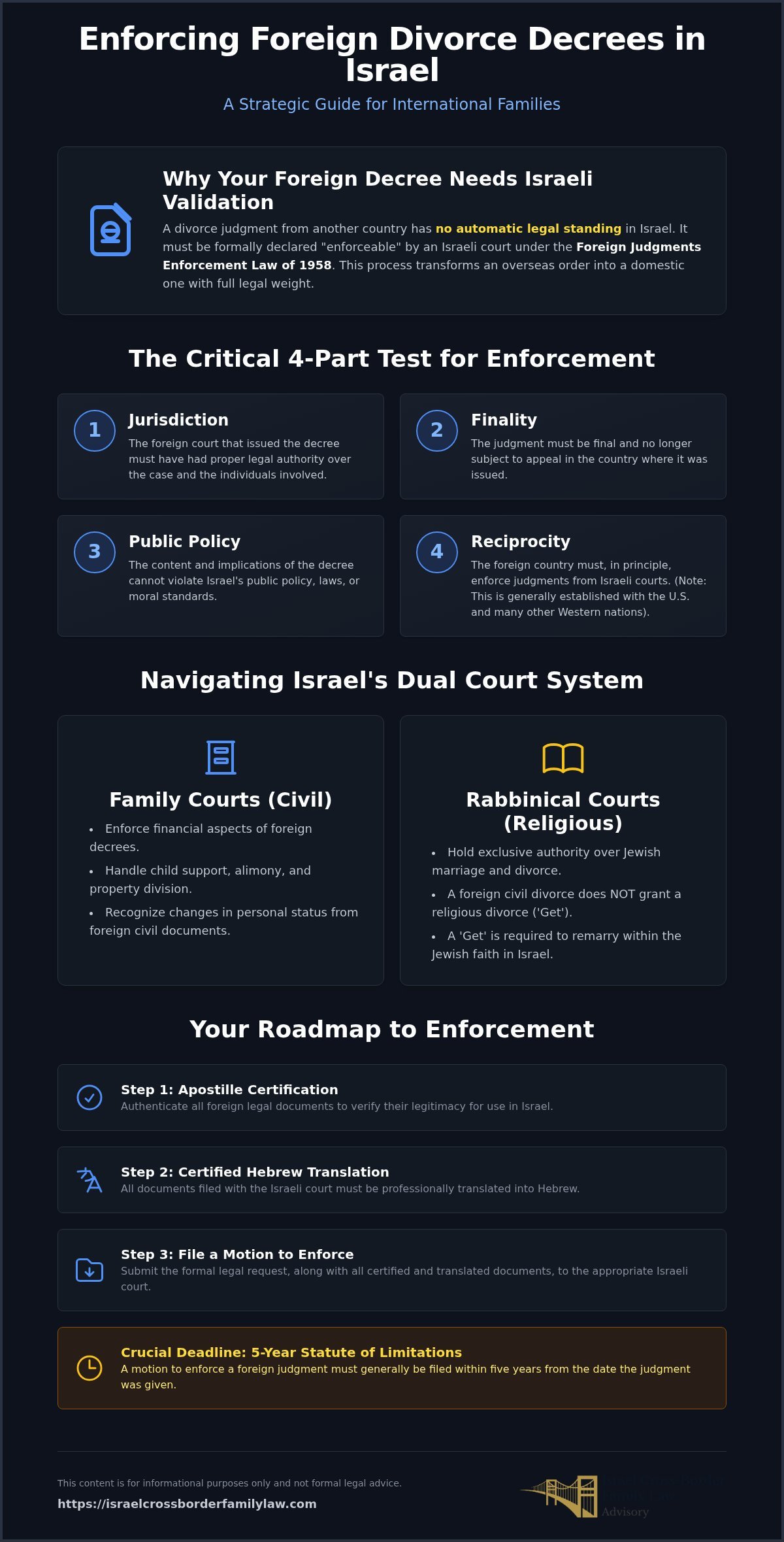
For an Israeli court to grant an enforcement order, the foreign judgment must pass a rigorous four-part test established by the 1958 Law. This process ensures that the decree aligns with Israeli legal standards while respecting international judicial authority. The four primary conditions include confirming the foreign court had proper jurisdiction, ensuring the judgment is final, verifying it doesn’t violate Israeli public policy, and establishing reciprocity between the two nations. Successfully enforcing foreign divorce decree in israel requires proving each of these elements with documented evidence.
One critical distinction often overlooked is how child support enforcement differs from general civil judgments. While a standard property division might follow the general 1958 Law, child support often benefits from specific international conventions that streamline the process. You can learn more about these specific mechanisms for child support cross-border enforcement to see how they might apply to your situation.
Finality and the ‘No Appeal’ Rule
Israeli courts generally won’t enforce a judgment that’s still subject to appeal in its country of origin. This “Finality Rule” creates significant hurdles for temporary or interim orders. If a US court issues a temporary support order while the divorce is pending, it’s typically not enforceable in Israel. Even after a “Final Decree” is issued, complications arise if the US court retains jurisdiction for future modifications. The Israeli court needs to see a certified, stamped document that represents the final word on the matter before it will step in to execute the terms.
The Public Policy Exception (Takant HaTzibur)
A foreign judgment must not contradict “Takant HaTzibur,” or Israeli public policy. This doesn’t mean the foreign law must be identical to Israeli law; rather, the judgment shouldn’t shock the “legal conscience” of the state. For example, if a decree was obtained without giving the other spouse proper notice or a chance to be heard, it violates basic due process and will be rejected. Interestingly, while Israel’s domestic divorce law is religious, the courts generally accept US “no-fault” divorces as long as the procedural rights of both parties were protected during the litigation.
Reciprocity and US-Israel Relations
Reciprocity is a cornerstone of international law, yet no formal treaty exists between the US and Israel for the enforcement of civil judgments. Instead, the two systems rely on “comity.” The Israeli court must be satisfied that a court in the issuing US state would similarly enforce an Israeli judgment. Because family law in the US is handled at the state level, the specific origin of your decree matters. Some states have more established histories of cooperation with Israel than others. If you’re unsure how your specific state’s laws will be viewed by an Israeli judge, it’s wise to seek a preliminary review of your documents to identify potential reciprocity issues early.
This content is published on an independent advisory platform, not a law firm, and focuses on strategy, risks, and decision-making guidance. It does not constitute formal legal advice or an attorney-client relationship.
The Role of the Rabbinical Court and the ‘Get’ Requirement
While civil family courts handle the financial and practical aspects of enforcing foreign divorce decree in israel, the Rabbinical Courts hold exclusive jurisdiction over the personal status of Jewish citizens and residents. This dual system creates a unique challenge for international families. A foreign civil decree effectively ends the legal marriage under the law of the issuing state, but it doesn’t automatically grant a “Get,” the religious divorce document required by Jewish law. Without this document, a person may find themselves in a “limping marriage,” where they’re considered civilly divorced abroad but remain religiously married within Israel.
This distinction is not merely a religious formality; it has significant legal and social implications. For example, a woman who hasn’t received a Get cannot legally remarry in Israel, and any children born from a subsequent relationship could face severe religious legal complications. In 2024, a special unit of the Israeli Rabbinical courts obtained divorce certificates for 221 women whose husbands had previously refused to grant a Get. As of January 2025, there were still 67 ongoing cases of Get refusal in Israel, highlighting the persistence of this issue for those navigating cross-border separations.
Civil Enforcement vs. Religious Recognition
Successfully resolving your status often requires a two-pronged strategy. You must file in the civil Family Court to ensure that child support or property division orders are executed. Simultaneously, you may need to open a file in the Rabbinical Court to have your foreign divorce recognized for the purpose of changing your marital status on the Israeli population registry. If the foreign decree isn’t handled with precision, there’s a risk the Rabbinical court might “open” the case to examine whether the religious requirements were met. This complexity is a primary reason why we provide specialized guidance for expats and foreign nationals who need to bridge the gap between their home country’s laws and the Israeli system.
Securing the ‘Get’ for International Families
The most effective strategy is to address the religious divorce during the initial negotiations in your home jurisdiction. Ensuring your US divorce settlement includes a clear, enforceable provision for the delivery of a Get can prevent years of litigation in Israel. If a spouse living abroad becomes recalcitrant, the Israeli Rabbinical courts have developed mechanisms to address the situation, including the use of special units that work internationally. However, these processes are inherently complex and time-sensitive. Early decisions regarding how you frame your foreign decree will directly impact your ability to remarry or resolve your status in Israel without further conflict.
This content is published on an independent advisory platform, not a law firm, and focuses on strategy, risks, and decision-making guidance. It does not constitute formal legal advice or an attorney-client relationship.
Practical Steps: Filing a Motion to Enforce
Moving from understanding the law to the actual execution requires meticulous attention to procedural detail. In Israel, a motion to enforce a foreign judgment must generally be filed within five years of the date the original judgment was rendered. If you miss this window, the court may refuse to hear the case unless there are exceptional circumstances. The specific court you file in often depends on the financial value involved. For matters where the value does not exceed NIS 2.5 million, the Magistrates’ Court generally has jurisdiction. For amounts exceeding this threshold, you’ll need to petition the District Court. Successfully enforcing foreign divorce decree in israel starts with these jurisdictional basics.
Procedural errors at this stage aren’t just frustrating; they’re expensive. A single missing certification can stall a case for months, leading to increased emotional strain and legal costs. Beyond the court filing, you’ll need to engage an expert for a professional Hebrew translation of the entire decree. Israeli judges require precise translations to ensure every clause of your international agreement is understood within the local legal context. This step is vital for ensuring that the intent of the foreign judge is preserved during the transition to the Israeli system.
The Importance of the Apostille
An Apostille is an international certification that verifies the authenticity of a document for use in another country. For US residents, this is the only method Israeli courts accept to prove that your divorce decree is a genuine legal document. Many people mistakenly believe a local notary’s stamp is sufficient, but this will lead to an immediate rejection by the Israeli court clerk. An Apostille must be issued by the Secretary of State where the judgment was rendered. Without this specific gold seal or attached certificate, your US decree remains just a piece of paper in the eyes of the Israeli system.
Service of Process and Due Process
The Israeli court’s primary concern is “natural justice.” This means they’ll refuse to enforce a decree if the defendant wasn’t properly notified of the original proceedings in the US. You must prove that the other party had a fair opportunity to present their case before the foreign judge. If the other party currently lives outside of Israel, the “Service of Process” becomes even more complex. You’ll need to document exactly how they were served according to both US and Israeli standards to prevent them from later claiming they were unaware of the litigation. This is particularly vital for child support cross-border enforcement, where the stakes for financial non-compliance are high. If you’re concerned about procedural gaps in your paperwork, it’s best to request a review of your documents before initiating the formal motion.
This content is published on an independent advisory platform, not a law firm, and focuses on strategy, risks, and decision-making guidance. It does not constitute formal legal advice or an attorney-client relationship.
Strategy and Risk: Why Professional Advisory is Vital
Approaching the Israeli legal system with a foreign decree is not a simple administrative task; it’s a strategic move that requires a deep understanding of how two distinct legal cultures intersect. Early decisions made during the process of enforcing foreign divorce decree in israel can have permanent effects on your financial future and your parental rights. If the initial motion is drafted poorly or fails to account for Israeli public policy, you may inadvertently invite the court to revisit the merits of your case rather than simply enforcing the existing order.
One of the most significant risks is jurisdictional competition. This occurs when one party attempts to relitigate issues in Israel that were already settled in a US court. For example, if a spouse moves to Israel and feels the US child support order is too high, they might try to use the local court system to modify the amount. Without a robust cross-border strategy, you could find yourself fighting the same legal battle twice in two different languages. Protecting your interests requires locking in the foreign judgment so it remains the final word on your asset division and custody arrangements.
Avoiding the ‘Limping’ Divorce
A “limping” divorce happens when your legal status is inconsistent. You might be considered single in New York but still married in Jerusalem. This unresolved status creates a psychological and financial burden that can last for years. It complicates everything from future marriages to inheritance rights and property sales in Israel. Ensuring your global status is clear and consistent requires an integrated approach that looks at both the civil and religious requirements from the very beginning. You can learn more about how we bridge these systems by visiting our page about the advisory.
Clarity Before You Commit
Before you file any documents in an Israeli court, you must identify potential red flags in your foreign decree. Common issues include errors in the service of process or clauses that might clash with Israeli family law standards. Identifying these risks early allows you to address them before they become expensive court delays. A confidential review of your case is the most effective way to determine the likelihood of success and to build a roadmap for enforcement. Get clarity before you commit. Request a confidential case review.
This content is published on an independent advisory platform, not a law firm, and focuses on strategy, risks, and decision-making guidance. It does not constitute formal legal advice or an attorney-client relationship.
Achieving Legal Certainty Across Borders
Successfully bridging the gap between two legal systems requires more than just submitting paperwork; it demands a strategic understanding of how Israeli courts interpret international judgments. By ensuring your foreign decree meets the strict criteria of the 1958 Law and addressing the religious ‘Get’ requirement early, you can avoid the financial and emotional toll of a “limping marriage.” The process of enforcing foreign divorce decree in israel is complex, but it’s manageable when you prioritize procedural precision and clear communication between jurisdictions.
Early strategic decisions will determine whether your child support or custody orders are upheld or subject to unnecessary relitigation. Our advisory specializes in US-Israel cross-border family law, providing a deep understanding of both civil and religious legal landscapes to help you manage these risks effectively. Protecting your global status starts with identifying potential red flags before they lead to court delays.
Get clarity before you commit. Request a confidential consultation to ensure your international orders are fully recognized and enforceable. With a well-prepared strategy, you can secure your rights and move forward with confidence.
This content is published on an independent advisory platform, not a law firm, and focuses on strategy, risks, and decision-making guidance. It does not constitute formal legal advice or an attorney-client relationship.
Frequently Asked Questions
Is a US divorce decree automatically valid in Israel?
No, a US divorce decree is not automatically valid in Israel. You must petition an Israeli court to declare the judgment enforceable under the Foreign Judgments Enforcement Law of 1958. This legal process ensures that the decree meets local standards and is formally recognized by the state before it gains the same legal standing as a domestic Israeli judgment.
How long does it take to enforce a foreign divorce judgment in an Israeli court?
The timeline for enforcing foreign divorce decree in israel depends on whether the motion is contested by the other party. While an uncontested motion might be resolved in a few months, a contested case involving complex financial assets or custody disputes can take a year or longer. Missing the five-year statute of limitations for filing can also lead to significant delays or a dismissal of the case.
Can I enforce a US child support order in Israel if my ex-spouse moved there?
Yes, you can enforce a US child support order in Israel if your ex-spouse resides there. You typically file a motion in the Family Court, and once the judgment is declared enforceable, it can be executed through the Bureau of Enforcement, known as Hotsaa La’Poal. This process ensures that financial obligations established abroad are upheld within the Israeli system.
Do I need to go to the Rabbinical Court to enforce my civil divorce?
You don’t necessarily need the Rabbinical Court for the financial or custody aspects of your divorce. These matters are handled by the civil Family Court. However, Jewish couples must involve the Rabbinical Court to resolve their religious status and obtain a “Get.” This is a separate but necessary step if you intend to remarry within Israel.
What documents do I need from the US to start the process in Israel?
You need three primary documents: a certified copy of the original decree, an Apostille from the Secretary of State, and a professional Hebrew translation. The translation must often be certified by an expert recognized by the Israeli court system. These documents prove the authenticity and finality of your foreign judgment to the Israeli judge.
What happens if my foreign divorce decree contradicts Israeli public policy?
If a foreign decree contradicts Israeli public policy, the court will likely refuse to enforce it. Public policy concerns often involve “natural justice,” such as whether the defendant was given proper notice or a fair chance to present their case in the US. The court ensures that the foreign proceedings didn’t violate basic rights or local legal ethics.
Can an Israeli court change the terms of my US divorce decree during enforcement?
An Israeli court doesn’t typically change the terms of your US decree during the enforcement stage. The court’s role is to decide if the existing judgment is valid for execution. However, if circumstances change significantly after enforcement, a party might later petition for a modification of child support or custody based on Israeli law and jurisdictional rules.
What is an Apostille and why is it required for my divorce papers?
An Apostille is an international certification that authenticates the origin of a public document. Israeli courts require it because it’s the only standardized way to verify that your US divorce papers are genuine. It prevents fraud and ensures that the Israeli judge is working with a legitimate legal instrument issued by a foreign sovereign state.

Article by
Gabriel Lior
A Personal Journey That Became a Mission
The advisory was founded by an American father Gabriel Lior, LLB, MBA , global entrepreneur, and cross-border advisor who spent more than a decade navigating the Israeli family court system firsthand and now lives in Singapore with his son.
As a divorced parent in a cross-border family, Gabriel faced nearly every legal challenge a foreign parent can encounter in Israel — including child custody disputes, child support proceedings, property matters in Israel and abroad, false accusations, and complex immigration and relocation proceedings.
Over the years, he learned the hard way how difficult it is for non-Israeli parents to understand the system, identify the right legal strategy, and choose the right legal representation — especially when language, culture, and jurisdictional differences are involved. He also witnessed how foreign parents and new immigrants are often disadvantaged or taken advantage of by service providers and institutions simply because they lack local knowledge or fluency.
From Client to Advisor
To truly understand — and survive — the system, Gabriel pursued formal legal education in Israel, completing two Israeli law degrees, alongside a BA and MBA earned in the United States. This was never about becoming a practicing attorney, but about gaining a deep, structural understanding of how the system works — and where it breaks down for foreign parents.
This rare combination of:
Firsthand client experience
Israeli legal and US business education
International business and negotiation training
Decades of commercial execution
created a unique perspective – one that understands both sides of the table.
After years of litigation, persistence, and at times self-representation, he ultimately succeeded in securing custody of his son and relocating abroad through a rare legal victory in the Israeli Supreme Court — becoming one of the first fathers in Israel to do so under these circumstances.
Disclaimer
Important Disclaimer:
The information provided on this website and in its content is for general informational and educational purposes only and does not constitute legal advice, legal opinion, or legal representation.
Gabriel Lior is not licensed to practice law in Israel (nor is he interested in doing so) and does not provide legal services, despite having completed 2 Law Degrees. The services offered are advisory in nature and are intended to provide general guidance, strategic insight, and information regarding cross-border family law considerations.
No attorney-client relationship is formed by accessing this website, reading its content, or communicating with us.
Any decisions made based on this information are at your own discretion and risk. For legal advice specific to your situation, you should consult a licensed attorney in the relevant jurisdiction.
Where appropriate, we may refer clients to independent, licensed attorneys or professionals. Such referrals do not constitute legal representation and no liability is assumed for services provided by third parties.