Navigating a cross-border child custody dispute between Israel and the United States presents a uniquely daunting set of challenges. The fear that a foreign court may misinterpret your home country’s laws or fail to grasp critical cultural nuances is a significant and valid concern, one that can feel overwhelming when the future of your family is at stake. In these sophisticated, multi-jurisdictional proceedings, subjective arguments are often insufficient to bridge the legal and cultural divide. This is where the strategic engagement of an expert witness for international custody dispute becomes not just beneficial, but essential for a favorable outcome. This article will guide you through the pivotal role these specialists play. We will explore how their authoritative, objective testimony can illuminate complex legal principles, clarify cultural contexts, and provide the court with the unimpeachable evidence needed to make a fully informed decision. By understanding this critical component of your litigation strategy, you can gain the confidence and strategic advantage necessary to protect your parental rights and ensure your children’s best interests are comprehensively represented, regardless of jurisdiction.
Key Takeaways
- An expert witness provides impartial, specialized legal analysis to the court, serving as an objective authority rather than an advocate for either side in a multi-jurisdictional case.
- In complex cross-border litigation, particularly matters involving the Hague Convention, an expert’s testimony is often indispensable for navigating conflicting international laws between the US and Israel.
- Selecting the right expert witness for international custody dispute requires looking beyond academic credentials to prioritize proven, real-world courtroom experience in both legal systems.
- The engagement of an expert is a structured, collaborative process that begins with an initial consultation to strategically align their analysis with your legal team’s objectives.
Defining the Expert Witness in a Cross-Border Legal Context
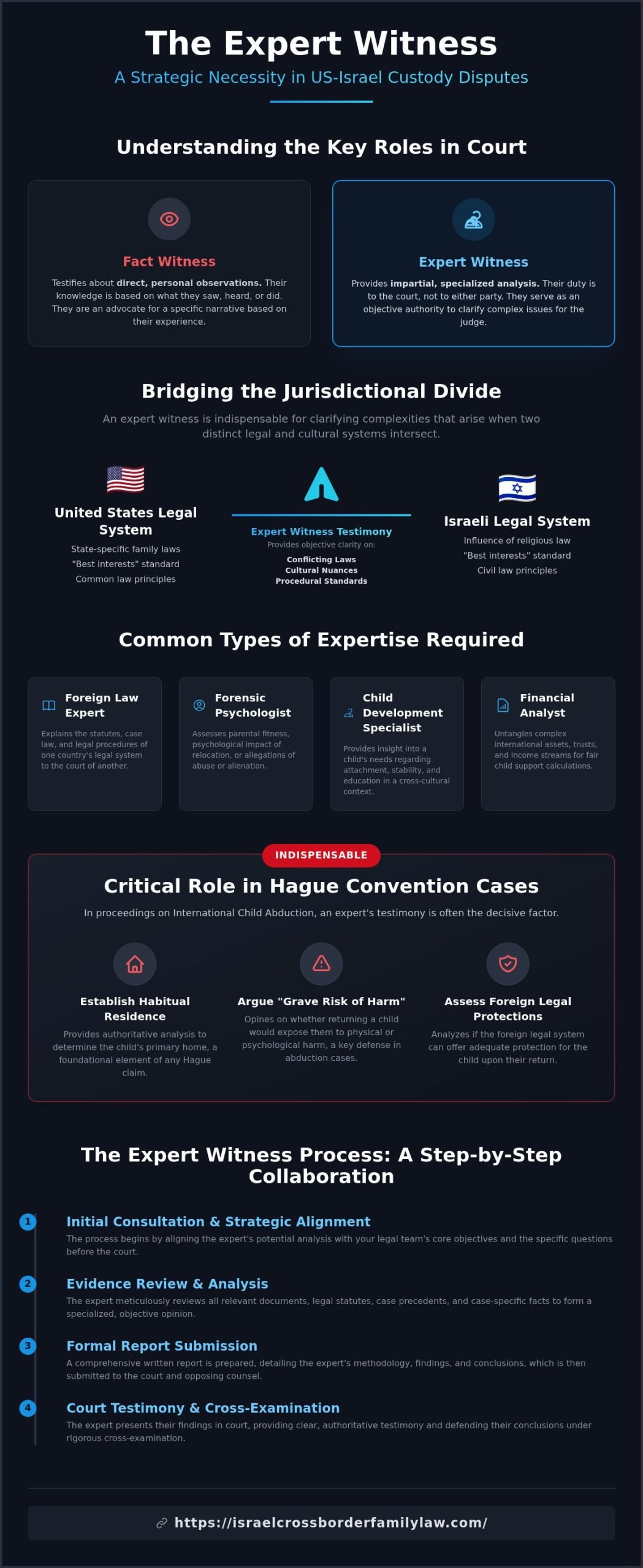
In the complex arena of international family law, an expert witness serves a critical and distinct function. Unlike a fact witness, who testifies about direct observations, an expert witness is an impartial professional engaged to provide objective, specialized knowledge to the court. Their primary duty is not to a party in the case but to the court itself, assisting the judge or mediator in understanding sophisticated issues that fall outside the scope of common knowledge. This testimony is instrumental in bridging the informational gap, ensuring that judicial decisions are based on a comprehensive and technically sound understanding of the evidence. The role of an expert becomes particularly vital in multi-jurisdictional disputes, where their analysis can demystify conflicting international laws, cultural norms, and procedural standards, thereby providing the court with the clarity needed to render an informed judgment. To better understand this concept, the following video provides a helpful overview of the role of experts in custody cases:
Why International Custody Cases Require Specialized Expertise
Cross-border custody litigation inherently involves navigating conflicting legal frameworks and cultural interpretations. The “best interests of the child” standard, a cornerstone of family law, can be defined and applied differently in Israel versus the United States, for example. Presenting evidence from a foreign country introduces procedural and evidentiary challenges that demand specialized guidance. Securing a qualified expert witness for international custody dispute proceedings is therefore not a luxury but a strategic necessity for clarifying these complexities for the court.
Types of Expertise Commonly Required
Given the multi-faceted nature of these cases, a range of specialists may be required to provide comprehensive testimony. The selection of an expert is tailored to the specific, complex questions before the court. Common types of experts include:
- Foreign Law Expert: A legal professional qualified to explain the statutes, case law, and legal procedures of one country’s legal system to the court of another.
- Forensic Psychologist: A specialist who conducts evaluations to assess parental fitness, the psychological impact of relocation on a child, or allegations of abuse or alienation.
- Child Development Specialist: An expert who provides insight into a child’s specific developmental needs concerning attachment, stability, and education in a cross-cultural context.
- Financial Analyst: A professional adept at untangling complex international assets, trusts, and income streams to ensure fair calculations for child support and asset division.
The Strategic Value: When is an Expert Witness Indispensable?
While not every cross-border family law matter requires third-party testimony, retaining an expert witness for an international custody dispute becomes a strategic necessity in several high-stakes scenarios. When the legal frameworks of two nations are in direct conflict, or when the court must adjudicate on matters beyond its standard purview, an expert’s testimony provides the clarity and authority needed to protect a child’s best interests. Their involvement is particularly crucial when navigating the complexities of multi-jurisdictional family law, including cases involving Israeli religious law, parental relocation, or allegations of abduction.
Navigating Hague Convention Abduction Cases
In proceedings under the Hague Convention on the Civil Aspects of International Child Abduction, an expert’s role is often decisive. They are instrumental in establishing the child’s “habitual residence,” a foundational element of any claim. Furthermore, an expert can provide critical testimony on the “grave risk of harm” defense, opining on whether returning a child to their country of origin would expose them to physical or psychological harm. Their analysis of whether a foreign legal system can offer adequate protection for the child provides the court with the nuanced understanding required for these sensitive cases. For a deeper analysis, review our guide on Hague Convention Child Abduction cases.
Winning International Relocation and Custody Disputes
When a parent seeks to relocate with a child to another country, the court must weigh the potential benefits against the disruption to the child’s stability. An expert witness for an international custody dispute can conduct a comprehensive evaluation of the proposed move’s impact on the child’s psychological well-being, educational continuity, and relationship with the non-moving parent. They provide objective insight into the child’s ties to each country and can develop viable, practical cross-border co-parenting plans that uphold the child’s best interests. Learn more about our sophisticated approach to international custody and relocation.
Addressing Complex Allegations
International custody cases can be fraught with serious allegations, including parental alienation, substance abuse, or neglect. A qualified psychological expert can conduct impartial assessments to evaluate these claims, as well as a parent’s mental fitness to provide care. These professionals provide the court with an objective, evidence-based perspective, fulfilling the core duties of expert witnesses to offer impartial analysis rather than advocacy. Their findings are invaluable in helping the court move beyond unsubstantiated claims to make a ruling based on verifiable facts and clinical assessment.
The Scope of Testimony: What an Expert Witness Delivers
The contribution of an expert witness in a multi-jurisdictional family law matter extends far beyond a simple court appearance. The process is a meticulous and strategic undertaking that commences long before any testimony is given. It involves a comprehensive and systematic review of all pertinent case documents, including court filings, affidavits, parental evaluations, and communications between the parties. Where permitted by the court, the expert may also conduct independent research into the specific legal and cultural frameworks of the foreign country involved, providing a level of granular detail that is often decisive. The primary deliverable from this preparatory phase is a formal, detailed written document-either an expert report or an affidavit. This document is not merely a summary but a substantive piece of evidence submitted directly to the court, forming the bedrock of the expert’s subsequent testimony.
The Expert Report or Affidavit
The expert report is a highly structured document designed to present a clear, defensible, and authoritative opinion. It systematically outlines the expert’s qualifications, the complete list of evidence reviewed, and the precise methodology employed to arrive at their conclusions. The core of the report presents the expert’s professional opinions on the critical international issues at hand, such as the enforceability of an Israeli custody order abroad or the interpretation of foreign family law statutes. This analysis is crucial, as it provides the court with an objective framework for understanding the complex impact of foreign law on custody. Every opinion is substantiated with clear reasoning, citing legal precedent, statutes, or relevant academic research.
Deposition and Trial Testimony
Following the submission of the report, the expert witness for international custody dispute cases will typically be required to provide testimony. This may first occur during a deposition-a formal, out-of-court session where the expert answers questions under oath from the opposing counsel. This process allows both sides to probe the expert’s findings before trial. During the trial itself, the expert presents their conclusions to the court, with a primary objective of translating sophisticated cross-border legal concepts into clear, understandable, and persuasive testimony. They must then defend their report and opinions under rigorous cross-examination, demonstrating the strength and integrity of their analysis and reinforcing their credibility before the court.
Selecting the Right Expert for Your US-Israel Custody Case
In the high-stakes environment of a US-Israel cross-border custody battle, the selection of an expert witness can be the single most influential factor in the outcome. A well-chosen expert does more than just present facts; they provide the court with a clear, authoritative framework for understanding complex issues of foreign law and culture, which can decisively shape the final judgment. Your primary attorney will guide this critical selection process, ensuring the chosen expert aligns perfectly with your case strategy. While academic credentials are foundational, they are not the sole determinant of an effective witness. The ideal candidate must possess a rare combination of scholarly knowledge and real-world courtroom acumen. They must be an excellent communicator, capable of distilling sophisticated legal principles into clear, persuasive testimony that resonates with a judge who may be unfamiliar with Israeli family law. For disputes involving the US and Israel, a bicultural and bilingual understanding is not merely a benefit-it is a significant strategic advantage, ensuring nuanced and accurate interpretation of evidence and testimony.
Essential Credentials and Qualifications
A thorough vetting process is non-negotiable when engaging an expert witness for international custody dispute cases. Your legal counsel will meticulously verify the following:
- Specific Expertise: Confirmation of deep, demonstrable knowledge in the relevant area, such as the application of Israeli family law, the Hague Convention, or child psychology within a cross-cultural context.
- Professional History: A comprehensive review of their curriculum vitae for relevant publications, academic appointments, and a history of past cases where they have provided testimony.
- Jurisdictional Experience: Prior experience testifying and being accepted as an expert in the specific court or jurisdiction where your case is being heard.
- Conflicts of Interest: A rigorous check to ensure no professional or personal conflicts exist that could compromise their impartiality or damage their credibility on the stand.
The Importance of Courtroom Experience
An expert’s value is truly tested under the pressure of cross-examination. An academic with no courtroom experience can be easily discredited, but a seasoned expert understands how to present evidence effectively and withstand rigorous questioning. They are adept at communicating complex ideas with simplicity and authority, guiding the judge toward a favorable understanding of the critical issues. Our firm has extensive experience identifying and preparing experts who possess this specialized, battle-tested expertise. Learn about our advisory services.
Questions to Ask a Potential Expert Witness
Before retaining an expert, your attorney should conduct a detailed interview. Key questions include:
- Have you previously provided expert testimony on this specific legal issue (e.g., relocation, parental alienation) in a US-Israel context?
- How many times have you been qualified by a court to serve as an expert in your field?
- Are you able to provide a redacted copy of a previous expert report you have authored for a similar case?
- What are your professional fees, and how is your retainer structured? Are payments required in Israeli Shekel (ILS)?
Engaging the right expert witness for international custody dispute matters is a strategic imperative. For guidance on navigating this and other complex aspects of your case, contact our firm for a confidential consultation.
The Expert Witness Process: A Step-by-Step Collaboration
Engaging an expert witness for an international custody dispute is not a passive action but a structured, strategic collaboration between you, your legal counsel, and the specialist. This process is designed to meticulously build a powerful, evidence-based argument that clarifies the complex cross-border issues at the heart of your case. Success depends on a methodical approach, ensuring every piece of evidence is analysed and every legal point is substantiated by an authoritative, independent opinion.
Phase 1: Engagement and Case Review
The process commences when your attorney formally engages the expert. Your legal team provides a comprehensive file containing all pertinent case materials, such as court filings, psychological evaluations, and relevant correspondence. The expert then conducts an independent review to identify the key multi-jurisdictional issues they will address. Following this, a preliminary analysis is shared with your counsel, outlining the initial findings and strategic direction. You can explore how our process works to understand our client onboarding in greater detail.
Phase 2: Report Preparation and Strategy
Following the initial review, the expert drafts a comprehensive written report or sworn affidavit. This formal document articulates their professional opinions, citing the specific evidence and legal principles that support their conclusions. Your attorney reviews this draft to ensure it aligns perfectly with the overarching legal strategy and addresses all necessary points for the court. Concurrently, your legal team prepares the expert for potential cross-examination, anticipating challenges and reinforcing the key tenets of their testimony.
Phase 3: Testimony and Court Appearance
The culmination of this collaborative effort is the expert’s testimony. Whether provided during a deposition or live at trial, the expert’s role is to present their findings and professional opinions with clarity, confidence, and objectivity. They must effectively educate the court on sophisticated matters of international law, The Hague Convention, or the child’s best interests in a cross-border context. Once their testimony and any cross-examination are complete, their formal role in the proceedings concludes, having provided the court with the critical insights needed for a just determination. To begin this vital process for your case, we invite you to request a confidential case review with our team.
Securing Your Family’s Future Across Borders
In the intricate landscape of US-Israel custody battles, the role of an expert witness transcends mere testimony; it becomes a cornerstone of your legal strategy. As we have explored, their value lies in their ability to demystify foreign law for the court, provide a clear framework for the child’s best interests across jurisdictions, and guide the selection of effective legal arguments. The process of selecting and collaborating with such an expert is a critical component of building a robust and persuasive case. Engaging the right expert witness for international custody dispute can decisively influence the outcome of your case. With decades of specialized experience in US-Israel cross-border family law, our team possesses a deep, nuanced understanding of both common law and Israeli legal systems. Our professionals are frequently accepted as legal experts in courts across the United States and Israel, providing the authoritative clarity needed to protect your parental rights. If you are facing the complexities of a multi-jurisdictional custody matter, we are here to provide the guidance you need. Schedule a Confidential Consultation to Discuss Your Case and take the first step toward securing a stable future for your family.
Frequently Asked Questions
What is the difference between a fact witness and an expert witness?
A fact witness provides testimony based on their direct, personal knowledge of events, testifying to what they saw, heard, or did. In contrast, an expert witness provides an opinion based on their specialized knowledge, skill, education, or experience. In complex cross-border litigation, the expert’s role is not to recount facts but to interpret them, helping the court understand sophisticated technical or legal issues that are beyond the common knowledge of a layperson.
How much does it cost to hire an expert witness in an international custody case?
The cost to retain a qualified expert witness for an international custody dispute in Israel is a significant investment, reflecting the complexity and high stakes of such matters. Fees can vary widely based on the expert’s reputation and the specifics of the case, but parties should anticipate costs ranging from ₪15,000 to over ₪60,000. This comprehensive fee typically covers the initial case review, preparation of a detailed report, and testimony in court proceedings.
Can the other side challenge the credibility of my expert witness?
Yes, challenging an expert’s credibility is a standard and expected part of cross-border litigation. Opposing counsel is entitled to scrutinize your expert’s qualifications, methodology, potential bias, and the factual basis for their opinions through a rigorous process of cross-examination. A well-qualified expert with a robust and defensible methodology is essential to withstand this scrutiny and maintain credibility before the court, ensuring their testimony remains influential and effective in the proceedings.
Does the court have to follow the opinion of the expert witness?
No, the court is not legally bound to accept or follow the opinion of an expert witness. The expert’s testimony is presented as evidence to assist the court in understanding complex issues within the case. While a compelling and well-reasoned expert opinion can be highly persuasive, the judge remains the ultimate arbiter of fact. The court will weigh the expert’s testimony against all other evidence presented before rendering its final judgment in the matter.
Can an attorney act as their own expert witness on foreign law?
It is highly improper and procedurally impermissible for an attorney to act as both legal counsel and an expert witness on foreign law in the same case. This dual role creates an irreconcilable conflict of interest, as the advocate’s duty of zealous representation is fundamentally incompatible with the expert’s required duty of objectivity to the court. Courts mandate that expert testimony be impartial, a standard that cannot be met by an attorney representing one of the parties.
How do I find a qualified expert witness for Israeli family law?
Securing a qualified expert witness for Israeli family law, particularly in a multi-jurisdictional dispute, requires a strategic approach. The most effective method is through a referral from your primary legal counsel, who can leverage their professional network. Additionally, you may consult with the Israel Bar Association for a list of accredited specialists or engage a law firm with a dedicated and preeminent cross-border family law practice, as they regularly collaborate with leading experts in the field.

Article by
Gabriel Lior
A Personal Journey That Became a Mission The advisory was founded by an American father Gabriel Lior, LLB, MBA , global entrepreneur, and cross-border advisor who spent more than a decade navigating the Israeli family court system firsthand and now lives in Singapore with his son.
As a divorced parent in a cross-border family, Gabriel faced nearly every legal challenge a foreign parent can encounter in Israel — including child custody disputes, child support proceedings, property matters in Israel and abroad, false accusations, and complex immigration and relocation proceedings. Over the years, he learned the hard way how difficult it is for non-Israeli parents to understand the system, identify the right legal strategy, and choose the right legal representation — especially when language, culture, and jurisdictional differences are involved. He also witnessed how foreign parents and new immigrants are often disadvantaged or taken advantage of by service providers and institutions simply because they lack local knowledge or fluency. From Client to Advisor To truly understand — and survive — the system, Gabriel pursued formal legal education in Israel, completing two Israeli law degrees, alongside a BA and MBA earned in the United States. This was never about becoming a practicing attorney, but about gaining a deep, structural understanding of how the system works — and where it breaks down for foreign parents. This rare combination of: Firsthand client experience Israeli legal and US business education International business and negotiation training Decades of commercial execution created a unique perspective – one that understands both sides of the table. After years of litigation, persistence, and at times self-representation, he ultimately succeeded in securing custody of his son and relocating abroad through a rare legal victory in the Israeli Supreme Court — becoming one of the first fathers in Israel to do so under these circumstances.
Disclaimer
Important Disclaimer: The information provided on this website and in its content is for general informational and educational purposes only and does not constitute legal advice, legal opinion, or legal representation. Gabriel Lior is not licensed to practice law in Israel (nor is he interested in doing so) and does not provide legal services, despite having completed 2 Law Degrees. The services offered are advisory in nature and are intended to provide general guidance, strategic insight, and information regarding cross-border family law considerations. No attorney-client relationship is formed by accessing this website, reading its content, or communicating with us. Any decisions made based on this information are at your own discretion and risk. For legal advice specific to your situation, you should consult a licensed attorney in the relevant jurisdiction. Where appropriate, we may refer clients to independent, licensed attorneys or professionals. Such referrals do not constitute legal representation and no liability is assumed for services provided by third parties.