The court that hears your case first often determines the law that applies, making your initial strategy more critical than the law itself. This reality is a cornerstone of family law in israel, where a unique dual system of civil and religious courts creates a “race for jurisdiction” that can catch international families off guard. When you’re managing a life across borders, the weight of early decisions can’t be overstated, as these choices often dictate the protection of your rights and assets for years to come.
It’s natural to feel anxious about navigating an unfamiliar legal culture while trying to secure your family’s future. You deserve to understand the risks and opportunities before making any formal commitments. This guide, published on the CrossBorder independent advisory platform, provides a roadmap for protecting cross-border assets and navigating child custody with confidence. We’ll break down the complexities of the jurisdictional race and offer strategic guidance for international families. Please note that this content is for informational purposes only and doesn’t constitute legal representation or formal legal advice.
Key Takeaways
- Grasp how the dual legal system impacts family law in israel and why the “race for jurisdiction” determines which court oversees your specific proceedings.
- Understand the intersection of civil and religious requirements in divorce, including the specific procedural steps necessary for international and Jewish families.
- Learn the “Best Interests of the Child” standard and how to manage the unique risks associated with cross-border custody and international relocation.
- Explore methods for protecting multi-jurisdictional assets and inheritances using strategic prenuptial agreements and wills that align with local property laws.
- Recognize why early decision-making and a cross-border perspective are vital for bridging the gap between foreign expectations and Israeli legal realities.
Understanding the Dual Legal System: Family Law in Israel Explained
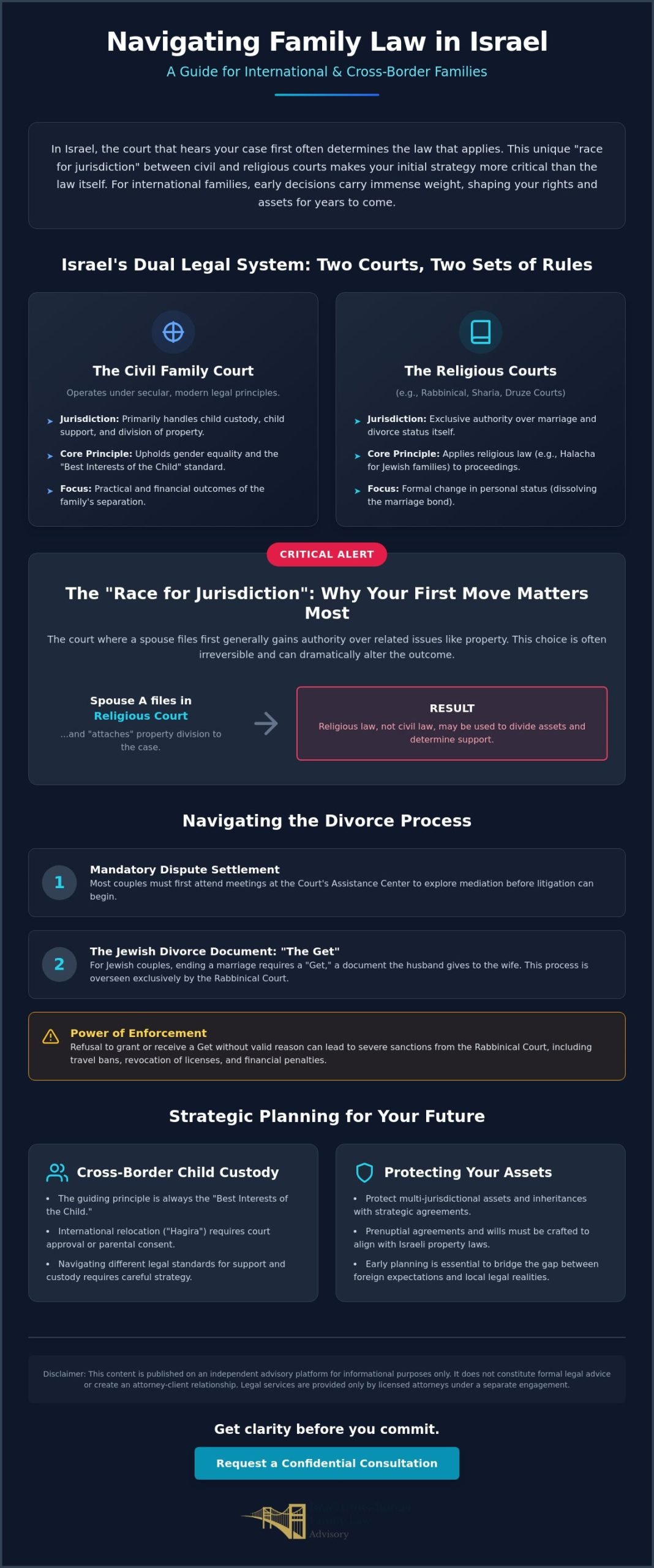
Israel’s legal framework for domestic relations is fundamentally different from the Western models most expats are accustomed to. It operates under a system of parallel jurisdiction where two distinct court systems share authority over different aspects of a family’s life. This structure is a defining characteristic of family law in israel. While the civil Family Court handles matters like property division and child custody, the religious courts maintain exclusive authority over the actual status of marriage and divorce.
Understanding this division is the first step toward building a sound strategy. For many international families, the realization that Marriage in Israel and its subsequent dissolution are governed by religious law can be startling. This is true even if the original wedding took place in a civil ceremony abroad. Since 2016, most couples must also navigate a mandatory “Settlement of Dispute” process before they can begin active litigation. This involves meetings with the Court’s Assistance Center to explore mediation, adding another layer of complexity for those balancing schedules across different time zones.
To better understand how these systems interact and the initial steps required by law, watch this helpful video:
The Family Court vs. The Rabbinical Court
The civil Family Court (Beit Mishpat Le’inyanei Mishpacha) operates under secular principles. It prioritizes gender equality and the “best interests of the child” in all rulings. Conversely, the Rabbinical courts apply Halacha, or Jewish law, to divorce proceedings. This dual system applies to other faiths as well, with Sharia and Druze courts serving their respective communities. For expats, this means your case could be handled differently depending on which court addresses specific issues like alimony or the “Get,” which is the religious divorce document. The civil court focuses on the practical and financial outcomes, while the religious court focuses on the change in personal status.
The Race for Jurisdiction: Why Timing Matters
In Israel, the court where a file is opened first generally retains jurisdiction over the associated issues. This phenomenon is known as the “race for jurisdiction.” If one spouse files for divorce in the Rabbinical Court and “attaches” matters like property division, that court may gain the authority to decide those issues using religious law rather than civil law. This choice can significantly change the outcome of asset division and spousal support. The “race” isn’t just a legal theory; it’s a practical reality that dictates which set of laws will govern your future. Because these early filings are often irreversible, it’s essential to learn more about how the advisory process works before taking any formal legal steps. Decisions made in the first few days of a dispute often carry the most weight.
Marriage and Divorce Law: Navigating the Religious Requirements
In Israel, the act of ending a marriage is never a purely civil matter. While the Family Court handles the financial and parental fallout, the actual dissolution of the marriage bond remains within the authority of religious courts. This is a primary source of confusion for those navigating family law in israel, as many expats assume a civil marriage performed in the US or Europe allows for a civil divorce in Israel. For Jewish couples, this process centers on the “Get,” which is a physical document that the husband must voluntarily give to the wife under the supervision of the Rabbinical Court.
The Rabbinical Court holds significant power to ensure this process moves forward. If a party refuses to grant or receive a Get without a valid legal reason, the court can impose severe sanctions, including travel bans, the revocation of professional licenses, or even financial penalties. This intersection of ancient tradition and modern legal enforcement is detailed in the Israeli Ministry of Justice overview of Family Law, which outlines how personal status matters are managed across different faith communities. Understanding these religious nuances is vital for international families who may be subject to these laws regardless of their level of personal observance.
Divorce for Foreigners and Non-Jewish Residents
Interfaith couples or those with no religious affiliation follow a different path under the Law for Dissolution of Marriage (Special Cases). This law allows the civil Family Court to dissolve marriages for those who don’t fall under the exclusive jurisdiction of a religious court. However, even US citizens married in civil ceremonies must engage with the Israeli system if they’re residents. Without careful planning, families risk a “limping marriage,” where they’re considered divorced in their home country but remain legally married in Israel. Ensuring your Israeli divorce is recognized and enforceable in the US requires a strategy that respects both legal cultures. If you’re unsure how your foreign marriage is treated locally, it’s helpful to review our resources for expats and foreign nationals.
Spousal Support and Alimony Considerations
The concept of alimony in Israel often surprises those used to American “maintenance” or “spousal support” models. In the religious system, spousal support is known as Mezonot Isha. Mezonot Isha is the husband’s religious obligation to maintain his wife’s standard of living during the marriage. Unlike many US jurisdictions, this obligation typically ends once the divorce is finalized and the Get is delivered. While civil courts can sometimes award compensatory alimony to address long-term financial gaps, it’s far less common than in the United States. Understanding these distinctions is essential before you take any formal steps. You can reach out for a confidential discussion to clarify how these religious requirements might apply to your specific international situation.
Cross-Border Child Custody and International Support
When a family’s life spans multiple countries, child custody matters become significantly more complex. In the local system, custody is referred to as Achrayut Horit, or parental responsibility. This framework is always guided by the “Best Interests of the Child” standard. It’s important to understand that as of 2026, the historical “Tender Years Presumption,” which automatically favored mothers for children under the age of six, is largely obsolete. Modern courts increasingly prioritize joint parental responsibility, reflecting a shift toward shared physical and legal guardianship. This evolution in family law in israel means that both parents are expected to remain active, decisive figures in the child’s daily life, regardless of their country of origin.
Financial support also carries international implications that require careful planning. If you’ve already secured a child support order in the United States, it isn’t automatically enforceable within the Israeli borders. To collect support locally, you must navigate a specific process through the civil court system to have the foreign ruling recognized. This step is vital for ensuring the child’s standard of living remains stable during a cross-border transition. Because the rules for calculating support can differ significantly from US models, obtaining clarity on your specific obligations or rights is a necessary first step for any expat parent.
The Hague Convention and Parental Abduction
Israel is a dedicated signatory to the Hague Convention on the Civil Aspects of International Child Abduction. This international treaty provides a legal mechanism to protect children from being wrongfully removed from their “habitual residence” or retained in a foreign country without parental consent. Israeli courts treat these cases with extreme urgency, often scheduling expedited hearings to ensure a swift resolution. It’s a high-stakes area of litigation where early strategy is paramount. For a more comprehensive look at these protections, you can review our guide on the Hague Convention and child abduction.
International Custody and Relocation
Many expats mistakenly believe they can return to their home country with their children at any time. However, once a child has lived in Israel for six months or more, the local courts generally consider Israel to be their habitual residence. Moving a child back to the US or any other country then requires either the written consent of the other parent or a formal relocation order from the court. The judiciary will examine the child’s stability, the quality of their current environment, and the potential impact of the move. You can explore the specific complexities of international custody and relocation to understand how these residency rules might affect your family’s long-term mobility.
Protecting Assets with Prenuptial Agreements and Wills
Standard Israeli law, governed primarily by the Spouses’ Property Relations Law of 1973, mandates an equal division of all assets acquired during the marriage. This default rule applies to everything from family homes and bank accounts to pension funds and high-tech stock options. For international families, this can create significant anxiety, especially when one spouse brings pre-marital wealth or expects a future inheritance from abroad. This is a nuanced area of family law in israel where the lack of a clear, formal agreement can lead to the unintended balancing of resources across multiple jurisdictions.
As this content is published on an independent advisory platform rather than a law firm, our focus is on providing the strategic clarity you need to make informed decisions. You can learn more about our independent advisory platform and how we help families bridge the gap between different legal systems. Understanding the weight of early decisions is essential for protecting your global financial footprint and avoiding the fear of losing rights due to unfamiliarity with local statutes.
Prenuptial and Postnuptial Agreements
In the local system, a marital contract is known as a Financial Agreement, or Heskem Mamon. It’s a common mistake to assume that a prenuptial agreement signed in the US or UK will be automatically honored by an Israeli judge. To be valid here, these agreements must be formally approved by either a court or a licensed notary. Navigating the complexity of family law in israel requires a document that addresses several specific criteria:
- Formal validation by an Israeli court or notary to ensure local enforceability.
- Strategic “mirroring” of foreign agreements to satisfy both Israeli civil standards and home-state laws.
- Clear delineation of pre-marital assets, future inheritances, and business interests.
- Consideration of both civil and religious court perspectives on property division.
Creating a robust agreement is a complex necessity to ensure that your asset protection strategy remains effective regardless of where a dispute might arise. Proactive planning today prevents the risk of years of litigation later.
Cross-Border Estate Planning
Estate planning for international families requires a dual approach because Israeli inheritance law differs significantly from the US probate process. If you own property or bank accounts in Israel, relying solely on a US-based trust or will can lead to significant jurisdictional delays and legal hurdles for your heirs. Assets located within the Israeli borders should be covered by a local, specifically drafted Israeli will to ensure they are distributed according to your wishes. Israel does not have an inheritance tax, but US citizens may still face US tax obligations on Israeli assets. Taking the time to align your global estate plan is a vital step in providing security for your family across borders. If you want to ensure your assets are protected under the current rules, you can request a confidential consultation to discuss your specific situation.
Strategic Guidance: Why a Cross-Border Perspective is Vital
Managing a domestic dispute across borders depends less on the black-letter law and more on the overarching strategy you employ from day one. In the context of family law in israel, the cultural gap between the American and Israeli legal systems is often as wide as the geographic distance. While US families might expect a purely secular, predictable process, the Israeli dual-court system introduces variables that require a different mindset. Success isn’t measured by immediate litigation, but by the ability to anticipate how decisions made in one jurisdiction will echo in another.
The Role of an International Family Law Advisor
Advisors serve as a critical bridge between your home-country expectations and the legal realities on the ground in Israel. Rather than rushing into a courtroom, the focus remains on strategy, mediation, and informed decision-making. This approach allows you to explore all available options, including how to structure agreements that satisfy both civil and religious authorities. By looking at the family’s situation through a cross-border lens, you can avoid common pitfalls that traditional local practitioners might overlook. For those interested in this strategic support, you can check our pricing and services for transparent advisory options.
Next Steps for Expats and Foreign Nationals
If you’re currently navigating a transition or a dispute, your first priority should be identifying potential jurisdictional risks. This involves more than just reading the rules; it requires a proactive assessment of your family’s unique footprint. We recommend taking the following steps to prepare:
- Gather all original documentation for marriages, births, and asset purchases performed outside of Israel.
- Assess your child’s habitual residence status based on the length of your stay in the country.
- Determine if any existing foreign prenuptial agreements or court orders need local validation.
Taking these steps early provides the foundation for a more secure legal strategy. Get clarity before you commit. Request a confidential case review to begin assessing your situation. This content is published on an independent advisory platform, not a law firm. It focuses on strategy, risks, and decision-making guidance. It’s clear that legal services are only provided by licensed attorneys under a separate engagement. This platform does not establish an attorney-client relationship.
Securing Your Family’s Global Future
Successfully managing the intersection of two distinct legal systems requires more than just local knowledge; it demands a comprehensive strategy that accounts for your family’s transnational footprint. You now have a clearer understanding of the “race for jurisdiction,” the weight of early decisions in asset protection, and the critical importance of habitual residence in custody matters. Navigating family law in israel doesn’t have to be a source of constant anxiety when you have a clear roadmap for the road ahead.
Our independent advisory platform provides a calm, advisory-first approach specifically tailored for international families. By working with licensed practitioners who possess deep jurisdictional knowledge in both US and Israeli frameworks, you can mitigate risks before they escalate into active disputes. We focus on bridging the cultural and legal gaps that often catch expats off guard. Please note that this content is for informational purposes only and doesn’t constitute legal representation or formal legal advice. Legal services are only provided by licensed attorneys under a separate engagement.
Get clarity before you commit. Request a confidential consultation. You have the power to protect your rights and your children’s stability through informed, proactive planning.
Frequently Asked Questions
Is a US divorce recognized in Israel?
Yes, but a US divorce decree isn’t automatically updated in the Israeli population registry. You must undergo a formal process of recognition through the Israeli court system to change your personal status. This step is essential for ensuring your rights regarding inheritance and remarriage are protected under local law. Without this recognition, you may still be considered legally married within the Israeli borders.
Can I get a civil divorce in Israel if I was married in the US?
Generally, you cannot obtain a purely civil divorce in Israel if you’re Jewish. Even if you had a civil ceremony in the US, the Rabbinical Court holds exclusive jurisdiction over the act of divorce for Jewish residents. This is a unique pillar of family law in israel that requires couples to navigate religious dissolution. Non-Jewish or interfaith couples follow a separate civil process for the dissolution of their marriage.
How is child support calculated for international families in Israel?
Child support calculations depend on the child’s specific needs and the parents’ respective financial resources. The courts also weigh the income levels of both parents and the time the child spends in each household. For international families, the judiciary may consider the cost of living in both countries and the significant expenses associated with cross-border visitation. These calculations vary depending on whether the civil or religious court handles the case.
What happens if my spouse takes our child to Israel without my consent?
If a child is moved to Israel without the consent of both guardians, it may be considered a wrongful removal under the Hague Convention. You should act quickly to determine if the child’s “habitual residence” was established in your home country. Israeli courts prioritize Hague cases and often schedule expedited hearings to ensure the child is returned to their original home while custody is being decided. Early strategy is vital in these high-stakes situations.
Do I need a separate will for my assets in Israel?
It’s highly advisable to have a local Israeli will for any assets located within the country, such as real estate or bank accounts. While a US will can sometimes be recognized, the probate process is much faster and less expensive when a local document exists. A separate will ensures that your Israeli property is distributed according to your wishes without the delays and complications of cross-border jurisdictional hurdles.
Are US prenuptial agreements valid in the Israeli Rabbinical Court?
A US prenuptial agreement isn’t automatically enforceable in any Israeli court, including the Rabbinical Court. To be valid, the agreement must be formally approved and validated by an Israeli court or a licensed notary. If an agreement hasn’t been “mirrored” or validated locally, its provisions regarding asset division might be challenged or ignored. Seeking clarity on your agreement’s local status is an essential first step for any expat.
How long does a typical international divorce take in Israel?
The duration of a divorce depends heavily on whether both parties can reach a mutual agreement. A consensual divorce can be finalized in a few months, but contested cases involving property and custody can last two years or more. Mandatory dispute settlement regulations require a waiting period of at least 45 to 60 days before litigation can begin. This reflection period is a standard part of family law in israel designed to encourage mediation.
What is the “Race for Jurisdiction” and how does it affect me?
The “Race for Jurisdiction” occurs because both the civil Family Court and the Rabbinical Court have the power to hear cases. The court where the first valid filing is made typically gains the authority to decide all related matters, such as alimony and property division. Because these two systems apply different legal principles, the court that wins the “race” can fundamentally change the financial outcome of your case. Early decision-making is therefore critical.

Article by
Gabriel Lior
A Personal Journey That Became a Mission
The advisory was founded by an American father Gabriel Lior, LLB, MBA , global entrepreneur, and cross-border advisor who spent more than a decade navigating the Israeli family court system firsthand and now lives in Singapore with his son.
As a divorced parent in a cross-border family, Gabriel faced nearly every legal challenge a foreign parent can encounter in Israel — including child custody disputes, child support proceedings, property matters in Israel and abroad, false accusations, and complex immigration and relocation proceedings.
Over the years, he learned the hard way how difficult it is for non-Israeli parents to understand the system, identify the right legal strategy, and choose the right legal representation — especially when language, culture, and jurisdictional differences are involved. He also witnessed how foreign parents and new immigrants are often disadvantaged or taken advantage of by service providers and institutions simply because they lack local knowledge or fluency.
From Client to Advisor
To truly understand — and survive — the system, Gabriel pursued formal legal education in Israel, completing two Israeli law degrees, alongside a BA and MBA earned in the United States. This was never about becoming a practicing attorney, but about gaining a deep, structural understanding of how the system works — and where it breaks down for foreign parents.
This rare combination of:
Firsthand client experience
Israeli legal and US business education
International business and negotiation training
Decades of commercial execution
created a unique perspective – one that understands both sides of the table.
After years of litigation, persistence, and at times self-representation, he ultimately succeeded in securing custody of his son and relocating abroad through a rare legal victory in the Israeli Supreme Court — becoming one of the first fathers in Israel to do so under these circumstances.
Disclaimer
Important Disclaimer:
The information provided on this website and in its content is for general informational and educational purposes only and does not constitute legal advice, legal opinion, or legal representation.
Gabriel Lior is not licensed to practice law in Israel (nor is he interested in doing so) and does not provide legal services, despite having completed 2 Law Degrees. The services offered are advisory in nature and are intended to provide general guidance, strategic insight, and information regarding cross-border family law considerations.
No attorney-client relationship is formed by accessing this website, reading its content, or communicating with us.
Any decisions made based on this information are at your own discretion and risk. For legal advice specific to your situation, you should consult a licensed attorney in the relevant jurisdiction.
Where appropriate, we may refer clients to independent, licensed attorneys or professionals. Such referrals do not constitute legal representation and no liability is assumed for services provided by third parties.