
This article is published on an independent advisory platform and does not constitute legal representation or an attorney-client relationship. Legal services are only provided by licensed attorneys under a separate engagement.
In the Tel Aviv legal landscape, the outcome of your divorce can be decided not just by the facts of your case, but by which court door you walk through first. Most international families feel overwhelmed by the “race for jurisdiction” between the civil Family Court and the Rabbinical Court. It’s natural to worry that cultural differences or linguistic barriers might jeopardize your rights to assets or your relationship with your children. Securing a family lawyer tel aviv families trust is the first step in managing this complexity and ensuring your international interests are protected.
You deserve to understand exactly how the Spouses’ Property Relations Law of 1973 impacts your global assets and what the mandatory 45 to 60 day dispute settlement process means for your timeline. This guide provides a clear roadmap through the dual court system, explains the financial realities of child support in 2026, and offers a strategic plan to protect your family’s future. We’ll explore how to navigate these complexities with a calm, expert perspective. Get clarity before you commit. Request a confidential consultation. You can also find more detailed explanations on our YouTube channel.
This article is published on an independent advisory platform and does not constitute legal representation or an attorney-client relationship. Legal services are only provided by licensed attorneys under a separate engagement.
Key Takeaways
- Gain clarity on the “Race of Jurisdiction” and why the choice between Civil and Rabbinical courts is the most critical early decision in your case.
- Learn how to protect assets located in both the US and Israel while navigating the complexities of international tax treaties and financial support.
- Understand why mediation and formal financial agreements often provide a more stable and predictable path for international families than litigation.
- Identify common pitfalls for expats, such as applying foreign legal logic to the Israeli system or misunderstanding the role of the Ministry of Welfare.
- Recognize the essential qualities of a family lawyer tel aviv families trust to navigate the intersection of local statutes and international legal standards.
This article is published on an independent advisory platform and does not constitute legal representation or an attorney-client relationship. Legal services are only provided by licensed attorneys under a separate engagement.
Understanding the Dual Court System in Tel Aviv
In Israel, family law operates through two parallel tracks, which is often the first shock for international families living in the center. Unlike many Western systems where a single court handles all domestic matters, you’re dealing with two distinct legal cultures. A family lawyer tel aviv advisor helps you understand how these systems overlap and compete. This Dual Court System in Tel Aviv means that both the civil Family Court and the religious Rabbinical Court have the authority to hear your case, depending on who files first and where.
To better understand this concept, watch this helpful video:
The Civil Family Court vs. The Rabbinical Court
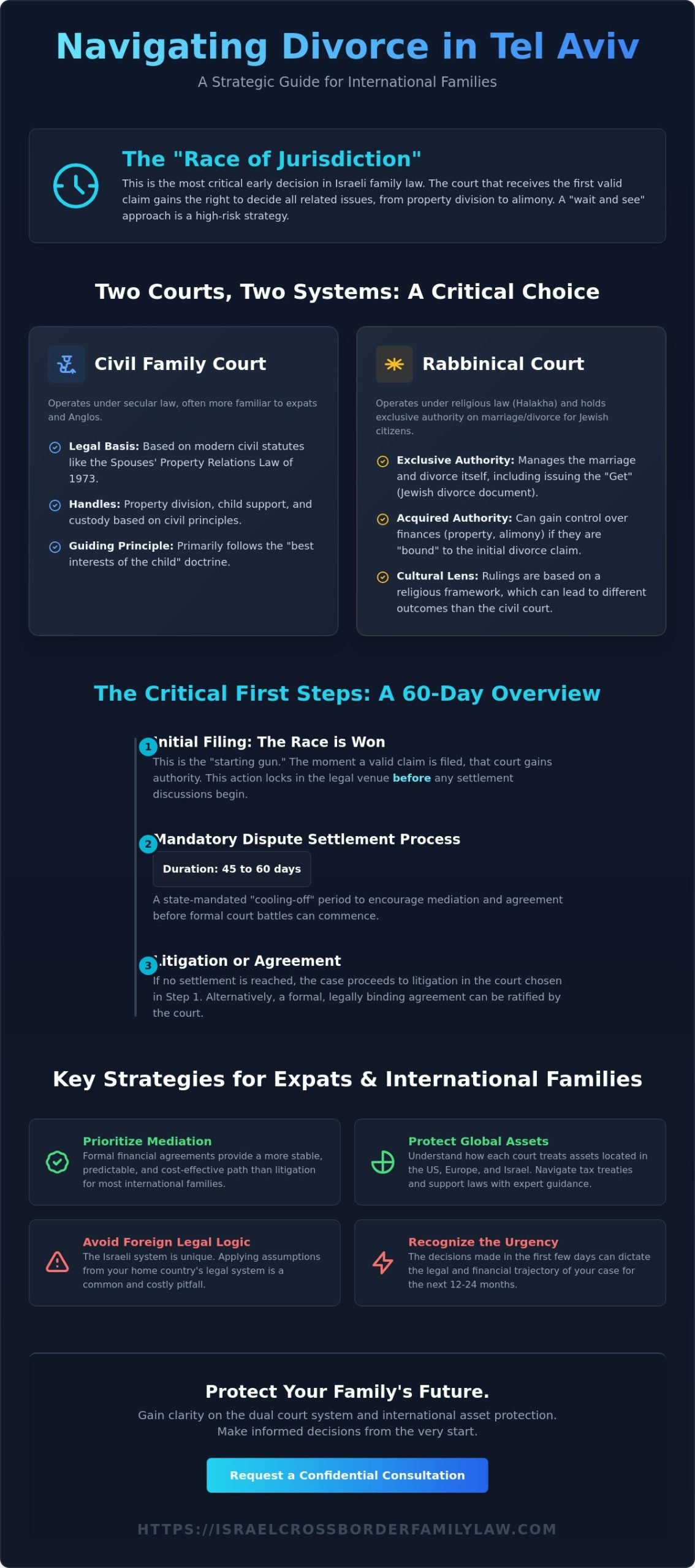
The civil Family Court follows secular law and is generally more familiar to Anglos and expats. It handles matters like property division, child support, and custody based on civil principles and the best interests of the child. However, the Rabbinical Court has exclusive authority over the marriage and divorce itself for Jewish residents. This applies even if you married in a civil ceremony in Cyprus or the US. You’ll still need a “Get”, which is the Jewish divorce document, to be legally single in the eyes of the state.
The two courts often have different approaches to family disputes. While the Family Court is guided by modern legal statutes, the Rabbinical Court operates under religious law. This can lead to different outcomes for alimony or how assets are viewed. It’s not just about rules; it’s about the cultural lens through which the judges view your family’s future.
Strategic Timing: The Race of Jurisdiction
This brings us to the “Race of Jurisdiction,” perhaps the most critical concept in Israeli family law. In most cases, the court that receives the first valid claim gains the right to decide all related issues. If one spouse files for divorce in the Rabbinical Court and “binds” property or alimony to that claim, that court may take control of those financial matters. This can significantly change your legal strategy and final settlement.
A “wait and see” approach is often a high-risk strategy in Israel. Since 2016, most couples must enter a mandatory “Settlement of Dispute” process that lasts 45 to 60 days before litigation can start. However, the initial filing that triggers this process is what secures your choice of court. Decisions made in the first few days can dictate the trajectory of your case for the next 12 to 24 months. Understanding the divorce and separation process for international families is essential before any papers are filed. Get clarity before you commit. Request a confidential consultation.
This article is published on an independent advisory platform and does not constitute legal representation or an attorney-client relationship. Legal services are only provided by licensed attorneys under a separate engagement.
The Cross-Border Dimension: Why Tel Aviv Cases Are Unique
Tel Aviv serves as the epicenter of the “start-up nation,” attracting a global community of professionals whose lives aren’t confined to a single country. When family disputes arise in this environment, the legal situation is rarely local. A family lawyer tel aviv advisor must understand that your residency status, whether you’re a citizen or a temporary resident, can influence your standing in Israeli courts. This is particularly true when courts determine “habitual residence,” a concept that dictates which country has the authority to make decisions about your children and your future.
International Child Custody and Relocation
Relocation is often the most sensitive issue for expats. Israeli courts apply a high legal threshold when a parent wishes to move children from Israel to the US. The court focuses on the child’s best interests, weighing their established roots in Tel Aviv against the potential benefits of the move. If a parent moves a child without a formal agreement or court order, the Hague Convention on the Civil Aspects of International Child Abduction may be triggered. Formal cooperation between nations is established, and you can find detailed guidance on cross-border child support enforcement to understand how orders are recognized internationally. Creating enforceable international custody and relocation plans is the most effective way to avoid high-stakes litigation.
Dividing Global Assets and Pensions
The division of assets for international families is rarely straightforward. While Israeli law generally dictates an equal split of marital assets, applying this to US-based 401(k)s, IRAs, and real estate is complex. Israeli courts must determine how to value these assets and whether they have the jurisdiction to order their division. For tech sector professionals and startup founders, the challenge grows when valuing unvested stock options or “commingled” assets—such as using a US inheritance to purchase property in Tel Aviv. These situations require sophisticated tracing to ensure your financial rights are protected in both jurisdictions. Seeking a confidential case review can help you identify these risks early in the process. Get clarity before you commit. Request a confidential consultation.
This article is published on an independent advisory platform and does not constitute legal representation or an attorney-client relationship. Legal services are only provided by licensed attorneys under a separate engagement.
Strategic Considerations for International Families in Israel
Strategic planning for international families requires shifting focus from courtroom battles to long-term risk management. In the complex legal environment of Tel Aviv, aggressive litigation often yields diminishing returns, especially when global assets and multi-jurisdictional parenting plans are involved. A family lawyer tel aviv advisor prioritizes clarity and de-escalation, helping you navigate the system without triggering unnecessary conflict. For those needing additional support during their transition, the government offers legal aid services for expats to ensure basic rights and procedures are understood.
Protecting your interests in a cross-border context isn’t about winning a fight; it’s about making informed choices that stand up in multiple jurisdictions. This requires bilingual and bicultural representation that can bridge the gap between Israeli statutes and your home country’s legal expectations. Early decisions regarding how you communicate and what documents you sign will dictate your legal standing for years to come.
Prenuptial and Postnuptial Agreements
Many families arrive in Israel assuming their US-drafted prenuptial agreement is a permanent shield. However, under the Spouses’ Property Relations Law of 1973, a foreign agreement isn’t always automatically enforceable. It must often meet specific Israeli formal requirements, such as approval by a judge or a notary, to be valid in a local court. To protect your interests, agreements should be drafted to satisfy both Israeli and US legal standards simultaneously. This prevents the “commingling” of pre-marital assets with marital property, a common trap for tech professionals. Using these agreements as a tool for risk reduction ensures that both parties understand the financial landscape before a crisis occurs.
Mediation as a Path to Resolution
Since 2016, the Israeli legal system has mandated a “Settlement of Dispute” process. This 45 to 60 day period requires couples to meet with the Court’s Assistance Center to explore alternatives before they can file a lawsuit. It’s a strategic window to explore mediation. An amicable divorce agreement in 2026 typically costs between 4,000 and 5,000 shekels in legal fees, whereas contested cases can easily exceed 30,000 shekels. Beyond the financial savings, mediation allows families to maintain control over their parenting plans rather than leaving decisions to a judge who may not understand their bicultural lifestyle. While litigation is sometimes necessary for high-conflict cases, a strategic approach always starts with a comprehensive advisory process to weigh the risks. Get clarity before you commit. Request a confidential consultation.
This article is published on an independent advisory platform and does not constitute legal representation or an attorney-client relationship. Legal services are only provided by licensed attorneys under a separate engagement.
Avoiding Common Pitfalls for Expats and Anglos
Expats often arrive in Tel Aviv with a set of legal expectations based on their home country’s system. This “home country” logic is one of the most common traps. For example, many assume that a US divorce decree is automatically valid here. In reality, foreign judgments usually require a formal recognition process, known as an “exequatur,” before they can be enforced by an Israeli court. A family lawyer tel aviv advisor helps you bridge this gap, ensuring you don’t make critical errors based on assumptions that don’t apply to the local system.
Another frequent misunderstanding involves the role of the Israeli Ministry of Welfare, specifically the social workers known as “Sia’at.” In many Western countries, social workers have limited influence unless there’s a safety concern. In Israel, the court-appointed social worker’s report (Teskir) carries immense weight. Their recommendations on custody and visitation often become the court’s default position. Ignoring the importance of these early interviews is a significant risk for international parents who may find the process culturally unfamiliar.
Financial settlements also hold hidden dangers for the unwary. When assets are split across borders, you must account for currency fluctuations and international transfer fees. A settlement reached in US Dollars might lose 5% or 10% of its value by the time it’s converted to New Israeli Shekels (NIS) for local living expenses. Strategic planning must include specific clauses to handle these shifts and ensure your long-term purchasing power remains stable.
Common Misconceptions About Israeli Law
Several myths persist within the Anglo community that can lead to poor decision-making. While the “Tender Years Presumption” (favoring mothers for children under six) is still technically on the books, Israeli courts have moved decisively toward joint parental responsibility. Assuming a specific outcome based on gender is no longer a reliable strategy. Similarly, you must understand the reality of child support enforcement across borders. While Israel and the US have a Memorandum of Understanding for enforcement, the process is administrative and requires precise documentation to succeed.
The Language and Culture Barrier
A literal translation of legal documents is rarely sufficient in Tel Aviv. Legal Hebrew uses specific terms that carry different weights than their English counterparts. Furthermore, the “assertive” culture of Israeli legal proceedings can feel aggressive or overwhelming to those used to a more reserved courtroom style. A lawyer who acts as a bicultural bridge is essential. They don’t just translate the words; they translate the intent and the strategy, ensuring you aren’t disadvantaged by a communication gap. To avoid these common mistakes, it’s vital to speak with a cross-border professional who understands both worlds. Get clarity before you commit. Request a confidential consultation.
This article is published on an independent advisory platform and does not constitute legal representation or an attorney-client relationship. Legal services are only provided by licensed attorneys under a separate engagement.
Choosing the Right Cross-Border Family Lawyer in Tel Aviv
Selecting a family lawyer tel aviv for an international case requires looking beyond local courtroom success. You need a professional who understands the multi-jurisdictional nature of your life. While a local litigator might focus solely on winning a specific motion in the Tel Aviv Family Court, a cross-border advisor considers how that decision affects your US tax status or your ability to enforce a judgment abroad. The goal is to move forward with a strategy-based approach rather than an emotion-based one. Early decisions driven by reactive feelings often lead to long-term legal complications that are difficult to reverse.
A strategic guide helps you maintain a calm perspective, focusing on risk-based decision-making. They act as a bridge, ensuring that your legal standing in Israel is synchronized with your interests in your home country. This coordination is the difference between a temporary win and a sustainable future for your family.
Evaluating Legal Expertise
When interviewing potential counsel, you should ask specific questions to gauge their experience with international matters. A qualified advisor should be able to discuss the following points with clarity:
- Experience with the Hague Convention on the Civil Aspects of International Child Abduction and its application in Israeli courts.
- Familiarity with US-Israel treaties and how they impact financial settlements and support.
- The ability to coordinate seamlessly with legal counsel in your home state to ensure global consistency.
- A proven methodology for handling complex international asset division involving pensions, stock options, and foreign real estate.
Taking the First Step Toward Clarity
The initial stage of your journey should focus on risk assessment rather than just filing papers. A confidential case review is an opportunity to map out the complexities of your specific situation in a calm, neutral environment. This process allows you to understand the potential impact of the “Race of Jurisdiction” and the mandatory dispute resolution period before any irreversible commitments are made.
Education is a powerful tool in reducing the anxiety associated with the Israeli legal system. To gain a deeper understanding of these concepts, you can watch our guide on navigating US-Israel family law on our YouTube channel. Taking the time to build a strategic plan now prevents high-conflict battles later. Get clarity before you commit. Request a confidential consultation.
This article is published on an independent advisory platform and does not constitute legal representation or an attorney-client relationship. Legal services are only provided by licensed attorneys under a separate engagement.
Securing Your Family’s Future Across Borders
Navigating the dual court system in Israel requires more than just local legal knowledge. It demands a strategic understanding of how the “Race of Jurisdiction” and early filings dictate the next 12 to 24 months of your life. Protecting global assets and creating enforceable parenting plans involves a specialized approach that respects both Israeli statutes and international treaties. Success depends on a deep understanding of how local laws interact with US-based assets like 401(k)s or property holdings.
As an independent advisory platform, we provide the bicultural and bilingual expertise necessary to bridge these gaps. Finding a family lawyer tel aviv families can rely on means choosing a partner who prioritizes risk-based strategy over emotional litigation. You don’t have to face these multi-jurisdictional complexities alone. By seeking clarity now, you ensure that your rights and your children’s future are protected in both the US and Israel.
Get clarity before you commit. Request a confidential consultation. We’re here to help you move forward with confidence and peace of mind.
This article is published on an independent advisory platform and does not constitute legal representation or an attorney-client relationship. Legal services are only provided by licensed attorneys under a separate engagement.
Frequently Asked Questions
Is a US divorce decree recognized in Israel?
A US divorce decree is not automatically recognized in Israel. To make it legally binding, you must complete a formal recognition process known as an “exequatur.” This involves filing a petition in the Israeli Family Court to prove the foreign judgment meets local standards. Without this, you cannot update your marital status with the Population Authority or enforce property transfers located within the country.
Can an Israeli court decide on custody for a child born in the US?
Israeli courts can decide custody for any child whose “habitual residence” is in Israel, regardless of their place of birth. If a child born in the US has lived in Tel Aviv for a significant period, the local Family Court has jurisdiction. The court prioritizes the child’s established social and educational environment over their citizenship or original country of birth.
What is the ‘Race of Jurisdiction’ in Tel Aviv family law?
The “Race of Jurisdiction” refers to the parallel authority of the civil Family Court and the religious Rabbinical Court. In many cases, the court where the first valid claim is filed gains the power to decide related matters like alimony and property division. This makes the timing of your initial filing a critical strategic decision for your entire case.
Do I need a separate lawyer for my assets in the US and Israel?
You generally need a family lawyer tel aviv advisor who can manage the Israeli proceedings while coordinating with US counsel. While one firm may not practice in both jurisdictions, your local advisor must understand the US-Israel Tax Treaty and international asset division. This ensures that your settlement in Israel doesn’t create unintended legal or tax liabilities in the US.
How long does a cross-border divorce in Tel Aviv typically take?
The timeline depends heavily on whether the divorce is mutual or contested. An amicable agreement can be finalized in 2 to 4 months. However, contested cases involving international assets or relocation disputes typically last between 12 and 24 months. You must also account for the mandatory 45 to 60 day dispute settlement process required by law since 2016.
Can I relocate with my children back to the US after a divorce in Israel?
You cannot relocate with your children to the US without the other parent’s written consent or a specific court order. Israeli courts view relocation as a major life change and apply a strict legal threshold. The judge will evaluate the child’s best interests, established roots in Israel, and the potential impact on the relationship with the parent staying behind.
Are prenuptial agreements from the US enforceable in Israeli Rabbinical courts?
US prenuptial agreements are not automatically enforceable in Israeli courts, including the Rabbinical Court. Under the Spouses’ Property Relations Law of 1973, an agreement must be formally approved by a judge or notary to be valid. If your US agreement wasn’t drafted or approved according to these specific Israeli standards, it might be challenged during a divorce.
What happens if my spouse files for divorce in the Rabbinical court first?
If your spouse files in the Rabbinical Court first, that court may gain jurisdiction over financial issues like alimony and property division. This is often a strategic move because the Rabbinical Court applies religious law, which can lead to different outcomes than the civil Family Court. It’s vital to seek clarity on your position as soon as you suspect a filing is imminent.

Article by
Gabriel Lior
A Personal Journey That Became a Mission
The advisory was founded by an American father Gabriel Lior, LLB, MBA , global entrepreneur, and cross-border advisor who spent more than a decade navigating the Israeli family court system firsthand and now lives in Singapore with his son.
As a divorced parent in a cross-border family, Gabriel faced nearly every legal challenge a foreign parent can encounter in Israel — including child custody disputes, child support proceedings, property matters in Israel and abroad, false accusations, and complex immigration and relocation proceedings.
Over the years, he learned the hard way how difficult it is for non-Israeli parents to understand the system, identify the right legal strategy, and choose the right legal representation — especially when language, culture, and jurisdictional differences are involved. He also witnessed how foreign parents and new immigrants are often disadvantaged or taken advantage of by service providers and institutions simply because they lack local knowledge or fluency.
From Client to Advisor
To truly understand — and survive — the system, Gabriel pursued formal legal education in Israel, completing two Israeli law degrees, alongside a BA and MBA earned in the United States. This was never about becoming a practicing attorney, but about gaining a deep, structural understanding of how the system works — and where it breaks down for foreign parents.
This rare combination of:
Firsthand client experience
Israeli legal and US business education
International business and negotiation training
Decades of commercial execution
created a unique perspective – one that understands both sides of the table.
After years of litigation, persistence, and at times self-representation, he ultimately succeeded in securing custody of his son and relocating abroad through a rare legal victory in the Israeli Supreme Court — becoming one of the first fathers in Israel to do so under these circumstances.
Disclaimer
Important Disclaimer:
The information provided on this website and in its content is for general informational and educational purposes only and does not constitute legal advice, legal opinion, or legal representation.
Gabriel Lior is not licensed to practice law in Israel (nor is he interested in doing so) and does not provide legal services, despite having completed 2 Law Degrees. The services offered are advisory in nature and are intended to provide general guidance, strategic insight, and information regarding cross-border family law considerations.
No attorney-client relationship is formed by accessing this website, reading its content, or communicating with us.
Any decisions made based on this information are at your own discretion and risk. For legal advice specific to your situation, you should consult a licensed attorney in the relevant jurisdiction.
Where appropriate, we may refer clients to independent, licensed attorneys or professionals. Such referrals do not constitute legal representation and no liability is assumed for services provided by third parties.
Related Insights & Resources

Modifying US Child Support in Israel: A Comprehensive Guide
For individuals residing in Israel but bound by a United States child support order, a...Read More →
Returning a Child Under the Hague Convention: Legal Guide
This article is published on an independent advisory platform and does not constitute an attorney-client...Read More →
Prévenir l’enlèvement international d’enfants : Un guide juridique
Ce contenu est publié sur une plateforme de conseil indépendante (et non un cabinet d'avocats)....Read More →