This article is published on an independent advisory platform and provides general information, not legal advice from a law firm, nor does it imply an attorney-client relationship.
Imagine arriving at Ben Gurion Airport for a family wedding only to be stopped at passport control because of a stay of exit order you never knew existed. For many international families, the first encounter with hotzaa lapoal israel, the Enforcement and Collection Authority, is a confusing Hebrew notice regarding a ₪15,000 debt that has quietly accrued interest for years. It’s a stressful experience, especially when you’re trying to figure out how a US child support order or a forgotten utility bill from a previous residency has suddenly compromised your freedom of movement.
You likely feel that the Israeli administrative system is a black box, operating with rules that don’t align with your experience in other jurisdictions. This guide provides the strategic clarity you need to understand how the Israeli Execution Office operates and what international families must know about enforcing or defending cross-border legal claims. We will examine the specific mechanics of the enforcement process, how to protect your assets from seizure, and the steps required to resolve these matters before they lead to permanent legal complications. For more detailed visual guides, you can also explore resources on the Israel Cross Border Law Firm YouTube channel. Get clarity before you commit. Request a confidential consultation from Israel Cross Border Law Firm.
Key Takeaways
- Understand the role of the Enforcement and Collection Authority as an independent administrative body within the Israeli Ministry of Justice.
- Identify the potential risks of hotzaa lapoal israel so you don’t face unexpected bank levies, asset seizures, or stay-of-exit orders.
- Discover the specific legal mechanisms for enforcing international child support orders and how the Israeli system handles multi-jurisdictional claims.
- Learn how to use “Means Inquiries” and structured payment plans to protect your assets and resolve outstanding debts effectively.
- Gain strategic clarity on why early decisions in your initial legal agreements are the most critical factor in navigating the enforcement system.
This article is published on an independent advisory platform and does not constitute a law firm or imply an attorney-client relationship.
What is Hotzaa LaPoal? Understanding the Israeli Execution Office
Hotzaa LaPoal is the Enforcement and Collection Authority operating under the Israeli Ministry of Justice. While a court issues a ruling, this authority is the mechanism that ensures the ruling is actually carried out. It functions as a powerful administrative arm designed to execute finalized judgments and financial obligations. Within the broader Israeli legal system, it operates with a high degree of autonomy to ensure creditors receive what they are owed through structured enforcement.
The system handles a wide variety of cases, ranging from unpaid utility bills and bounced cheques to complex child support arrears. For many international citizens, hotzaa lapoal israel can feel administratively aggressive because it focuses on efficiency over mediation. Once a file is opened, the authority has the power to act quickly to secure assets. This often happens before the debtor has a chance to contest the underlying claim in a traditional courtroom setting.
For a broader understanding of the Israeli legal and enforcement landscape, consider this video:
The Difference Between a Court Judgment and Execution
It is helpful to view the court as the body that determines the “what” of a debt, while Hotzaa LaPoal manages the “how” of its collection. This entity is an administrative body with quasi-judicial powers. This means its Registrars can make significant decisions, like seizing vehicles or freezing bank accounts, without a new trial. Once a judgment is “opened” in the Execution Office, interest and penalties begin to accrue at rates that can surprise those used to Western systems. These additions can quickly turn a manageable debt into a significant financial burden if left unaddressed for even a few months.
Why Expats Often Struggle with the System
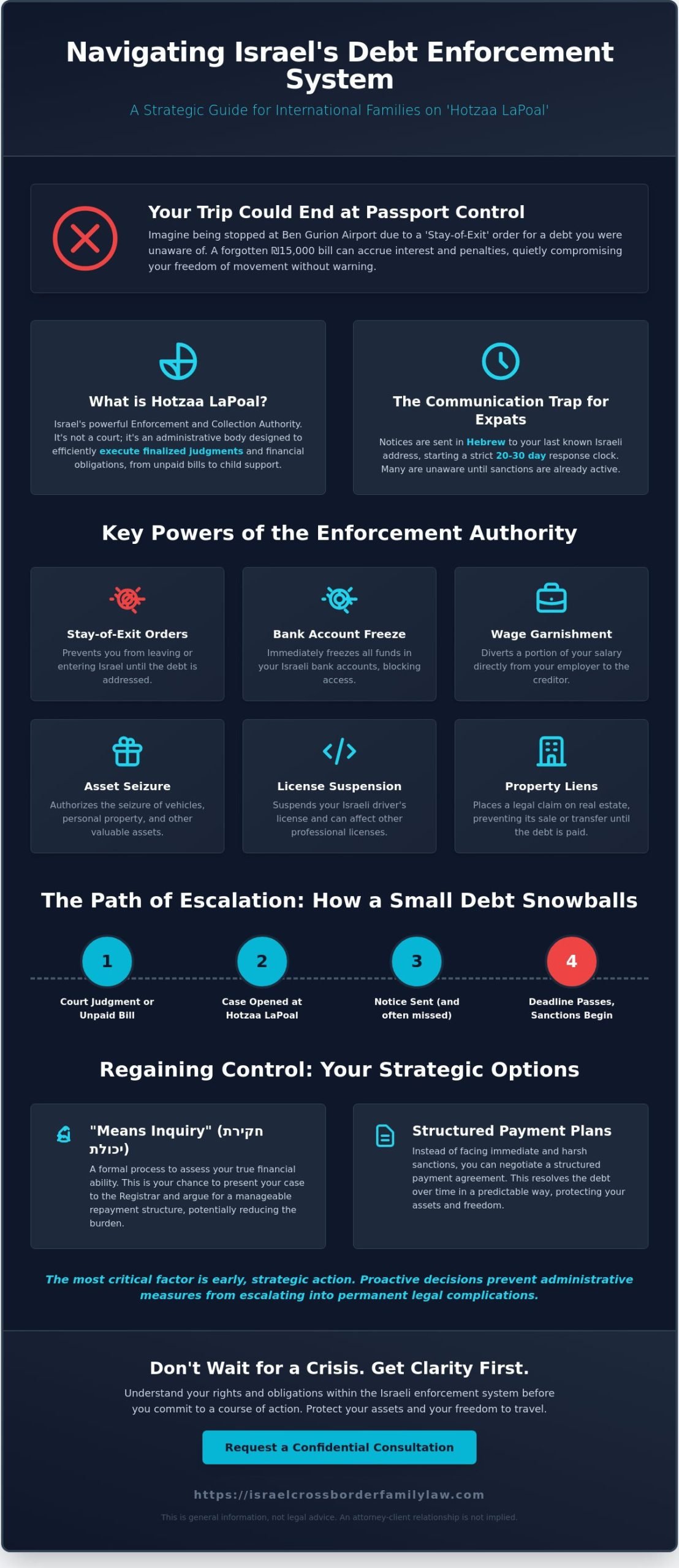
International families and expats frequently find themselves at a disadvantage due to the way the system communicates. Notices are almost exclusively written in Hebrew and delivered to the last known local address on file with the Ministry of Interior. This often results in individuals being unaware of a case until their credit card is declined or they are stopped at the airport. The “Notice of Opening a Case” starts a strict 20 to 30 day clock for a formal response. Missing this window usually leads to automatic sanctions, such as driver’s license suspensions or liens on property, without further warning. Early strategy is the only way to prevent these administrative measures from escalating.
Key Powers of the Enforcement Authority: From Bank Levies to Exit Bans
The Enforcement and Collection Authority holds a suite of tools designed to ensure compliance with financial obligations. These powers go far beyond simple reminders. They allow the system to intervene directly in your financial and personal life. In the context of hotzaa lapoal israel, the authority can freeze Israeli bank accounts, seize liquid assets, and garnish wages directly from an employer’s payroll. For international families, these measures aren’t just financial inconveniences; they can disrupt residency status and the ability to work in the local market.
The system is highly digitized and efficient. When a case is opened, the authority pings all major Israeli banking institutions to locate accounts associated with a specific ID or passport number. This often leads to blocked credit cards and frozen savings accounts before the individual has even received a physical notice in the mail. Understanding the Enforcement of Judgments in Israel is vital for anyone managing assets across borders, as the administrative speed can be much faster than the court systems in the US or Europe.
The ‘Stay of Exit’ Order: A Critical Risk for International Families
Perhaps the most daunting tool is the “Tzav Ikur Yetzia Min HaAretz,” or stay of exit order. This prevents a person from leaving the country until the debt is settled or a sufficient financial guarantee is provided. In child support cases, these orders can be issued for relatively small arrears. For an expat who needs to travel for business or to visit family abroad, being flagged at passport control is a traumatic experience. These orders remain active until a Registrar formally lifts them, which typically requires a strategic legal response and proof of intent to return or pay.
Asset Seizure and Bank Liens
Beyond bank accounts, the authority places liens on tangible assets. This includes vehicles, real estate, and even professional licenses. A driver’s license suspension is a common tactic used to compel debtors to enter a payment plan. These actions happen administratively. This means a Registrar can approve a lien based on a creditor’s request without a full hearing. If you find yourself facing these sanctions, it’s essential to seek professional guidance to understand your options for relief and asset protection.
Managing a case within hotzaa lapoal israel requires a proactive approach. Waiting for the system to find you usually results in the most restrictive sanctions being applied first. Strategic intervention, such as filing for a means inquiry or proposing a payment schedule, can often prevent the most disruptive tools, like the stay of exit, from being utilized against you.
This article is published on an independent advisory platform and does not constitute a law firm or imply an attorney-client relationship.
Cross-Border Enforcement: Collecting Support When One Party is Abroad
Enforcing financial support across international borders presents unique challenges that require a deep understanding of multi-jurisdictional protocols. When one parent resides in the United States while the other is in Israel, the collection of child support relies on a specific interplay between the two countries’ legal systems. The Israeli Central Authority, situated within the Ministry of Justice, acts as the primary liaison for these international cases. It coordinates with foreign jurisdictions to ensure that maintenance orders are recognized and executed. For families navigating this path, understanding child support cross-border enforcement is the first step in securing the financial stability of their children.
Once an international claim is processed through the Central Authority, it eventually reaches hotzaa lapoal israel for physical collection. However, the process isn’t automatic. If a debtor has relocated to the United States, the Israeli system must work through reciprocal agreements to garnish wages or seize assets abroad. This process can be slow, often taking several months to initiate, and requires precise documentation to survive the scrutiny of both Israeli and American administrative bodies. It’s a complex bridge that requires a steady hand to navigate effectively.
Enforcing a Foreign Judgment in Israel
You can’t simply present a US court order to a clerk in Israel and expect immediate action. A foreign judgment must first undergo a process called “domestication” or recognition through the Israeli family court system. This ensures the order doesn’t contradict local public policy. A significant difference often arises in financial calculations; Israeli orders are frequently linked to the Consumer Price Index (CPI), whereas US orders often remain fixed. This can lead to discrepancies in the total debt amount over time. The 1956 UN Convention on the Recovery Abroad of Maintenance provides the legal framework for these actions, allowing for a more streamlined recognition of support obligations between member states.
The Risk of Early Decisions in Divorce
Strategic clarity is essential during the initial drafting of a separation agreement. A standard divorce decree written in a foreign country might lack the specific language required for aggressive enforcement within the Israeli system. For example, if an agreement doesn’t account for the specific way hotzaa lapoal israel calculates interest on arrears, the creditor might lose out on thousands of shekels (₪). International families should prioritize including flexibility clauses that account for potential relocation and the differences in cost-of-living adjustments between countries. Decisions made during divorce and separation for international families often dictate how easily the Execution Office can be used years later when circumstances change.
This article is published on an independent advisory platform and does not constitute a law firm or imply an attorney-client relationship.
Protecting Your Rights: Managing a Case as a Debtor or Creditor
The Registrar at hotzaa lapoal israel serves as the pivotal decision-maker in every enforcement proceeding. While they operate within the Ministry of Justice, they possess quasi-judicial authority. This means they can issue orders that carry the weight of a court ruling, such as authorizing asset searches or approving payment schedules. Whether you’re trying to collect a debt or defending against a claim, understanding the Registrar’s role is essential for navigating the system effectively.
For individuals who find themselves unable to settle a debt in one lump sum, the Chakirat Yecholot (Means Inquiry) is the primary tool for relief. During this process, you must provide a transparent account of your global financial standing, including bank statements, tax records, and proof of living expenses. If the Registrar is satisfied with your disclosure, they will issue a Tsav Tashlumim (Payment Order). Maintaining consistent payments under this plan is often the most direct way to lift restrictive sanctions like bank liens or stay of exit orders.
For the Debtor: Avoiding Automatic Sanctions
Timing is the most critical factor when you receive a notice from the Execution Office. You generally have a strict 20-day window to respond before the system begins applying automatic sanctions. If you believe the debt is invalid because it has already been settled, you must file a Ta’anat Pera’ti (Claim of Extinguishment). Simply ignoring the notice because “I didn’t know” or “I don’t live there anymore” is rarely a valid defense in Israel. The system assumes that any notice sent to your registered address is legally delivered, making a proactive strategy your only real protection. If you’re unsure how to respond to a Hebrew notice, you can request a case review to clarify your position.
For the Creditor: Maximizing Collection Efficiency
Creditors have powerful tools at their disposal to ensure they aren’t left with an empty judgment. If you’re collecting child support, you can utilize Maslul Yarok (Track 800). This is a streamlined path where the Authority takes a more proactive role in locating the debtor’s income sources and assets. Creditors can also request access to a centralized database that pings various government and financial bodies to identify hidden property or vehicles. While the system is robust, it requires a realistic approach to recovery. Success often depends on how well you’ve tracked the debtor’s local and international financial activity before the enforcement process even begins.
This article is published on an independent advisory platform and does not constitute a law firm or imply an attorney-client relationship.
Strategy First: Why Clarity Matters Before Entering the System
Entering the enforcement phase shouldn’t be a surprise. It’s the byproduct of the wording in your initial divorce decree or financial settlement. If you view hotzaa lapoal israel as a standalone administrative hurdle, you’ve already missed the opportunity to mitigate its most severe effects. Strategic clarity is about looking three steps ahead. It’s about knowing how a ₪5,000 disagreement today can lead to a stay of exit order that costs far more in lost wages or travel disruptions tomorrow. The enforcement system is the final step in a much larger financial journey.
Cross-border situations require a risk-based decision-making process. You can’t assume that because an agreement was fair in New York or London, it will be executed with the same logic in Tel Aviv. The complexity arises when two different legal philosophies collide. One system might prioritize negotiation while the other focuses on administrative speed. Seeking clarity on the long-term impact of a “stay of exit” before a dispute escalates is the most effective way to maintain your freedom of movement and your professional reputation.
Risk Management in International Family Law
International families face a unique set of variables that local residents often overlook. You must evaluate the risk of asset seizure before you relocate or sign a binding agreement that involves Israeli jurisdiction. Structuring child support payments so they are recognized by both US and Israeli authorities is a technical challenge. If the math doesn’t align with Israeli inflation indexing, you’re essentially inviting the Execution Office to intervene. For visual guides on these specific risks and how to manage them, the Israel Family Law YouTube channel offers detailed breakdowns of the cross-border landscape.
The Importance of Professional Guidance
Navigating the Israeli administrative system without a clear map is a high-risk endeavor. The rules of hotzaa lapoal israel are designed for local efficiency, not necessarily for the convenience of global citizens who split their lives between countries. Understanding how our advisory works for international families can help you build a bridge between these two legal cultures. Early clarity is the only way to prevent years of enforcement headaches. It ensures you make informed choices based on risk rather than reacting to a Hebrew notice in a moment of crisis. Get clarity before you commit. Request a confidential consultation.
Securing Your Future Through Strategic Enforcement Management
Navigating the complexities of hotzaa lapoal israel requires more than just a literal translation of Hebrew notices. It demands a sophisticated understanding of how administrative decisions in Jerusalem impact financial standing in New York or London. We have explored how proactive strategy prevents the escalation of bank levies and stay of exit orders, ensuring that international families maintain their global mobility. Success in the Israeli enforcement system is built on bicultural and bilingual advisory that bridges the gap between different legal cultures and expectations. By prioritizing risk-based decision making, you can protect your assets and resolve cross-border support claims without the stress of sudden, unexpected sanctions.
Our specialized expertise in US-Israel family law provides a steady, authoritative guide through these challenging multi-jurisdictional matters. Every decision made early in the process serves to prevent years of administrative complications. Get clarity before you commit. Request a confidential consultation to discuss your specific situation. You can move forward with confidence when you have a clear map of the Israeli legal landscape and a team that understands your unique international needs.
This article is published on an independent advisory platform and does not constitute a law firm or imply an attorney-client relationship.
Frequently Asked Questions
Can Hotzaa LaPoal stop me from leaving Israel for a vacation?
Yes, the Authority can prevent your departure if a creditor has successfully requested a “Stay of Exit” order. This is a common administrative measure in cases involving child support or financial arrears exceeding ₪50,000. The order is flagged at passport control, meaning you won’t know it’s active until you attempt to board your flight. Resolving this requires immediate strategic intervention to provide financial guarantees to the Registrar.
How do I know if there is an active Execution Office case against me?
You can verify your status through the Enforcement and Collection Authority’s online portal using a personal ID number or passport. Many international residents remain unaware of cases because notices are delivered in Hebrew to old Israeli addresses. If you suspect an issue, a professional search of the hotzaa lapoal israel database is the most reliable way to confirm active files before they lead to bank freezes.
Can a US child support order be enforced directly through Hotzaa LaPoal?
No, a US child support order cannot be sent straight to the Execution Office for collection. It must first undergo a “domestication” process in an Israeli family court to be legally recognized. Once the court grants an enforcement order, the file is opened within the local system. This ensures the foreign judgment aligns with Israeli public policy before administrative sanctions are applied to the debtor.
What is a ‘Stay of Exit’ order and how can I cancel it?
A “Stay of Exit” is a restrictive order that legally bars you from leaving the country until a debt is secured. To cancel or temporarily lift it, you must typically pay the debt in full or provide a significant bank guarantee. Alternatively, you might offer two financially stable guarantors who agree to stay in Israel and cover the debt if you don’t return by a specific date, allowing you to travel.
What happens if I cannot afford the payment plan set by the Registrar?
You must formally request a “Means Inquiry” (Chakirat Yecholot) to demonstrate your actual financial capacity to the Registrar. You’ll need to submit 12 months of bank statements, pay stubs, and proof of monthly expenses like rent or ₪3,500 for groceries. The Registrar can then adjust your payment plan to a more realistic ₪ amount, which helps prevent the reactivation of aggressive collection measures like asset seizures.
Can Hotzaa LaPoal seize my bank accounts in the United States?
Not directly through the Israeli system, but enforcement can reach the US via reciprocal legal treaties. The Israeli Central Authority coordinates with US state agencies to recognize and enforce support orders abroad. This can eventually result in the garnishment of your US wages or the seizure of assets located in the United States, depending on the specific state laws and the nature of the debt being collected.
How long does a debt remain active in the Israeli Execution Office?
A debt remains active until it is fully paid or a settlement is reached; there is no automatic expiration for most judgments. In fact, debts often grow over time due to high interest rates and mandatory linkages to the Consumer Price Index. A ₪10,000 debt from 2015 can easily double by 2024 if left unaddressed, making early resolution the only way to stop the continuous financial accumulation.
Do I need to be in Israel to defend a Hotzaa LaPoal case?
No, you don’t need to be physically present in the country to manage your defense or negotiate a settlement. Most proceedings within hotzaa lapoal israel are handled through electronic filings and written submissions. A bicultural attorney can represent your interests, file the necessary financial disclosures, and communicate with the Registrar while you remain abroad, ensuring your rights are protected without the need for international travel.

Article by
Gabriel Lior
A Personal Journey That Became a Mission
The advisory was founded by an American father Gabriel Lior, LLB, MBA , global entrepreneur, and cross-border advisor who spent more than a decade navigating the Israeli family court system firsthand and now lives in Singapore with his son.
As a divorced parent in a cross-border family, Gabriel faced nearly every legal challenge a foreign parent can encounter in Israel — including child custody disputes, child support proceedings, property matters in Israel and abroad, false accusations, and complex immigration and relocation proceedings.
Over the years, he learned the hard way how difficult it is for non-Israeli parents to understand the system, identify the right legal strategy, and choose the right legal representation — especially when language, culture, and jurisdictional differences are involved. He also witnessed how foreign parents and new immigrants are often disadvantaged or taken advantage of by service providers and institutions simply because they lack local knowledge or fluency.
From Client to Advisor
To truly understand — and survive — the system, Gabriel pursued formal legal education in Israel, completing two Israeli law degrees, alongside a BA and MBA earned in the United States. This was never about becoming a practicing attorney, but about gaining a deep, structural understanding of how the system works — and where it breaks down for foreign parents.
This rare combination of:
Firsthand client experience
Israeli legal and US business education
International business and negotiation training
Decades of commercial execution
created a unique perspective – one that understands both sides of the table.
After years of litigation, persistence, and at times self-representation, he ultimately succeeded in securing custody of his son and relocating abroad through a rare legal victory in the Israeli Supreme Court — becoming one of the first fathers in Israel to do so under these circumstances.
Disclaimer
Important Disclaimer:
The information provided on this website and in its content is for general informational and educational purposes only and does not constitute legal advice, legal opinion, or legal representation.
Gabriel Lior is not licensed to practice law in Israel (nor is he interested in doing so) and does not provide legal services, despite having completed 2 Law Degrees. The services offered are advisory in nature and are intended to provide general guidance, strategic insight, and information regarding cross-border family law considerations.
No attorney-client relationship is formed by accessing this website, reading its content, or communicating with us.
Any decisions made based on this information are at your own discretion and risk. For legal advice specific to your situation, you should consult a licensed attorney in the relevant jurisdiction.
Where appropriate, we may refer clients to independent, licensed attorneys or professionals. Such referrals do not constitute legal representation and no liability is assumed for services provided by third parties.