This article is published on an independent advisory platform and is not a law firm. The information provided is for educational purposes only and does not constitute an attorney-client relationship or legal advice. Legal services are only provided by licensed attorneys under a separate engagement.
You open an email from your Israeli counsel at 8:00 AM in New York, only to find that a critical decision was made while you were asleep, described in Hebrew terms that don’t quite align with your understanding of the law. Many international clients feel a profound sense of disconnect when dealing with the less formal, fast-paced nature of the Israeli legal environment. Understanding how to ensure clear communication with my lawyer is not just about language; it’s about translating your strategic goals into a system that operates on different cultural and procedural assumptions. We recognize that feeling “lost in translation” is a significant hurdle for expats and international families managing cross-border estates or family law matters.
This guide provides a structured framework to help you bridge the gap between divergent legal cultures, ensuring your strategy is understood and every risk is clearly managed. You’ll learn how to provide information to your attorney in a way that commands clarity and gain the confidence that your voice is heard. We’ll explore the essential steps to manage time zone differences and cultural nuances, providing you with a clear understanding of the risks involved in your case.
Key Takeaways
- View legal communication as a two-way strategic exchange that ensures your cross-border objectives are understood and prioritized.
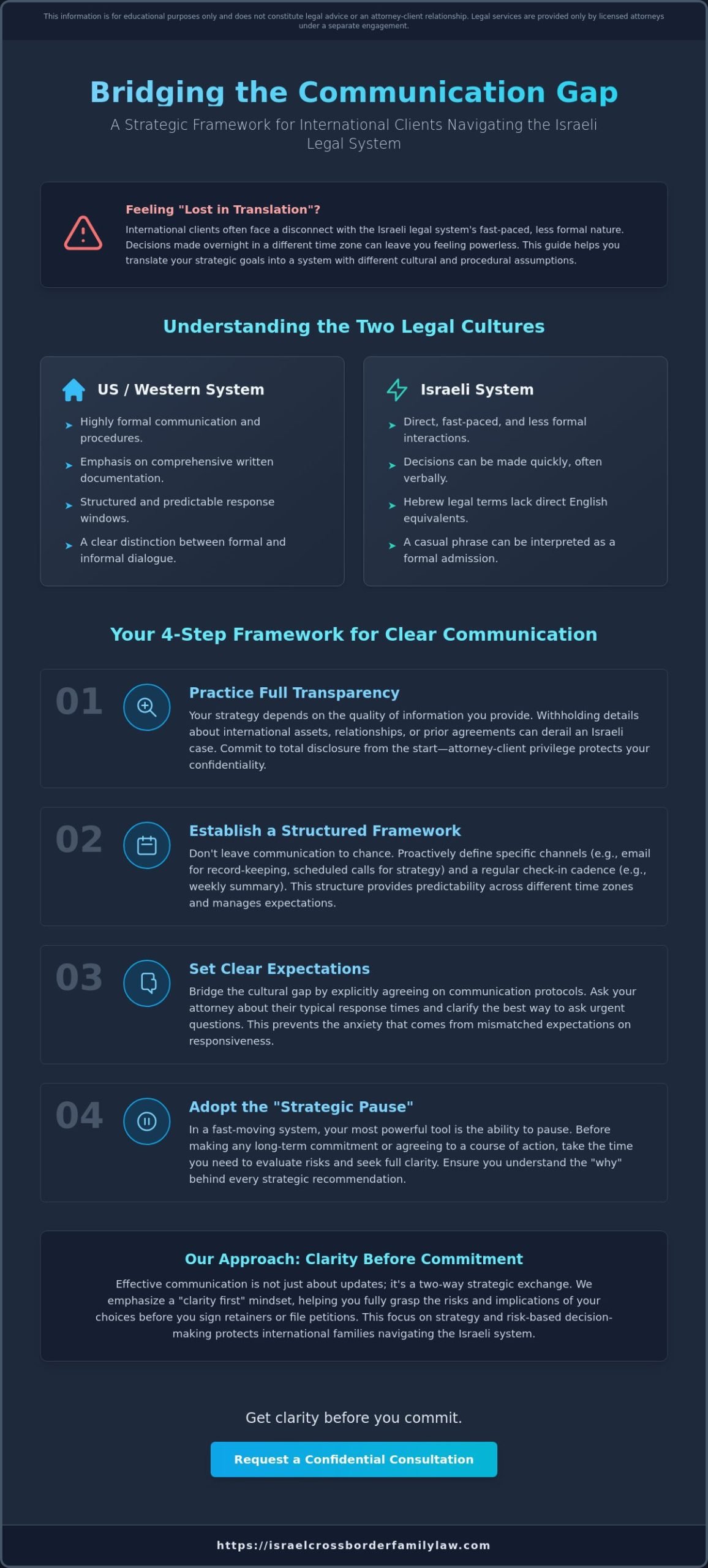
- Learn how to ensure clear communication with my lawyer by practicing full transparency, as withholding details about international assets can significantly derail an Israeli case.
- Bridge the cultural gap between formal US legal standards and the direct nature of the Israeli system by setting clear expectations for response windows.
- Establish a structured framework for your matter by defining specific communication channels and a regular check-in cadence to manage time zone challenges.
- Adopt a strategy of the “strategic pause,” allowing you to evaluate risks and seek clarity before making any long-term legal commitments.
The Critical Role of Communication in Cross-Border Legal Matters
This article is published on an independent advisory platform and is not a law firm. The content provided is for educational purposes only and does not imply an attorney-client relationship. Legal services are only provided by licensed attorneys under a separate engagement.
Communication in a legal context is often misunderstood as a simple series of status updates. In reality, effective legal communication is a two-way strategic exchange of information and expectations. It’s the process of ensuring that your attorney understands your personal or financial goals as clearly as you understand the risks they describe. Learning how to ensure clear communication with my lawyer is the most critical step you can take when managing a case from abroad. This dialogue relies on the foundational principle of attorney-client privilege, which ensures that your disclosures remain confidential; this allows for the total honesty needed to build a resilient strategy.
To better understand this concept, watch this helpful video:
Cross-border cases involving Israel and the US carry a significantly higher risk of miscommunication than domestic matters. These two systems operate on different procedural and cultural assumptions. Early decisions based on poor communication can have irreversible impacts on international assets, custody arrangements, or estate distributions. A minor detail lost during the initial stages of a case can manifest as a major tactical error months later in an Israeli courtroom. You don’t want to discover that a phrase you used casually has been interpreted as a formal legal admission under Israeli civil procedure.
Why Cross-Border Communication is Different
Navigating two sets of laws simultaneously requires more than just a bilingual attorney. It requires a translator of legal cultures. Hebrew legal terms often lack a direct equivalent in the US system. A concept that sounds like “plain English” might actually carry a specific, technical meaning in Israeli law that differs from your expectations. You must verify that your lawyer’s explanations align with the technical realities of the Israeli courts. This prevents the “lost in translation” effect that often plagues international families and expats who assume the Israeli system mirrors the American one.
Understanding the Advisory Approach
It’s vital to distinguish between legal representation in court and strategic advisory services. Our approach emphasizes a “clarity first” mindset. We believe you should fully grasp the implications of your choices before signing long-term commitments or filing petitions. By focusing on strategy and risk-based decision-making, we help you bridge the gap between your current situation and your desired outcome. You can learn more about the advisory and how this perspective protects international families dealing with the Israeli system.
Establishing a Framework for Transparency and Organization
A successful legal strategy in Israel depends entirely on the quality and accuracy of the information you provide. Transparency is the most effective tool in your arsenal, particularly when dealing with family law or estate matters that span multiple jurisdictions. Many clients hesitate to share details they find embarrassing or irrelevant. However, in a cross-border context, these omissions can lead to catastrophic tactical errors. If you are wondering how to ensure clear communication with my lawyer, the answer begins with a commitment to total disclosure before the first document is filed.
The Israeli court system takes a dim view of parties who fail to disclose assets held abroad. Whether it’s a 401(k) in the US, a family trust, or real estate in another state, withholding this information often backfires. If these assets are discovered later, it doesn’t just impact the financial outcome; it destroys your credibility with the judge. Providing a comprehensive list of all global interests at the outset allows your counsel to build a strategy that accounts for every variable and protects your long-term interests.
To streamline the process, prepare a written “Case Summary” before your initial consultation. This document should outline the timeline of events, key parties involved, and your primary objectives. It serves as a roadmap that ensures your attorney focuses on the most critical elements of your situation from day one. It also reduces the time spent on basic fact-finding, allowing more resources to be allocated to strategic planning.
Organizing Multi-Jurisdictional Documents
Managing a case across borders requires a centralized digital file. You should categorize your documentation by country to prevent jurisdictional confusion. This organization is vital when your lawyer needs to reference foreign tax returns or US-based trusts.
- Financials: Group Israeli bank statements separately from US brokerage accounts.
- Translation: Professional translations are necessary for court filings, but a simple English summary may suffice for initial internal reviews.
- Log of Communications: Keep a record of your interactions with foreign banks or legal entities to share with your Israeli counsel.
Honesty as a Risk Management Tool
Your lawyer needs to identify the weak points in your case immediately. It’s better for your counsel to hear about a potential problem from you than from the opposing side during a hearing. Avoiding the exaggeration trap is essential; you must stick to verifiable facts rather than emotional interpretations. This level of honesty enables risk-based decision-making. You can then weigh the costs of litigation against the likelihood of success with a clear head. If you need a professional perspective on your specific situation, you can request a confidential case review to begin the process.
Bridging the Gap Between Israeli and US Legal Cultures
The transition from the US legal system to the Israeli one often feels jarring for many international clients. While the US system relies on rigid formality and predictable procedural steps, the Israeli environment is notably more direct and less formal. This cultural shift can lead to misunderstandings if you aren’t prepared for the “Dugri” or straightforward style of communication common in Israel. Understanding how to ensure clear communication with my lawyer requires recognizing that your attorney’s directness isn’t a lack of professionalism. It is a reflection of local efficiency. By adjusting your expectations, you can focus on the strategic substance of your case rather than being distracted by the difference in tone.
Managing the time zone gap between New York and Tel Aviv is another practical hurdle. With a seven-hour difference, your Israeli counsel is often ending their workday just as your morning begins in the US. You should set clear expectations for response windows early in the process. A multi-qualified practitioner acts as a critical bridge in these scenarios. They understand the urgency of US-based clients while operating within the rhythm of the Israeli courts. These professionals can translate not just the language, but the underlying intent of legal actions across both jurisdictions.
Legal terminology often carries different weights across borders. For example, the term “alimony” is frequently used in the US to describe spousal support. In Israel, the concept of “Mezonot” primarily focuses on child support. The rules governing spousal support are deeply tied to whether a case is heard in a civil or religious court. Misinterpreting these terms can lead to incorrect assumptions about your financial obligations or rights. It’s vital to ask for a “translation of impact” rather than just a literal word-for-word translation.
Cultural Nuances in Legal Strategy
The Israeli court, or “Bet Mishpat,” operates under an adversarial system but lacks the jury trials common in the US. All judicial proceedings are bench trials where decisions are made entirely by judges. You must also consider the dual-track system of civil and religious courts. The Knesset passed the Religious Courts Arbitration Bill in 2026. This law expanded the authority of Rabbinic and Sharia courts to act as arbitrators in certain civil matters by mutual consent. Discussing the “forum risk” between these systems with your counsel is essential to protect your international assets.
Navigating Language Barriers
Even if you speak some Hebrew, legal Hebrew is a specialized dialect. You should insist on written summaries in English for every Hebrew court filing. Assuming a term in English means the same thing in the Israeli context is a significant risk. For example, procedural deadlines in Israel can be more rigid than you might expect based on US experiences. We provide tailored cultural guidance for expats and foreign nationals to ensure you aren’t caught off guard by these procedural differences.
A Step-by-Step Guide to Managing Your Legal Communication
- Step 1: Define your primary communication channel. While WhatsApp is ubiquitous in Israeli culture, it is often better to use email for substantive legal records. Choose one platform for formal updates and stick to it.
- Step 2: Establish a regular check-in cadence. Determine how often you will receive updates. This prevents the anxiety that often arises during quiet periods when the court is in recess or documents are being processed.
- Step 3: Prepare a written agenda. Before every meeting or call, send a brief list of the points you wish to discuss. This ensures that your time is used efficiently and that your primary concerns are addressed.
- Step 4: Confirm understanding by echoing advice. After your lawyer provides a strategy, repeat it back in your own words. This “echoing” technique is vital for catching cultural nuances or technical misunderstandings early.
- Step 5: Document every major decision. Keep a log of what was decided and the reasoning behind it. Under Israel Bar Association regulations, you should already have a written fee agreement; use this as the foundation for documenting all further substantive changes to your case strategy.
Making the Most of Your Consultation
During your meetings, shift your focus toward risk management. Instead of asking “Will I win?”, ask “What are the specific risks involved in this path?”. This allows you to make decisions based on strategy rather than emotion. Clarifying the fee structure early is also essential to prevent communication breakdowns over billing. Transparency regarding costs allows both parties to focus on the legal objectives. You can review our pricing and how it works page for further tips on maintaining financial clarity throughout your matter.
Leveraging Technology for Clarity
Modern technology offers powerful tools for maintaining organization in cross-border cases. Shared drives or project management platforms are excellent for tracking the volume of documentation required for international divorce or estate cases. We also utilize video updates to explain complex concepts that might be difficult to grasp through text alone. You can find several examples of these explanations on our YouTube channel. Finally, ensure that you are using secure, private channels when discussing sensitive family matters to protect your confidentiality across jurisdictions. If you are ready to establish a clear strategy for your case, contact us to begin the process.
This article is published on an independent advisory platform and is not a law firm. The information provided is for educational purposes only and does not constitute an attorney-client relationship or legal advice. Legal services are only provided by licensed attorneys under a separate engagement.
Strategic Decision-Making: Seeking Clarity Before Commitment
In the high-pressure environment of cross-border legal disputes, the impulse to act quickly often overrides the need for strategic alignment. However, the most successful outcomes in Israeli law are rarely the result of hasty reactions. We advocate for the “Strategic Pause,” a deliberate period of reflection where you ensure that every implication of a proposed action is fully understood. Developing this habit of pausing to verify facts and consequences is a fundamental part of how to ensure clear communication with my lawyer. It prevents you from committing to a path that might satisfy an emotional need today but creates a significant legal vulnerability tomorrow.
Strategic decision-making requires you to pivot from emotional reactions to risk-based assessments. In cross-border matters, an emotional response can cloud your judgment regarding jurisdictional advantages or financial trade-offs. Clear communication facilitates a smoother transition between the legal expectations of the US and the procedural realities of Israel. When you and your counsel are in total sync, you can navigate the complexities of international asset division or multi-state estate planning with a cohesive vision. This alignment ensures that your Israeli strategy does not inadvertently compromise your legal standing or tax obligations in the United States.
The Impact of Early Decisions
A single miscommunicated detail during the initial phase of a case can have a profound impact on your rights in both jurisdictions. For instance, the “first to file” rule in Israel creates a jurisdictional race that often dictates which court system will hear your case. If you fail to communicate the full scope of your US-based interests, you might file in a venue that is less favorable for your specific asset structure. This is particularly critical in divorce for international families, where the choice between a civil family court and a religious tribunal can change the outcome of your property distribution. Absolute clarity between client and lawyer is the only way to manage these “forum risks” effectively.
Your Path Forward
Our advisory stance is built on the belief that education leads to empowerment. By understanding the mechanics of the Israeli system and the cultural nuances of its practitioners, you transition from being a passive participant to an informed partner in your legal journey. You should feel confident asking for clarification until the strategy makes sense in both Hebrew and English contexts. Please remember that this information is an educational resource and is not a substitute for licensed legal representation. Every cross-border situation is unique and requires specific analysis by a qualified professional.
Get clarity before you commit. Request a confidential consultation.
This article is published on an independent advisory platform and is not a law firm. The information provided is for educational purposes only and does not constitute an attorney-client relationship or legal advice. Legal services are only provided by licensed attorneys under a separate engagement.
Securing Your Strategy Through Effective Dialogue
Navigating the intersection of Israeli and US legal systems requires more than just legal skill; it demands a disciplined approach to information exchange. By centralizing your multi-jurisdictional documentation and practicing total transparency, you provide your counsel with the tools needed to protect your global assets. We’ve explored how a strategic pause and a risk-based mindset prevent emotional reactions from derailing your long-term objectives. When you understand how to ensure clear communication with my lawyer, you transform the inherent complexity of cross-border family law into a structured, manageable process.
Our advisory-first approach is specifically tailored for the English-speaking international community, providing authoritative cross-border expertise that bridges the gap between different legal cultures. We focus on risk management to ensure your voice is heard and your strategy remains robust. Empower yourself with knowledge before making life-altering decisions in a system that may still feel unfamiliar. You don’t have to manage these challenges alone.
Get clarity before you commit. Request a confidential consultation.
This article is published on an independent advisory platform and is not a law firm. The information provided is for educational purposes only and does not constitute an attorney-client relationship or legal advice. Legal services are only provided by licensed attorneys under a separate engagement.
Frequently Asked Questions
What should I do if I don’t understand the Hebrew documents my lawyer sent?
You should request a written summary in English for every Hebrew court filing or legal document. Signing a document you don’t fully comprehend is a significant procedural risk in the Israeli system. While your lawyer can explain the general intent, a professional translation is often necessary for complex agreements to ensure your specific interests are protected across both jurisdictions.
How often should I expect updates from my lawyer in a cross-border case?
You can expect updates based on a pre-defined check-in cadence established at the beginning of your matter. Cross-border cases often involve long quiet periods while waiting for court dates or international document verification. Setting a monthly or bi-weekly update schedule helps manage expectations and reduces anxiety during these procedural gaps without incurring unnecessary billing for constant status checks.
Is it okay to ask my lawyer about their experience with the US legal system?
It is highly recommended to ask your lawyer about their specific experience with the US legal system. Understanding how to ensure clear communication with my lawyer often depends on their ability to translate Israeli legal concepts into a context you already understand. A practitioner who is familiar with both jurisdictions can better identify potential conflicts between Israeli court orders and US-based assets or custody arrangements.
Can I use WhatsApp to communicate with my lawyer in Israel?
You can use WhatsApp for brief logistical updates, as it is a standard tool in Israeli business culture, but you should use email for all substantive legal records. Email provides a searchable, formal trail of advice and decisions that is essential for complex family law or estate matters. Relying solely on messaging apps for strategic discussions can lead to lost details and a lack of procedural clarity.
What are the risks of not being fully honest with my legal counsel?
The primary risk of withholding information is the total loss of credibility with the Israeli judge if the details emerge later. In family law matters, the court prioritizes full disclosure of global assets. If the opposing side reveals a weak point or a hidden US asset that you didn’t share with your counsel, it can derail your entire strategy and lead to unfavorable rulings that are difficult to appeal.
How do I handle the time difference when my lawyer is in Israel and I am in the US?
You should establish specific windows for calls that align with both New York and Tel Aviv work hours. Managing the seven-hour time difference requires a proactive approach to scheduling. By using the strategic pause mentioned earlier, you can review evening updates from Israel and respond the following morning, ensuring that decisions are made with clarity rather than under the pressure of an immediate time gap.
Should I have a separate lawyer in the US and Israel for the same case?
You might need separate counsel if you have active legal proceedings or significant assets in both countries that require local representation. However, your Israeli counsel should act as the primary strategist for the Israeli portion of your case. Ensuring that your US and Israeli teams are collaborative prevents conflicting legal maneuvers that could inadvertently trigger negative tax or jurisdictional consequences in either state.
How can I keep my legal costs down through better communication?

Article by
Gabriel Lior
A Personal Journey That Became a Mission
The advisory was founded by an American father Gabriel Lior, LLB, MBA , global entrepreneur, and cross-border advisor who spent more than a decade navigating the Israeli family court system firsthand and now lives in Singapore with his son.
As a divorced parent in a cross-border family, Gabriel faced nearly every legal challenge a foreign parent can encounter in Israel — including child custody disputes, child support proceedings, property matters in Israel and abroad, false accusations, and complex immigration and relocation proceedings.
Over the years, he learned the hard way how difficult it is for non-Israeli parents to understand the system, identify the right legal strategy, and choose the right legal representation — especially when language, culture, and jurisdictional differences are involved. He also witnessed how foreign parents and new immigrants are often disadvantaged or taken advantage of by service providers and institutions simply because they lack local knowledge or fluency.
From Client to Advisor
To truly understand — and survive — the system, Gabriel pursued formal legal education in Israel, completing two Israeli law degrees, alongside a BA and MBA earned in the United States. This was never about becoming a practicing attorney, but about gaining a deep, structural understanding of how the system works — and where it breaks down for foreign parents.
This rare combination of:
Firsthand client experience
Israeli legal and US business education
International business and negotiation training
Decades of commercial execution
created a unique perspective – one that understands both sides of the table.
After years of litigation, persistence, and at times self-representation, he ultimately succeeded in securing custody of his son and relocating abroad through a rare legal victory in the Israeli Supreme Court — becoming one of the first fathers in Israel to do so under these circumstances.
Disclaimer
Important Disclaimer:
The information provided on this website and in its content is for general informational and educational purposes only and does not constitute legal advice, legal opinion, or legal representation.
Gabriel Lior is not licensed to practice law in Israel (nor is he interested in doing so) and does not provide legal services, despite having completed 2 Law Degrees. The services offered are advisory in nature and are intended to provide general guidance, strategic insight, and information regarding cross-border family law considerations.
No attorney-client relationship is formed by accessing this website, reading its content, or communicating with us.
Any decisions made based on this information are at your own discretion and risk. For legal advice specific to your situation, you should consult a licensed attorney in the relevant jurisdiction.
Where appropriate, we may refer clients to independent, licensed attorneys or professionals. Such referrals do not constitute legal representation and no liability is assumed for services provided by third parties.