This article is published on an independent advisory platform and does not constitute a law firm or an attorney-client relationship. Legal services are only provided by licensed attorneys under a separate engagement.
A divorce decree issued by a court in London, New York, or Toronto is not a “passport” that grants automatic legal status the moment you enter Israel. Many international families mistakenly believe that their existing court orders regarding property or support will be immediately honored, only to find themselves stalled by the unique complexities of the local system. Learning how to enforce foreign divorce decree in israel is a critical step for anyone looking to protect their assets or secure financial support within the country. It’s natural to feel anxious about the interaction between civil and religious jurisdictions, especially when your future stability depends on a document issued thousands of miles away.
This guide provides the clarity you need to navigate the Foreign Judgments Enforcement Law, 5718-1958, and the specific requirements of the Israeli Family Court. You’ll learn about the essential documentation needed for recognition, the typical two to four month timeline for uncontested cases, and how to manage the dual-track system between civil and rabbinical authorities. We will outline the strategic steps to ensure your international judgment is legally binding, helping you move forward with confidence. For more visual guidance, you can also explore our resources at https://www.youtube.com/@IsraelFamilyLaw. Get clarity before you commit. Request a confidential consultation.
Key Takeaways
- Understand why foreign decrees are not automatically valid in Israel and how the 1958 Law serves as the primary legal framework for recognition.
- Learn how to enforce foreign divorce decree in israel by meeting the four mandatory legal conditions, including proof of jurisdiction and the finality of the judgment.
- Identify the critical differences between status recognition in the Family Court and the religious requirements often mandated by the Rabbinical Court.
- Discover the practical steps for filing a Motion to Enforce, including the necessity of certified translations and proper Apostille authentication.
- Gain a strategic perspective on managing cross-border risks to help you decide whether to enforce an existing order or pursue a new legal path.
Understanding the Foreign Judgments Enforcement Law in Israel
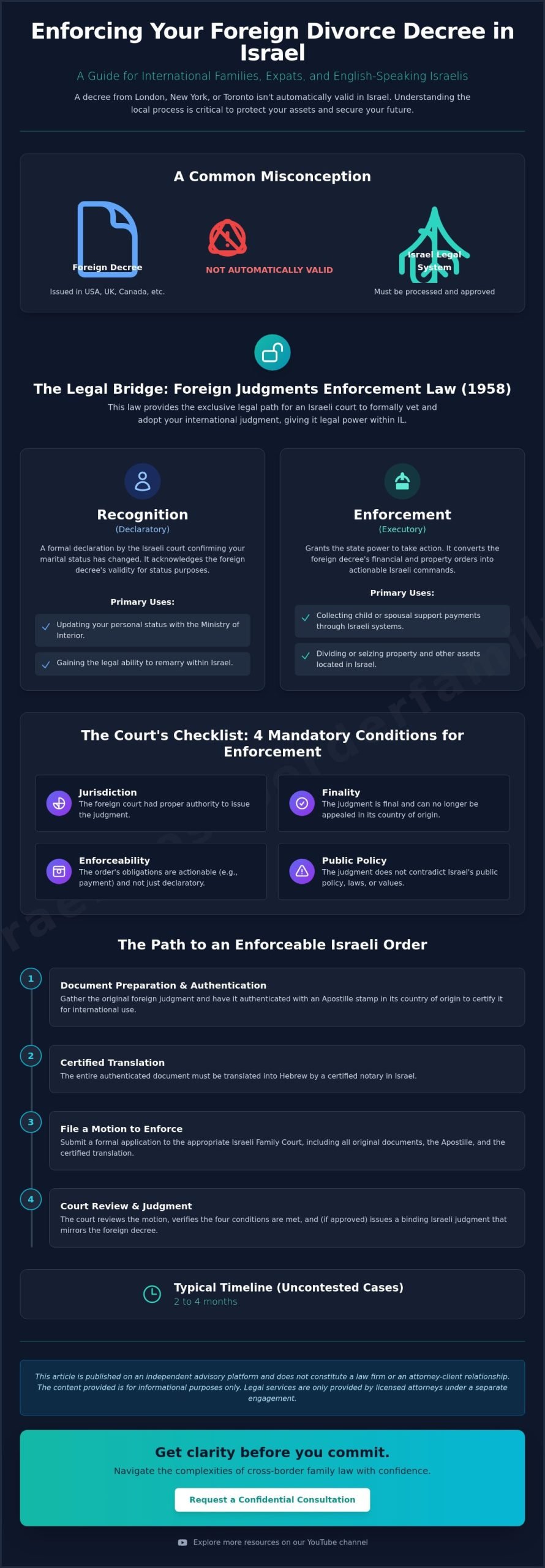
The legal framework for bringing an international court order into the Israeli system is governed by a specific piece of legislation known as the Foreign Judgments Enforcement Law, 5718-1958. This law ensures that the Israeli legal system maintains its integrity while acknowledging the global nature of modern family life. It’s a common misconception that a divorce decree from a foreign jurisdiction is automatically valid once you land at Ben Gurion Airport. In reality, the Israeli court acts as a strategic gatekeeper. Every foreign order must pass through a formal vetting process to ensure it aligns with local standards and public policy before it can be used for local legal purposes.
The process of enforcement of foreign judgments involves more than just translating a document. It requires a clear understanding of whether you are seeking “recognition” or “enforcement.” Recognition is a declaratory process where the court confirms your marital status has changed, which is vital for updating your registration with the Ministry of Interior. Enforcement, however, is executory. It allows the state to take action, such as seizing assets or collecting payments based on the foreign decree. Understanding how to enforce foreign divorce decree in israel starts with identifying which of these paths is necessary for your specific situation.
To better understand how these principles apply in practice, watch this helpful video regarding the general mechanics of foreign judgment enforcement:
For families navigating divorce and separation for international families, the 1958 Law provides the only legal bridge between two divergent systems. Without this formal recognition, a foreign judgment remains a piece of paper with no authority over Israeli banks, schools, or government offices. The court will examine if the foreign court had the authority to issue the ruling and if the process was fair to both parties. This scrutiny protects the rights of all involved and ensures that the final Israeli order is robust and reliable for future planning.
The CrossBorder Advisory Snippet
This article is published on an independent advisory platform, not a law firm. The content provided is for informational purposes only and does not create an attorney-client relationship. Legal services are only provided by licensed attorneys under a separate engagement.
Why Enforcement Matters for Expats
For the international community in IL, the stakes of successful enforcement are high. Without a recognized divorce, you cannot legally remarry within the country. Additionally, if your foreign decree dictates the division of property located in Tel Aviv or Jerusalem, the Land Registry won’t update the title without an Israeli court order. Perhaps most critically, cross-border child support enforcement relies entirely on the local court’s willingness to adopt the foreign financial obligations. Securing this recognition early prevents future delays and provides the legal clarity needed to build a new life in Israel.
This article is published on an independent advisory platform and does not constitute a law firm or an attorney-client relationship. Legal services are only provided by licensed attorneys under a separate engagement.
The Four Essential Conditions for Enforcement
For an Israeli court to adopt a foreign judgment, the petition must satisfy four cumulative conditions set forth in the Foreign Judgments Enforcement Law. These requirements serve as a protective framework to ensure that the order is compatible with the local legal environment. If you are researching how to enforce foreign divorce decree in israel, you must first verify that your original judgment meets these standards. The court will not re-try the case; instead, it will audit the decree to ensure it possesses the necessary legal weight.
- Jurisdiction: The court that issued the original decree must have had the legal authority to do so according to its own laws. It must also align with international private law principles recognized in IL.
- Finality: The decree must be “final” and no longer subject to appeal in the country of origin. If a case is still active or the appeal window remains open, the Israeli court will typically wait for a conclusive result.
- Enforceability: The order must be capable of being executed in the state where it was given. An expired or stayed order cannot be revived by bringing it to Israel.
- Reciprocity: This principle, often called “comity,” implies that Israel enforces judgments from countries that show the same respect to Israeli court orders.
Deep Dive into Reciprocity and US Judgments
The relationship between Israeli courts and United States jurisdictions is generally built on high levels of mutual respect. Because most US states regularly recognize and enforce Israeli judgments, Israeli courts typically find that the reciprocity requirement is met for American decrees. This spirit of comity allows for a smoother transition of legal status for many expats and foreign nationals living in IL. While reciprocity is a standard requirement, Israeli courts maintain the legal discretion to waive this condition if they believe it is necessary to serve the interests of justice.
Defenses Against Enforcement
Even if the four primary conditions are met, the other party may raise specific defenses to block the enforcement. The most common defense is the “Public Policy” exception. This occurs if a foreign order contains provisions that fundamentally contradict Israeli values or basic legal principles. For example, a property division that is deemed extremely predatory might face scrutiny. Other defenses include a lack of due process, such as a spouse proving they were never properly served with the original papers, or the existence of a contradictory judgment already issued by an Israeli court. Fraud in obtaining the original judgment is also a significant barrier to recognition. You may find it helpful to request a confidential case review to understand how these defenses might apply to your specific situation.
This article is published on an independent advisory platform and does not constitute a law firm or an attorney-client relationship. Legal services are only provided by licensed attorneys under a separate engagement.
Recognition vs. Enforcement: Navigating the Dual Court System
Understanding the distinction between recognition and enforcement is vital for any expat managing a cross-border separation. Recognition, or a “declaratory” judgment, is the court’s official acknowledgment that your foreign divorce is valid. This allows you to update your marital status in the population registry. Enforcement, on the other hand, is “executory.” This means the court gives the state the power to take action, such as garnishing wages for support or transferring title to a home. When analyzing how to enforce foreign divorce decree in israel, you must determine which level of legal intervention your specific situation requires.
For many divorce for international families, the process involves a unique interplay between two distinct systems. While the civil Family Court handles most practical matters, the religious courts maintain exclusive authority over the personal status of citizens. This dual system can create layers of complexity that don’t exist in most Western jurisdictions. Strategic planning is required to ensure that a victory in the civil arena isn’t undermined by a status issue in the religious court.
The Role of the Family Court
The Israeli Family Court is a civil institution that focuses on the practical and financial aspects of a divorce. If your foreign decree involves property division, debt allocation, or child custody, this is where the motion for enforcement will be heard. The court evaluates these requests through the lens of the “best interests of the child.” This is a universal standard, but its application in IL can differ from what you might expect in London or New York. For a more detailed look at these court procedures, you can view the educational content on our YouTube channel at https://www.youtube.com/@IsraelFamilyLaw. The goal is to provide a stable legal environment where foreign orders are integrated into the local system without compromising the welfare of the family members involved.
Rabbinical Court Considerations
Jewish expats must be aware that a civil divorce decree from abroad does not automatically permit them to remarry within the Jewish faith in Israel. The Rabbinical Court holds exclusive jurisdiction over the “status” of Jewish residents. Even after a successful civil enforcement, a religious divorce, or “Get,” may still be required. Conflicts can arise if a foreign decree attempts to settle religious matters or if the timing of the civil filing triggers a jurisdictional dispute. It’s often safer to address these religious requirements early in the process to avoid future legal roadblocks. Decisions made in the early stages of recognition can have lasting impacts on your ability to move forward with your personal life in IL.
This article is published on an independent advisory platform and does not constitute a law firm or an attorney-client relationship. Legal services are only provided by licensed attorneys under a separate engagement.
Step-by-Step: The Process of Filing a Motion to Enforce
Once you understand the legal landscape, the focus shifts to the practical implementation of the 1958 Law. The formal process begins with filing a “Motion to Enforce,” known in Hebrew as a Bakasha L’achifa. This petition is submitted to the Family Court and must clearly outline how the foreign judgment meets the four essential conditions discussed earlier. It’s a procedural bridge that requires meticulous attention to detail; a single missing document can stall the recognition of your status for months. Knowing how to enforce foreign divorce decree in israel involves coordinating between the court that issued the order and the Israeli judicial administration.
Documentation Requirements
The foundation of your motion is a certified copy of the original foreign divorce decree. This document must carry an Apostille from the issuing country. An Apostille is a specialized certificate that authenticates the origin of a public document. Without this authentication, the Israeli court has no way of verifying that the foreign decree is a legitimate government record. It’s a non-negotiable requirement for all international submissions.
Contrary to common misconceptions, a Hebrew translation is almost always required for family law matters in IL. The court must be able to verify every clause regarding property, custody, or financial obligations. These translations must be professionally prepared and notarized to ensure accuracy. This is especially critical in cases involving child support cross-border enforcement, where precise wording determines how much will be collected through the local Execution Office.
Timeline and Expectations
While every case is unique, an uncontested motion for recognition typically takes between two to four months to complete. This timeline assumes that all documents are in order and there is no active opposition from the other spouse. If the other party challenges the motion, the process can extend significantly as the court reviews defenses like lack of due process or public policy violations. Early decisions, such as ensuring proper service of process on the other party, can prevent these delays from derailing your plans.
The complexity of these cross-border filings means that small errors can have a lasting impact on your legal standing. It’s often helpful to speak with a professional who understands both the foreign and Israeli systems. To begin organizing your documents correctly, you can reach out for a confidential review of your case.
This article is published on an independent advisory platform and does not constitute a law firm or an attorney-client relationship. Legal services are only provided by licensed attorneys under a separate engagement.
Strategic Risk Management in Cross-Border Family Law
Managing a separation across two different legal systems is less about simple document filing and more about long-term risk management. Many expats assume that enforcement is the only available path, yet choosing how to enforce foreign divorce decree in israel requires a careful evaluation of your specific goals. You must consider the cost-benefit ratio of enforcing an existing foreign order versus filing a new claim within the Israeli system. If a foreign decree is missing critical elements or was issued by a court with questionable jurisdiction, the resources spent attempting to fix those gaps might outweigh the benefits of starting fresh in IL. Seeking a confidential case review early in the process helps clarify these strategic options before you commit to a specific course of action.
The differences between US and Israeli litigation cultures also play a significant role in your decision. US proceedings are often formulaic and heavily reliant on rigid procedural rules. In contrast, the Israeli Family Court operates with broader judicial discretion and focuses on the current reality of the family living in IL. Understanding these cultural nuances prevents the frustration that often arises when an international family expects the Israeli system to mirror their experience in a foreign court. Strategy-first thinking ensures that your local legal standing is robust enough to support your future financial and personal plans.
Identifying Risks Early
One of the most significant dangers in cross-border cases is the “jurisdictional race.” This occurs when both spouses attempt to secure a judgment in different countries to gain a tactical advantage. If you delay the recognition of your foreign decree in Israel, you risk the other spouse filing a new claim locally that could contradict your existing order. This often leads to “limping marriages,” a situation where you are legally divorced in your home country but remain married under Israeli law. Such a status creates immense legal complications regarding taxes, inheritance, and the ability to remarry. Identifying these risks early allows you to close the gap between the two legal systems before a conflict arises.
Leading Toward an Informed Choice
There is a fundamental difference between receiving legal advice on a specific filing and engaging in a strategic advisory process. A risk-based approach prioritizes your long-term stability over emotional litigation. Expats who succeed in navigating the Israeli system are those who move beyond the initial stress of the divorce and focus on the practical impact of every court decision. By evaluating the inherent complexity of cross-border situations, you can make an informed choice that protects your assets and your children. Get clarity before you commit. Request a confidential consultation.
This article is published on an independent advisory platform and does not constitute a law firm or an attorney-client relationship. Legal services are only provided by licensed attorneys under a separate engagement.
Moving Forward with Legal Clarity in Israel
Successfully integrating an international judgment into the Israeli judicial system requires more than simple administrative filing; it demands a strategic bridge between divergent legal cultures. By ensuring your decree meets the essential conditions of the 1958 Law and addressing the unique requirements of both civil and religious courts, you can protect your assets and stabilize your personal status. Understanding how to enforce foreign divorce decree in israel is the first step toward preventing legal complications and ensuring long-term financial security for your family.
Our advisory platform draws on the expertise of practitioners with a physical presence in both Tel Aviv and New York. This multi-jurisdictional perspective is specifically tailored for the needs of Anglo and expat families who require steady, authoritative guidance in complex cross-border matters. We focus on providing the strategic insight necessary to navigate the dual court system with confidence. Get clarity before you commit. Request a confidential consultation today. You can achieve the legal certainty you need to build your future in Israel with the right strategy in place.
This article is published on an independent advisory platform and does not constitute a law firm or an attorney-client relationship. Legal services are only provided by licensed attorneys under a separate engagement.
Frequently Asked Questions
Is a US divorce decree automatically valid in Israel?
No, a US divorce decree is not automatically valid upon your arrival in IL. You must petition the Israeli Family Court for a formal recognition order to update your marital status in the population registry or to enforce financial obligations. Without this judicial step, the Ministry of Interior will continue to list you as married, which can complicate tax filings and inheritance matters.
What is an Apostille and do I need one for my divorce papers?
An Apostille is a specialized authentication certificate that verifies the origin of a public document for use in another country. You absolutely need one for your divorce papers to be accepted by Israeli courts or government offices. This certificate is issued by the state or national authority where your divorce was granted and serves as proof that the document is a legitimate court record.
Can I enforce a foreign child support order in Israel if my ex-spouse moved there?
Yes, you can enforce a foreign child support order through the Israeli judicial system. Once you have successfully navigated the steps of how to enforce foreign divorce decree in israel, the financial components can be executed via the local Execution Office. This allows for the collection of support through wage garnishment or other local enforcement mechanisms to ensure the children’s needs are met.
Do I need to translate my divorce decree into Hebrew for the Israeli courts?
Yes, a professional Hebrew translation is almost always a requirement for court submissions in IL. The judge must be able to review the exact terms of your property division and custody arrangements. These translations must be notarized to certify their accuracy, as the court relies on the precise wording of the foreign decree to issue a matching local enforcement order.
What happens if my foreign divorce decree contradicts an existing Israeli court order?
The Israeli court will generally refuse to enforce a foreign judgment if it contradicts a ruling already issued by a local court. This is one of the primary defenses against enforcement under the 1958 Law. If you have overlapping proceedings in multiple countries, it is critical to seek clarity early to avoid a situation where your foreign decree is rendered unenforceable in Israel.
How long does it take for an Israeli court to recognize a foreign divorce?
The process for recognition typically takes between two and four months for uncontested cases where all documentation is in order. If the other spouse opposes the motion or if there are complex jurisdictional disputes, the timeline can extend significantly. Providing a complete file with the necessary Apostilles and translations from the start is the best way to prevent unnecessary procedural delays.
Can the Rabbinical court refuse to recognize a civil divorce from abroad?
Yes, the Rabbinical Court maintains exclusive jurisdiction over the personal status of Jewish residents in Israel. While the civil Family Court may recognize your divorce for property and registry purposes, the Rabbinical Court may still require a religious divorce, or “Get,” before you are permitted to remarry within the country. This dual system requires a strategic approach to ensure your status is clear in both arenas.
What is the Foreign Judgments Enforcement Law of 1958?
This legislation is the primary framework that dictates how to enforce foreign divorce decree in israel. It establishes the mandatory conditions a foreign judgment must meet, such as being final and issued by a court with proper jurisdiction. The law acts as a safeguard, ensuring that international orders are compatible with Israeli public policy and legal standards before they are granted local power.

Article by
Gabriel Lior
A Personal Journey That Became a Mission
The advisory was founded by an American father Gabriel Lior, LLB, MBA , global entrepreneur, and cross-border advisor who spent more than a decade navigating the Israeli family court system firsthand and now lives in Singapore with his son.
As a divorced parent in a cross-border family, Gabriel faced nearly every legal challenge a foreign parent can encounter in Israel — including child custody disputes, child support proceedings, property matters in Israel and abroad, false accusations, and complex immigration and relocation proceedings.
Over the years, he learned the hard way how difficult it is for non-Israeli parents to understand the system, identify the right legal strategy, and choose the right legal representation — especially when language, culture, and jurisdictional differences are involved. He also witnessed how foreign parents and new immigrants are often disadvantaged or taken advantage of by service providers and institutions simply because they lack local knowledge or fluency.
From Client to Advisor
To truly understand — and survive — the system, Gabriel pursued formal legal education in Israel, completing two Israeli law degrees, alongside a BA and MBA earned in the United States. This was never about becoming a practicing attorney, but about gaining a deep, structural understanding of how the system works — and where it breaks down for foreign parents.
This rare combination of:
Firsthand client experience
Israeli legal and US business education
International business and negotiation training
Decades of commercial execution
created a unique perspective – one that understands both sides of the table.
After years of litigation, persistence, and at times self-representation, he ultimately succeeded in securing custody of his son and relocating abroad through a rare legal victory in the Israeli Supreme Court — becoming one of the first fathers in Israel to do so under these circumstances.
Disclaimer
Important Disclaimer:
The information provided on this website and in its content is for general informational and educational purposes only and does not constitute legal advice, legal opinion, or legal representation.
Gabriel Lior is not licensed to practice law in Israel (nor is he interested in doing so) and does not provide legal services, despite having completed 2 Law Degrees. The services offered are advisory in nature and are intended to provide general guidance, strategic insight, and information regarding cross-border family law considerations.
No attorney-client relationship is formed by accessing this website, reading its content, or communicating with us.
Any decisions made based on this information are at your own discretion and risk. For legal advice specific to your situation, you should consult a licensed attorney in the relevant jurisdiction.
Where appropriate, we may refer clients to independent, licensed attorneys or professionals. Such referrals do not constitute legal representation and no liability is assumed for services provided by third parties.