This article is published on an independent advisory platform and does not imply an attorney-client relationship. The content provided is for informational and advisory purposes only and does not constitute legal representation or legal advice. Legal services are only provided by licensed attorneys under a separate engagement.
The most talented legal translator in the world cannot help your case if they don’t hold the specific credentials required by the state. Many people assume that a high quality English-to-Hebrew translation is enough to satisfy a judge, but the reality is that the Israeli legal system follows very rigid authentication rules. If your documents aren’t processed correctly, your entire cross-border strategy could stall before it even begins. It’s a common frustration for international families and expats who find themselves caught between two different legal cultures and sets of terminology.
Finding court-certified translators, or more accurately, those who can provide a notarized translation, is a critical step in ensuring your US or Israeli documents are legally recognized. We understand the fear of having a petition rejected due to a simple paperwork error or a misunderstanding of local requirements. This practical guide provides a clear path to identifying and verifying the right professionals for your needs. We’ll explain the specific certification requirements for your case, detail the regulated fees for notary services, and help you avoid the common pitfalls that lead to costly delays in international legal matters.
Key Takeaways
- Identify the specific authentication standards, such as the “Affidavit of Accuracy,” required for your documents to be legally recognized in US and Israeli courts.
- Streamline your search by using official Ministry of Justice registries and specialized directories for finding court-certified translators with verified legal credentials.
- Protect your case by selecting professionals who understand the conceptual differences between legal terms like “alimony” and “mezonot” rather than just providing literal translations.
- Follow a structured step-by-step process to gather your original documents and secure quotes that include all necessary notary and certification fees.
- Integrate professional translation into your legal strategy early to avoid procedural delays and ensure your documents are ready for pre-trial negotiations.
This article is published on an independent advisory platform and does not imply an attorney-client relationship. The content provided is for informational and advisory purposes only and does not constitute legal representation or legal advice. Legal services are only provided by licensed attorneys under a separate engagement.
What is a Court-Certified Translator and Why is it Required?
When you are dealing with legal matters that cross borders, the language used in your documents must be more than just accurate; it must be legally “visible” to the court. A court-certified translator is a professional whose credentials and expertise have been vetted by a recognized legal or licensing body. This vetting process ensures the individual understands the specific legal frameworks of both jurisdictions. In many cases, finding court-certified translators is the only way to ensure that your foreign documents are accepted as valid evidence by a judge.
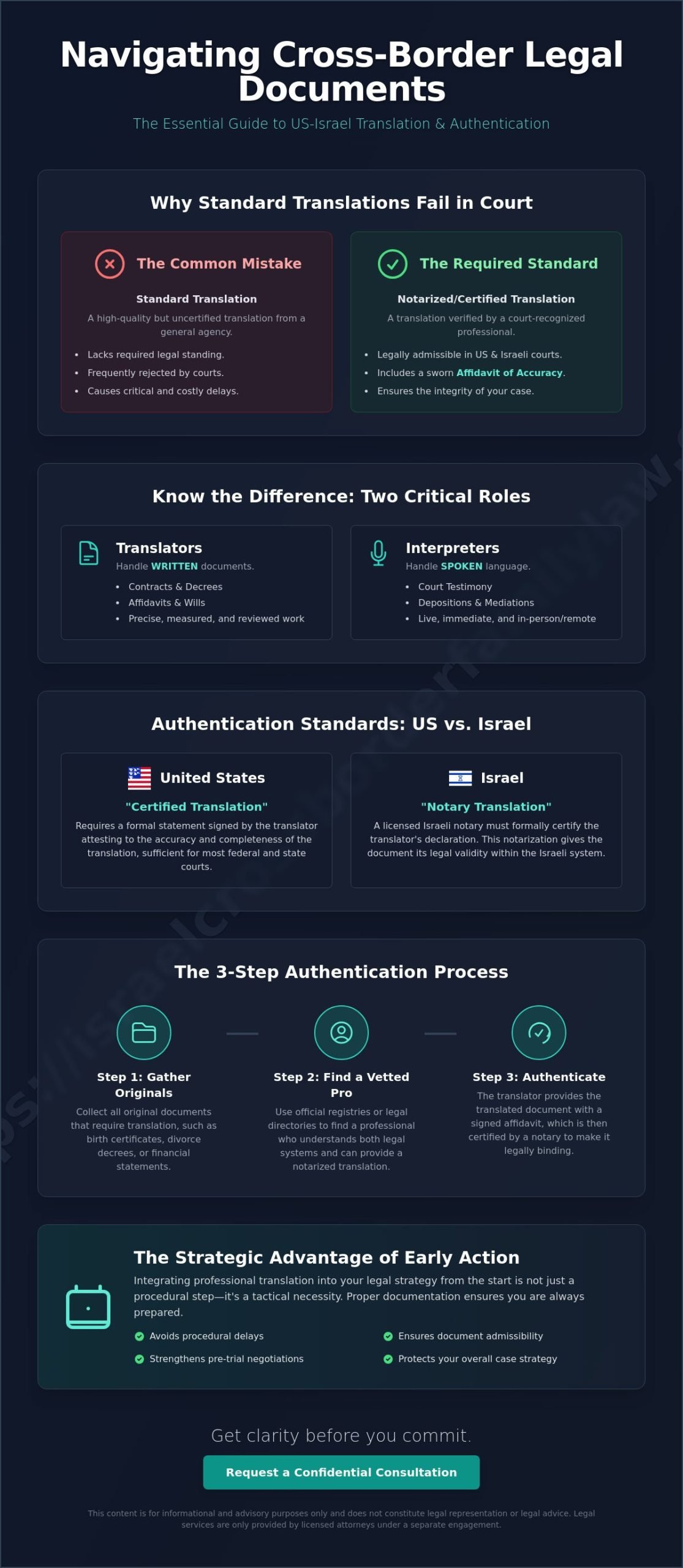
Standard translations provided by general agencies often fail in US-Israel proceedings because they lack a formal “Affidavit of Accuracy.” This affidavit is a sworn statement where the translator confirms, under penalty of law, that the translation is a complete and true representation of the original document. Without this, the court has no way to verify the integrity of the information. This requirement applies to a wide range of essential documents, including:
- Birth and marriage certificates
- Divorce decrees and settlement agreements
- Wills, trusts, and estate records
- Affidavits and witness statements
The translator’s role is to maintain the integrity of the legal record across different languages. They act as a neutral bridge, ensuring that the nuances of a legal argument aren’t lost in translation. In family law, a single word can change the interpretation of a custody agreement or a financial obligation. By using a certified professional, you ensure that the court sees exactly what was intended in the original document, preventing procedural delays or misunderstandings that could jeopardize your case.
Translators vs. Interpreters: Knowing the Difference
It’s helpful to distinguish between two distinct professional roles. Translators handle written documents such as contracts, decrees, and affidavits. Their work is measured and precise, often involving multiple drafts to ensure legal terminology is perfectly captured. Interpreters, however, handle spoken language during live events like court testimony, depositions, or mediation sessions. Because these roles require different skill sets, you may need to hire different professionals for each task to protect your interests in a cross-border case.
Legal Admissibility in Israel and the US
The Israeli legal system typically requires a “Notary Translation” for documents originating outside of IL. This process involves a licensed notary certifying the translator’s declaration. Similarly, US courts generally refuse to admit foreign-language evidence unless it is accompanied by a Certified translation that meets specific state or federal rules. A certified translation acts as a legal instrument that allows a foreign document to be admitted into evidence by providing a verified bridge between two different judicial systems.
Where to Search for Certified Translators for US-Israel Matters
Locating a professional who understands both the linguistic and legal nuances of the US-Israel corridor requires using specific, verified databases. Relying on a general search engine often leads to providers who lack the necessary credentials for court admissibility. To protect your legal interests, you should prioritize registries maintained by government bodies or recognized professional organizations. Finding court-certified translators through these official channels ensures that the individual has undergone a formal vetting process and maintains a professional standing within the legal community.
Specialized law firms handling cross-border matters often maintain their own private, vetted networks of linguists. These professionals are frequently chosen because they have a proven track record of handling complex international family law or estate documents. If you are unsure where to begin your search, you can request an advisory call to discuss how to align your translation needs with your broader legal strategy. Consular services, such as the US Embassy in Israel (IL), also provide lists of local translation providers, though they do not formally “certify” the work produced.
Finding Professionals in Israel (IL)
In Israel, the most reliable way to find a qualified professional is through the official registries provided by the Ministry of Justice. Because the Israeli legal system relies on notarized translations, you should search the national Notary database. It’s also beneficial to consult the Israel Translators Association (ITA), which allows you to filter members by their specific expertise in legal translation. Finding a translator who is licensed to practice or reside in Israel is often essential for local court filings, as they are familiar with the specific procedural requirements of the Israeli family court system.
US-Based Resources for Legal Translation
If your documents are being prepared for a US court, the American Translators Association (ATA) directory is the primary resource. You can filter your search by the Hebrew-English language pair and specifically look for “Certified” members. It’s important to distinguish between “Certified” and “Associate” members; certified members have passed a rigorous exam specifically for that language pair. Additionally, many state court systems, such as those in New York or California, maintain their own lists of certified court interpreters and translators who have met state-specific standards for legal accuracy and ethical conduct. Selecting a professional with these credentials reduces the risk of your evidence being challenged by opposing counsel.
Evaluating Specialization in International Family Law
The process of finding court-certified translators is a procedural necessity, but for international family law, it’s merely the starting point. Linguistic fluency does not guarantee that a professional understands the conceptual equivalence required for legal documents to hold weight in both jurisdictions. A translator might be able to read Hebrew and English perfectly, yet fail to capture the specific legal obligations inherent in a foreign decree. This is particularly true when dealing with the Hague Convention on Child Abduction or complex cross-border probate matters where precise terminology is a matter of law, not just language.
One major pitfall involves terms like “alimony.” In a US context, this is a well-understood civil concept. In Israel (IL), the closest equivalent is often “mezonot,” but this term carries different legal weight depending on whether the case is heard in a civil family court or a Rabbinical court. A generalist might use these terms interchangeably, potentially creating a procedural error where the translated document doesn’t actually reflect the original legal intent. Ensuring your translator understands these systemic differences is vital for a smooth divorce or separation process.
Subject-Matter Expertise: Beyond the Language
When you’re interviewing a potential professional, ask specifically about their experience with family law. A translator who spends their days on corporate mergers might struggle with the emotional and technical nuances of a custody agreement or a sensitive affidavit. You should verify if they understand the distinction between the authority of the Israeli Rabbinical Court and the Civil Family Court, as the language used in each can vary significantly. Confidentiality is also paramount; ensure the professional has secure protocols for handling sensitive personal data and family history.
Checking References and Legal Track Records
Don’t hesitate to ask for examples of redacted documents they’ve translated for court use. This allows you to verify they are familiar with the specific formatting requirements of the receiving jurisdiction, such as the way affidavits are structured in US federal courts versus Israeli courts. Providing the correct legal context is more important than achieving word-for-word accuracy in a translation. By reviewing their track record, you can confirm they have successfully navigated the complexities of international custody and relocation cases before. This due diligence ensures your cross-border strategy isn’t delayed by linguistic errors that a generalist might overlook.
This article is published on an independent advisory platform and does not imply an attorney-client relationship. The content provided is for informational and advisory purposes only and does not constitute legal representation or legal advice. Legal services are only provided by licensed attorneys under a separate engagement.
Step-by-Step: The Process of Document Translation and Authentication
Ensuring your international documents are admissible requires a specific sequence of actions. It’s not enough to simply produce a translated text; you must follow a chain of authentication that satisfies both the originating and receiving jurisdictions. The process of finding court-certified translators should begin as soon as you identify which documents are necessary for your case, as the authentication steps can add significant time to your legal schedule. Following a structured workflow helps prevent the procedural errors that often lead to document rejection.
- Step 1: Determine Requirements. Contact the receiving court or your legal advisor to confirm if they require a specific type of certification or if a digital Apostille is acceptable for your document type.
- Step 2: Request Comprehensive Quotes. Ensure the quote you receive covers the translation itself, the notary’s affidavit, and any government filing fees required for international authentication.
- Step 3: Verify Vital Data. During the translation phase, confirm that all names, dates, and places match your passports and original records exactly. Even a minor spelling variation between a Hebrew translation and an English passport can cause a court to reject the filing.
- Step 4: Complete the Authentication Chain. This involves obtaining the notary’s signature on the translator’s declaration followed by the necessary government Apostille.
- Step 5: Perform a Final Audit. Review the completed package for clerical errors, missing stamps, or incorrect word counts before formal submission.
The Role of the Notary in Israeli Translations
In the Israeli legal system, a “Notarized Translation” is distinct from a simple “Notarial Certification of a Signature.” When you’re managing divorce and separation for international families, the notary must specifically certify the translator’s affidavit of accuracy. This sworn statement confirms that the translator is proficient in both languages and that the Hebrew text is a faithful representation of the English original. This higher level of certification is what makes the document a valid legal instrument in the eyes of an Israeli judge, especially when dealing with sensitive family matters.
Ensuring Cross-Border Recognition with an Apostille
An Apostille is an international certification that authenticates the origin of a public document. It’s the final step required for your documents to be recognized between the US and Israel (IL). If your document is from the US, you must obtain the Apostille from the Secretary of State in the state where the document was issued. For documents issued in Israel, the Ministry of Foreign Affairs or the court system handles this process. Because government processing times vary, you should start this workflow at least several weeks before your scheduled court date. If you’re overwhelmed by these requirements, you can contact us to discuss how to manage these procedural steps as part of your broader cross-border strategy.
This article is published on an independent advisory platform and does not imply an attorney-client relationship. The content provided is for informational and advisory purposes only and does not constitute legal representation or legal advice. Legal services are only provided by licensed attorneys under a separate engagement.
Integrating Translation into Your Legal Strategy
Translation should never be treated as a mere clerical afterthought in cross-border litigation. It is a tactical component of your case. When you wait until the weeks before a hearing to begin the authentication process, you risk a “procedural ambush.” In these scenarios, the opposing party may challenge the validity of your evidence based on technicalities in the certification. This can lead to the court striking your documents from the record or forcing a costly postponement. Finding court-certified translators at the start of your case ensures that your evidence is legally “visible” and ready for use from the first filing.
There is also a significant risk in using “unofficial” or informal translations during pre-trial negotiations. While it’s tempting to use automated tools or bilingual friends to save time, these versions lack legal weight. If a negotiation is based on a misunderstood term, the subsequent formal translation may reveal a discrepancy that undermines your position. A cross-border advisor acts as a bridge during this phase, coordinating between your lawyers and linguists to ensure that the strategy discussed in English is accurately reflected in the Hebrew documents submitted to the court in Israel (IL).
The Impact of Early Decisions
A single poorly translated phrase can alter the trajectory of an entire case, particularly regarding international custody and relocation. In these sensitive matters, the difference between “visitation” and “parental responsibility” can have long-term legal consequences. Having your legal counsel review translations for strategic accuracy before they are notarized prevents these errors from becoming part of the permanent court record. Early decisions regarding which documents to prioritize for translation can also help you manage costs more effectively, as you avoid the surcharges often associated with express services.
Seeking Clarity Before Commitment
You should never sign a Hebrew document, such as a settlement agreement or a financial affidavit, if you don’t fully understand every clause through a certified English translation. Rushing into a commitment without linguistic clarity is one of the most common mistakes made by expats and international families. Our role at the advisory is to help you navigate these complexities with confidence. You can learn more about how we support families by visiting our page about the advisory. Professional guidance ensures that your documents serve your interests rather than creating new legal hurdles. Clarity and strategy must always come before the first word is translated.
Get clarity before you commit. Request a confidential advisory call or reach out via WhatsApp.
This article is published on an independent advisory platform and does not imply an attorney-client relationship. The content provided is for informational and advisory purposes only and does not constitute legal representation or legal advice. Legal services are only provided by licensed attorneys under a separate engagement.
Securing Your Cross-Border Legal Strategy
Navigating the complexities of the US-Israel legal landscape requires more than just bilingual skills; it demands a precise understanding of how two distinct judicial systems view evidence. Successfully finding court-certified translators is a vital step in ensuring your international legal documents, from divorce decrees to probate records, are recognized by the courts. By prioritizing subject-matter expertise and following the correct chain of authentication through notaries and the Apostille process, you protect your case from procedural delays and technical rejections.
The decisions you make early in your case regarding document preparation will have a lasting impact on your legal trajectory. We provide a calm, authoritative advisory for international families facing complex multi-jurisdictional challenges. Our focus is on helping you understand the systemic differences within the Israeli legal environment so you can make informed choices with confidence. Guidance on these nuanced landscapes ensures that your paperwork supports your goals rather than creating unnecessary obstacles.
Get clarity before you commit. Request a confidential consultation or message us via WhatsApp. We are here to help you navigate your international legal journey with transparency and strategic foresight.
This article is published on an independent advisory platform and does not imply an attorney-client relationship. The content provided is for informational and advisory purposes only and does not constitute legal representation or legal advice. Legal services are only provided by licensed attorneys under a separate engagement.
Frequently Asked Questions
Can I translate my own documents if I am fluent in both Hebrew and English?
No, you cannot translate your own documents for court use. Even if you’re perfectly bilingual, courts require a neutral third party to verify the accuracy of the text. This prevents any appearance of bias or conflict of interest in sensitive family law matters. A professional’s signature on an affidavit of accuracy is a mandatory requirement for the document to be admitted as evidence.
What is the difference between a certified translation and a notarized translation?
A certified translation is a statement by a professional translator attesting to the accuracy of their work. A notarized translation is the standard requirement in Israel (IL). It involves a licensed notary certifying the translator’s sworn declaration. This chain of authentication is what makes the document legally visible to the court and is a critical step when finding court-certified translators for international cases.
How much does a court-certified translation typically cost for US-Israel cases?
In Israel, notary fees for certifying translations are fixed by law. As of January 2026, the regulated fee is 251 NIS for the first 100 words and 197 NIS for each subsequent 100 words up to 1,000. These fees are consistent across all notaries. The cost of the actual translation is a separate market rate that varies by provider, typically around 120 NIS per page for common language pairs.
Will a US court accept a translation certified by an Israeli professional?
Most US courts will accept these documents if they carry an Apostille. This international certification confirms the validity of the notary’s signature. Finding court-certified translators who understand US evidentiary standards is key to ensuring your Israeli documents are accepted without challenge. However, you should always check the specific rules of the state or federal court where you’re filing.
How long does the certified translation and Apostille process take?
You should allow at least 7 to 10 business days for the full process. While a translation might be finished in 48 hours, obtaining the notary certification and the government Apostille often takes more time. As of January 2026, digital Apostilles for certain public documents in Israel can sometimes be obtained more quickly and free of charge through the gov.il portal.
What happens if a court finds an error in a certified translation?
An error can lead to a procedural delay where the opposing party challenges the evidence. The court might strike the document or demand a new, verified version. This leads to additional costs and could jeopardize your legal strategy. Using a professional who specializes in family law terminology reduces the risk of these clerical or conceptual errors occurring.
Does the translator need to be present in court for the testimony?
Translators generally do not need to appear in court. Their certified work is submitted as a written exhibit. If you need someone to translate spoken testimony during a hearing, you must hire a court interpreter. In IL, the state provides free interpreters for litigants who don’t have an attorney. Those with legal representation are expected to hire their own professionals.
Is a digital signature acceptable for a court-certified translation in Israel?
Digital signatures and electronic Apostilles are becoming more common in the Israeli legal system. As of 2026, many public documents can be processed entirely online through the national identification system. However, you must confirm that the receiving court in the US or another jurisdiction is equipped to accept digital files. Some jurisdictions still require paper originals with physical “wet” signatures and stamps.

Article by
Gabriel Lior
A Personal Journey That Became a Mission
The advisory was founded by an American father Gabriel Lior, LLB, MBA , global entrepreneur, and cross-border advisor who spent more than a decade navigating the Israeli family court system firsthand and now lives in Singapore with his son.
As a divorced parent in a cross-border family, Gabriel faced nearly every legal challenge a foreign parent can encounter in Israel — including child custody disputes, child support proceedings, property matters in Israel and abroad, false accusations, and complex immigration and relocation proceedings.
Over the years, he learned the hard way how difficult it is for non-Israeli parents to understand the system, identify the right legal strategy, and choose the right legal representation — especially when language, culture, and jurisdictional differences are involved. He also witnessed how foreign parents and new immigrants are often disadvantaged or taken advantage of by service providers and institutions simply because they lack local knowledge or fluency.
From Client to Advisor
To truly understand — and survive — the system, Gabriel pursued formal legal education in Israel, completing two Israeli law degrees, alongside a BA and MBA earned in the United States. This was never about becoming a practicing attorney, but about gaining a deep, structural understanding of how the system works — and where it breaks down for foreign parents.
This rare combination of:
Firsthand client experience
Israeli legal and US business education
International business and negotiation training
Decades of commercial execution
created a unique perspective – one that understands both sides of the table.
After years of litigation, persistence, and at times self-representation, he ultimately succeeded in securing custody of his son and relocating abroad through a rare legal victory in the Israeli Supreme Court — becoming one of the first fathers in Israel to do so under these circumstances.
Disclaimer
Important Disclaimer:
The information provided on this website and in its content is for general informational and educational purposes only and does not constitute legal advice, legal opinion, or legal representation.
Gabriel Lior is not licensed to practice law in Israel (nor is he interested in doing so) and does not provide legal services, despite having completed 2 Law Degrees. The services offered are advisory in nature and are intended to provide general guidance, strategic insight, and information regarding cross-border family law considerations.
No attorney-client relationship is formed by accessing this website, reading its content, or communicating with us.
Any decisions made based on this information are at your own discretion and risk. For legal advice specific to your situation, you should consult a licensed attorney in the relevant jurisdiction.
Where appropriate, we may refer clients to independent, licensed attorneys or professionals. Such referrals do not constitute legal representation and no liability is assumed for services provided by third parties.