What if the decision to move your child back to your home country, even with the best intentions, was legally classified as international child abduction? For many expat families and international couples, the line between a planned relocation and a legal crisis is thinner than it seems. You’re likely feeling the weight of this complexity, worrying about which court holds the power or how a foreign judge might interpret your child’s best interests.
It’s completely normal to feel a sense of dread when facing the intersection of international child relocation laws US Israel. You want to provide a better life for your family, but the fear of making a wrong move can be paralyzing. This guide provides a clear roadmap to help you understand the legal requirements of both nations, ensuring you stay compliant and protected. We’ll examine how to prevent Hague Convention claims, the reality of Israeli court timelines in 2026, and the strategic importance of securing a legally binding agreement before you pack a single suitcase. Moving across borders is a permanent modification of your jurisdictional rights; we’re here to help you understand the risks before you commit to a path.
Key Takeaways
- Understand the legal distinction between a planned move and parental child abduction to ensure your actions don’t inadvertently trigger international legal proceedings.
- Navigate the complexities of international child relocation laws US Israel by learning how courts in both jurisdictions evaluate the “Best Interests of the Child” standard.
- Learn why formal, written consent is mandatory and how the Hague Convention functions to return children to their country of habitual residence if a move is contested.
- Discover the strategic importance of a jurisdictional audit and how a detailed relocation plan can provide the clarity needed before you commit to a move.
- Explore how an independent advisory platform helps you manage cross-border risks and legal differences without the immediate pressure of aggressive litigation.
Defining International Child Relocation in US-Israel Law
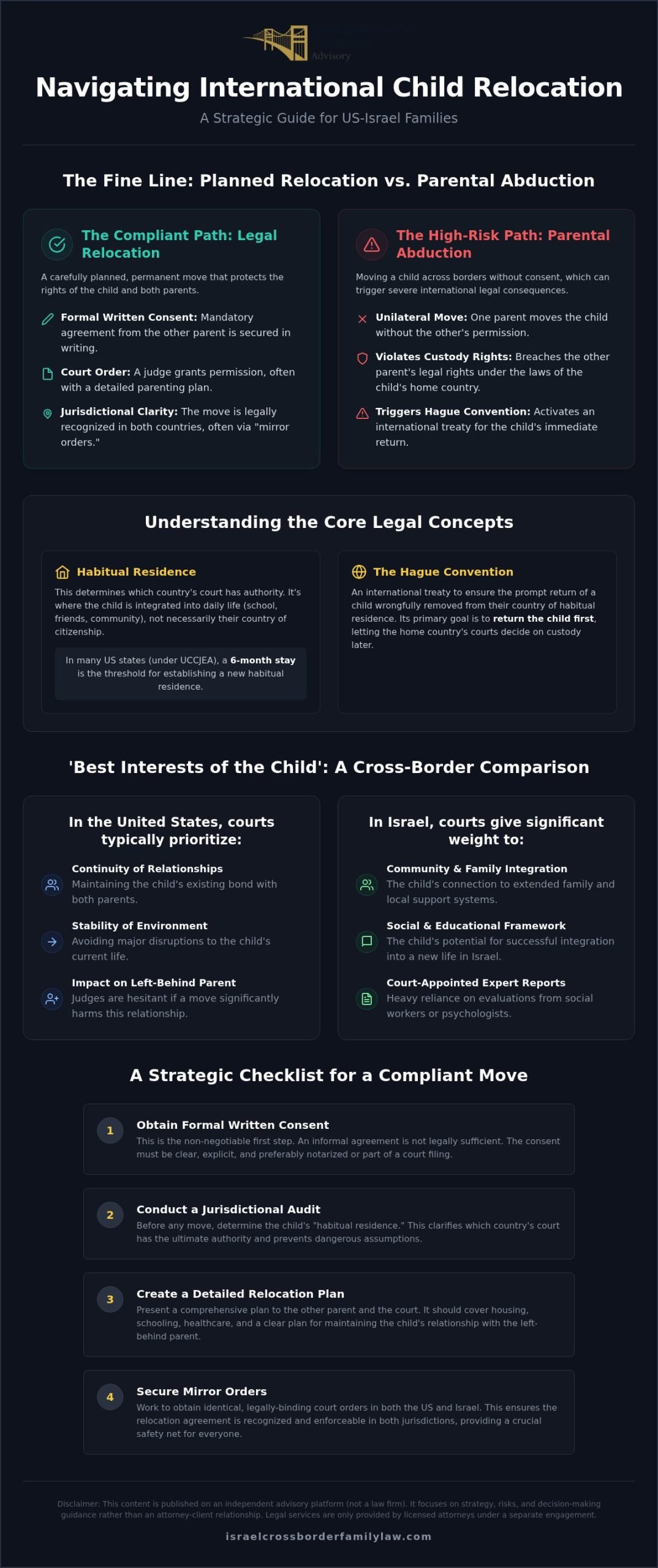
International child relocation is a permanent shift in a child’s legal and geographical foundation, moving far beyond the scope of temporary travel. In the context of international child relocation laws US Israel, the distinction between a summer vacation and a permanent move is critical. When a parent moves a child across borders without the other parent’s written consent or a court order, they risk crossing from a personal choice into the territory of international child abduction. This distinction often catches families off guard, especially when they believe their parental rights are absolute regardless of where they reside.
To better understand the strategy behind these moves and how to protect your family’s rights, watch this helpful video:
The Concept of Habitual Residence
Determining which country has the authority to make decisions about a child depends on the concept of habitual residence. This is not necessarily tied to where a child holds citizenship or where they were born. Instead, courts look at where the child has integrated into daily life, including their school, social circles, and medical care. In many US states, under the Uniform Child Custody Jurisdiction and Enforcement Act (UCCJEA), a six-month stay is often the threshold for establishing a new habitual residence. Israeli courts also place heavy weight on a child’s stability in IL. Attempting to move a child to a different country to find a more favorable court, a practice known as forum shopping, often leads to conflicting orders and years of litigation in two different languages.
Relocation vs. Abduction: The Fine Legal Line
The Hague Convention on the Civil Aspects of International Child Abduction defines wrongful removal as taking a child from their habitual residence in violation of the other parent’s rights of custody. Even if your intent is to protect the child or seek a better career, a foreign court may view a unilateral move as a legal violation. To mitigate these risks, families often seek mirror orders. These are identical court orders issued in both the US and IL that recognize the same custody and relocation terms. This ensures that the agreement made in one country is recognized and enforceable in the other, providing a safety net for both parents.
Securing clarity before you act is essential. You can learn more about the strategic approach to these cases on our international custody and relocation page. Understanding how these systems interact helps you avoid the high costs and emotional toll of a contested abduction claim.
Disclaimer: This content is published on an independent advisory platform (not a law firm). It focuses on strategy, risks, and decision-making guidance rather than an attorney-client relationship. Legal services are only provided by licensed attorneys under a separate engagement.
The ‘Best Interests of the Child’ in Cross-Border Contexts
The “best interests of the child” is a universal legal phrase, yet its application within international child relocation laws US Israel reveals significant cultural and procedural differences. US courts typically prioritize the continuity of the child’s environment and the existing relationship with both parents. If a move significantly disrupts the bond with the left-behind parent, US judges are often hesitant to grant relocation. In contrast, the Israeli Family Court, known as Beit Mishpat LeInyanei Mishpacha, balances these factors against the child’s potential for successful integration into a new social and educational framework.
Israeli judges often view the child’s connection to their community and extended family as a primary indicator of stability. While a parent may argue that the US offers superior economic or educational opportunities, the court will investigate whether those benefits outweigh the loss of a familiar support system in IL. It’s a complex balancing act where the right of a parent to move and pursue a new life must be weighed against the child’s right to maintain a deep, consistent relationship with the parent staying behind.
Israeli Judicial Factors for Relocation
Israeli judges rely heavily on the reports of court-appointed experts, such as social workers or psychologists, to evaluate the emotional impact of a move. These experts examine the strength of the extended family support system in IL compared to what is available in the US. While Israeli courts previously followed the “Tender Years Doctrine” more strictly, modern trends show a clear shift toward shared parenting. Judges now scrutinize whether the relocating parent is acting in good faith or attempting to alienate the other parent. The child’s own preference is also considered; it generally gains more weight as they approach their teenage years, though it is never the sole determining factor.
The Left-Behind Parent’s Rights
Protecting the rights of the parent who remains is a critical component of any relocation petition. Courts in both nations require a detailed plan to maintain a meaningful parental bond across thousands of miles. This often includes scheduled virtual visitation through video calls, which judges now view as a standard requirement. However, technology cannot replace physical presence. Courts frequently mandate that the relocating parent bears the financial burden of international travel for holiday visits, ensuring the child spends significant time in their original home country each year.
Before making a decision that could alter your family’s future, it’s wise to reach out for a strategic overview of your specific situation. Understanding these judicial nuances early can help you build a more persuasive case or better defend against an unreasonable relocation request.
Disclaimer: This content is published on an independent advisory platform, not a law firm. It focuses on strategy and risk management for international families. Legal services are only provided by licensed attorneys under a separate engagement.
Parental Consent and the Shadow of the Hague Convention
Informal agreements are the primary source of legal crises for cross-border families. You might believe that a verbal “okay” from your co-parent is enough to start packing, but in the eyes of international child relocation laws US Israel, it’s virtually invisible. Without a formal document, a move can quickly be reframed as a “wrongful removal” under the 1980 Hague Convention. This treaty acts as a powerful mechanism between the US and Israel to return children to their original country so that local courts can decide on custody. It’s a procedural tool designed to restore the status quo, not to determine who’s a better parent.
If a child is moved without proper authorization, the parent staying behind can file a petition through the Central Authority. In the US, this is the Department of State; in Israel, it’s the Ministry of Justice. These agencies cooperate to locate the child and initiate court proceedings. In Israel, these cases move with remarkable speed. By 2026, initial hearings are mandated within 15 days of a petition being filed. The goal is to reach a resolution and mandate a return, if necessary, within 45 to 90 days.
Obtaining Legally Binding Consent
A handshake isn’t a strategy. To protect your family, you need a written relocation agreement that’s notarized and, crucially, approved by a court. You can learn about international custody and relocation protocols to see how these agreements are structured. For families in IL, you must also address “Stay of Exit” orders, also known as No-Exit orders. These are common in Israeli family law and prevent a child from leaving the country without both parents’ consent. Even with a signed paper, attempting to cross the border while an active order is in place can lead to immediate detention at Ben Gurion Airport.
When Consent is Refused: The Court Petition
If your co-parent refuses to sign off on a move, you’ll need to petition the court for a relocation order. The burden of proof rests entirely on the parent wishing to move. You must demonstrate that the relocation serves the child’s interests better than remaining in their current home. This is where mediation often becomes a valuable tool. It allows parents to negotiate terms like travel costs and visitation schedules without the aggression of a full trial. If mediation fails and a Hague claim is filed, certain defenses exist, such as “grave risk of harm” or “acquiescence,” but these are exceptionally difficult to prove. It’s far safer to understand how the Hague Convention affects child abduction claims before any move occurs.
Disclaimer: This content is published on an independent advisory platform, not a law firm. It focuses on strategy, risks, and decision-making guidance rather than an attorney-client relationship. Legal services are only provided by licensed attorneys under a separate engagement.
Strategic Steps for Requesting or Opposing a Relocation
Successful navigation of the divide between two legal systems requires strategic foresight rather than reactive litigation. Before taking any formal steps, conducting a jurisdictional audit is essential. You must determine whether the US or Israeli courts are better positioned to hear your case based on your child’s habitual residence and the specific legal precedents of each region. This isn’t about finding a “loophole” but about ensuring the court that makes the decision has the most relevant connection to your family’s daily life. Success in these cases often hinges on a deep understanding of international child relocation laws US Israel.
Building a comprehensive relocation plan is the cornerstone of a successful request. This plan should go beyond mere intentions; it must provide concrete details regarding new school enrollments, healthcare providers, and a logistical map for visitation. You’ll need to gather evidence of the child’s current integration, such as school reports and social participation, to demonstrate how the move will either enhance or preserve their well-being. Additionally, prepare for the psychological evaluation conducted by court-appointed professionals in IL. These experts hold significant influence over the judge’s final decision and typically focus on the emotional impact of the proposed move.
Drafting the Comprehensive Relocation Agreement
A robust agreement must include specific clauses that address the unique challenges of cross-border living. Essential elements include choice of law provisions and clear travel logistics that define who pays for flights and where the child will spend major holidays. Consider including “reversionary” custody clauses; these specify what happens if the relocation fails to meet certain milestones, such as a parent losing their job in the new country. Securing a mirror order in both jurisdictions is the final, critical step to ensure your agreement is enforceable in both the US and Israel. This prevents one parent from trying to relitigate the same issues in a different country later.
Opposing a Relocation: Protecting the Parental Bond
If you are opposing a move, your strategy should focus on demonstrating the irreparable harm that a cross-border relocation would cause to the parental bond. You might propose alternative custody arrangements that maintain the child’s current stability while addressing the other parent’s needs. In Israel, “Stay of Exit” orders can be used as a preventative measure if there’s a credible risk of a unilateral move. These orders act as a legal shield, ensuring that the status quo remains until a court can fully evaluate the situation. Showing that the child’s “Best Interests” are served by remaining in their current social and educational environment is often the most effective defense.
To begin building your strategy, request a confidential case review to discuss your specific circumstances.
Disclaimer: This content is published on an independent advisory platform, not a law firm. It focuses on strategy, risks, and decision-making guidance. Legal services are only provided by licensed attorneys under a separate engagement.
Securing Clarity Through Cross-Border Advisory
Many families mistakenly believe that any experienced family lawyer can handle a move between countries. However, international child relocation laws US Israel require a specialized understanding of how two distinct legal cultures interact. A generalist lawyer might understand the custody laws of their specific state but may be unfamiliar with the procedural speed of an Israeli Hague hearing or the nuances of “Stay of Exit” orders. Relying on advice that doesn’t account for both jurisdictions can lead to unintended legal consequences, such as being barred from leaving IL or facing an abduction claim in the US.
Using an independent advisory platform provides a space to navigate these complexities before litigation begins. It’s about strategy, not just filing papers. You need to understand how a judge in Jerusalem might view your child’s “integration” differently than a judge in New York or Los Angeles. Early decisions, such as where you first file for custody or how you frame a temporary visit, often determine which country’s laws will govern your family’s future for the next decade. These initial steps carry the most legal weight and are the hardest to undo.
The Role of Cross-Border Strategy
Strategy involves looking at the long-term roadmap rather than just the next court date. This means evaluating risks honestly, without the exaggeration often found in litigation-heavy firms. For those living abroad, seeking specialized advisory for expats and foreign nationals is a vital step in ensuring your rights are protected. You’ll learn how to build a relocation plan that addresses the specific concerns of both legal systems, from financial logistics to cultural education. This foresight helps establish jurisdictional security and reduces the likelihood of a contested, high-stress legal battle.
Conclusion and Next Steps
Navigating the US-Israel legal landscape requires more than just legal knowledge; it requires a bridge between two different ways of thinking about family and the law. The intersection of these systems is complex, but it’s manageable with the right preparation. Before you pack a suitcase or sign a document, ensure you have a clear understanding of the risks and requirements involved. You can watch expert insights on US-Israel family law to gain more clarity on these issues. Get clarity before you commit. Request a confidential consultation.
Disclaimer: This content is published on an independent advisory platform (not a law firm). It focuses on strategy, risks, and decision-making guidance rather than an attorney-client relationship. Legal services are only provided by licensed attorneys under a separate engagement.
Strategic Planning for Your Family’s Global Future
Navigating the intersection of international child relocation laws US Israel requires a shift from reactive legal battles to proactive strategic planning. You’ve learned that a unilateral move can unintentionally trigger complex Hague Convention proceedings, often resulting in swift court-mandated returns. Securing a formal, court-approved relocation agreement is the only way to protect your parental rights and ensure your child’s stability across borders. By prioritizing clarity on jurisdiction and “Best Interests” standards early, you avoid the high emotional and financial costs of cross-border litigation.
As an independent advisory platform, we focus on providing the strategy and risk management necessary for international families to make informed decisions. We act as a bridge between the American and Israeli legal cultures, offering calm and authoritative guidance tailored to your specific needs. It’s essential to understand the weight of your early choices before they become permanent legal precedents. Get clarity before you commit. Request a confidential consultation to discuss your family’s roadmap.
Disclaimer: This content is published on an independent advisory platform, not a law firm. It focuses on strategy and decision-making guidance. Legal services are only provided by licensed attorneys under a separate engagement.
Frequently Asked Questions
Can I move my child to the US if I have an Israeli custody order?
An Israeli custody order does not automatically grant you the right to relocate. You still require the explicit written consent of the other parent or a specific relocation order from the court. Moving a child without this authorization can be legally classified as wrongful removal under international law. It’s essential to understand that custody refers to daily care, while relocation involves a permanent change in the child’s habitual residence and jurisdictional oversight.
What happens if I take my child to the US and the other parent files a Hague claim?
If you move to the US and a Hague claim is filed, the US court will focus on whether the child was wrongfully removed from their habitual residence in Israel. Under the Hague Convention, the goal is to return the child quickly so Israeli courts can decide custody. In 2026, Israeli courts must hold an initial hearing within 15 days of a petition, with most cases resolved within 45 to 90 days.
How long does the relocation process take in the Israeli Family Court?
The timeline for a relocation case in the Israeli Family Court typically ranges from several months to over a year. This is because the court requires comprehensive reports from social workers or psychologists to determine the child’s best interests. These evaluations take time to complete. Because international child relocation laws US Israel are so complex, judges often move cautiously to ensure the child’s stability and parental bonds are adequately protected.
Is a US prenuptial agreement relevant in an Israeli relocation case?
A US prenuptial agreement may be relevant if it contains specific clauses regarding jurisdiction or choice of law, but it isn’t always binding in Israeli relocation cases. Israeli courts prioritize the “Best Interests of the Child” above private contracts. While the court may consider the intent of the parents expressed in a prenup, they’ll always conduct their own independent analysis of what arrangement serves the child’s current well-being best.
What is an Israeli ‘No-Exit’ order and how does it affect relocation?
An Israeli “No-Exit” order, also known as a Stay of Exit order, is a legal measure that prevents a child from leaving Israel without a court’s permission. These are frequently issued as a standard protective measure in international family cases. If an order is active, the child will be stopped at the border. You must petition the court to lift this order, even for a short vacation, to avoid being accused of abduction.
Do I need a lawyer in both the US and Israel for a relocation case?
It’s highly beneficial to have legal guidance in both jurisdictions to manage the strategy of your case. A US attorney understands state-specific custody rules, while an Israeli practitioner navigates the Family Court system and religious court overlaps. Working with a cross-border advisory platform helps bridge these two systems, ensuring that a “mirror order” is properly established so your relocation agreement is legally enforceable in both the US and Israel.
Can a teenager choose which country they want to live in?
A teenager cannot unilaterally choose where to live, but their preference carries significant weight in the eyes of the court. As children grow older, Israeli and US judges are more likely to listen to their desires regarding school, social circles, and parental bonds. However, the court still makes the final decision based on a holistic “Best Interests” analysis. The child’s preference is just one of several factors the judge will evaluate.
How is child support affected by an international move between the US and Israel?
Child support is often modified following an international move due to the significant differences in the cost of living and travel expenses for visitation. Israeli courts may adjust support amounts if the relocating parent is now responsible for expensive international flights. Enforcement also becomes more complex. It’s critical to include specific support and travel cost clauses in your relocation agreement to avoid future disputes over cross-border payments and financial responsibilities.
Disclaimer: This content is published on an independent advisory platform (not a law firm). It focuses on strategy, risks, and decision-making guidance rather than an attorney-client relationship. Legal services are only provided by licensed attorneys under a separate engagement.

Article by
Gabriel Lior
A Personal Journey That Became a Mission
The advisory was founded by an American father Gabriel Lior, LLB, MBA , global entrepreneur, and cross-border advisor who spent more than a decade navigating the Israeli family court system firsthand and now lives in Singapore with his son.
As a divorced parent in a cross-border family, Gabriel faced nearly every legal challenge a foreign parent can encounter in Israel — including child custody disputes, child support proceedings, property matters in Israel and abroad, false accusations, and complex immigration and relocation proceedings.
Over the years, he learned the hard way how difficult it is for non-Israeli parents to understand the system, identify the right legal strategy, and choose the right legal representation — especially when language, culture, and jurisdictional differences are involved. He also witnessed how foreign parents and new immigrants are often disadvantaged or taken advantage of by service providers and institutions simply because they lack local knowledge or fluency.
From Client to Advisor
To truly understand — and survive — the system, Gabriel pursued formal legal education in Israel, completing two Israeli law degrees, alongside a BA and MBA earned in the United States. This was never about becoming a practicing attorney, but about gaining a deep, structural understanding of how the system works — and where it breaks down for foreign parents.
This rare combination of:
Firsthand client experience
Israeli legal and US business education
International business and negotiation training
Decades of commercial execution
created a unique perspective – one that understands both sides of the table.
After years of litigation, persistence, and at times self-representation, he ultimately succeeded in securing custody of his son and relocating abroad through a rare legal victory in the Israeli Supreme Court — becoming one of the first fathers in Israel to do so under these circumstances.
Disclaimer
Important Disclaimer:
The information provided on this website and in its content is for general informational and educational purposes only and does not constitute legal advice, legal opinion, or legal representation.
Gabriel Lior is not licensed to practice law in Israel (nor is he interested in doing so) and does not provide legal services, despite having completed 2 Law Degrees. The services offered are advisory in nature and are intended to provide general guidance, strategic insight, and information regarding cross-border family law considerations.
No attorney-client relationship is formed by accessing this website, reading its content, or communicating with us.
Any decisions made based on this information are at your own discretion and risk. For legal advice specific to your situation, you should consult a licensed attorney in the relevant jurisdiction.
Where appropriate, we may refer clients to independent, licensed attorneys or professionals. Such referrals do not constitute legal representation and no liability is assumed for services provided by third parties.