When a former partner resides in Israel and fails to meet their child support obligations, the geographical and legal distance can feel insurmountable. The uncertainty of enforcing a foreign court order from the US or UK, coupled with the perceived complexities of Israel’s legal system, creates significant challenges for parents seeking what is rightfully owed to their children. Navigating the sophisticated landscape of international child support israel requires not just determination, but precise legal knowledge and a clear strategic path forward. This comprehensive guide is engineered to provide that clarity. We will demystify the process by exploring the key treaties and domestic laws that govern cross-border enforcement, outlining the specific steps to validate and execute a foreign judgment within an Israeli court, and explaining how support amounts are calculated. Our objective is to empower you with an authoritative understanding of the legal framework, enabling you to take decisive action and secure the financial support your child deserves.
The Legal Framework for International Child Support in Israel
Navigating claims for international child support in Israel requires a sophisticated understanding of a multi-layered legal landscape. These complex cases are governed by a combination of international treaties, domestic civil statutes, and, uniquely, religious law. Establishing jurisdiction is the critical first step, as it determines which legal frameworks will apply to the recognition and enforcement of a support order from a foreign country. For a deeper understanding of how child support agreements can be modified within Israel’s legal system, the following video provides valuable insights:
The Hague Convention on International Recovery of Child Support
The primary mechanism for enforcing foreign support orders in Israel is the 2007 Hague Convention on the International Recovery of Child Support and Other Forms of Family Maintenance. The core purpose of this treaty is to create an efficient, streamlined process for cross-border enforcement. As both Israel and the United States are signatories, the Hague Child Support Convention provides the most direct path for many families. It operates through a system of Central Authorities-designated government bodies in each country-that process and transmit applications, simplifying the recognition of foreign orders and reducing legal hurdles for the custodial parent.
Israel’s Unique Domestic Law: The Role of Religion
A defining feature of Israeli family law is the application of personal status law, which means religious law often governs matters of marriage, divorce, and child support. For Jewish citizens, support obligations are primarily determined by Jewish Law (Halakha), which dictates the amount and duration of support based on the child’s age and needs. This religious framework operates alongside Israel’s civil law, such as the Family Law Amendment (Alimony) Act, 1959. Consequently, the religious affiliation of the parents can significantly influence the nature and extent of a child support obligation, a critical factor in any case of international child support Israel.
Recognition and Enforcement of Foreign Judgments Law, 1958
For cases originating from countries that are not party to the Hague Convention or another applicable treaty with Israel, enforcement must proceed under the Recognition and Enforcement of Foreign Judgments Law, 1958. This domestic statute allows Israeli courts to recognize a foreign judgment, provided certain conditions are met. These include:
- The foreign court had proper jurisdiction.
- The judgment is no longer appealable.
- The judgment does not contradict Israeli public policy.
- The principle of reciprocity exists between Israel and the foreign country.
This pathway is generally more complex and requires more extensive litigation than proceeding under an international convention, making it a secondary but essential legal tool.
Scenario 1: Enforcing a Foreign Child Support Order in Israel
For a custodial parent residing abroad, securing a child support order from a local court is a significant victory. However, when the paying parent resides in Israel, that foreign order is not automatically enforceable. It must be formally recognized and converted into an Israeli judgment to have legal effect. This multi-step process requires a sophisticated understanding of both international conventions and Israeli domestic law, presenting a common challenge in the realm of international child support israel.
Step 1: Authenticating and Submitting Your Foreign Order
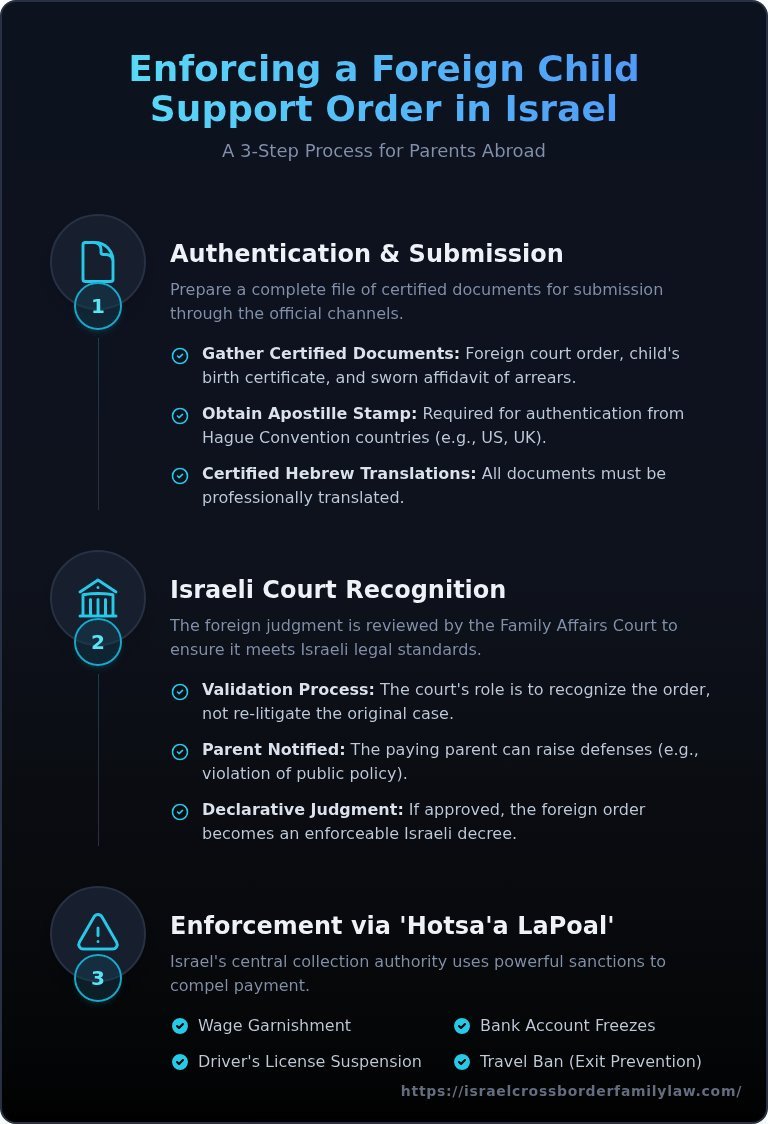
The initial phase is administrative and requires meticulous preparation. You must gather a complete file of certified documents, including the final foreign court order, the child’s birth certificate, and a sworn affidavit detailing arrears. For documents originating from countries party to the Hague Convention (such as the United States), each must bear an Apostille stamp for international authentication. The entire application, along with precise, certified Hebrew translations, is then submitted through the designated Central Authority, which facilitates state-to-state cooperation.
Step 2: The Israeli Court Recognition Process
Upon receipt, the file is transferred to Israel’s Family Affairs Court (Beit Mishpat L’Inyanei Mishpacha). The court’s role is not to re-litigate the case but to review the foreign judgment and ensure it meets Israeli legal standards for recognition. The paying parent will be notified and may raise specific defenses, such as a claim they were denied due process in the original proceedings or that the order violates Israeli public policy. If the court is satisfied, it will issue a declarative judgment, effectively domesticating the foreign order and making it an enforceable Israeli decree.
Step 3: Enforcement through ‘Hotsa’a LaPoal’ (Execution Office)
With a recognized Israeli judgment in hand, enforcement proceedings can commence through the Hotsa’a LaPoal, Israel’s central collection and execution authority. This powerful agency has broad authority to compel payment and can impose significant sanctions on a delinquent parent, including:
- Garnishment of wages and other income sources.
- Liens and freezes on Israeli bank accounts and real estate.
- Suspension of their Israeli driver’s license.
- Imposing a travel ban (tzav ikuv yetzia min ha’aretz) to prevent them from leaving the country.
Navigating this complex enforcement landscape requires expert guidance to ensure your rights are protected and obligations are met. Facing enforcement issues? Consult our experts today.
Scenario 2: Establishing or Paying Support From Israel to a Foreign Country
For parents residing in Israel with financial obligations to children living abroad, navigating the legal framework presents a unique set of multi-jurisdictional challenges. The Israeli Family Court retains the authority to establish, modify, and enforce child support orders, but it must do so with a sophisticated understanding of the child’s circumstances in their country of residence. Successfully managing these cross-border obligations requires meticulous legal strategy to ensure compliance with both Israeli and foreign court requirements, thereby safeguarding the financial well-being of the child and the paying parent’s legal standing.
Calculating Child Support in an Israeli Court
When an Israeli court adjudicates a matter of international child support israel, it conducts a comprehensive financial analysis. The primary consideration is the child’s needs, which must be evidenced with detailed documentation reflecting the cost of living in the foreign country-including expenses like school tuition, healthcare, and housing. The court then assesses the income and earning potential of both parents, converting foreign income to ILS for a unified comparison. The final obligation is determined by applying the relevant personal status law (e.g., Jewish law) or Israeli civil law.
Modifying Existing Israeli Child Support Orders
An existing Israeli child support order for a child abroad can be modified upon demonstrating a significant change in circumstances. Such changes can include the paying parent’s involuntary job loss in Israel, a substantial and permanent change in the child’s needs (such as a new medical condition), or major economic shifts like severe currency devaluation in the child’s country of residence. Filing a motion to modify requires presenting clear evidence of this change to the court, which will then re-evaluate the support amount based on the new reality.
Practical Challenges of International Payments
Executing cross-border support payments involves logistical and financial complexities that demand careful planning. Key considerations include:
- Currency Fluctuation: Parties should agree whether payments will be made in a fixed amount of ILS, the foreign currency, or be linked to a specific exchange rate to mitigate volatility.
- Payment Channels: Utilizing secure, documented methods like international wire transfers is crucial for creating a clear record and proving compliance.
- Tax Implications: Child support payments may have different tax treatments in Israel versus the recipient’s country, necessitating professional advice to avoid unforeseen liabilities.
- Proof of Payment: Meticulous record-keeping is essential to defend against any potential enforcement actions initiated in the foreign jurisdiction.
Navigating the intricate details of international child support israel requires experienced legal counsel capable of bridging legal systems and cultures. For expert guidance on establishing, modifying, or managing cross-border support obligations, contact our firm for a consultation.
Common Challenges and Strategic Solutions in Cross-Border Cases
Successfully enforcing international child support obligations requires navigating a labyrinth of procedural and substantive legal challenges that extend far beyond simple non-payment. These multi-jurisdictional disputes demand a sophisticated legal strategy, realistic expectations regarding timelines, and the guidance of experienced counsel adept at operating within two distinct legal frameworks. Understanding these obstacles is the first step toward overcoming them.
Challenge: Locating a Parent or Their Assets in Israel
The initial hurdle in many enforcement actions is the physical location of the non-compliant parent or their financial assets within Israel. We strategically employ licensed private investigators and utilize official legal channels, including formal inquiries with the Israeli Land Registry (Tabu), the Registrar of Companies, and financial institutions. Acting with urgency is paramount, as delays can provide an opportunity for a parent to conceal or transfer assets, complicating recovery efforts significantly.
Challenge: Jurisdictional Disputes and Conflicting Orders
A frequent complication arises when courts in both Israel and another country could potentially claim jurisdiction over the matter. This can lead to a “race to the courthouse,” where each party attempts to initiate proceedings in the legal system most favorable to their position. Our attorneys are highly experienced in arguing for the most appropriate jurisdiction and in resolving the complex legal conflicts that arise when contradictory orders have been issued by courts in different nations.
Solution: The Indispensable Role of a Specialized Attorney
Attempting to manage a case of international child support israel with counsel based in only one country is a significant disadvantage. Success requires an integrated legal team with deep, practical expertise in both Israeli family law and the legal system of the foreign country involved. Our bicultural and bilingual attorneys act as a seamless bridge, adeptly interpreting legal nuances and advocating effectively before courts in both jurisdictions. This dual competency is not merely an advantage-it is essential for protecting your rights and achieving a favorable outcome. Our firm is uniquely positioned to handle complex US-Israel cases. Learn how we can help.
Navigating Complex Cross-Border Obligations with Confidence
Navigating the multi-jurisdictional landscape of child support requires a sophisticated understanding of both Israeli and foreign legal systems. As this guide has detailed, whether you are seeking to enforce a foreign support order within Israel or establish obligations for a parent residing abroad, the process is governed by a complex framework of international treaties and domestic laws. Successfully managing cases of international child support israel hinges on strategic legal counsel that can anticipate and overcome the inherent procedural and cultural challenges. Our firm provides a decisive advantage in these sophisticated matters. With a proven track record in both enforcing and defending cross-border support orders, our team possesses deep, integrated expertise in both US and Israeli family law. Our bilingual attorneys are not only fluent in the relevant languages but are also adept at navigating the critical cultural and legal nuances that define these cases. We serve as the essential bridge between legal systems, ensuring your rights are protected and your child’s needs are met. To secure dedicated and knowledgeable representation, we invite you to Schedule a confidential consultation to discuss your international child support case. Taking the right step today can provide clarity and security for your family’s future.
Frequently Asked Questions
How long does it take to enforce a US child support order in Israel?
The enforcement of a foreign judgment, such as a US child support order, in Israel is a structured yet often complex process governed by international treaties. While timelines can vary significantly based on case specifics and the cooperation of the paying parent, clients should anticipate a timeframe of approximately 6 to 18 months. Our firm’s expertise in navigating the multi-jurisdictional framework ensures all documentation is correctly filed with the Israeli Central Authority to facilitate the most efficient resolution possible.
What happens if the parent in Israel is self-employed or hiding their income?
Addressing situations where a parent is self-employed or suspected of concealing income requires a sophisticated legal strategy. Israeli family courts possess broad authority to investigate a parent’s true financial capacity, which may include appointing financial investigators, compelling the disclosure of bank records, and assessing lifestyle indicators. Our team is adept at initiating these comprehensive discovery processes to ensure any child support obligation is based on an accurate and complete financial picture, not merely on declared income.
Can a child support amount be modified if my financial situation changes?
Yes, both Israeli and US legal systems recognize that child support orders can be modified following a significant and material change in circumstances for either parent. This could include a substantial increase or decrease in income, a change in the child’s needs, or other major life events. Pursuing a modification requires filing a formal motion with the competent court, a complex cross-border action for which experienced legal guidance is essential to demonstrate the requisite change and achieve a favorable outcome.
Does it matter if the parents were never married?
Under Israeli law, the marital status of the parents is irrelevant to the obligation of child support. The duty to provide for a child’s needs is based on parentage, not the existence of a marriage certificate. Therefore, a child born to unmarried parents has the same legal right to financial support from both parents as a child born within a marriage. Our firm represents clients in establishing paternity and securing support orders irrespective of their prior marital relationship.
Are child support payments taxable in Israel or the US?
The tax implications of child support are a critical component of any financial settlement. In both the United States and Israel, child support payments are generally not considered taxable income for the recipient, nor are they tax-deductible for the paying parent. Navigating the nuances of international child support israel requires a clear understanding of these multi-jurisdictional tax rules to ensure full compliance and avoid unforeseen financial liabilities for our clients.
Can a parent be prevented from leaving Israel if they owe child support?
Israel possesses robust enforcement mechanisms to secure child support obligations. A parent with significant child support arrears can be subject to a “stay of exit” order (Tzav Ikuv Yetzia Me’HaAretz), which legally prevents them from leaving the country until the debt is settled or a suitable arrangement is made. This powerful tool is frequently utilized by the Israeli Enforcement and Collection Authority to ensure parents meet their financial responsibilities to their children, regardless of their international ties.
What are the typical legal fees for an international child support case?
Legal fees for a complex international child support israel case are contingent upon several factors, including the case’s complexity, the level of cooperation from the opposing party, and the need for financial investigations. Our firm typically operates on an hourly basis with an initial retainer, which can range from ₪15,000 to ₪50,000 or more, depending on the anticipated scope of work. We provide a detailed engagement letter outlining our fee structure to ensure full transparency for our clients.

Article by
Gabriel Lior
A Personal Journey That Became a Mission The advisory was founded by an American father Gabriel Lior, LLB, MBA , global entrepreneur, and cross-border advisor who spent more than a decade navigating the Israeli family court system firsthand and now lives in Singapore with his son.
As a divorced parent in a cross-border family, Gabriel faced nearly every legal challenge a foreign parent can encounter in Israel — including child custody disputes, child support proceedings, property matters in Israel and abroad, false accusations, and complex immigration and relocation proceedings. Over the years, he learned the hard way how difficult it is for non-Israeli parents to understand the system, identify the right legal strategy, and choose the right legal representation — especially when language, culture, and jurisdictional differences are involved. He also witnessed how foreign parents and new immigrants are often disadvantaged or taken advantage of by service providers and institutions simply because they lack local knowledge or fluency. From Client to Advisor To truly understand — and survive — the system, Gabriel pursued formal legal education in Israel, completing two Israeli law degrees, alongside a BA and MBA earned in the United States. This was never about becoming a practicing attorney, but about gaining a deep, structural understanding of how the system works — and where it breaks down for foreign parents. This rare combination of: Firsthand client experience Israeli legal and US business education International business and negotiation training Decades of commercial execution created a unique perspective – one that understands both sides of the table. After years of litigation, persistence, and at times self-representation, he ultimately succeeded in securing custody of his son and relocating abroad through a rare legal victory in the Israeli Supreme Court — becoming one of the first fathers in Israel to do so under these circumstances.
Disclaimer
Important Disclaimer: The information provided on this website and in its content is for general informational and educational purposes only and does not constitute legal advice, legal opinion, or legal representation. Gabriel Lior is not licensed to practice law in Israel (nor is he interested in doing so) and does not provide legal services, despite having completed 2 Law Degrees. The services offered are advisory in nature and are intended to provide general guidance, strategic insight, and information regarding cross-border family law considerations. No attorney-client relationship is formed by accessing this website, reading its content, or communicating with us. Any decisions made based on this information are at your own discretion and risk. For legal advice specific to your situation, you should consult a licensed attorney in the relevant jurisdiction. Where appropriate, we may refer clients to independent, licensed attorneys or professionals. Such referrals do not constitute legal representation and no liability is assumed for services provided by third parties.