This article is published on an independent advisory platform and does not constitute legal representation or an attorney-client relationship. Legal services are only provided by licensed attorneys under a separate engagement.
What if the legal document that confirms your marriage in New York or California loses its authority the moment you land at Ben Gurion Airport? For many, the reality of international family law for same-sex couples is that legal status is not a constant; it’s a variable that changes based on which border you cross. You likely expect your rights to travel with you, yet the intersection of US and Israeli law creates unique challenges that require careful planning.
It’s natural to feel concerned about the “limping marriage” effect, where you are legally wed in one country but face ambiguity in another. This article provides the clarity you need to understand how IL recognizes foreign civil marriages and what steps you must take to protect your family. You’ll gain a clear strategy for securing parental rights and an awareness of the jurisdictional risks that arise during a divorce. We will examine the specific 90 day window for parental orders and the shift toward gender-neutral standards in civil courts. Get clarity before you commit. Request a confidential consultation.
Key Takeaways
- Identify the legal “blind spots” created by a limping marriage, where your union is recognized in the US but faces different standards in IL.
- Learn how to navigate the Ministry of Interior registration process to ensure your foreign marriage is officially recorded by the state.
- Understand the critical role of habitual residence in determining which jurisdiction will manage a divorce and the potential financial impact on your assets.
- Discover the essential steps for protecting non-biological parents through second-parent adoption and the legal recognition of children born via surrogacy.
- Develop a proactive strategy for international family law for same-sex couples to ensure that early relocation decisions do not lead to permanent legal risks.
The Concept of the ‘Limping Marriage’ in International Law
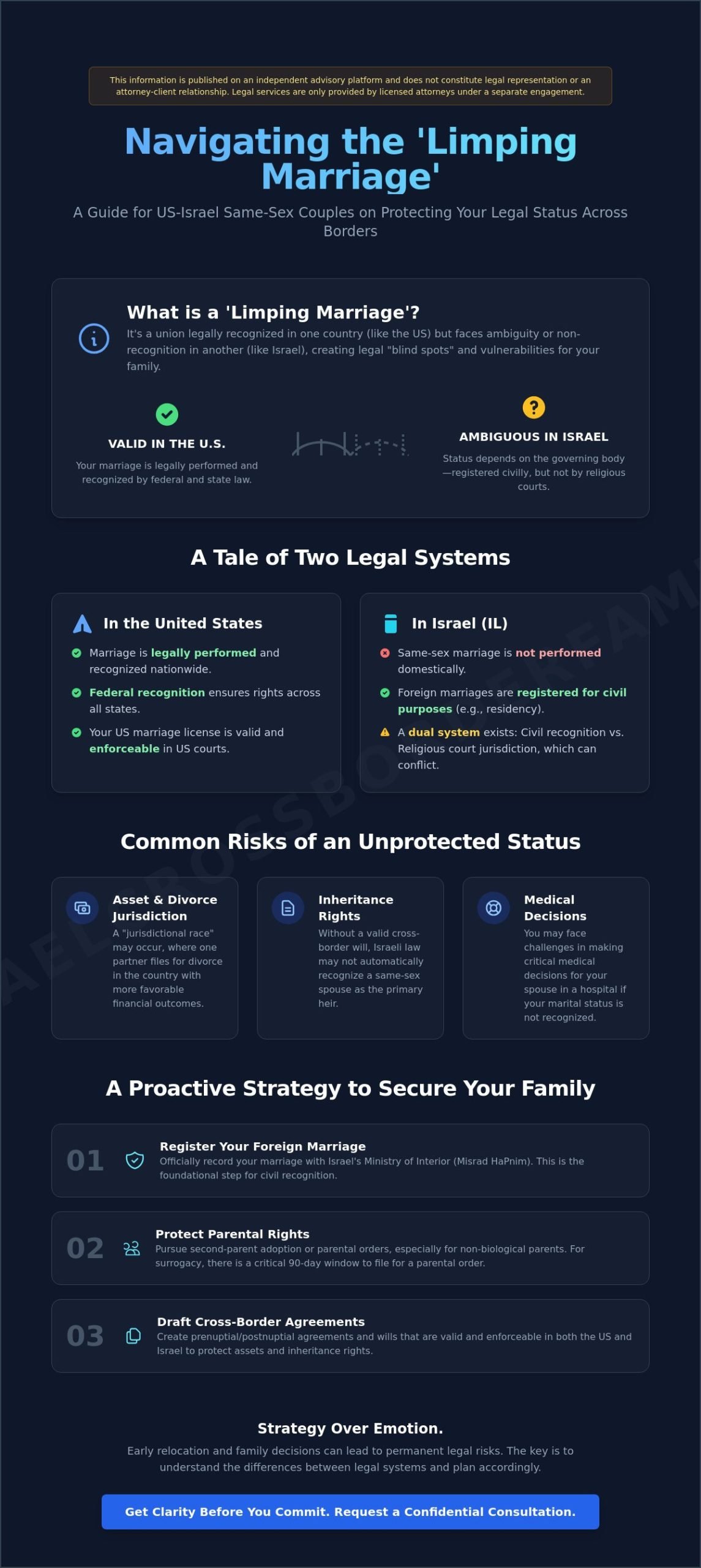
This article is published on an independent advisory platform and does not constitute legal representation or an attorney-client relationship. Legal services are only provided by licensed attorneys under a separate engagement. In the field of international family law for same-sex couples, the term “limping marriage” describes a specific and often stressful legal reality. It refers to a union that is legally recognized in one jurisdiction, such as New York or London, but is considered non-existent or void in another, such as the religious courts of IL. This discrepancy creates legal “blind spots” that can leave families vulnerable during major life transitions.
To better understand this concept, watch this helpful video:
The international recognition of same-sex marriage remains a complex patchwork of evolving regulations. Many couples move between the US and IL assuming that their marital status is a global constant. However, assuming global recognition carries significant financial and emotional risks. Without a proactive strategy, you may find that the protections you rely on in one country simply do not exist in the other. This complexity is why early clarity is essential before making international commitments.
Why Your US Marriage License Might Not Be Enough
There is a fundamental difference between a marriage being “valid” and being “enforceable” in a foreign court. Your US marriage license is legally valid where it was issued. Yet, when you relocate to IL, the enforcement of that status depends on which government body you are dealing with. While the Ministry of Interior may register the union for residency purposes, religious courts often maintain a different standard. The US federal system complicates this further, as state-level marriage laws do not always align with the requirements of international treaties. Strategic planning is required to bridge these two very different legal systems.
Common Risks for International Same-Sex Couples
The lack of uniform recognition leads to several practical risks that can impact your daily life and future security. One primary concern is the sudden loss of inheritance rights. If assets are moved to IL without a cross-border will, the local legal system might not automatically recognize a same-sex spouse as the primary heir. Other risks include:
- Challenges in making critical medical decisions for a spouse in a foreign hospital setting.
- Tax complications arising from inconsistent marital status across different jurisdictions.
- A “jurisdictional race” where one partner attempts to file for divorce or separation in the country that offers them a more favorable financial outcome.
Understanding international family law for same-sex couples means recognizing that your rights are tied to your location. Taking the time to evaluate these risks before relocating helps ensure your family remains protected regardless of which border you cross. Get clarity before you commit. Request a confidential consultation.
The Israeli Context: Civil Registration vs. Religious Jurisdiction
This article is published on an independent advisory platform and does not constitute legal representation or an attorney-client relationship. Legal services are only provided by licensed attorneys under a separate engagement. While IL does not perform same-sex marriages within its borders, it maintains a unique policy of recognizing those performed abroad. This creates a dual reality for many couples. Your marriage is administratively valid for state purposes, yet it remains outside the scope of domestic religious law. Understanding how these systems interact is a core component of international family law for same-sex couples.
The Ministry of Interior, known as Misrad HaPnim, is the body responsible for this registration. When you present a valid foreign marriage certificate, the Ministry records your status as “married.” This registration is free of charge and grants access to essential rights like residency, joint taxation, and health insurance. It’s common to wonder if this means you’re “fully married” in every sense. In practical terms, you are. However, because there’s no civil marriage law in IL, your union exists as a recognized foreign act rather than a domestic religious one. This distinction is vital when discussing Israeli family law for same-sex couples, as it dictates which court will handle your affairs if the relationship ends.
The Role of the High Court of Justice (Bagatz)
Most advancements in rights for expats and foreign nationals have come from judicial rulings rather than legislation. The High Court of Justice, often called Bagatz, has repeatedly stepped in to protect the rights of same-sex families. A landmark 2006 ruling forced the Ministry to register foreign same-sex marriages. More recently, a 2023 administrative court decision confirmed that even online civil marriages, like those conducted through Utah, must be registered. These rulings act as a shield, ensuring the state treats your family with dignity. They don’t, however, change the fundamental lack of civil marriage options within the country.
Navigating the Rabbinical Courts’ Influence
In IL, divorce for heterosexual Jewish couples is usually the exclusive domain of the Rabbinical Courts. For same-sex couples, the situation is different. Because religious law does not recognize these unions, same-sex couples generally bypass the Rabbinical system entirely. Instead, they fall under the residual jurisdiction of the civil Family Court. This is often a strategic advantage for Anglo expats. It means your divorce or custody matters are handled by a secular judge focused on civil principles rather than religious doctrine. If you are considering a move, it’s wise to discuss your specific situation to understand how these jurisdictional lines affect your future. Get clarity before you commit. Request a confidential consultation.
International Divorce and Dissolution: US vs. Israel
This article is published on an independent advisory platform and does not constitute legal representation or an attorney-client relationship. Legal services are only provided by licensed attorneys under a separate engagement. Managing international family law for same-sex couples requires a clear understanding of where a case can legally be heard. While many US states operate under “no-fault” divorce laws, the process in IL is technically a “dissolution of marriage” handled by civil family courts. The primary hurdle in these cross-border cases is establishing “habitual residence,” which determines which court has the authority to issue a decree. In the US, this is often a fixed period of months in a specific state. In IL, the court examines your “center of life,” looking at where you work, live, and maintain your primary social ties.
The doctrine of forum non conveniens allows a court to dismiss a legal proceeding if it determines that a court in another jurisdiction is a more appropriate and convenient location for the dispute. This often becomes a central issue when one spouse remains in the US while the other has relocated to IL. The financial implications of divorce and separation for international families are significant, as the choice of court can dictate how global assets, pensions, and real estate are divided. Understanding these differences early allows you to make decisions based on strategy rather than emotion.
Choosing the Right Jurisdiction for Divorce
The “race to the courthouse” is a real factor in international cases. The first person to file in a valid jurisdiction can often lock in that country’s laws for asset distribution. US states vary between community property and equitable distribution models. In contrast, IL civil courts apply specific balancing rules for assets acquired during the union. Academic analysis in The Reluctant Acceptance of Same-Sex Unions and Parents in Israel highlights how these civil processes have evolved to provide more predictability. A well-drafted prenuptial agreement that accounts for both US and Israeli law is the most effective way to mitigate these jurisdictional risks.
Enforcement of Foreign Divorce Decrees
If you obtain a divorce in the US, you must “domesticate” the decree in an Israeli court to have it recognized locally. This process involves proving that the foreign court had proper jurisdiction and that the proceedings were fair. Hurdles can arise if the foreign decree contains clauses that contradict local public policy, though this is less common in same-sex civil matters than in religious ones. Mutual consent remains the smoothest path. When both parties agree on the terms and the forum, the risk of a foreign decree being rejected by the Ministry of Interior or the Family Court is greatly reduced. Get clarity before you commit. Request a confidential consultation.
This article is published on an independent advisory platform and does not constitute legal representation or an attorney-client relationship. Legal services are only provided by licensed attorneys under a separate engagement.
Protecting Parental Rights: Adoption and Surrogacy Across Borders
Securing legal parenthood is perhaps the most critical challenge within international family law for same-sex couples. While a US birth certificate may list both parents, IL law requires specific domestic procedures to ensure that the non-biological parent’s rights are fully enforceable. Relying solely on foreign documents can create significant vulnerabilities, especially if the family later faces a dispute or medical emergency. In IL, a 2021 Supreme Court ruling streamlined the recognition process, but parents must still act decisively. Filing for a “Parental Order” or a “Declaratory Judgment” of parenthood within 90 days of a child’s birth is the standard protocol for ensuring both individuals are legally recognized from the start.
The complexity increases when families consider international custody and relocation. Without formal recognition in both jurisdictions, one parent might find themselves legally “invisible” in the eyes of local authorities. This lack of status can have permanent consequences if the relationship breaks down or if one parent decides to move back to the US. Taking the time to formalize these rights through the Israeli Family Court system is a strategic necessity that provides security for both the parents and the child. If you have questions about your specific family structure, it is helpful to request a review of your situation before you relocate.
The Hague Convention and Same-Sex Parenting
The Hague Convention on child abduction applies to same-sex parents just as it does to heterosexual ones. However, the legal hurdles differ. If a parent relocates a child to or from IL without the other’s consent, the court must determine if “wrongful removal” occurred. If the left-behind parent hasn’t formalized their rights in the country of residence, proving they had legal custody can be difficult. A US birth certificate alone isn’t always enough to prevent a Hague Convention claim; the court looks at where the child was habitually resident and who held enforceable parental rights under that specific country’s laws.
Surrogacy Rulings in Israel
Recent shifts in the legal landscape have opened new doors for families. A landmark High Court of Justice ruling on July 11, 2021, which took effect on January 11, 2022, now allows same-sex couples and single men to access surrogacy services within IL. Many Anglo families still choose US surrogacy for its established legal certainty, but they must then navigate the process of ensuring the child’s dual citizenship is recognized. This involves coordinating between US birth records and the Israeli Ministry of Interior. While the 2021 ruling has made domestic surrogacy more accessible, the multi-jurisdictional complexity of international family law for same-sex couples remains a factor that requires early, risk-based decision-making. Get clarity before you commit. Request a confidential consultation.
This article is published on an independent advisory platform and does not constitute legal representation or an attorney-client relationship. Legal services are only provided by licensed attorneys under a separate engagement.
Strategic Planning: Strategy Over Emotion
Strategic planning is the most effective tool for managing the complexities of international family law for same-sex couples. When relocating between the US and IL, it’s easy to let the excitement of a move overshadow the legal realities of your new jurisdiction. However, early decisions regarding where you establish your center of life or how you document your marriage often have permanent consequences. Building a legal bridge between these two systems requires more than just translating documents. It involves a deep understanding of how one country’s court will interpret the other’s decrees. Seeking clarity before making international commitments is the only way to ensure your family’s protections remain intact across borders.
The inherent complexity of cross-border situations means that assumptions are your greatest risk. Many families believe that because their status is settled in the US, it will naturally be respected in IL. As we’ve explored, the intersection of civil registration and religious jurisdiction creates a landscape where rights can shift. A proactive strategy allows you to address these shifts before they become legal crises. This approach moves the focus away from emotional reactions and toward informed, risk-based decision-making. Get clarity before you commit. Request a confidential consultation.
The Value of a Cross-Border Advisory
An advisory platform provides a neutral risk assessment that is often missing during the high-pressure phases of an international move. There is a significant difference between litigation and strategic planning. Litigation is a reactive process used to resolve disputes after they’ve already caused damage. Strategic planning is a proactive approach designed to prevent those disputes from occurring in the first place. Anglo families specifically benefit from a guide who understands both cultural contexts. This dual perspective ensures that your global interests are aligned and that no legal blind spots are left in your family’s structure. You can learn more about how this process works by visiting our page on how the advisory functions.
Next Steps for International Families
The first step in any cross-border strategy is to review your existing legal documents for international compatibility. A will drafted in a US state or a prenuptial agreement signed abroad may not be automatically enforceable in an Israeli Family Court. You must ensure that your asset protection plans and parental security documents are recognized in both jurisdictions. This includes forming a specific strategy for your estates and wills to account for differing inheritance laws. For a deeper look at these topics, you can view the educational resources and expert discussions on the Israel Family Law YouTube channel. Taking these steps early provides the peace of mind that your family is protected, regardless of where you choose to call home.
This article is published on an independent advisory platform and does not constitute legal representation or an attorney-client relationship. Legal services are only provided by licensed attorneys under a separate engagement.
Securing Your Family’s Future Across Borders
The legal landscape connecting the US and IL is constantly evolving, making it essential to prioritize long-term strategy over immediate convenience. We have explored how the state registration of foreign marriages differs from religious jurisdiction and why securing parental orders within the first 90 days is a vital step for non-biological parents. These nuances demonstrate that international family law for same-sex couples is rarely straightforward; it demands a focus on risk mitigation and careful planning.
Our advisory platform provides tailored guidance for the Anglo expat community, leveraging deep expertise in US-Israel cross-border family law to help you navigate these multi-jurisdictional challenges. By building a legal bridge between two distinct systems, you can protect your assets and your parental rights from the uncertainties of relocation. Get clarity before you commit. Request a confidential consultation. With the right strategy, you can move forward with confidence, knowing your family’s legal foundation is secure in both nations.
This article is published on an independent advisory platform and does not constitute legal representation or an attorney-client relationship. Legal services are only provided by licensed attorneys under a separate engagement.
Frequently Asked Questions
Does Israel recognize same-sex marriages performed in the United States?
Yes, IL recognizes same-sex marriages performed abroad for administrative registration purposes. Following a 2006 High Court of Justice ruling, the Ministry of Interior must register these unions in the population registry. This recognition also extends to online civil marriages, such as those conducted through the Utah model, which was confirmed by an administrative court decision in 2023. While these marriages aren’t performed domestically, registration grants you access to state benefits like residency and joint taxation.
Can a same-sex couple get divorced in Israel if they were married in the US?
Yes, same-sex couples can divorce in IL through the civil Family Court system. Because religious courts don’t recognize these unions, same-sex couples bypass the Rabbinical system entirely. This provides a secular and predictable procedural path for Anglo expats. The court will handle the dissolution of the marriage and the division of assets based on civil principles rather than religious doctrine, offering a more streamlined process than heterosexual couples often face.
How do I ensure both parents are legally recognized in both the US and Israel?
You should formalize parental status in both countries to avoid legal blind spots during a relocation. In IL, the non-biological parent should file for a “Parental Order” within 90 days of the child’s birth to ensure full recognition on the birth certificate. Relying on a US birth certificate alone may not provide sufficient domestic protection in an IL court during a dispute. Securing these rights early is a fundamental part of international family law for same-sex couples.
What happens to our assets in Israel if we divorce in a US court?
A US divorce decree must be domesticated in an IL court to affect assets located within Israel. The court will review the foreign decree to ensure it doesn’t contradict local public policy and that both parties were treated fairly during the proceedings. Without this domestication process, IL assets may still be subject to local balancing rules. This is a critical area of international family law for same-sex couples that requires early strategic planning.
Is surrogacy for same-sex couples legal and recognized in Israel?
Yes, surrogacy is legal for same-sex couples in IL as of January 11, 2022. This followed a 2021 High Court ruling that ended gender-based restrictions on the process. If you choose surrogacy in the US, the process for recognizing the child’s status in IL involves coordinating with the Ministry of Interior and obtaining a parental order. Both paths require careful navigation to ensure the child’s dual citizenship and parental rights are fully secured from birth.
Can a US prenuptial agreement be enforced in an Israeli family court?
Yes, an Israeli Family Court can enforce a US prenuptial agreement if it is properly validated and meets local legal standards for fairness. The agreement should clearly address the cross-border nature of your assets to be effective in both jurisdictions. It’s helpful to have the agreement reviewed for international compatibility before you move. This proactive step helps mitigate the risk of a jurisdictional race if the relationship breaks down in the future.
What is the role of the Ministry of Interior in same-sex family matters?
The Ministry of Interior, or Misrad HaPnim, handles the administrative registration of your family status rather than judicial matters. They are responsible for recording foreign marriages, issuing residency permits for foreign spouses, and updating the population registry. While they don’t have the power to grant a divorce, their registration is the gateway to state-level rights. It’s important to ensure your documentation is accurate and submitted promptly to avoid delays in residency or health benefits.
How does the Hague Convention protect same-sex parents in relocation disputes?
The Hague Convention protects against the wrongful removal of a child from their country of habitual residence by a parent. For same-sex parents, this protection depends on both individuals having legally recognized parental rights in that specific country. If one parent relocates a child without consent, the convention provides a mechanism for the child’s return. However, without formal recognition in both the US and IL, proving rights of custody can become significantly more complex during a dispute.

Article by
Gabriel Lior
A Personal Journey That Became a Mission
The advisory was founded by an American father Gabriel Lior, LLB, MBA , global entrepreneur, and cross-border advisor who spent more than a decade navigating the Israeli family court system firsthand and now lives in Singapore with his son.
As a divorced parent in a cross-border family, Gabriel faced nearly every legal challenge a foreign parent can encounter in Israel — including child custody disputes, child support proceedings, property matters in Israel and abroad, false accusations, and complex immigration and relocation proceedings.
Over the years, he learned the hard way how difficult it is for non-Israeli parents to understand the system, identify the right legal strategy, and choose the right legal representation — especially when language, culture, and jurisdictional differences are involved. He also witnessed how foreign parents and new immigrants are often disadvantaged or taken advantage of by service providers and institutions simply because they lack local knowledge or fluency.
From Client to Advisor
To truly understand — and survive — the system, Gabriel pursued formal legal education in Israel, completing two Israeli law degrees, alongside a BA and MBA earned in the United States. This was never about becoming a practicing attorney, but about gaining a deep, structural understanding of how the system works — and where it breaks down for foreign parents.
This rare combination of:
Firsthand client experience
Israeli legal and US business education
International business and negotiation training
Decades of commercial execution
created a unique perspective – one that understands both sides of the table.
After years of litigation, persistence, and at times self-representation, he ultimately succeeded in securing custody of his son and relocating abroad through a rare legal victory in the Israeli Supreme Court — becoming one of the first fathers in Israel to do so under these circumstances.
Disclaimer
Important Disclaimer:
The information provided on this website and in its content is for general informational and educational purposes only and does not constitute legal advice, legal opinion, or legal representation.
Gabriel Lior is not licensed to practice law in Israel (nor is he interested in doing so) and does not provide legal services, despite having completed 2 Law Degrees. The services offered are advisory in nature and are intended to provide general guidance, strategic insight, and information regarding cross-border family law considerations.
No attorney-client relationship is formed by accessing this website, reading its content, or communicating with us.
Any decisions made based on this information are at your own discretion and risk. For legal advice specific to your situation, you should consult a licensed attorney in the relevant jurisdiction.
Where appropriate, we may refer clients to independent, licensed attorneys or professionals. Such referrals do not constitute legal representation and no liability is assumed for services provided by third parties.