Could a trust established in Delaware or London suddenly become transparent to an Israeli family court during a high-stakes divorce? While many international families rely on these structures for security, the reality is that the intersection of International Trusts and Family Law is often more fragile than it appears. You likely feel that your global assets are protected by layers of legal veils, yet the fear of a foreign jurisdiction seizing control or a court piercing those protections remains a significant source of anxiety.
We understand that managing assets across the US and Israel involves navigating conflicting laws and high-stakes complexity. This guide provides a clear roadmap to help you understand how Israel recognizes foreign trusts and what the new 2026 reporting requirements mean for your family’s privacy. We will examine the specific risks of cross-border litigation and offer strategies to ensure your legacy remains secure. This content is published on an independent advisory platform and is for informational purposes only; it does not constitute legal representation. For additional guidance, you may find the resources on the Israel Family Law YouTube channel helpful.
Key Takeaways
- Learn how International Trusts and Family Law interact to safeguard cross-border assets and ensure your family’s financial future remains secure across multiple jurisdictions.
- Understand the specific risks of “piercing the trust veil” in Israeli family courts and why your foreign trust may be more vulnerable during a divorce than you expect.
- Discover the critical differences between US common law traditions and Israel’s hybrid legal system regarding how discretionary trusts are interpreted by judges.
- Identify the essential steps for aligning your trust structure with a valid Israeli Financial Agreement to prevent assets from being caught in a division of property dispute.
- Prepare for the new 2026 reporting requirements for trustees residing in Israel to ensure your asset protection strategy remains compliant with evolving regulations.
What are International Trusts in the Context of Family Law?
In the field of International Trusts and Family Law, an international trust is defined as a legal arrangement where the structure is established in one jurisdiction, such as a US state, while the assets, the person who created it, or the beneficiaries reside in another, like Israel. These structures are not merely financial vehicles; they are sophisticated legal tools used by families to manage wealth across borders. This content is published on an independent advisory platform and is for informational purposes only. It’s designed to provide clarity on how these arrangements interact with the Israeli legal system.
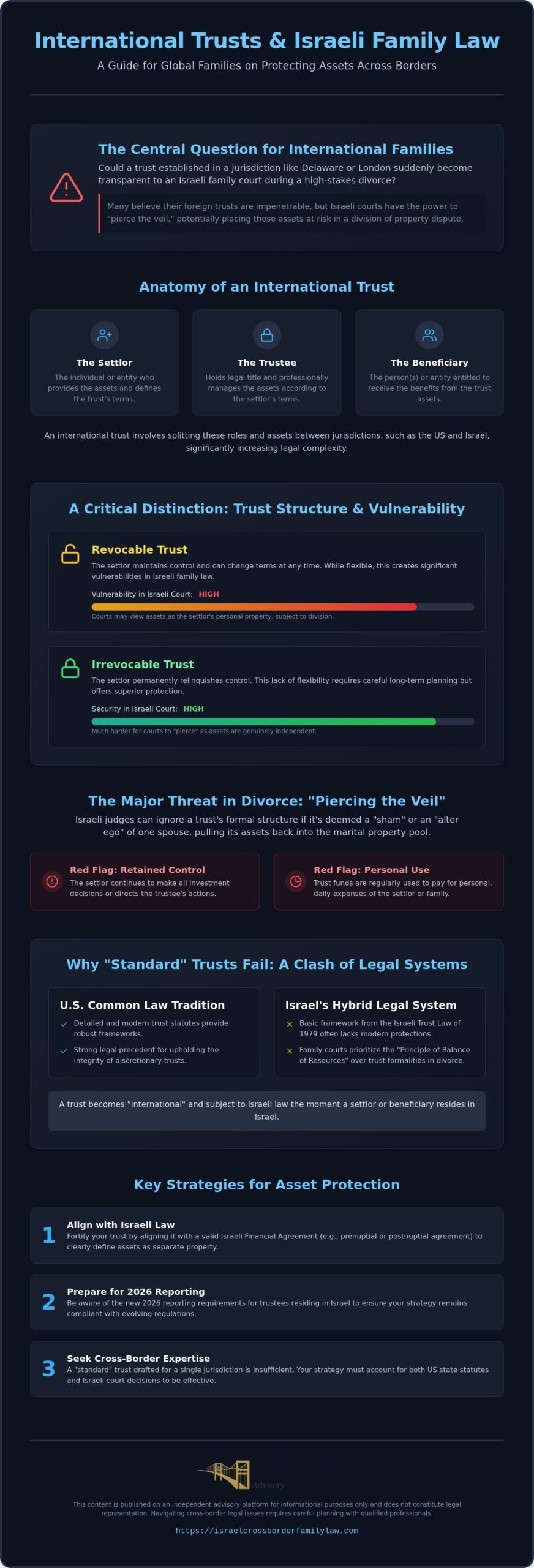
Families typically utilize these trusts to achieve three primary goals: robust asset protection, tax efficiency, and seamless succession planning. By placing assets into a trust, a family can shield them from personal liabilities and ensure they are managed by a professional. Understanding the three key roles is essential. The Settlor is the individual who provides the assets and defines the trust’s terms. The Trustee holds legal title and manages the property according to those terms. Finally, the Beneficiary is the person or entity entitled to receive the benefits from the trust assets. When these roles are split between two countries, the legal complexity increases significantly.
For a visual explanation of how these structures function within the US-Israel legal framework, we recommend exploring the resources available on our dedicated channel: Israel Family Law on YouTube.
A critical factor in cross-border litigation is the distinction between revocable and irrevocable trusts. A revocable trust allows the settlor to maintain control and change terms at any time. While this offers flexibility, it can also create vulnerabilities, as Israeli courts may view these assets as the settlor’s personal property. Conversely, an irrevocable trust is much harder to “pierce” because the settlor has permanently relinquished control. This lack of flexibility requires careful, long-term planning but offers a higher degree of security against future claims.
The Role of Trusts for US Expats in Israel
Why ‘Standard’ Trusts Often Fail in Cross-Border Scenarios
A “standard” trust drafted by a local attorney who is only familiar with one legal system often fails in a cross-border context. Conflicts frequently arise between US state statutes and the decisions of Israeli civil or religious courts. There’s also a significant risk of unintended tax consequences if the trust is not synchronized with the US-Israel tax treaty. Without a strategy that accounts for both jurisdictions, a trust can quickly become a liability rather than a shield. A trust technically becomes “international” once a beneficiary moves to Israel.
Trusts in Divorce: Protection or Vulnerability?
When a marriage dissolves, the intersection of International Trusts and Family Law becomes a primary battleground for asset division. Israeli family courts typically follow the Principle of Balance of Resources, which aims for an equitable distribution of assets acquired during the marriage. However, assets held within a trust occupy a complex gray area. While a trust is technically a separate legal entity, the court’s priority is to determine whether those assets are genuinely independent or if they remain, in practice, under the control of one spouse.
The “Piercing the Veil” doctrine allows Israeli judges to ignore the formal structure of a trust if it’s deemed a “sham” or an “alter ego” of the settlor. If you’ve maintained total control over the trust’s investments or used trust funds to pay for personal daily expenses, a court may conclude the structure is merely a facade. In such cases, the assets could be pulled back into the marital pool for division. This risk is particularly high in cases involving US-based revocable trusts, which Israeli courts often view as personal property due to the settlor’s power to revoke the arrangement at will.
One critical gap many expats overlook is that a trust is not a legal substitute for a formal Israeli Financial Agreement (Prenuptial or Postnuptial Agreement). In Israel, any agreement regarding the division of property must be approved by a court to be legally binding. Even if a trust was established before the marriage, a spouse might claim that the growth in the value of those trust assets during the marriage is a joint resource. Aligning your trust with a validated Financial Agreement is the most effective way to provide clarity for both parties. It’s often helpful to request a confidential review to see how these two legal tools can work together.
Can a Spouse Access Trust Assets in an Israeli Divorce?
Success in protecting trust property often hinges on the “Settlor’s Intent” and the timing of the trust’s creation. Assets placed into an irrevocable trust years before a marriage are generally more secure than those moved shortly before a separation. In high-stakes cases in Tel Aviv or Herzliya, courts scrutinize whether the trust was used to support the family’s lifestyle. If trust distributions were the primary source of the family’s income, the court might treat the trust capital as a resource for calculating child support or alimony, even if it doesn’t divide the principal assets.
Protecting a Family Business Held in Trust
For entrepreneurs in Herzliya or the “Silicon Wadi” with US-based interests, protecting your business assets from a divorce requires a proactive strategy. Maintaining the integrity of a business trust often depends on the role of independent trustees. When a third-party professional makes the distribution decisions, it’s much harder for a spouse to argue that the business is your personal “pocketbook.” This separation is vital for ensuring that a corporate entity remains a distinct asset, shielded from the emotional and financial volatility of divorce proceedings.
US vs. Israel: Differing Perspectives on Trust Assets
Success in managing cross-border assets requires an understanding of two fundamentally different legal traditions. US trust law is built on a deep foundation of Common Law, where centuries of judicial precedents provide high levels of predictability for trustees and beneficiaries. In contrast, Israel operates under a hybrid legal system. While it adopted many trust concepts, the primary framework is the Israeli Trust Law of 1979. This statute is less detailed than US state laws, leaving more room for judicial interpretation, which can create uncertainty in the context of International Trusts and Family Law.
Discretionary trusts highlight this jurisdictional divide. In the US, a discretionary trust generally prevents a beneficiary from claiming a specific right to assets until the trustee chooses to distribute them. This provides a strong shield against creditors and ex-spouses. However, Israeli judges may take a more “substance over form” approach. If a judge perceives that a beneficiary has a de facto right to the funds, they might treat those assets as a financial resource during a divorce or child support hearing. This makes the language used during the trust’s creation vital; where you sign and which law you choose can dictate the level of protection you receive.
Compliance is another area where the two systems diverge sharply. For US citizens or residents, IRS Form 3520 remains a critical and complex reporting requirement for foreign trust transactions. Simultaneously, the Israeli Tax Authority (ITA) has introduced significant changes effective January 1, 2026. All trustees residing in Israel must now report “controlling individuals” of a trust, even if the trust holds no assets in Israel. For trusts established before 2026, the reporting deadline is April 2026. This content is published on an independent advisory platform and is for informational purposes only.
Recognition of Foreign Trusts in Israeli Courts
Validating a US-based trust in Israel is not an automatic process. While Israeli courts generally respect foreign legal structures, they will scrutinize any trust that appears to contradict “Public Policy” (Takkanat HaShuk). For example, if a trust is used to circumvent mandatory Israeli laws regarding fair asset division between spouses, a court may refuse to recognize its specific provisions. Engaging practitioners who are licensed and experienced in both jurisdictions is the only way to ensure your structure survives this cross-cultural legal scrutiny.
Succession Planning: Avoiding Multi-Jurisdictional Probate
One of the most practical benefits of a trust is its ability to bypass the lengthy Israeli probate process. For foreigners with assets in Israel, the “Kiyum Tzavah” (probate) process can be slow and expensive. A properly structured trust allows for the immediate transfer of assets to the next generation without court intervention. It’s essential to synchronize your US will with your Israeli trust to prevent conflicting instructions. You can find more details on understanding international inheritance and relocation to see how these tools work together to protect your legacy. Seeking clarity before making these commitments ensures your family avoids the traps of multi-jurisdictional litigation.
Strategic Planning for Families with Cross-Border Assets
Proactive management is the only reliable defense against the inherent volatility of cross-border disputes. Within the framework of International Trusts and Family Law, a successful asset protection strategy requires a structured, multi-step approach that bridges the gap between US and Israeli legal systems. This content is published on an independent advisory platform and is for informational purposes only. It’s essential to follow these five strategic steps to ensure your legacy remains intact:
- Conduct a full audit: You must identify all assets in both the US and Israel, including real estate, brokerage accounts, and business interests, to map out potential jurisdictional vulnerabilities.
- Align with a Financial Agreement: Your trust shouldn’t exist in a vacuum. It must be synchronized with a valid Israeli Financial Agreement that has been formally approved by an Israeli court to ensure it’s recognized during a divorce.
- Appoint a cross-cultural trustee: Select a trustee who understands the nuances of both legal cultures. A trustee who only knows US law may inadvertently trigger Israeli tax or succession traps.
- Regularly review for treaty changes: The US-Israel tax treaty is not static. Periodic reviews ensure your trust remains efficient and compliant with evolving reporting mandates in both nations.
- Seek clarity first: Never move significant assets or sign trust documents without understanding the long-term implications in both jurisdictions.
The Importance of Early Decision-Making
Waiting for a crisis to occur before reviewing your trust structure is the most expensive mistake an expat can make. Israeli courts often view retroactive planning with skepticism, particularly if assets are moved during periods of marital strain or just before a divorce filing. The jurisdiction you select at the outset will dictate the legal reality your family faces for decades. Early decisions carry immense weight; correcting a poorly structured trust after a dispute has already begun is often a complex and costly endeavor.
Navigating the US-Israel Tax Treaty
The US-Israel tax treaty plays a pivotal role in how trust distributions are handled for beneficiaries residing in Israel. Without specialized cross-border advisory, families risk facing double taxation on trust income, which can significantly erode the principal value of a family legacy. Strategic planning ensures that distributions are timed and structured to maximize treaty benefits while remaining fully compliant with both the IRS and the Israeli Tax Authority. To ensure your strategy is robust enough to withstand these challenges, you should request a confidential consultation to discuss your specific multi-jurisdictional needs.
Navigating Complexity with Israel Cross Border Law Firm
Managing assets across the US and Israel requires a strategic perspective that spans two distinct legal cultures. The intersection of International Trusts and Family Law is rarely straightforward. It involves balancing the rigid requirements of US tax law with the evolving precedents of Israeli family courts. Our role is to act as a bridge, providing the steady guidance needed to manage these multi-jurisdictional complexities without compromising your family’s long-term security. This content is published on an independent advisory platform; it’s for informational purposes and does not constitute formal legal representation.
Why Anglo Families Trust Our Advisory
Families from the US and other English-speaking countries often find the Israeli legal system opaque and unpredictable. We provide a sense of security by translating complex Israeli statutes into plain English and highlighting the practical risks of every decision. Our advisory is built on decades of experience navigating the cultural and legal nuances that define the US-Israel relationship. We prioritize risk management and strategic foresight, ensuring that your trust structure is robust enough to survive a divorce or an inheritance dispute. You can learn more about how our advisory works for international families to see how we help clients achieve peace of mind.
Take the First Step Toward Clarity
The weight of early decisions cannot be overstated. A minor oversight in a trust document signed in New York or California can have profound consequences when those assets are scrutinized by a judge in Tel Aviv. A confidential initial review of your trust documents is often the first step toward identifying these vulnerabilities. We focus on providing the guidance you need to make informed choices about your future. We invite you to request a confidential case review to discuss your specific situation. For ongoing educational insights into these matters, you can also learn more about family law on our YouTube channel.
Securing Your Legacy Across Borders
Navigating the complex intersection of International Trusts and Family Law requires more than just a standard trust document. It demands a proactive strategy that bridges the gap between US common law traditions and the Israeli legal system. As established throughout this guide, aligning your foreign trust with a court-approved Israeli Financial Agreement and preparing for the 2026 reporting mandates are essential steps for any expat family. These decisions carry significant weight; they’re best made well before a crisis arises to ensure your assets remain protected.
This platform serves as an independent advisory focused on cross-border strategy. We bring decades of experience to the unique legal needs of Anglo families and expats in Israel. Our goal is to provide the steady, knowledgeable guidance you need to navigate multi-jurisdictional traps with confidence. Don’t leave your family’s future to chance in a foreign court. Get clarity before you commit. Request a confidential consultation. Your family’s long-term security is achievable with the right preparation and a commitment to early planning.
Frequently Asked Questions
Are US revocable living trusts recognized in Israel?
Israeli courts generally recognize the existence of US revocable living trusts, but they don’t always respect the asset separation. Because the settlor maintains total control, a judge may treat the trust assets as personal property. This is especially true during a divorce or debt collection. You should ensure the trust is aligned with local Israeli requirements to avoid it being disregarded as a mere “pocketbook” for the owner.
Can an Israeli court order the distribution of assets held in a US trust?
An Israeli court can order the distribution of US trust assets if it determines the structure was used to hide marital property. This usually happens through the “piercing the veil” doctrine. If the court finds the trust is a sham or an alter ego of one spouse, it can include those assets in the marital pool. Such orders are complex to enforce across borders but can result in significant local financial penalties.
Do I need a separate trust for my assets in Tel Aviv or Jerusalem?
You don’t always need a separate trust, but it’s often advisable for Israeli real estate. Local property transactions in Tel Aviv or Jerusalem involve specific tax and registration rules that a US trust might not address. Creating a local structure or a specific sub-trust can simplify management and prevent the lengthy probate process. It’s a strategic decision that depends on the total value and nature of your Israeli holdings.
What happens to an international trust if I divorce in Israel?
In an Israeli divorce, the court examines if the trust assets were acquired or improved during the marriage. The field of International Trusts and Family Law suggests that irrevocable trusts created before marriage are generally safer. However, if trust income supported the family’s lifestyle, a judge might include that income in child support calculations. This content is published on an independent advisory platform and is for informational purposes only.
How does the US-Israel tax treaty impact trust beneficiaries?
The US-Israel tax treaty functions to prevent double taxation on trust distributions for residents. It establishes which jurisdiction has the primary right to tax income and capital gains. You must remain aware of the new reporting requirements effective January 1, 2026. All trustees in Israel must report controlling individuals to the Israeli Tax Authority, regardless of where the trust was originally established or where the assets are located.
Can I appoint a US citizen as a trustee for an Israeli trust?
You can appoint a US citizen as a trustee, but this choice triggers significant reporting obligations in both countries. If that trustee resides in Israel, they are subject to the new 2026 reporting mandates. They’ll need to disclose the settlor and beneficiaries to the Israeli Tax Authority by April 2026. This multi-jurisdictional complexity requires a trustee who is comfortable navigating both the IRS requirements and the Israeli regulatory landscape.
Is an international trust better than a prenuptial agreement for asset protection?
Neither tool is objectively “better” because they offer different types of protection. A trust manages assets, while an Israeli Financial Agreement (prenuptial agreement) defines how assets are divided upon divorce. In Israel, a trust is rarely seen as a valid substitute for a court-approved financial agreement. Using both in tandem provides the most robust defense against the “piercing of the veil” during high-stakes cross-border litigation.
How do I enforce a US trust document in the Israeli legal system?
Enforcing a US trust in Israel requires a legal process to validate the document under foreign law. The court will check if the trust provisions conflict with Israeli public policy or mandatory succession laws. Expert testimony is often needed to explain the US legal framework to an Israeli judge. Mastering the nuances of International Trusts and Family Law is the only way to ensure your foreign documents are respected by local authorities.

Article by
Gabriel Lior
A Personal Journey That Became a Mission
The advisory was founded by an American father Gabriel Lior, LLB, MBA , global entrepreneur, and cross-border advisor who spent more than a decade navigating the Israeli family court system firsthand and now lives in Singapore with his son.
As a divorced parent in a cross-border family, Gabriel faced nearly every legal challenge a foreign parent can encounter in Israel — including child custody disputes, child support proceedings, property matters in Israel and abroad, false accusations, and complex immigration and relocation proceedings.
Over the years, he learned the hard way how difficult it is for non-Israeli parents to understand the system, identify the right legal strategy, and choose the right legal representation — especially when language, culture, and jurisdictional differences are involved. He also witnessed how foreign parents and new immigrants are often disadvantaged or taken advantage of by service providers and institutions simply because they lack local knowledge or fluency.
From Client to Advisor
To truly understand — and survive — the system, Gabriel pursued formal legal education in Israel, completing two Israeli law degrees, alongside a BA and MBA earned in the United States. This was never about becoming a practicing attorney, but about gaining a deep, structural understanding of how the system works — and where it breaks down for foreign parents.
This rare combination of:
Firsthand client experience
Israeli legal and US business education
International business and negotiation training
Decades of commercial execution
created a unique perspective – one that understands both sides of the table.
After years of litigation, persistence, and at times self-representation, he ultimately succeeded in securing custody of his son and relocating abroad through a rare legal victory in the Israeli Supreme Court — becoming one of the first fathers in Israel to do so under these circumstances.
Disclaimer
Important Disclaimer:
The information provided on this website and in its content is for general informational and educational purposes only and does not constitute legal advice, legal opinion, or legal representation.
Gabriel Lior is not licensed to practice law in Israel (nor is he interested in doing so) and does not provide legal services, despite having completed 2 Law Degrees. The services offered are advisory in nature and are intended to provide general guidance, strategic insight, and information regarding cross-border family law considerations.
No attorney-client relationship is formed by accessing this website, reading its content, or communicating with us.
Any decisions made based on this information are at your own discretion and risk. For legal advice specific to your situation, you should consult a licensed attorney in the relevant jurisdiction.
Where appropriate, we may refer clients to independent, licensed attorneys or professionals. Such referrals do not constitute legal representation and no liability is assumed for services provided by third parties.