Navigating a complex cross-border family law matter between Israel and the United States presents a unique set of challenges, chief among them the uncertainty surrounding legal costs. For clients with multi-jurisdictional interests, the fear of opaque fee structures and escalating bills can add significant stress to an already difficult situation, making the true Israeli Family Lawyer price seem unpredictable. This guide is designed to provide clarity and strategic insight into this critical aspect of your case, moving you from a position of apprehension to one of informed confidence.
We will deconstruct the primary factors that influence legal fees in Israel, from case complexity and attorney seniority to the fundamental differences between retainer agreements and hourly billing, all denominated in Israeli Shekels (₪). Our objective is to empower you with a sophisticated understanding of legal cost structures. You will gain the ability to realistically budget for your representation, confidently discuss fees with prospective counsel, and find a pathway to managing your investment in expert legal services without compromising on the quality required for a successful outcome.
Key Takeaways
- Understand the primary factors driving legal costs in Israel, including case complexity, time commitment, and the level of professional expertise required.
- Demystify the common fee structures-such as hourly billing, flat fees, and retainers-to better anticipate and manage your legal expenditures.
- The final Israeli Family Lawyer price is influenced by your unique circumstances; this guide provides estimated cost ranges in Israeli Shekels (₪) to help you budget effectively.
- Discover why multi-jurisdictional family law matters, particularly those involving Israel and the U.S., possess unique complexities that impact legal strategy and costs.
Understanding the Core Factors That Determine Legal Costs in Israel
Prospective clients often seek a straightforward price list for legal services, but in the realm of family law, such a document is an impossibility. The final Israeli Family Lawyer price is not a static figure but a dynamic calculation based on the unique variables of your case. The cost is fundamentally tied to the time, complexity, and specialized expertise required to navigate your legal challenges successfully. Therefore, it is crucial to view legal fees not as an expense, but as a strategic investment in skilled representation designed to protect your assets, family, and future.
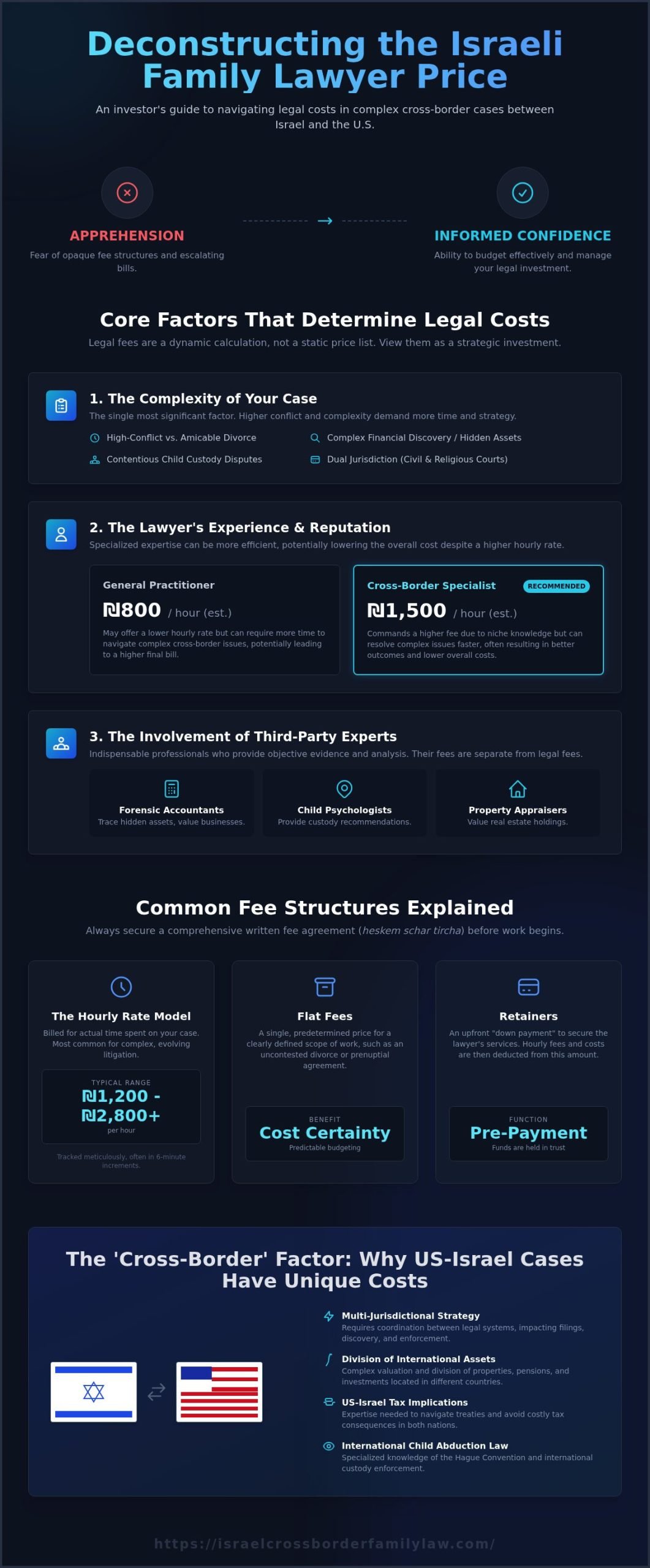
To better understand the components that contribute to legal costs, this overview provides valuable context:
Ultimately, the foundation of a productive and trust-based client-lawyer relationship is a transparent and comprehensive fee agreement. This document should clearly outline the billing structure, rates, and scope of services, ensuring there are no ambiguities as you move forward together.
The Complexity of Your Case
The single most significant factor influencing the cost is the level of conflict and complexity involved. An amicable, uncontested divorce where both parties agree on all major issues will require substantially fewer legal hours than a high-conflict, contested case. Matters involving complex financial discovery, such as uncovering hidden assets, performing business valuations, or dividing international property, demand meticulous legal work. Similarly, contentious child custody disputes or navigating the dual jurisdiction of Israel’s civil and religious courts within the Israeli legal system adds layers of strategy and time, directly impacting the final cost.
The Lawyer’s Experience and Reputation
The advocate you choose has a direct bearing on your case’s cost and outcome. A general practitioner may offer a lower hourly rate, but a seasoned specialist in complex or cross-border family law brings sophisticated expertise that can be more efficient and effective. An attorney with deep experience in US-Israel tax implications or international child abduction, for example, commands a higher fee due to their niche knowledge. This specialized experience often allows for quicker resolution of complex issues, potentially leading to a lower overall Israeli Family Lawyer price despite a higher hourly rate (e.g., ₪1,500 vs. ₪800).
The Involvement of Third-Party Experts
Many sophisticated family law cases require the input of external professionals to build a robust legal position. These expert fees are separate from your lawyer’s fees but are often indispensable. Their involvement is critical for providing objective evidence and analysis in court. Common experts include:
- Forensic Accountants: To trace hidden assets or determine the true value of a business.
- Child Psychologists: To provide assessments and recommendations in custody disputes.
- Property Appraisers: To value real estate holdings in Israel and abroad.
Common Fee Structures for Israeli Family Lawyers Explained
Navigating family law matters in Israel requires a clear understanding of the financial commitments involved. The overall Israeli Family Lawyer price is not a single figure but is determined by a specific fee structure agreed upon at the outset of your engagement. Demystifying these models is the first step toward a transparent and predictable professional relationship. We advise all clients to secure a comprehensive written fee agreement, or heskem schar tircha, before any legal work commences.
The Hourly Rate Model
The most prevalent structure for litigation and complex, evolving disputes is the hourly rate. Under this model, you are billed for the actual time your legal team dedicates to your case, including consultations, court appearances, document drafting, and correspondence. Experienced family lawyers in major Israeli cities typically charge between ₪1,200 and ₪2,800+ per hour. This work is meticulously tracked and billed in increments, often in tenths of an hour (6-minute intervals). Clients receive detailed monthly invoices itemizing all activities performed. For sophisticated, cross-border cases involving international child custody or asset division, the required hours can increase, sometimes necessitating coordination with bodies like Israel’s Department for Legal Aid Between Countries for official assistance.
Flat Fee (Fixed Fee) Arrangements
For legal tasks with a clearly defined scope and predictable outcome, a flat fee arrangement offers cost certainty. This is a single, pre-agreed price for a specific service, regardless of the hours spent. Think of it as a fixed quote for a project rather than paying for labor by the hour. Common examples in Israeli family law include:
- Drafting and negotiating a prenuptial or postnuptial agreement (heskem mamon).
- Managing an uncontested divorce (gerushin b’haskama).
- Filing a straightforward inheritance petition.
While advantageous for its predictability, this model is less common for contentious disputes where the trajectory is uncertain.
Retainer Fees: Your Upfront Deposit
A retainer is one of the most frequently misunderstood components of the Israeli Family Lawyer price structure. It is not a fee in itself but rather a down payment or an advance on future hourly fees and costs. This amount is deposited into a dedicated client trust account (ne’emanut). As your lawyer performs work, they will bill their hourly rate against this fund. For example, if you pay a ₪20,000 retainer and your lawyer performs 10 hours of work at ₪1,500/hour, ₪15,000 will be deducted, leaving a ₪5,000 balance. Many agreements require an “evergreen” retainer, meaning you must replenish the fund whenever it drops below a specified threshold, ensuring your legal representation continues without interruption.
Estimated Cost Ranges for Common Family Law Cases
While providing a precise cost for legal services without an initial consultation is impossible, we can offer estimated ranges for common family law matters in Israel. It is imperative to understand that these figures are illustrative. The final Israeli Family Lawyer price is contingent upon the unique complexities of your case, the level of cooperation from the opposing party, and the specific legal strategy required to achieve your objectives. These estimates primarily reflect legal fees and do not include third-party costs such as expert valuations, translations, or court filing fees.
Prenuptial & Postnuptial Agreements
For straightforward prenuptial or postnuptial agreements involving domestic assets, many firms offer a flat-fee structure. This provides cost certainty for clients seeking to protect their assets proactively. A typical range for drafting, negotiating, and finalizing such an agreement is between ₪9,000 and ₪26,000. However, matters involving sophisticated cross-border assets, international business holdings, or complex trust structures will necessitate a more comprehensive approach, thereby increasing the overall cost.
Uncontested vs. Contested Divorce
The path a divorce takes is the single most significant factor influencing its cost.
- Uncontested (Amicable) Divorce: When both parties agree on all major issues-including asset division, child custody, and support-the process is streamlined. Legal representation focuses on formalizing the agreement and ensuring its legal validity. Costs typically range from ₪18,000 to ₪55,000.
- Contested (Litigated) Divorce: Disagreements necessitate litigation, a process involving discovery, multiple motions, and court appearances. Each step is billable, and costs are compounded by mandatory official Israeli court fees for each filing. The financial investment can range widely from ₪75,000 to ₪370,000+, depending on the duration and intensity of the dispute. For a deeper understanding of the factors involved, see our guide on divorce for international families.
Child Custody and Support Matters
Disputes involving children are often the most emotionally and financially demanding aspects of family law. The overall cost is directly proportional to the level of conflict between the parents. Cases requiring psychological evaluations, testimony from child specialists, or extensive court battles over parenting plans will incur substantial fees. The complexity escalates dramatically in cases of international relocation (hagira), which involve multi-jurisdictional legal challenges and are among the most sophisticated and costly matters to navigate.
The ‘Cross-Border’ Factor: Why US-Israel Cases Have Unique Costs
When a family law matter, such as divorce or child custody, spans both the United States and Israel, the legal complexity increases exponentially. These are not standard domestic cases; they are multi-jurisdictional matters requiring a sophisticated level of expertise. Consequently, the Israeli Family Lawyer price for cross-border representation reflects the intricate challenges and specialized knowledge necessary to navigate two distinct legal, financial, and cultural landscapes effectively.
Navigating Multiple and Conflicting Legal Systems
A fundamental challenge in US-Israel cases is determining which country’s laws apply and which court holds jurisdiction. This initial strategic decision can profoundly impact the outcome of matters from asset division to custody arrangements. Our firm possesses deep, integrated expertise in both Israeli family law and the relevant US state laws, enabling us to advise clients on the most advantageous legal venue. Furthermore, enforcing a judgment-such as a support order issued in Tel Aviv-in a state like New York requires navigating international treaties and complex procedural rules, a task for which specialized counsel is indispensable.
International Asset Tracing and Division
The financial dimension of a cross-border divorce is uniquely complex. Valuing and dividing assets held in different countries involves significant hurdles. For example, an Israeli court may not be familiar with the structure of a US-based 401(k) retirement account, while a US court may struggle to properly assess Israeli real estate or business holdings. This necessitates engaging forensic accountants adept in both financial systems and addressing the divergent tax implications in each country, ensuring an equitable and legally sound division of the marital estate.
Managing International Logistics
Beyond the legal theory, the practicalities of a transatlantic case introduce tangible costs. Successfully managing these logistics requires a streamlined, efficient approach to minimize expenses and delays. Key considerations include:
- Costs associated with secure international document shipping and certified translations.
- Coordinating depositions, hearings, and expert testimony across multiple time zones.
- Potential travel for court appearances or critical negotiations.
- Seamless collaboration with co-counsel in the United States.
Our firm has developed a proven methodology for managing these operational demands. We invite you to learn about how our process works to streamline these logistical challenges and deliver value. The higher Israeli Family Lawyer price for these cases is a direct investment in the robust infrastructure required to protect your interests across borders.
For expert guidance on your US-Israel family law matter, contact our team of dedicated cross-border specialists.
Strategies for Managing Your Legal Fees and Achieving Clarity
Navigating a family law matter involves significant emotional and financial considerations. While legal fees are a necessary investment, you are not a passive observer in this process. By taking a strategic and proactive approach, you can directly influence the efficiency of your case, manage costs effectively, and transform the conversation from one of pure cost to one of value and strategic investment. Our firm is committed to partnering with you to ensure transparency and control over the financial aspects of your legal representation.
Be Organized and Responsive
The single most effective way to manage legal fees is to minimize the time your lawyer spends on administrative tasks. An organized client enables their legal team to focus on high-value strategic work. Before your initial meetings, we advise you to:
- Gather and organize all relevant financial documents, such as bank statements, property deeds, and investment reports.
- Create a clear, chronological timeline of key events pertinent to your case.
- Respond to requests for information or documentation from our office in a timely manner.
By presenting information clearly and being responsive, you save your legal team valuable time, which translates directly into cost savings for you.
Understand Your Fee Agreement
The fee agreement, or schar tircha, is the foundational document governing the financial relationship with your legal counsel. It is imperative that you read this document carefully and ask questions before signing. Ensure you have absolute clarity on the retainer (sh’char tircha rishoni), the hourly rates in Israeli Shekels (₪) for partners, associates, and paralegals, and how case-related expenses (hotsa’ot) are billed. A transparent fee agreement is fundamental to understanding the overall Israeli Family Lawyer price for your case. We encourage clients to request monthly, itemized invoices to track progress and maintain a clear financial overview.
Schedule a Confidential Case Review
Ultimately, abstract discussions about fees have limited value. The most accurate understanding of potential costs is achieved through a direct and confidential consultation regarding the specific facts of your case. An initial review allows our experienced attorneys to provide a strategic overview, identify potential complexities in your cross-border matter, and furnish a tailored cost estimate. Our commitment to transparency is a cornerstone of our practice, as detailed in our pricing philosophy.
To gain a comprehensive understanding of the potential Israeli Family Lawyer price for your unique circumstances and to develop a clear legal strategy, we invite you to contact our firm. Scheduling a confidential case review is the definitive step toward achieving both legal and financial clarity.
Achieving Financial Clarity in Your Israeli Family Law Matter
Navigating the financial aspects of a family law matter in Israel demands a clear understanding of the core variables at play. As we have explored, the final Israeli Family Lawyer price is determined by a confluence of factors, including case complexity, the chosen fee structure, and critically, the multi-jurisdictional nature of a dispute. Achieving transparency on these costs from the outset is paramount, particularly when navigating the intricate legal systems of both the U.S. and Israel.
As dedicated specialists in complex US-Israel cross-border cases, our team leverages decades of combined experience in international family law to provide the strategic, clear, and confidential legal advice you require. We are committed to demystifying the process and providing a transparent path forward. To gain a precise understanding of the costs pertinent to your unique situation, we invite you to request a confidential case review to understand your costs.
Taking this decisive first step is the most effective way to gain clarity and confidently protect your future.
Frequently Asked Questions About Israeli Family Lawyer Prices
Is the initial consultation with an Israeli family lawyer free?
Most established Israeli law firms, particularly those advising on complex, cross-border family law matters, do not offer free initial consultations. This first meeting is a substantive legal strategy session where our experienced attorneys assess the intricate details of your case and provide preliminary advice. The fee for this comprehensive consultation is an investment in understanding your legal position and potential outcomes, and it is typically credited toward your retainer if you choose to engage our firm’s services.
Am I responsible for paying my spouse’s legal fees in an Israeli divorce?
In Israel, each party is generally responsible for their own legal representation costs. However, the Family Court or Rabbinical Court can, under specific circumstances, order one spouse to contribute to the other’s legal fees. This typically occurs when there is a significant disparity in financial resources or if one party’s conduct has unnecessarily prolonged the litigation. Our role is to advise on strategies to mitigate such risks and advocate for a fair allocation of all financial responsibilities.
What are typical court fees in Israel, and are they included in the lawyer’s price?
Court filing fees (known as “agra”) are statutory costs mandated by the Israeli court system and are separate from legal fees. For instance, opening a divorce file in the Family Court can cost approximately ₪500-₪600, with additional fees for specific motions. These disbursements are not included in the Israeli Family Lawyer price for professional services. We manage these payments on your behalf, providing a transparent and itemized account of all court-related expenditures in your regular invoicing.
Can I get legal aid or a pro bono lawyer in Israel as a foreign national?
Legal aid from the Israeli Ministry of Justice is available to foreign nationals, but it is strictly means-tested and subject to specific eligibility criteria, often related to residency status and the nature of the case. While our firm is a private entity focused on complex international litigation, we recognize the importance of access to justice. For clients who may not qualify for our services, we can provide guidance on navigating the public legal aid system or connecting with appropriate non-governmental organizations.
How is travel time billed for international cases between the US and Israel?
For multi-jurisdictional matters requiring international travel, such as between the United States and Israel, travel time is typically billed at a reduced hourly rate, often 50% of the attorney’s standard professional rate. This policy acknowledges the necessity of travel while ensuring cost-effectiveness for our clients. All travel-related billing protocols, including rates and anticipated expenses, are clearly delineated in our engagement agreement to ensure complete transparency and alignment on the financial scope of the representation.
What’s the difference between a lawyer’s fee and a ‘costs order’ from the court?
A lawyer’s fee is the agreed-upon remuneration for professional legal services, governed by the retainer agreement between you and our firm. In contrast, a ‘costs order’ (psak din l’hotsa’ot) is a judicial ruling made at the conclusion of a hearing or trial. The court may order the losing party to pay a portion of the prevailing party’s legal expenses. This amount is determined by the judge and is rarely equivalent to the full legal fees incurred by the successful party.

Article by
Gabriel Lior
A Personal Journey That Became a Mission
The advisory was founded by an American father Gabriel Lior, LLB, MBA , global entrepreneur, and cross-border advisor who spent more than a decade navigating the Israeli family court system firsthand and now lives in Singapore with his son.
As a divorced parent in a cross-border family, Gabriel faced nearly every legal challenge a foreign parent can encounter in Israel — including child custody disputes, child support proceedings, property matters in Israel and abroad, false accusations, and complex immigration and relocation proceedings.
Over the years, he learned the hard way how difficult it is for non-Israeli parents to understand the system, identify the right legal strategy, and choose the right legal representation — especially when language, culture, and jurisdictional differences are involved. He also witnessed how foreign parents and new immigrants are often disadvantaged or taken advantage of by service providers and institutions simply because they lack local knowledge or fluency.
From Client to Advisor
To truly understand — and survive — the system, Gabriel pursued formal legal education in Israel, completing two Israeli law degrees, alongside a BA and MBA earned in the United States. This was never about becoming a practicing attorney, but about gaining a deep, structural understanding of how the system works — and where it breaks down for foreign parents.
This rare combination of:
Firsthand client experience
Israeli legal and US business education
International business and negotiation training
Decades of commercial execution
created a unique perspective – one that understands both sides of the table.
After years of litigation, persistence, and at times self-representation, he ultimately succeeded in securing custody of his son and relocating abroad through a rare legal victory in the Israeli Supreme Court — becoming one of the first fathers in Israel to do so under these circumstances.
Disclaimer
Important Disclaimer:
The information provided on this website and in its content is for general informational and educational purposes only and does not constitute legal advice, legal opinion, or legal representation.
Gabriel Lior is not licensed to practice law in Israel (nor is he interested in doing so) and does not provide legal services, despite having completed 2 Law Degrees. The services offered are advisory in nature and are intended to provide general guidance, strategic insight, and information regarding cross-border family law considerations.
No attorney-client relationship is formed by accessing this website, reading its content, or communicating with us.
Any decisions made based on this information are at your own discretion and risk. For legal advice specific to your situation, you should consult a licensed attorney in the relevant jurisdiction.
Where appropriate, we may refer clients to independent, licensed attorneys or professionals. Such referrals do not constitute legal representation and no liability is assumed for services provided by third parties.