This article is published on an independent advisory platform and does not constitute an attorney-client relationship. Legal services are provided only by licensed attorneys under a separate engagement.
Why won’t an Israeli bank accept your valid US or UK probate order to release your family’s inheritance? It’s a common and frustrating reality for many international families to discover that their home country’s legal documents carry little weight when dealing with the Land Registry or local financial institutions. Understanding israeli inheritance law for non residents is the first step in bridging this jurisdictional gap and securing the assets your loved ones left behind.
We recognize that you need a clear path to resolving these issues without excessive costs or unnecessary travel to IL. You’ll learn exactly how Israeli law governs your local assets and how to navigate the probate process as a non-resident. This guide provides a strategic roadmap for releasing frozen accounts, managing property transfers through the digital portal, and determining if a separate Israeli will is necessary to protect your family’s future interests.
Key Takeaways
- Learn how Section 136 establishes Israeli jurisdiction over local assets, ensuring you understand why a local court order is required to access property or bank accounts.
- Understand the mandatory role of an “Expert Opinion on Foreign Law” in israeli inheritance law for non residents, which bridges the gap between your home country’s rules and Israeli procedure.
- Identify the documentation needed for a successful application, including the critical use of the Apostille to authenticate foreign wills and death certificates.
- Prepare for the implementation phase by learning how to navigate bank anti-money laundering hurdles that can delay the transfer of inherited funds abroad.
- Discover how a separate Israeli will can simplify the probate process for your heirs by potentially removing the need for costly foreign law experts.
Understanding Israeli Jurisdiction Over Non-Resident Estates
This article is published on an independent advisory platform and does not imply an attorney-client relationship.
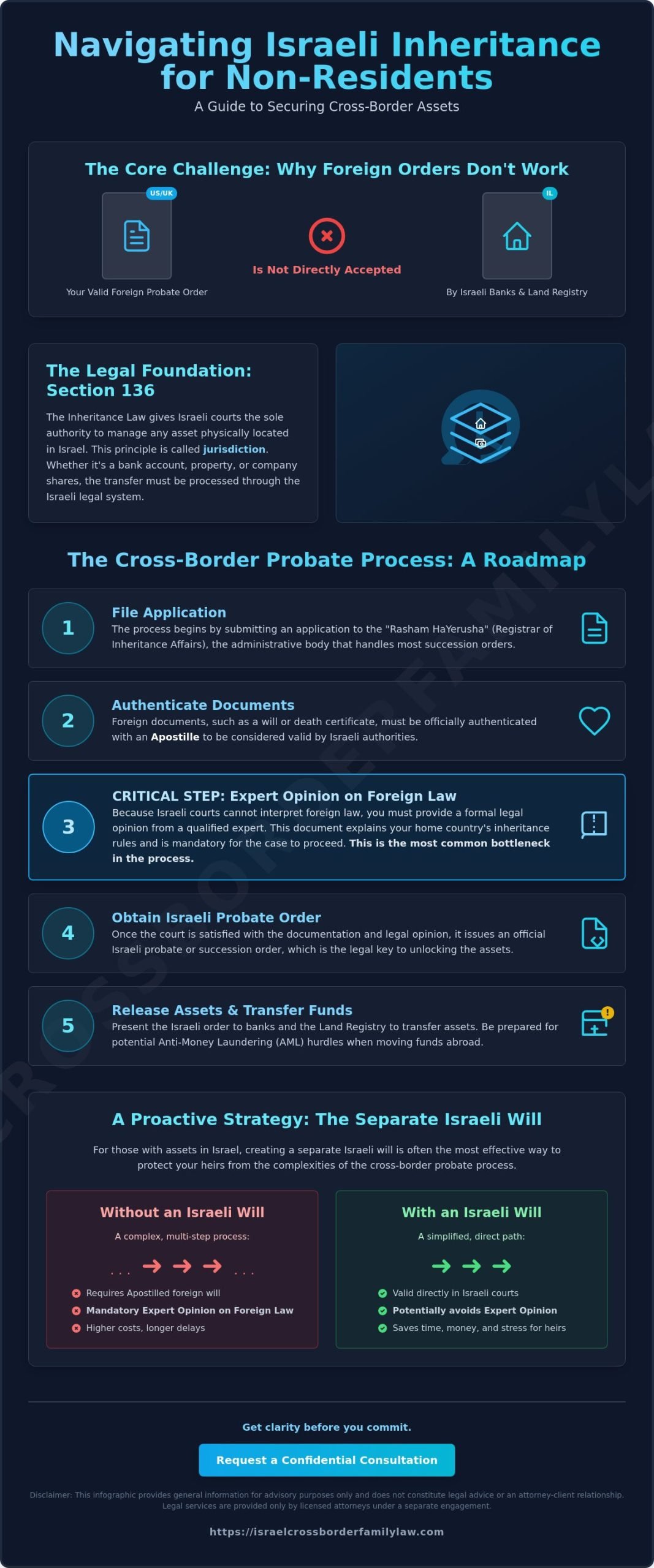
Section 136 of the Inheritance Law (5725-1965) is the cornerstone of israeli inheritance law for non residents. It grants Israeli courts the authority to manage any assets physically located in IL, whether the deceased was a citizen or had never stepped foot in the country. If there’s an apartment in Jerusalem or a bank account in Tel Aviv, the local legal system must get involved to transfer those titles. You can’t simply present a foreign probate order from a US or UK court and expect a local bank to release funds; the order must be processed through the Israeli system first.
There’s a vital difference between jurisdiction and the law that actually governs the distribution. Jurisdiction refers to which court has the power to hear the case. Applicable law refers to which country’s rules decide who gets the assets. This complexity is rooted in Israel’s Constitutional Framework, which balances specific statutes with broader international legal principles. While Israel takes jurisdiction over the physical assets, it often looks to the laws of the deceased’s home country to determine the rightful heirs.
To better understand how these laws function when no will is present, watch this helpful video:
When Does Israeli Law Apply?
Israeli law applies primarily to assets physically situated within its borders. This list includes real estate, local bank accounts, and shares in Israeli companies. However, the “domicile” factor is the primary trigger for distribution rules. Section 137 clarifies that the distribution follows the law of the deceased’s primary residence at the time of death. If a person lived in California but owned a villa in Herzliya, the Israeli court has jurisdiction to issue the order, but it will apply California law to decide the shares of the heirs. International treaties also play a role in ensuring that jurisdiction is handled fairly across borders.
The Role of the Registrar of Inheritance Affairs
Most cases begin with the “Rasham HaYerusha” (Registrar of Inheritance Affairs). This administrative body handles standard applications for succession orders. Non-residents often face more scrutiny during this initial filing because the Registrar must verify foreign documents and ensure the estate complies with cross-border requirements. If an heir files an objection or the case involves complex legal questions, the Registrar transfers it to the Family Court. Gaining clarity on these procedural steps is essential for expats and foreign nationals who want to avoid bureaucratic delays.
This article is published on an independent advisory platform and does not imply an attorney-client relationship.
The Role of Foreign Law and the Expert Opinion Requirement
Section 137 of the Inheritance Law establishes that the estate’s distribution is governed by the law of the deceased’s domicile at the time of death. This creates a unique challenge for those navigating israeli inheritance law for non residents. Even though an Israeli court handles the probate of local assets, it doesn’t automatically apply local statutes to the inheritance hierarchy. Instead, it must look to the laws of the deceased’s home country to determine who is entitled to the estate.
Israeli judges are experts in local legislation but are legally prohibited from assuming knowledge of foreign legal codes. They can’t simply look up the probate code of New York, London, or Toronto. To satisfy the court, the applicant must provide formal evidence of what the foreign law dictates. This requirement is often the primary bottleneck in the process. The court won’t move forward without a verified explanation of the rules that would apply in the deceased’s place of residence.
What is an Expert Opinion on Foreign Law?
The court requires a specific document known as an “Expert Opinion on Foreign Law.” This must be authored by a qualified professional, typically a lawyer licensed and experienced in the relevant foreign jurisdiction. The opinion details how the estate would be distributed under local laws, identifying the legal heirs and their respective shares. The Expert Opinion serves as the essential evidentiary bridge between two legal systems. Without this document, the Israeli Registrar cannot confirm that the distribution aligns with the laws of the deceased’s domicile.
The Conflict of Laws in Practice
Complexity arises when foreign law conflicts with Israeli public policy, known as “Order Public.” For instance, if a foreign law includes rules that the Israeli court finds discriminatory or contrary to local values, the judge may choose to override those specific provisions. There’s also the concept of “Renvoi,” where the foreign law might actually refer the matter back to Israeli law for certain types of assets, like real estate. This creates a circular legal loop that requires careful navigation.
Managing these cross-border nuances requires foresight and strategic planning. Choosing the right expert and ensuring the opinion is comprehensive can prevent months of bureaucratic delays. If you’re feeling uncertain about these requirements, it’s helpful to get clarity on your specific situation before submitting your application. Understanding how foreign law interacts with local procedures is the best way to ensure a smooth transfer of assets to the next generation.
This article is published on an independent advisory platform and does not imply an attorney-client relationship.
The Israeli Probate Process for Foreign Beneficiaries
Securing a Succession Order (Tzav Yerusha) or a Probate Order is a multi-step journey that requires precision in documentation. For those navigating israeli inheritance law for non residents, the process is less about a single court date and more about clearing a series of bureaucratic checkpoints. While a standard domestic case might move quickly, non-resident petitions generally take between 8 and 12 months to complete due to the extra layers of verification required for foreign documents.
The first hurdle is authentication. Any document issued outside of IL, such as a death certificate or an original will, must bear an Apostille. This is an international seal that confirms the document’s authenticity for use abroad. Additionally, all foreign language documents require a notarized Hebrew translation. The Israeli authorities will not review documents in English or other languages without these certified translations, making this a non-negotiable early step in your strategy.
Filing the Application for a Succession Order
As of May 2026, all probate and succession order petitions involving foreign residents must be submitted through a mandatory digital portal. This shift toward a fully online system is designed to streamline the process, though it requires specific technical compliance. Your application must include the deceased’s death certificate, the original will (if one exists), and a power of attorney. Once submitted, the file is reviewed by the Administrator General. This official ensures that the interests of all potential heirs are protected and that the foreign file meets every local regulatory standard. You can learn more about how the advisory process works to help manage these requirements from abroad.
Public Notice and the Objection Period
Transparency is a core principle of the Israeli legal system. Once the application is filed, a mandatory public notice is published in Israeli newspapers. This notice serves to inform potential creditors or unknown heirs that a succession order has been requested. There is a set window, typically 14 days from the date of publication, during which any interested party can file an objection. If no objections are raised, the Registrar can issue the final order. However, if a dispute arises, the case is transferred from the Registrar to the Family Court for a formal hearing. Managing these disputes from a distance requires a clear understanding of the systemic differences in the Israeli courtroom environment.
This article is published on an independent advisory platform and does not imply an attorney-client relationship.
Releasing Assets: Navigating Israeli Banks and Land Registries
Obtaining a Succession Order or a Probate Order is a significant milestone, but it does not automatically place funds in your hand or names on a deed. This “implementation phase” is where many non-residents encounter the most resistance. Under israeli inheritance law for non residents, you must navigate the specific internal compliance departments of local institutions that are often risk-averse regarding international transfers. The court order is simply the key; you still have to turn the lock at each individual financial or governmental entity.
The Land Registry, commonly known as “Tabu,” requires a specific application to transfer the title of real estate to the heirs. While the process is administrative, it requires the digital submission of the Succession Order and proof of identity for all beneficiaries. It’s vital to remember that while Israel abolished its inheritance and estate tax in 1981, other fiscal obligations remain. If you choose to sell an inherited property, a capital gains tax (Mas Shevach) of 25% is applied to the real gain. Unlike some other jurisdictions, Israel does not offer a “step-up in basis,” meaning the tax is calculated based on the original purchase price paid by the deceased, which can result in a substantial liability for properties held for decades.
Dealing with Israeli Financial Institutions
Israeli banks are subject to rigorous Anti-Money Laundering (AML) protocols. They are often hesitant to transfer inherited funds to foreign accounts without exhaustive documentation that goes well beyond the Probate Order. Banks may demand tax residency certifications or proof of the deceased’s source of wealth to satisfy their “Know Your Customer” requirements. Locating accounts can also be difficult if the deceased did not leave clear records. In such cases, a search through the Ministry of Finance’s central database is necessary to identify dormant holdings. For a deeper look at these systemic challenges, you can review our Guide for Expats and Foreign Nationals.
Taxation and Reporting for US Beneficiaries
For US citizens and residents, the inheritance of Israeli assets triggers specific federal obligations. While the US-Israel tax treaty helps mitigate double taxation on income from assets like rental properties, it does not exempt heirs from reporting requirements. Under FBAR and FATCA regulations, US beneficiaries must report their interest in Israeli bank accounts once the value exceeds certain thresholds. These reporting mandates are strictly enforced by the IRS, and non-compliance can lead to severe penalties. Strategic planning is essential to ensure that the transition of assets remains transparent to both Israeli and US authorities. Before you approach a local bank, it’s highly recommended to coordinate your asset release strategy to avoid having funds frozen during the transfer process.
This article is published on an independent advisory platform and does not imply an attorney-client relationship.
Strategic Considerations for Cross-Border Estate Management
Managing an international estate requires a shift from reactive filing to proactive strategy. For many families, the complexities of israeli inheritance law for non residents only become apparent after a loved one has passed, leading to frozen accounts and lengthy court delays. Identifying potential “red flags” in a cross-border estate early on is the most effective way to protect the value of the assets and ensure the intentions of the deceased are honored without unnecessary bureaucratic friction.
A cross-border advisory approach differs from standard legal representation by focusing on the jurisdictional bridge. Instead of simply processing documents, a strategic approach evaluates how early decisions regarding jurisdiction and document preparation will impact the final distribution. This foresight is critical in a system where cultural and systemic differences can significantly alter the timeline for asset release.
Drafting a Will for Israeli Assets
One of the most effective strategies for non-residents is the creation of a “Situs Will,” which is a local will specifically designed to govern assets located in IL. By having a separate Israeli will, heirs can often bypass the mandatory requirement for an Expert Opinion on Foreign Law, which we discussed in previous sections as a primary bottleneck. This local document allows the Israeli Registrar to process the estate under local rules, significantly reducing the “cost of complexity.”
However, precision is vital when drafting these documents. You must ensure that the Israeli will is carefully coordinated with your existing US or UK estate plan so that it doesn’t inadvertently revoke your primary will. Asset protection is a multifaceted discipline, often intersecting with other life changes such as divorce and separation for international families. Coordinating these legal instruments ensures that your global footprint is fully protected against conflicting jurisdictional claims.
The Importance of Strategy Before Commitment
Before you file any application with the Registrar of Inheritance Affairs, it’s essential to calculate the impact of your “early moves.” The choice of which documents to present and how to frame the deceased’s domicile can dictate the speed of asset release. Once a file is submitted, it becomes difficult to change course, making the initial strategy the most important phase of the process. A well-planned approach identifies risks before they become legal hurdles, saving both time and financial resources.
Get clarity before you commit. Request a confidential consultation to understand how these strategic choices apply to your specific family circumstances.
This article is published on an independent advisory platform and does not imply an attorney-client relationship. Legal services are provided only by licensed attorneys under a separate engagement.
Securing Your Family’s Global Legacy
Navigating israeli inheritance law for non residents requires more than just filling out forms; it demands a comprehensive strategy that bridges two distinct legal systems. We’ve explored how the “Expert Opinion on Foreign Law” acts as a mandatory bridge for the court and why local bank compliance is often the final hurdle to releasing assets. By prioritizing early decision-making and cross-border coordination, you can avoid the common bureaucratic pitfalls that often freeze estates for months.
Our advisory specializes in cross-border US-Israel strategy with extensive experience navigating the Registrar of Inheritance Affairs. We focus on proactive strategy and risk management to ensure your transition of assets is as seamless as possible. Don’t leave your family’s future to chance in a complex legal landscape. It’s possible to manage these assets effectively without the need for constant travel or administrative stress.
Get clarity before you commit. Request a confidential case review to start moving your estate forward with confidence.
This article is published on an independent advisory platform and does not imply an attorney-client relationship. Legal services are provided only by licensed attorneys under a separate engagement.
Frequently Asked Questions
Do I need to travel to Israel to claim my inheritance?
You generally don’t need to travel to IL to claim your inheritance or manage the probate process. Most procedures can be handled remotely by a local representative using a Power of Attorney. This document must be properly authenticated at an Israeli consulate or through an Apostille in your home country to be recognized by the Registrar of Inheritance Affairs.
Can I use my US-based Will to transfer property in Israel?
You can use a US-based Will, but it isn’t automatically enforceable for assets located in IL. You must first validate the document through the Israeli probate process to obtain a local Probate Order. This involves submitting the original Will, a certified Hebrew translation, and an expert opinion explaining how the Will complies with the laws of your home jurisdiction.
What is a “Foreign Law Expert Opinion” and why is it so expensive?
A “Legal Opinion on Foreign Law” is a mandatory evidentiary document that explains the inheritance rules of the deceased’s home country to the Israeli court. It’s required because Israeli judges can’t assume knowledge of foreign legal codes. The cost reflects the specialized expertise of practitioners qualified to bridge two legal systems and the professional liability associated with providing formal evidence in court.
Is there an inheritance tax in Israel for foreign residents?
There is no inheritance or estate tax in IL; this tax was abolished in 1981. However, heirs should be aware of other fiscal obligations. For example, if you sell inherited real estate, you may be subject to a 25% capital gains tax. Understanding israeli inheritance law for non residents also requires checking for tax reporting requirements in your country of residence.
How long does the probate process take in Israel for a non-resident?
The probate process for a non-resident typically takes between 8 and 12 months to complete. This timeline includes the mandatory digital filing, the public notification period in local newspapers, and the review by the Administrator General. Delays can occur if documents are missing an Apostille or if the case involves complex jurisdictional disputes.
What happens if a non-resident dies in Israel without a Will?
If a non-resident dies without a Will, the Israeli Succession Law of 1965 applies to their local assets. The distribution is generally governed by the law of the deceased’s last place of residence. You’ll need to apply for a Succession Order (Tzav Yerusha), which requires a foreign law expert to confirm who the legal heirs are according to the laws of that person’s home country.
Can an Israeli bank refuse to release funds even with a Probate Order?
An Israeli bank can delay or refuse to release funds if the heirs don’t meet strict anti-money laundering (AML) and tax compliance standards. The bank may require additional documentation, such as tax residency certificates or proof of the source of wealth, before they authorize a transfer to a foreign account. A Probate Order is the legal key, but bank internal compliance is a separate hurdle.
How do I authenticate my foreign documents for use in the Israeli court?
You must authenticate foreign documents like death certificates and Wills with an Apostille seal from the relevant authority in your home country. This seal confirms the document’s validity for international use under the Hague Convention. If your country isn’t part of this convention, you’ll need to follow a more traditional legalization process through the nearest Israeli consulate.

Article by
Gabriel Lior
A Personal Journey That Became a Mission
The advisory was founded by an American father Gabriel Lior, LLB, MBA , global entrepreneur, and cross-border advisor who spent more than a decade navigating the Israeli family court system firsthand and now lives in Singapore with his son.
As a divorced parent in a cross-border family, Gabriel faced nearly every legal challenge a foreign parent can encounter in Israel — including child custody disputes, child support proceedings, property matters in Israel and abroad, false accusations, and complex immigration and relocation proceedings.
Over the years, he learned the hard way how difficult it is for non-Israeli parents to understand the system, identify the right legal strategy, and choose the right legal representation — especially when language, culture, and jurisdictional differences are involved. He also witnessed how foreign parents and new immigrants are often disadvantaged or taken advantage of by service providers and institutions simply because they lack local knowledge or fluency.
From Client to Advisor
To truly understand — and survive — the system, Gabriel pursued formal legal education in Israel, completing two Israeli law degrees, alongside a BA and MBA earned in the United States. This was never about becoming a practicing attorney, but about gaining a deep, structural understanding of how the system works — and where it breaks down for foreign parents.
This rare combination of:
Firsthand client experience
Israeli legal and US business education
International business and negotiation training
Decades of commercial execution
created a unique perspective – one that understands both sides of the table.
After years of litigation, persistence, and at times self-representation, he ultimately succeeded in securing custody of his son and relocating abroad through a rare legal victory in the Israeli Supreme Court — becoming one of the first fathers in Israel to do so under these circumstances.
Disclaimer
Important Disclaimer:
The information provided on this website and in its content is for general informational and educational purposes only and does not constitute legal advice, legal opinion, or legal representation.
Gabriel Lior is not licensed to practice law in Israel (nor is he interested in doing so) and does not provide legal services, despite having completed 2 Law Degrees. The services offered are advisory in nature and are intended to provide general guidance, strategic insight, and information regarding cross-border family law considerations.
No attorney-client relationship is formed by accessing this website, reading its content, or communicating with us.
Any decisions made based on this information are at your own discretion and risk. For legal advice specific to your situation, you should consult a licensed attorney in the relevant jurisdiction.
Where appropriate, we may refer clients to independent, licensed attorneys or professionals. Such referrals do not constitute legal representation and no liability is assumed for services provided by third parties.