Disclaimer: This content is provided by Israel Cross Border Law Firm for educational and advisory purposes only and does not constitute formal legal advice or a legal representation agreement. Legal services are only provided by our licensed attorneys under a separate engagement.
What if the court that decides your family’s future was determined simply by which spouse reached the filing office first? In Israel, this “race to jurisdiction” is a reality that often catches expats off guard. You likely arrived with expectations rooted in the legal systems of the US or UK, and it’s natural to feel anxious when those familiar rules don’t seem to apply. Navigating the Legal Challenges Facing Anglo Families requires a clear understanding of how the Israeli system differs from what you know.
We’re here to help you bridge that gap and regain a sense of security. This article explores how to protect your assets and children by navigating the complex intersection of international backgrounds and local regulations. We will look at jurisdictional risks, cross-border estate planning, and the frameworks needed to approach the Israeli legal system with confidence and clarity.
Key Takeaways
- Learn why the “Race to Court” determines whether your divorce is managed by a civil family court or a rabbinical tribunal.
- Identify the primary Legal Challenges Facing Anglo Families who expect Common Law outcomes in Israel’s hybrid legal environment.
- Discover why foreign wills often fail to meet the requirements of the Israeli Succession Law of 1965 and how to secure your global assets.
- Understand the strict regulations surrounding international child relocation and your rights under the Hague Convention.
- Gain a proactive framework for conducting a cross-border legal audit to ensure your family’s future is protected before a crisis occurs.
The Jurisdictional Clash: Common Law vs. the Israeli Legal System
The Israeli legal system often surprises international families. You might expect a system similar to the British Common Law used in the US or UK. However, Israel uses a mixed jurisdiction. This system blends old Ottoman rules, British procedures, and religious laws. These religious laws govern “personal status” issues like marriage and divorce. One of the primary Legal Challenges Facing Anglo Families is assuming a US or UK contract works the same way here. In Israel, written statutes usually carry more weight than judicial precedents or past court rulings.
Many Anglos fall into the trap of believing their foreign agreements are automatically valid. A contract signed in London or New York isn’t always enforceable in a Jerusalem court. For example, local judges often prioritize the Spouses’ Property Relations Law of 1973. This law usually requires a 50/50 split of assets. If your foreign contract hasn’t been approved by an Israeli judge, it might not protect you during a dispute. Seeking clarity on these differences early on can prevent significant financial loss later.
The Mixed Jurisdiction Reality
Israeli law is a tapestry of history. It includes Ottoman land codes and British mandates. The “Status Quo” agreement is also a key part of this system. it gives religious courts power over family matters. This means secular expats are often subject to religious rules they didn’t expect. Your rights can also change based on your residency status. For instance, the Hague Convention on the Civil Aspects of International Child Abduction uses “habitual residence” to decide cases. This status depends on where your family truly lives, not just your citizenship.
The Weight of Early Decisions
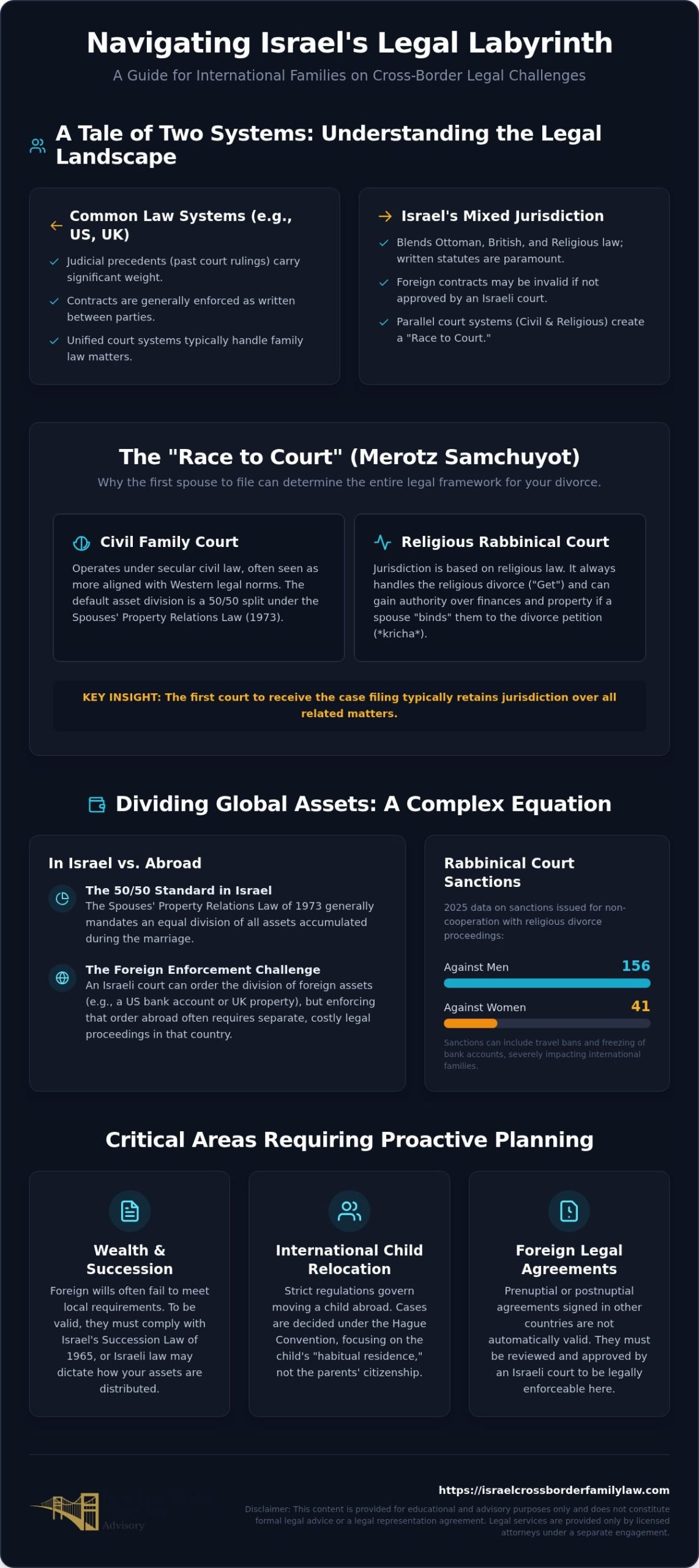
Early choices in a legal dispute can dictate your entire future. Israel has two parallel court systems: civil Family Courts and religious Rabbinical Courts. Both can hear the same types of cases. The first court to receive a file usually keeps control of the case. This leads to “forum shopping,” where each person tries to pick the court that favors them. Understanding this is vital for any international family. A jurisdictional race is a situation where one spouse files a claim first to lock the case into their preferred court system.
Navigating Cross-Border Divorce: The Race to Court
The dual court system in Israel often creates a profound sense of culture shock for secular Anglos. Unlike the unified family courts in the US or UK, Israel splits authority between civil Family Courts and religious Rabbinical Courts. This creates a strategic environment known as Merotz Samchuyot, or the “Race to Court.” It’s one of the most pressing Legal Challenges Facing Anglo Families because the venue that hears your case can significantly influence the division of your property and spousal support. With a standard divorce filing in Family Court costing ₪568 and a mandatory “Settlement of Dispute” application priced at ₪119 as of January 2026, the financial entry point is low, but the long-term stakes are incredibly high.
Civil vs. Rabbinical Courts
The Rabbinical court naturally holds jurisdiction over the “Get” (the religious divorce decree). However, it can also gain authority over financial matters, child support, and property through a process called kricha, or binding. If a spouse files for divorce in the Rabbinical court and explicitly “binds” these issues to the petition, the civil court may lose the ability to hear them. This is why the first filing matters so much. In 2025, Rabbinical courts were active in enforcing divorce decrees, issuing 156 sanctions against men and 41 against women who refused to cooperate with the religious process. These sanctions can include travel bans and bank account restrictions, which are particularly disruptive for those with international business interests.
Cross-Border Asset Division
Israeli law typically follows a 50/50 split for assets accumulated during a marriage under the Spouses’ Property Relations Law of 1973. However, managing Divorces Involving Dual Citizenship introduces layers of complexity regarding property located in the US or UK. While an Israeli court has the authority to order the division of foreign bank accounts or real estate, enforcing that order in a foreign jurisdiction is rarely straightforward. Local courts in your home country might not automatically recognize an Israeli ruling without additional legal proceedings. This can lead to expensive, parallel litigation in multiple countries.
Strategic planning is essential to avoid these pitfalls. You can review our Pricing and Strategic Reviews to understand the costs associated with protecting your global interests. Because early decisions dictate the legal track for years to come, you should seek a confidential advisory session before any papers are filed.
Wealth and Succession: Protecting Global Assets
Many families arrive in Israel assuming their existing estate plans are sufficient. This is a significant oversight. Legal Challenges Facing Anglo Families often stem from the friction between foreign estate documents and the Israeli Succession Law of 1965. While Israel has no inheritance tax as of 2026, the procedural hurdles of probate can be exhaustive and costly if not addressed proactively. A standard “Last Will and Testament” from the US or UK may satisfy foreign requirements but fail to meet the formal execution standards required by Israeli authorities.
Multi-jurisdictional estates require a strategy that addresses assets in both countries simultaneously. Mirror Wills are often the most effective solution; they consist of separate, compatible documents that govern assets in each specific territory. This prevents the need for a foreign will to be translated or re-interpreted by an Israeli court, which often delays asset distribution for months. Heirs must also navigate the US-Israel tax treaty updates for 2026 to avoid double taxation on income-generating assets, even though Israel itself does not levy an estate tax.
Inheritance and Probate in Israel
To manage local assets like real estate or bank accounts after a death, heirs must obtain an Israeli Succession Order (Tsav Yerusha) or a Probate Order (Tsav Kiyum Tsava). This application is submitted to the Registrar of Inheritance Affairs, who ensures the distribution aligns with the Israeli Succession Law of 1965. For foreign residents, this process often requires a legal opinion regarding the laws of the deceased’s domicile. Anglos who fail to execute a valid Israeli will risk having their local property distributed according to fixed statutory percentages under the Succession Law rather than their personal wishes.
Trusts and Asset Protection
Trusts are a staple of US and UK estate planning, yet the Israeli Trust Law of 1979 operates on vastly different principles than Common Law trusts. Reporting requirements are particularly strict; the Israeli Tax Authority requires detailed disclosures for any trust where an Israeli resident is a beneficiary or settlor. To protect pre-aliyah wealth, many families utilize financial agreements that clearly delineate separate property. You can learn more about how these structures work by visiting our page for expats and foreign nationals. Establishing these protections before a crisis ensures that your global legacy remains intact despite the complexities of living in two legal worlds.
International Child Custody and the Hague Convention
Relocation is a primary source of Legal Challenges Facing Anglo Families. Many parents believe that as US or UK citizens, they maintain an inherent right to return to their home country with their children at any time. This is a dangerous misconception. If your children have established “habitual residence” in Israel, removing them without the other parent’s written consent or a court order can be legally classified as international child abduction. As of August 2026, the US Department of State recognizes Israel as a fully compliant partner under the Hague Convention, meaning Israeli courts are obligated to return children who have been wrongfully removed or retained.
The “Habitual Residence” test is the standard used to determine which country’s courts hold jurisdiction. It isn’t a simple calculation of days spent in the country. Judges look at where the children attend school, their social integration, and the family’s shared intention when they moved. For expat families, this test becomes complex if the move to Israel was intended to be temporary but became permanent over time. To prevent disputes, families should utilize formal travel consent forms and clear custody orders before crossing borders. A standard child custody claim in Israel carried a benchmark filing fee of ₪515 as of 2024, a small price compared to the risks of a Hague Convention dispute.
Relocation and Abduction Risks
Israeli courts handle requests for permanent relocation with extreme caution. While the “Tender Years Doctrine” remains Israeli law-presuming that mothers should receive custody of children under age six-a 2022 Supreme Court ruling emphasized that this is not an absolute rule. Judges increasingly examine the child’s specific welfare and the father’s involvement. If you are planning a move back to the US or UK, you must secure a formal relocation order to avoid being accused of abduction. You can find detailed support on our Hague Convention and Child Abduction Guidance page.
Cross-Border Child Support
Enforcing child support orders across the US-Israel corridor involves the Israeli Ministry of Justice and specific international treaties. One of the greatest Legal Challenges Facing Anglo Families is the difference in how support is calculated. Israeli courts traditionally use a “needs-based” approach, focusing on the child’s actual expenses, while many US and UK jurisdictions use “income-based” formulas. This discrepancy can lead to friction when trying to enforce a foreign order that doesn’t align with local standards. For more on this, see our guide on Child Support Cross-Border Enforcement.
If you are navigating a relocation dispute or need to enforce a support order, it’s vital to consult with an international family law advisor to protect your parental rights and your children’s future.
Proactive Legal Strategy for the Anglo-Israeli Family
Living between two legal systems requires more than just an awareness of the differences; it demands a structured approach to risk management. The “Clarity Before Commitment” framework is designed for families who want to avoid the high-stress, high-cost environment of reactive litigation. One of the greatest Legal Challenges Facing Anglo Families is the tendency to assume that because life feels normal, their legal status is secure. Waiting for a crisis to occur, whether that is a divorce filing or a sudden inheritance issue, is the most expensive strategy an expat can adopt. Proactive planning allows you to set the terms of your future while you are in a position of strength, rather than under the pressure of a ₪568 court filing fee or a ₪119 dispute resolution mandate.
The 3-Step Legal Audit
A cross-border legal audit serves as the foundation for your family’s security. This process involves three essential steps to bridge the gap between your home country expectations and Israeli reality:
- Step 1: Reviewing existing US/UK Wills for Israeli compliance. As established, the Israeli Succession Law of 1965 has specific formal requirements that a foreign document might not meet, potentially leaving your local assets in a state of intestacy.
- Step 2: Assessing the need for a postnuptial financial agreement. Since the default rule in Israel is a 50/50 split of marital assets, a postnuptial agreement can protect pre-aliyah wealth or business interests that you intend to keep separate under the Spouses’ Property Relations Law.
- Step 3: Clarifying jurisdictional clauses in family and business contracts. You must ensure that if a dispute arises, you aren’t forced into a “race to court” in a venue that doesn’t understand your international background or multi-jurisdictional lifestyle.
Engaging Professional Support
Navigating these complexities requires a team that understands both sides of the Atlantic. Working with an advisory platform offers a strategic advantage over a traditional law firm that may focus solely on aggressive litigation. You benefit from practitioners who are multi-qualified and licensed to practice in both Israel and the US, providing a critical bridge between divergent legal cultures. This collaborative approach ensures that your legal strategy aligns with your commercial goals and personal values, giving you the confidence to build your life in Israel without fear of the unknown. Our educational resources on the about the advisory page provide further insight into this strategic model.
Get clarity before you commit. Request a confidential consultation.
Securing Your Family’s Future in a Multi-Jurisdictional World
Navigating the intersection of Common Law expectations and the Israeli legal reality requires a shift from reactive problem-solving to proactive strategic planning. Whether you’re managing the complexities of the “race to court” in a divorce or ensuring your US-based will complies with the Israeli Succession Law of 1965, the decisions you make today will dictate your family’s security for years to come. Understanding the unique Legal Challenges Facing Anglo Families is the first step toward bridging the gap between two divergent legal cultures.
Our firm serves as a dedicated bridge for expat families, offering decades of cross-border legal experience and specific expertise in US-Israel jurisdictional clashes. We provide the steady, knowledgeable guidance necessary to navigate multi-jurisdictional complexities with confidence. By conducting a thorough legal audit and building a multi-qualified professional team, you can protect your global assets and parental rights before a crisis arises. We don’t just offer representation; we provide a framework for long-term stability.
Get clarity before you commit. Request a confidential consultation.
Israel is a unique landscape, but with the right advisory partner, you can turn complexity into a clear, actionable plan for your family’s future.
Frequently Asked Questions
Is my US will valid for assets I own in Israel?
A US will may not be sufficient to manage assets located in Israel. While foreign wills can sometimes be recognized, the Israeli Succession Law of 1965 imposes specific formal requirements that US documents often miss. Many families find that executing a mirror will specifically for their Israeli interests is a more secure strategy. This helps ensure that local real estate and bank accounts are distributed according to your wishes without lengthy court delays.
Can my spouse take our children back to the US without my consent?
No, a spouse cannot legally remove children to the US without your written consent or a court order if the children are habitual residents of Israel. Israel is a signatory to the Hague Convention. The US Department of State recognizes it as a compliant partner. If a child is taken without permission, the left-behind parent can file for an immediate return order through the Israeli Central Authority to resolve the dispute.
Do Israeli courts recognize prenuptial agreements signed in the UK or US?
Israeli courts do not automatically enforce prenuptial agreements signed in the UK or US. For these documents to be valid in Israel, they must typically be validated by a local family court to ensure compliance with the Spouses’ Property Relations Law. This is one of the primary Legal Challenges Facing Anglo Families. Failure to validate a foreign agreement can lead to a default 50/50 asset split that ignores your original intentions.
What happens if a divorce is filed in both the US and Israel simultaneously?
Simultaneous filings lead to complex jurisdictional disputes where courts determine the “center of life” for the family. If an Israeli court decides it is the appropriate forum, it will handle matters of custody and local property regardless of US proceedings. This situation often requires a multi-qualified team to manage parallel litigation. Conflicting orders between two countries can create significant legal and financial deadlock for everyone involved.
How does the Rabbinical court affect me if I am a secular Anglo?
The Rabbinical court has exclusive jurisdiction over the religious divorce decree, known as the “Get,” for all Jewish citizens and residents. This applies even if you are secular or were married in a civil ceremony abroad. If a spouse “binds” financial or custody issues to their divorce petition in the religious court first, that court may also gain the authority to decide those specific matters instead of a civil court.
Can I enforce a US child support order if my ex-spouse moves to Israel?
It is possible to enforce a US child support order in Israel through the Ministry of Justice under international treaties. However, the process is not automatic and requires the Israeli Family Court to formally recognize the foreign judgment. It is helpful to understand that Israeli support calculations are often based on the child’s actual needs. These may differ from the income-based formulas used in many US states or the UK.
What is the “Race to Court” and how can I protect myself?
The “Race to Court” is a strategic filing period where the first spouse to submit a petition determines whether the case is heard in a civil or Rabbinical court. This early decision dictates the legal framework for the entire separation. You can protect yourself by seeking a cross-border legal audit before any papers are filed. This proactive approach helps you navigate the Legal Challenges Facing Anglo Families before a crisis occurs.
Is there an inheritance tax in Israel for foreign beneficiaries?
Israel does not levy an inheritance or estate tax. This law was abolished in 1981. However, foreign beneficiaries must still account for potential capital gains tax when selling inherited Israeli property. Additionally, US citizens are required to report their global assets to the IRS. You should review the 2026 US-Israel tax treaty updates to ensure your inheritance strategy remains compliant with the tax regulations of both jurisdictions.

Article by
Gabriel Lior
A Personal Journey That Became a Mission
The advisory was founded by an American father Gabriel Lior, LLB, MBA , global entrepreneur, and cross-border advisor who spent more than a decade navigating the Israeli family court system firsthand and now lives in Singapore with his son.
As a divorced parent in a cross-border family, Gabriel faced nearly every legal challenge a foreign parent can encounter in Israel — including child custody disputes, child support proceedings, property matters in Israel and abroad, false accusations, and complex immigration and relocation proceedings.
Over the years, he learned the hard way how difficult it is for non-Israeli parents to understand the system, identify the right legal strategy, and choose the right legal representation — especially when language, culture, and jurisdictional differences are involved. He also witnessed how foreign parents and new immigrants are often disadvantaged or taken advantage of by service providers and institutions simply because they lack local knowledge or fluency.
From Client to Advisor
To truly understand — and survive — the system, Gabriel pursued formal legal education in Israel, completing two Israeli law degrees, alongside a BA and MBA earned in the United States. This was never about becoming a practicing attorney, but about gaining a deep, structural understanding of how the system works — and where it breaks down for foreign parents.
This rare combination of:
Firsthand client experience
Israeli legal and US business education
International business and negotiation training
Decades of commercial execution
created a unique perspective – one that understands both sides of the table.
After years of litigation, persistence, and at times self-representation, he ultimately succeeded in securing custody of his son and relocating abroad through a rare legal victory in the Israeli Supreme Court — becoming one of the first fathers in Israel to do so under these circumstances.
Disclaimer
Important Disclaimer:
The information provided on this website and in its content is for general informational and educational purposes only and does not constitute legal advice, legal opinion, or legal representation.
Gabriel Lior is not licensed to practice law in Israel (nor is he interested in doing so) and does not provide legal services, despite having completed 2 Law Degrees. The services offered are advisory in nature and are intended to provide general guidance, strategic insight, and information regarding cross-border family law considerations.
No attorney-client relationship is formed by accessing this website, reading its content, or communicating with us.
Any decisions made based on this information are at your own discretion and risk. For legal advice specific to your situation, you should consult a licensed attorney in the relevant jurisdiction.
Where appropriate, we may refer clients to independent, licensed attorneys or professionals. Such referrals do not constitute legal representation and no liability is assumed for services provided by third parties.