This article is published on an independent advisory platform, not a law firm, and does not imply an attorney-client relationship. Legal services are only provided by licensed attorneys under a separate engagement.
Moving a child to Israel is often viewed as a cultural homecoming, but without the correct legal preparation, it can inadvertently trigger an international custody dispute. You likely understand that relocating a family involves immense logistical pressure, yet the legal requirements for moving a child to israel involve much more than just booking a flight or applying for Aliyah. Missteps in understanding the difference between guardianship and physical custody can lead to severe delays or even legal action under the Hague Convention.
We recognize the stress of managing a foreign legal system while trying to build a new life. This guide provides the clarity you need to navigate the Ministry of Interior’s residency requirements and the Israeli Family Court’s standards for the best interests of the child. You’ll learn how to secure your child’s legal status while avoiding the risks of cross-border litigation. We will walk through the essential steps to ensure your relocation is both legally sound and strategically planned for your family’s future in IL. Get clarity before you commit. Request a confidential consultation.
Key Takeaways
- Define the legal distinction between physical residency and ‘Apotropsut’ (guardianship) to protect your parental rights under the IL Legal Capacity and Guardianship Law.
- Navigate the legal requirements for moving a child to israel by securing notarized parental consent and aligning your plans with the ‘Best Interests of the Child’ judicial standard.
- Streamline your interactions with the Ministry of Interior by identifying the specific Apostilled documentation required for Aliyah or A/5 residency visas.
- Mitigate the risk of international abduction claims by understanding how the Hague Convention applies to unilateral relocations and the concept of wrongful retention.
- Develop a proactive relocation strategy to identify potential legal risks and secure your child’s status before making irreversible financial or logistical commitments.
Understanding the Legal Framework: Guardianship and Residency in Israel
This article is published on an independent advisory platform and does not constitute an attorney-client relationship. Legal services are only provided by licensed attorneys under a separate engagement. In IL, the concept of “Guardianship,” known in Hebrew as Apotropsut, is the foundational pillar of parental rights. It isn’t simply a matter of who the child lives with on a daily basis; it encompasses the legal authority to make critical life decisions regarding education, medical care, and permanent residence. You must distinguish this from physical custody, as having the child live with you doesn’t automatically grant the right to move them across borders.
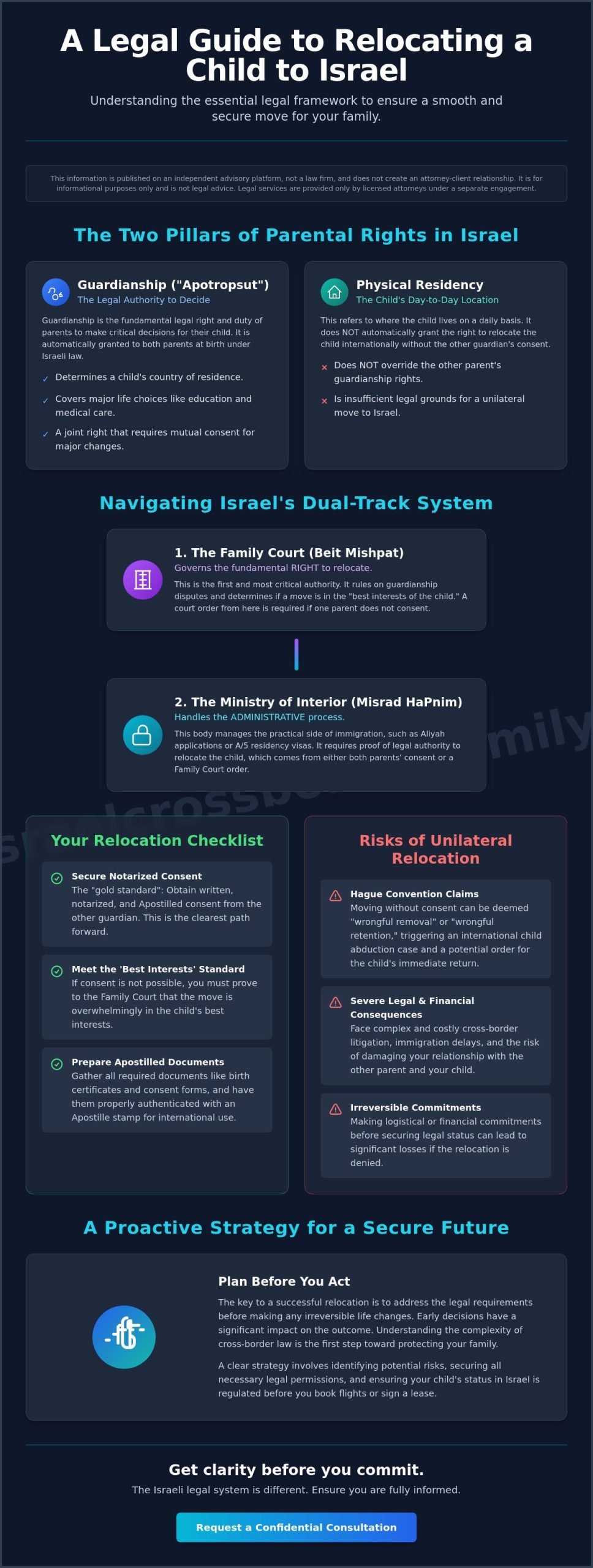
Understanding the legal requirements for moving a child to israel begins with recognizing the dual-track system involving the Family Court and the Ministry of Interior. While the Ministry of Interior handles the administrative aspects of visas and residency, the Family Court governs the underlying right of the child to relocate. Neither parent can change the child’s country of residence without the express consent of the other guardian or a specific court order. Failure to secure this legal foundation can lead to significant complications, including claims of wrongful removal under international law.
To better understand this concept, watch this helpful video:
The Role of the Legal Capacity and Guardianship Law
The Legal Capacity and Guardianship Law is the primary statute that dictates child residence and parental authority in IL. Under this framework, both parents are considered the natural guardians of their children from birth unless a court explicitly rules otherwise. The law views the “place of residence” as a joint parental decision, which means that moving a child to a new country is a decision that belongs to both guardians equally. If you are exploring international custody and relocation, you must realize that IL law prioritizes the child’s right to maintain a consistent relationship with both parents, making early consensus or judicial intervention a strategic necessity.
Family Court vs. Religious Courts
The Family Court (Beit Mishpat LeInyanei Mishpacha) generally takes precedence in relocation matters because it is designed to handle the civil aspects of family disputes. Jewish citizens should be aware that the Rabbinical Court also holds jurisdiction over certain family matters, particularly if a divorce case is already active within that system. Determining which court has jurisdiction early in the relocation process is vital to avoid conflicting rulings that could stall your move. This jurisdictional clarity is especially important when considering the Hague Convention on the Civil Aspects of International Child Abduction, as the choice of forum can influence how a claim of “wrongful retention” is managed. Get clarity before you commit. Request a confidential consultation.
This article is published on an independent advisory platform, not a law firm, and does not imply an attorney-client relationship. Legal services are only provided by licensed attorneys under a separate engagement.
Essential Requirements for Relocation: Consent and the ‘Best Interests’ Standard
Securing written, notarized consent from both parents is the absolute gold standard for meeting the legal requirements for moving a child to israel. While the legal framework of guardianship establishes who has the right to make decisions, this consent serves as the physical proof required by border and residency authorities. Without this document, the Ministry of Interior or the Family Court may view the relocation as a breach of the other parent’s rights. Even if the other parent verbally agrees to the move, a lack of formal documentation can lead to immediate legal challenges and potential orders for the child’s return to their original country if a dispute arises later.
When consensus between parents is unattainable, the Israeli legal system shifts its focus to the “Best Interests of the Child” (Tovat HaYeled). This is the primary judicial metric used by judges to determine if a move should be authorized despite one parent’s objection. The court conducts an exhaustive evaluation of how the relocation will impact the child’s social, educational, and emotional adjustment. They look at the child’s entire world to ensure the transition is beneficial. Understanding how these factors overlap is a critical part of any international custody and relocation strategy.
Obtaining and Documenting Parental Consent
A valid consent letter must be more than a simple signed note. To be recognized in IL, the document usually requires an Apostille, which is an international certification that authenticates the notary’s signature. If the original document isn’t in Hebrew or English, a certified translation may also be necessary. Many families find that a formal “Relocation Agreement” is the most secure tool. This contract outlines not just the move, but also future visitation schedules and how travel costs will be shared between the parents. Get clarity before you commit. Request a confidential consultation.
How Israeli Courts Determine the ‘Best Interests’ Standard
The Family Court relies heavily on professional assessments from social workers, known as Pkidot Saad. These court-appointed professionals interview the family and provide a recommendation based on several key factors. The court’s priority is always stability, and the judge will examine the child’s age, their existing ties to IL, and the non-relocating parent’s visitation rights. They also scrutinize the proposed educational and social environment in the new location. A judge will rarely approve a move based solely on a parent’s career goals if the move risks severing the child’s bond with their other parent. The goal is to ensure the child thrives while maintaining their essential family connections.
This article is published on an independent advisory platform, not a law firm, and does not imply an attorney-client relationship. Legal services are only provided by licensed attorneys under a separate engagement.
How to Regulate a Child’s Legal Status with the Ministry of Interior
Establishing a child’s legal standing in IL involves a rigorous administrative process through the Ministry of Interior (Misrad HaPnim). While the Family Court handles the rights of the parents, the Ministry focuses on the child’s right to reside in the country. Understanding the legal requirements for moving a child to israel means preparing for a multi-step journey that often begins months before your arrival. The process is highly bureaucratic and requires precise attention to detail to avoid residency gaps.
The first step is determining the specific eligibility of the child. Families moving under the Law of Return (Aliyah) follow a different path than those seeking a residency visa, such as an A/5 temporary resident status. Regardless of the path, gathering documentation is the most labor-intensive phase. You’ll need original birth certificates with an Apostille. In certain cases where paternity wasn’t clearly established at birth or the parents weren’t married, the Ministry may require a court-ordered DNA test to confirm the biological link before granting status.
Once you arrive, you’ll submit your application and attend a formal interview. Here, the Ministry evaluates your “Center of Life” (Merkaz HaChaim). They look for evidence that your family’s primary residence, financial interests, and social ties are now within IL. This involves providing rental contracts, utility bills, and proof of school enrollment for the child to demonstrate that your move is permanent rather than transitory.
Visas and Status for Children of Foreign Nationals
For parents residing in IL on work or residency visas, the “Accompanying Minor” procedure is the primary mechanism for securing a child’s status. This is often more complex for expats and foreign nationals who have children from previous marriages. The Ministry requires documented proof of sole custody or a notarized, Apostilled consent from the non-relocating parent. Without these, the application will likely stall, leaving the child without legal residency or access to essential state services. A checklist for this process typically includes the child’s passport, previous school records, and the parents’ current visa documentation.
Navigating Israeli Schools and Local Registration
IL law mandates that every child living in the country must be registered in the educational system. This isn’t just a social step; it’s a legal one. Upon arrival, you must visit your local municipality (Iriya) to register your address and enroll your child in a school. This registration serves as vital evidence for your “Center of Life” application. It also triggers the child’s eligibility for national health insurance through Bituach Leumi, though you should check the current waiting periods for new residents. Get clarity before you commit. Request a confidential consultation.
This article is published on an independent advisory platform, not a law firm, and does not imply an attorney-client relationship. Legal services are only provided by licensed attorneys under a separate engagement.
Cross-Border Custody and the Hague Convention
Meeting the legal requirements for moving a child to israel requires a deep understanding of international treaties, specifically the Hague Convention. Two critical terms often surface in these disputes: “wrongful removal” and “wrongful retention.” Wrongful removal occurs when a parent moves a child to IL without the other parent’s consent or a court’s permission. Wrongful retention happens when a child travels to IL for a legitimate visit, such as a summer holiday, but the parent refuses to return them to their home country. Both actions can trigger a Hague Convention on Child Abduction petition, which prioritizes the child’s immediate return to their place of habitual residence.
Timing is a decisive factor in these international proceedings. The Hague Convention establishes a 12-month window for a left-behind parent to file a petition. If the application is submitted within this year, the Israeli court is generally mandated to order the child’s return unless specific, narrow exceptions apply. If a parent waits longer than a year, the court has more discretion to consider whether the child has become “settled” in their new Israeli environment. Because IL courts treat international abduction claims with extreme urgency and severity, acting without formal legal authorization is a high-risk strategy that rarely succeeds.
Avoiding the Pitfalls of ‘Self-Help’ Relocation
Parents sometimes assume that a custody order from a US court grants them the unilateral right to move, but these orders aren’t automatically recognized in IL. This is a common trap in “self-help” relocations. Without a “Mirror Order” issued by an Israeli Family Court, your foreign custody rights may lack local enforceability. Furthermore, the risk of “retention” is ever-present; even if the other parent agreed to a temporary stay, keeping the child in IL beyond that date without a written extension constitutes a legal breach. You shouldn’t rely on verbal promises or foreign documents alone when the child’s habitual residence is at stake.
Enforcing Foreign Custody and Support Orders
To ensure long-term stability, you must “domesticate” your foreign court orders. This process involves petitioning the IL Family Court to recognize and adopt the terms of your US or international judgment. A Mirror Order strategy is often the most effective way to align both jurisdictions, ensuring that visitation schedules and custody rights remain consistent across borders. This alignment also extends to financial obligations. If a parent fails to pay support after the move, enforcement can be managed through the Bureau of Enforcement (Hotsa’a LaPoal), which has the authority to garnish wages or restrict travel. To ensure your foreign orders are properly recognized in IL, speak with a cross-border professional today.
This article is published on an independent advisory platform, not a law firm, and does not imply an attorney-client relationship. Legal services are only provided by licensed attorneys under a separate engagement.
Strategic Planning: How to Move Forward Safely
Relocating a family across international borders is a permanent decision that requires more than just logistical preparation. Before you make irreversible commitments, such as selling your primary residence or resigning from a long-term position, you must ensure your plan aligns with the legal requirements for moving a child to israel. Moving too quickly without a verified strategy can lead to jurisdictional conflicts that are difficult and expensive to resolve once the child is already in IL. A proactive approach allows you to identify potential risks before they become active legal disputes.
One of the most effective tools for international families is a dedicated Relocation Strategy session. This process focuses on identifying the specific pressure points in your situation, such as the non-relocating parent’s future access or the child’s eligibility for specific residency visas. You should also prepare for the cultural differences in IL family litigation. Unlike some common law systems where the court remains a passive observer, Israeli Family Courts are often very “hands-on.” Judges and court-appointed professionals take an active role in scrutinizing the child’s daily environment to ensure their well-being is protected. For visual guidance on these complex topics, you can explore the advisory resources available on our YouTube channel.
The Importance of Early Strategy
Decisions you make during the first 30 days of your arrival can impact your family’s legal status for years. Establishing a “status quo” in IL, such as enrolling a child in a specific school or signing a long-term lease, creates a factual foundation that the court will use to determine the child’s habitual residence. A comprehensive cross-border assessment should look at both your home country’s laws and IL statutes to ensure there are no gaps in protection. You should always prioritize “legal peace” over the speed of the move. Taking the time to secure a Mirror Order or a formal Relocation Agreement provides a level of security that a verbal promise never can.
Next Steps for International Families
If you are currently navigating this transition, we recommend reviewing the for expats and foreign nationals section of this platform for more detailed guidance on residency and status. Every family’s situation is unique, and the inherent complexity of cross-border law means that general information should never replace a personalized strategy. Get clarity before you commit. Request a confidential consultation. Please remember that this content is for informational and educational purposes only; it does not constitute specific legal advice for your case.
This article is published on an independent advisory platform, not a law firm, and does not imply an attorney-client relationship. Legal services are only provided by licensed attorneys under a separate engagement.
Securing Your Family’s Future in Israel
Successfully navigating the legal requirements for moving a child to israel requires a blend of administrative precision and strategic foresight. The transition involves more than just physical relocation; it requires a formal alignment of guardianship rights, residency status through the Ministry of Interior, and the proactive domestication of foreign court orders. By prioritizing written consent and understanding the “Best Interests” standard, you can mitigate the risks of international custody disputes and ensure a stable environment for your child’s growth.
Managing the multi-jurisdictional complexity between the US and IL requires specific expertise that accounts for two distinct legal systems. With a physical presence in both Tel Aviv and New York, our advisory platform provides authoritative cross-border insights to help international families move forward safely. Get clarity before you commit. Request a confidential consultation.
Your family’s move to IL is a significant milestone. With the right strategy and a clear understanding of the legal landscape, you can build a secure and thriving future in your new home.
This article is published on an independent advisory platform, not a law firm, and does not imply an attorney-client relationship. Legal services are only provided by licensed attorneys under a separate engagement.
Frequently Asked Questions
Can I move my child to Israel if I have sole physical custody in the US?
No, having sole physical custody in the US doesn’t grant you the unilateral right to move your child to IL. In most jurisdictions, physical custody is separate from legal guardianship, which governs the right to determine the child’s residence. You generally still need the other parent’s written consent or a court order to change the child’s residence internationally. Failing to secure this can lead to claims of wrongful removal.
What happens if the other parent refuses to sign a consent form for Aliyah?
You must obtain a court order from the child’s current country of residence if the other parent refuses to sign a consent form. Moving a child without this authorization is considered a “wrongful removal” under international law and the Hague Convention. The Israeli Ministry of Interior will typically not process a residency application for a minor without proof of consent from both legal guardians.
How does the Israeli Ministry of Interior verify a child’s relationship to an Israeli parent?
Relationship verification is primarily handled through original birth certificates that carry an Apostille certification. If the child was born out of wedlock or paternity wasn’t established at birth, the Ministry of Interior may require a DNA test ordered by an Israeli court. This process ensures the biological link is verified before the child is granted status or citizenship under Israeli law.
Is a US-based prenuptial or custody agreement valid in Israel?
US agreements aren’t automatically valid and must be “domesticated” through a Mirror Order in the Israeli Family Court. This process ensures that the terms of your custody or prenuptial agreement are recognized and enforceable under the IL legal system. Without this step, you may find it difficult to enforce visitation schedules or child support payments once you have relocated to the country.
What is the ‘Best Interests of the Child’ standard in Israeli law?
The ‘Best Interests’ standard (Tovat HaYeled) is a judicial metric that prioritizes the child’s stability and emotional well-being over the parents’ preferences. Judges evaluate factors like the child’s age, language skills, and their ability to maintain a relationship with the non-relocating parent. The court’s goal is to ensure that the move doesn’t cause developmental harm or sever essential family bonds.
Can a child move to Israel on a tourist visa and change status later?
Yes, a child can enter on a tourist visa, but changing status from within the country is often more complex and bureaucratic. It’s generally safer to regulate the child’s status before arrival to ensure immediate access to health insurance and schools. Arriving without the correct residency visa can lead to delays in accessing state services and may complicate your “Center of Life” application.
What are the legal consequences of moving a child to Israel without the other parent’s permission?
Moving a child without permission can result in an immediate Hague Convention petition for the child’s return. These proceedings are urgent and can lead to the court ordering the child’s immediate departure from IL. Understanding these risks is fundamental to the legal requirements for moving a child to israel, as a “self-help” move can lead to criminal charges or the loss of custody rights.
How long does the legal process for relocation take in the Israeli Family Court?
The legal process for relocation in the Family Court typically takes between 6 and 18 months. This timeline accounts for the mandatory involvement of social workers (Pkidot Saad) and the detailed professional assessments required to satisfy the legal requirements for moving a child to israel. Early strategic planning is essential to manage these timelines and avoid long periods of legal uncertainty for your family.

Article by
Gabriel Lior
A Personal Journey That Became a Mission
The advisory was founded by an American father Gabriel Lior, LLB, MBA , global entrepreneur, and cross-border advisor who spent more than a decade navigating the Israeli family court system firsthand and now lives in Singapore with his son.
As a divorced parent in a cross-border family, Gabriel faced nearly every legal challenge a foreign parent can encounter in Israel — including child custody disputes, child support proceedings, property matters in Israel and abroad, false accusations, and complex immigration and relocation proceedings.
Over the years, he learned the hard way how difficult it is for non-Israeli parents to understand the system, identify the right legal strategy, and choose the right legal representation — especially when language, culture, and jurisdictional differences are involved. He also witnessed how foreign parents and new immigrants are often disadvantaged or taken advantage of by service providers and institutions simply because they lack local knowledge or fluency.
From Client to Advisor
To truly understand — and survive — the system, Gabriel pursued formal legal education in Israel, completing two Israeli law degrees, alongside a BA and MBA earned in the United States. This was never about becoming a practicing attorney, but about gaining a deep, structural understanding of how the system works — and where it breaks down for foreign parents.
This rare combination of:
Firsthand client experience
Israeli legal and US business education
International business and negotiation training
Decades of commercial execution
created a unique perspective – one that understands both sides of the table.
After years of litigation, persistence, and at times self-representation, he ultimately succeeded in securing custody of his son and relocating abroad through a rare legal victory in the Israeli Supreme Court — becoming one of the first fathers in Israel to do so under these circumstances.
Disclaimer
Important Disclaimer:
The information provided on this website and in its content is for general informational and educational purposes only and does not constitute legal advice, legal opinion, or legal representation.
Gabriel Lior is not licensed to practice law in Israel (nor is he interested in doing so) and does not provide legal services, despite having completed 2 Law Degrees. The services offered are advisory in nature and are intended to provide general guidance, strategic insight, and information regarding cross-border family law considerations.
No attorney-client relationship is formed by accessing this website, reading its content, or communicating with us.
Any decisions made based on this information are at your own discretion and risk. For legal advice specific to your situation, you should consult a licensed attorney in the relevant jurisdiction.
Where appropriate, we may refer clients to independent, licensed attorneys or professionals. Such referrals do not constitute legal representation and no liability is assumed for services provided by third parties.