Most people assume that an Israeli court cannot reach a 401(k) in New York or an LLC in Delaware, but this assumption is often a costly mistake. You’re likely feeling a mix of confusion and anxiety about how your family’s international footprint will be treated during a separation. It’s natural to worry about a spouse hiding offshore assets in divorce or to feel overwhelmed by the technical complexity of multi-jurisdictional discovery. The fear that foreign accounts might simply disappear can be paralyzing, especially when you’re dealing with different legal cultures and tax systems.
This article provides the strategic clarity you need to understand how international bank accounts, US-based retirement funds, and business interests are handled within the Israeli legal system. We’ll explore the disclosure process, the severe penalties for non-compliance, and the critical factors that determine whether you should seek a resolution in Israel or the United States. By understanding the “Balancing of Resources” principle and the necessity of US-specific tools like QDROs, you can move forward with confidence. Please note that this content is published on an independent advisory platform, not by a law firm, and is intended for informational purposes rather than formal legal advice.
Key Takeaways
- Learn about the legal obligation for full disclosure and the serious risks of failing to report foreign holdings to the Israeli courts.
- Understand how currency volatility and exchange rate fluctuations between the Dollar and Shekel impact the valuation of your Offshore Assets in Divorce.
- Gain clarity on the “Race to Jurisdiction” and how filing first in the right court can significantly protect your US-based property and business interests.
- Identify the specific challenges and legal requirements for dividing complex international structures like Trusts, LLCs, and Family Limited Partnerships.
- Discover the benefits of a strategy-led approach that bridges the gap between the US and Israeli legal systems before you commit to litigation.
Defining Offshore Assets in the US-Israel Divorce Context
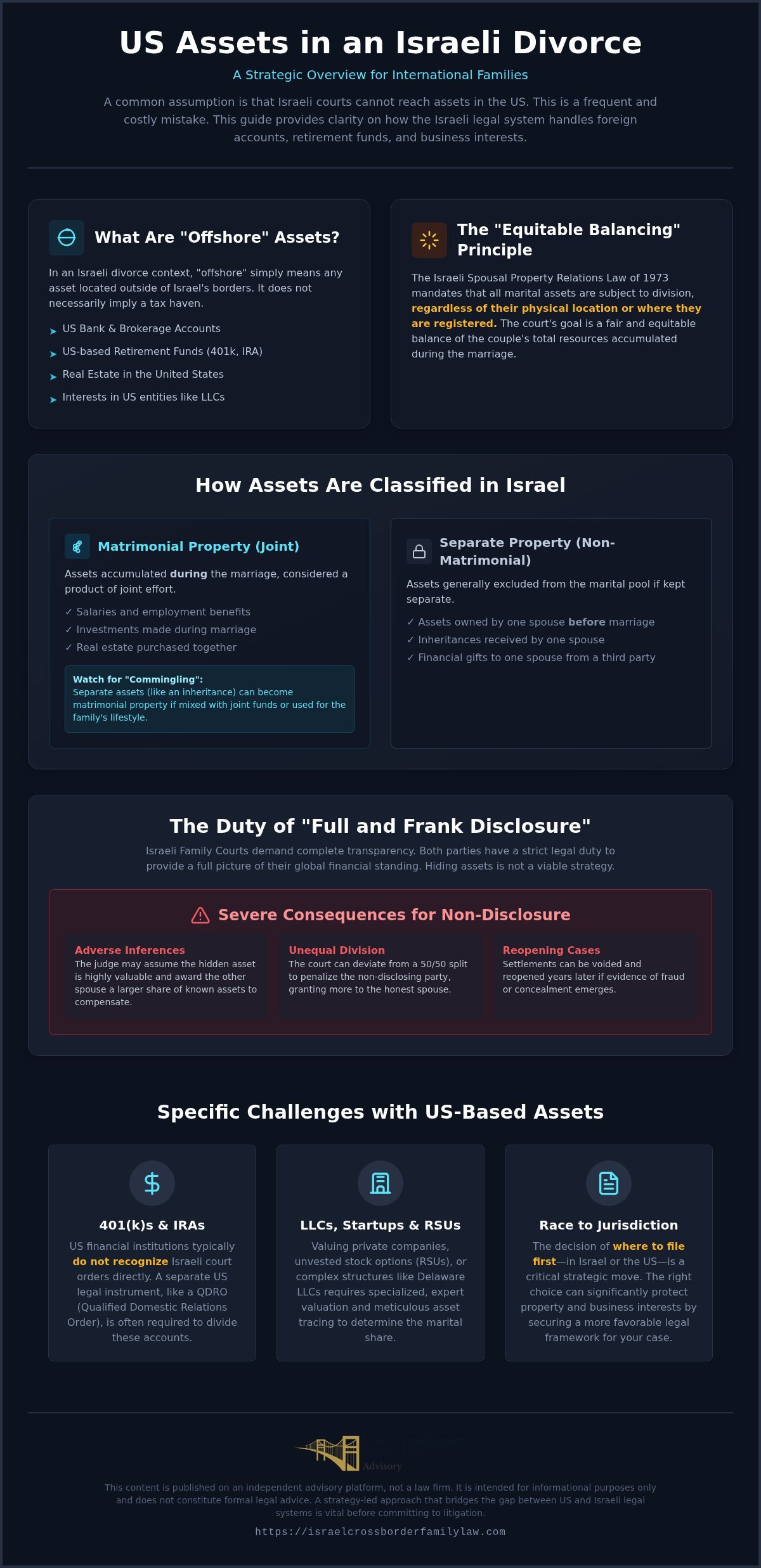
For an expat living in Tel Aviv or Jerusalem, the term “offshore” doesn’t necessarily imply a hidden tropical tax haven. In the context of an Israeli divorce, an offshore asset is simply any property, account, or business interest located outside the borders of Israel. This frequently includes US bank accounts, brokerage portfolios, and residential real estate in American suburbs. Under the Israeli legal principle of “Equitable Balancing,” these assets are generally subject to division regardless of where they’re physically held. Managing Offshore Assets in Divorce requires a clear understanding of how local courts view foreign wealth, especially when that wealth is tied to complex US structures like Delaware LLCs or tech startups with US-based parent companies. As an independent advisory platform and not a law firm, we focus on providing strategy and risk management guidance to help you find clarity before committing to a legal path.
Matrimonial vs. Non-Matrimonial Property in Israel
The classification of assets depends heavily on the date of marriage and the specific provisions of the Spousal Property Relations Law of 1973. Generally, assets accumulated during the marriage are considered joint property, meant to be shared equally. However, the Division of property in Israel distinguishes between matrimonial assets and those acquired before the marriage, through inheritance, or as specific gifts. While a US-based inheritance might seem safely “offshore” and separate, it can become matrimonial property if it was used to fund the family’s lifestyle in Israel or if it was commingled with joint funds. This process, known as “incorporation,” can happen gradually. Common exceptions that usually remain separate property include:
- Assets acquired by one spouse before the marriage date.
- Financial gifts received by one spouse from a third party.
- Inheritances held abroad that haven’t been mixed with marital wealth.
Early decisions on how to hold these assets carry significant weight during a divorce, making it vital to understand the inherent complexity of cross-border property rights and the differences between legal cultures.
The Role of US-Based Financial Vehicles
US-based retirement accounts like 401(k)s and IRAs present unique challenges because they don’t exist in the same legal form under the Israeli system. While an Israeli court may order an equal division of these funds, US financial institutions won’t typically recognize an Israeli court order on its own. This is a common point of confusion for expats and foreign nationals who have spent years building equity in US-based companies. When dealing with Offshore Assets in Divorce, the treatment of Delaware LLCs or Israeli startups with US parent companies also requires specialized attention. Valuing unvested stock options or restricted stock units (RSUs) adds another layer of multi-jurisdictional complexity. These assets are often contingent on future employment, and their value can fluctuate wildly. In long-term marriages, identifying which portions of these accounts are truly separate and which have been “commingled” requires meticulous tracing and expert valuation. Gaining strategic clarity on these issues is essential before you commit to any litigation path in Israel.
The Legal Obligation of Full Disclosure and Asset Tracing
Israeli Family Courts operate under the strict principle of “Full and Frank Disclosure.” This means both parties have a legal duty to provide a transparent and complete picture of their global financial standing. When managing Offshore Assets in Divorce, you can’t simply omit a US-based brokerage account or a rental property in Florida because it’s outside Israeli territory. The consequences of non-disclosure are severe. If a court discovers hidden wealth, it may draw “adverse inferences,” which essentially means the judge assumes the hidden asset is of significant value and awards the other spouse a larger share of the known assets. In extreme cases, settlements can be reopened years later if evidence of fraud or concealment emerges.
Methods for Tracing Assets Across Borders
Tracing wealth between Israel and the United States requires a blend of local legal authority and international cooperation. One primary tool is the use of “Letters Rogatory,” which are formal requests from an Israeli court to a US court seeking assistance in obtaining bank records or testimony. While effective, this process is formal and time-consuming. Most successful tracing efforts begin with a digital footprint analysis. We often look for international wire transfers leaving Israeli accounts, which serve as breadcrumbs leading to foreign destinations. Working with forensic accountants is vital to bridge the gap between Shekel-based Israeli records and US tax filings. These professionals analyze Asset Protection in High-Net-Worth Global Divorce Cases to ensure that complex structures don’t shield marital wealth from a fair division.
Identifying Red Flags in Financial Statements
Identifying hidden Offshore Assets in Divorce often starts with spotting inconsistencies in a spouse’s lifestyle versus their reported income. Sudden, unexplained transfers to foreign entities or the sudden emergence of complex trust structures are common red flags. In these scenarios, understanding “beneficial ownership” is critical. Beneficial ownership refers to the individual who enjoys the benefits and control of an asset despite the legal title being held in the name of a third party or a corporate entity. Tracing these connections often requires coordinating with US-based investigators who can perform local property searches or corporate registry deep-dives.
International asset tracing is a powerful tool, but it involves a careful cost-benefit analysis. The expense of hiring multi-jurisdictional experts and filing international motions must be weighed against the projected value of the assets you’re seeking. It’s often helpful to speak with an advisor about your specific situation to determine if the complexity of a search aligns with your strategic goals. Our role on this independent advisory platform is to help you weigh these risks and costs before you commit to an expensive litigation strategy. Gaining clarity early prevents you from spending more on the search than the asset itself is worth.
Valuing and Dividing Complex International Structures
Valuing Offshore Assets in Divorce is rarely as simple as checking a bank balance. One of the most significant hurdles is “Currency Risk,” which can drastically alter the fairness of a settlement. In early 2026, the Bank of Israel reported an 8.4% volatility for the shekel/dollar exchange rate. For a spouse receiving a lump-sum payment in Shekels based on the value of a US-based brokerage account, this fluctuation can lead to a substantial loss or gain by the time the funds are actually transferred. Strategic clarity is required to decide whether to value assets at the time of filing or at the time of the final agreement to mitigate these shifts.
Israeli courts often take a substance-over-form approach to US-based Family Limited Partnerships (FLPs) and Trusts. While these structures are designed for asset protection in the US, an Israeli judge may “pierce the veil” if they determine the assets were funded with marital wealth accumulated during the marriage. This is particularly relevant for expats and foreign nationals who may have established these vehicles before moving to Israel. Additionally, valuation experts must be careful to avoid “double dipping,” a common error where the value of a professional practice or business is counted once as a divisible asset and then used a second time as the income source for calculating alimony.
Tax Implications and the US-Israel Treaty
The “market value” of a property in New York or California is often a misleading figure in a cross-border divorce. What matters is the “net value” after accounting for the tax friction of a potential sale. Capital gains tax considerations in the US can significantly reduce the actual cash available to the parties. Fortunately, the US-Israel Tax Treaty provides a framework to manage these issues, particularly regarding transferred retirement funds. For instance, transfers “incident to divorce” may avoid the 10% early withdrawal penalty in the US if executed as a direct trustee-to-trustee transfer. Understanding the Hague Convention on the Recognition of Divorces is also essential, as it ensures that the legal dissolution of the marriage—and the resulting financial orders—are recognized across borders, preventing a situation where a spouse is considered divorced in one country but still married in another.
Valuation of Private Interests and Startups
Founders and early employees of “Born Global” startups face unique valuation challenges. These companies often have complex cap tables with US-based parent companies and Israeli subsidiaries. Israeli courts may look at “Exit” clauses and future earnings to determine how much of a future windfall belongs to the marital estate. Because these assets are often illiquid and their future value is speculative, the role of neutral, cross-border valuation experts is vital. These experts help determine a fair “wait and see” approach or a buy-out price that accounts for the inherent risks of the tech sector. This independent advisory platform focuses on helping you navigate these risks and the significant differences between legal systems before you commit to a binding agreement.
Strategic Considerations: Civil vs. Rabbinical Jurisdictions
In Israel, the choice of court is not just a procedural detail; it’s a critical strategic decision that can dictate the outcome of your financial future. The “Race to Jurisdiction” means the first spouse to open a file, whether in the Family Court or the Rabbinical Court (Beit Din), generally locks in that court’s authority over the divorce matters. While both systems are bound by the “Balancing of Resources” principle, their approach to Offshore Assets in Divorce can vary in practice. The Rabbinical Court may place more weight on the conduct of the parties, whereas the Family Court strictly adheres to civil property laws. You can find detailed explanations of these jurisdictional nuances on the Israel Family Law YouTube channel.
Since an Israeli judge cannot physically seize a building in New York or a bank account in London, they rely on “in personam” jurisdiction. This allows the court to issue orders directly to the individual rather than the asset itself. If a spouse refuses to comply with an order to liquidate a US brokerage account or transfer property, the Israeli court can impose personal sanctions, including fines or travel restrictions. This bridge between legal systems ensures that foreign holdings remain part of the marital pot, even when they’re beyond the physical reach of the local authorities.
Enforcement of Israeli Orders in the United States
US courts generally respect Israeli divorce decrees through the principle of “Comity,” provided the proceedings were fair and both parties had proper notice. However, technicalities matter for execution. A US bank won’t move funds based on an Israeli order alone; you’ll often need to have the order “domesticated” or recognized by a US court. For families with children, the International Custody & Relocation aspects under the Hague Convention often intersect with asset division, adding another layer of multi-jurisdictional complexity that requires careful coordination between your legal teams.
The ‘Race to the Court’ Strategy
Filing in the US might be preferable for a high-earning spouse if specific state laws offer more favorable treatment of pre-marital wealth or complex trust structures. However, starting proceedings in two countries at once is a high-risk move. Parallel proceedings often lead to conflicting orders and astronomical legal fees. In some cases, a spouse may request a “Stay of Proceedings,” asking one court to pause while the other handles specific issues like the valuation of Offshore Assets in Divorce. Because these early decisions carry so much weight, you should consult with a cross-border advisor to map out your jurisdictional strategy before you commit to a specific court. This independent advisory platform focuses on helping you find clarity before the litigation process begins.
Navigating the Divide: Strategy Before Litigation
Managing Offshore Assets in Divorce requires more than just local legal representation; it demands a comprehensive strategy that bridges the gap between two distinct legal systems. For international families, jumping straight into litigation without a clear roadmap often leads to conflicting orders and unnecessary financial loss. An independent advisor serves as a critical bridge, helping you understand how the advisory works to coordinate your interests across borders. This approach focuses on risk management and decision-making before you ever step into an Israeli courtroom. By prioritizing strategy, you can better manage the emotional and financial toll that multi-jurisdictional disputes inevitably impose on a family. Please note that the content on this independent advisory platform is for informational purposes and does not constitute formal legal representation or advice.
The Importance of Early Decision-Making
The earliest stages of an Israeli divorce are often the most consequential for your global wealth. When you file a “Statement of Assets” in the Family Court, you’re making a formal declaration that will be scrutinized by both the Israeli judge and potentially US-based financial institutions. Early commitments made in Israel regarding the division of property can inadvertently impact your ability to claim or divide assets held in the United States. Filing documents in an Israeli court without a comprehensive cross-border review can lead to unintended waivers of rights to US-based retirement funds or corporate equity. Gaining clarity on these risks before you sign any affidavit is the most effective way to protect your long-term interests and ensure your international footprint is accurately represented.
Building a Cross-Border Legal Team
A standard local litigator is trained to win cases within the Israeli system, but they may not be familiar with the nuances of a US 401(k) or the specific reporting requirements of the IRS. A successful outcome for Offshore Assets in Divorce requires a team that speaks both legal “languages.” This means ensuring seamless communication between your US-based CPA and your Israeli lawyer. A cross-border strategist doesn’t replace your local counsel; they act as a coordinator to ensure that a victory in Tel Aviv doesn’t create a tax disaster in Washington or New York. This coordination prevents the common trap of “winning” an asset in court only to lose its value to unforeseen penalties or withholding taxes. Clarity is the best protection against asset dissipation and the inherent complexity of international wealth division.
Get clarity before you commit. Request a confidential consultation.
Securing Your Financial Future Across Borders
Managing Offshore Assets in Divorce requires a nuanced understanding of how the Israeli legal system interacts with US-based financial structures. We’ve explored the necessity of full disclosure to avoid judicial sanctions, the critical role of currency volatility in valuations, and the strategic weight of choosing the correct court forum. These early decisions often determine whether your global wealth remains intact or is significantly diminished by tax friction and legal oversights. It’s essential to remember that the first financial affidavit you file carries immense weight in both jurisdictions and can impact your rights for years to come.
As an independent advisory platform with specialized US-Israel family law expertise, we provide the authoritative guidance international families need to bridge these two systems. Please be aware that this content is for informational purposes and is published on an independent advisory platform, not by a law firm. Clarity is your strongest asset when dealing with multi-jurisdictional complexity. Before you file a single document or make a binding commitment, ensure you’ve established a roadmap that accounts for both Israeli law and US financial realities. You don’t have to navigate this divide alone.
Get clarity before you commit. Request a confidential consultation.
Frequently Asked Questions
Can an Israeli court force the sale of a house located in the US?
An Israeli court cannot directly order a US county recorder to transfer a deed, but it can compel the owner to sell. The court uses “in personam” jurisdiction to issue orders against the individual resident in Israel. If a spouse refuses to comply, they may face personal sanctions such as travel bans or fines. This indirect approach is a standard method for dividing Offshore Assets in Divorce involving US real estate.
What happens if my spouse hides money in an offshore bank account?
If a spouse conceals funds, the court may draw an “adverse inference” against them. This allows the judge to assume the hidden assets are substantial and award the other party a larger share of the known marital property. Forensic accountants can also trace international wire transfers and digital footprints to uncover these holdings. These experts bridge the gap between Israeli bank records and US financial filings to ensure a transparent and fair division of wealth.
Are US retirement accounts like 401(k)s divided in an Israeli divorce?
US retirement accounts like 401(k)s are generally subject to division under the Israeli principle of equitable balancing. However, an Israeli court order alone isn’t sufficient for a US plan administrator to release or transfer funds. You’ll typically need a Qualified Domestic Relations Order (QDRO) from a US court to execute the division without triggering immediate tax penalties. Managing this requires a strategy that coordinates the requirements of both the Israeli and US legal systems.
Will the US-Israel Tax Treaty protect me from double taxation during asset division?
The US-Israel Tax Treaty provides a framework to prevent double taxation, but it doesn’t automatically cover every asset transfer. You must structure the division of Offshore Assets in Divorce carefully to meet specific treaty requirements. For instance, retirement fund transfers should be “incident to divorce” to avoid IRS penalties. Consulting with a cross-border advisor ensures your settlement accounts for the tax laws of both nations, protecting the net value of your holdings.
How long does it take to trace assets in multiple countries?
Tracing international wealth typically takes between six months and two years depending on the complexity of the holdings. The timeline is influenced by whether the other party complies with disclosure orders or if you must use formal “Letters Rogatory” to obtain US records. While digital footprints can be analyzed quickly, obtaining certified documents from foreign institutions involves administrative delays. Early coordination between your US and Israeli teams is essential to manage these timelines.
Can I use a US Prenuptial Agreement to protect my offshore assets in Israel?
A US prenuptial agreement is not automatically recognized in Israel but can be enforceable if handled correctly. To protect your assets, the agreement must be “validated” by an Israeli Family Court or a notary, depending on when it was signed. If the document wasn’t drafted with Israeli legal standards in mind, a judge may scrutinize its provisions. It’s vital to have a cross-border professional review your US agreement to ensure it remains effective in Israel.
What is the difference between how the Rabbinical and Civil courts handle foreign property?
Both court systems must follow the “Balancing of Resources” principle, which mandates an equal division of marital property. However, the Rabbinical Court (Beit Din) may sometimes consider the conduct of the parties when determining the method of division. The Family Court strictly applies civil law, focusing on the date of marriage and the 1973 Spousal Property Relations Law. These nuances can significantly affect how foreign business interests or real estate are valued during the process.
Is it better to divorce in the US or Israel if most of our assets are abroad?
Choosing the best forum depends on the specific US state’s laws and the nature of your assets. Some US jurisdictions offer stronger protections for pre-marital wealth or assets held in trusts. Israel’s system may be more effective if you need to compel a local spouse to disclose global holdings. Seek strategic clarity before filing, as the first move often dictates which country’s laws will govern the division of your international estate.

Article by
Gabriel Lior
A Personal Journey That Became a Mission
The advisory was founded by an American father Gabriel Lior, LLB, MBA , global entrepreneur, and cross-border advisor who spent more than a decade navigating the Israeli family court system firsthand and now lives in Singapore with his son.
As a divorced parent in a cross-border family, Gabriel faced nearly every legal challenge a foreign parent can encounter in Israel — including child custody disputes, child support proceedings, property matters in Israel and abroad, false accusations, and complex immigration and relocation proceedings.
Over the years, he learned the hard way how difficult it is for non-Israeli parents to understand the system, identify the right legal strategy, and choose the right legal representation — especially when language, culture, and jurisdictional differences are involved. He also witnessed how foreign parents and new immigrants are often disadvantaged or taken advantage of by service providers and institutions simply because they lack local knowledge or fluency.
From Client to Advisor
To truly understand — and survive — the system, Gabriel pursued formal legal education in Israel, completing two Israeli law degrees, alongside a BA and MBA earned in the United States. This was never about becoming a practicing attorney, but about gaining a deep, structural understanding of how the system works — and where it breaks down for foreign parents.
This rare combination of:
Firsthand client experience
Israeli legal and US business education
International business and negotiation training
Decades of commercial execution
created a unique perspective – one that understands both sides of the table.
After years of litigation, persistence, and at times self-representation, he ultimately succeeded in securing custody of his son and relocating abroad through a rare legal victory in the Israeli Supreme Court — becoming one of the first fathers in Israel to do so under these circumstances.
Disclaimer
Important Disclaimer:
The information provided on this website and in its content is for general informational and educational purposes only and does not constitute legal advice, legal opinion, or legal representation.
Gabriel Lior is not licensed to practice law in Israel (nor is he interested in doing so) and does not provide legal services, despite having completed 2 Law Degrees. The services offered are advisory in nature and are intended to provide general guidance, strategic insight, and information regarding cross-border family law considerations.
No attorney-client relationship is formed by accessing this website, reading its content, or communicating with us.
Any decisions made based on this information are at your own discretion and risk. For legal advice specific to your situation, you should consult a licensed attorney in the relevant jurisdiction.
Where appropriate, we may refer clients to independent, licensed attorneys or professionals. Such referrals do not constitute legal representation and no liability is assumed for services provided by third parties.