This report is published by an independent advisory platform for informational purposes and does not constitute legal advice or an attorney-client relationship. What if the most aggressive litigator in Tel Aviv isn’t actually the best person to protect your assets in a cross-border divorce? For many Anglos and expats in Israel, the realization that the legal system involves a complex “race for jurisdiction” between secular and religious courts often comes too late. Choosing a firm like Matat Plesner Law Firm requires an understanding of how they manage the friction between different legal cultures and international jurisdictions.
We recognize that the anxiety of managing an unfamiliar system can lead to hasty decisions with long-term consequences. This article offers an independent analysis of the Matat Plesner Law Firm’s practice areas and their standing in the Israeli legal community. You’ll gain perspective on their suitability for complex family law matters, including the differences between mediation and litigation. We also provide a strategic framework to help you evaluate if their expertise aligns with your cross-border needs, ensuring you have clarity before you commit to a specific legal strategy.
Key Takeaways
- Understand why Matat Plesner Law Firm focuses on a boutique approach to family law and how their experience since 1999 shapes their handling of complex divorce cases.
- Learn the critical differences between litigating in secular Family Courts versus Rabbinical Courts and how a strategic choice of forum impacts your case outcome.
- Identify the specific challenges of cross-border family law, including child custody disputes under the Hague Convention and the division of international assets.
- Gain a framework for evaluating local legal representation, focusing on communication styles and cultural nuances essential for English-speaking clients in Israel.
- Discover why seeking independent strategic advice is a vital first step before committing to long-term legal representation or specific litigation paths.
Who is Matat Plesner Law Firm? A Profile of an Israeli Boutique
Adv. Matat Plesner founded the Matat Plesner Law Firm in 2006, building on a professional foundation established when she joined the Israel Bar in 1999. Based in Israel, the firm operates as a specialized boutique practice. This means the firm doesn’t dilute its expertise across multiple legal fields like criminal defense or real estate. Instead, it dedicates its resources entirely to family law, mediation, and divorce proceedings. This focused approach is designed to provide clients with deep technical knowledge in a niche that is often emotionally charged and legally intricate.
This profile is provided by an independent advisory platform for informational purposes. It isn’t legal advice, and legal services are only provided by licensed attorneys under a separate engagement.
To better understand the complexities of legal filings and motions in specialized cases, watch this helpful video:
The Boutique Model in Israel’s Legal Landscape
In the Israeli legal market, a boutique firm is defined by its narrow specialization. While larger firms might offer a wide array of services, a boutique practice like Matat Plesner Law Firm focuses on depth rather than breadth. This model is often preferred for high-stakes family disputes because it allows for a higher degree of privacy and personalized attention. Clients often find that the direct involvement of the lead attorney provides a level of reassurance that’s sometimes lost in larger corporate structures where cases might be passed to junior associates.
The unique nature of Family Law in Israel often requires a level of discretion that large firms struggle to maintain. Managing the balance between personalized attention and resource availability is a hallmark of this model. It ensures that sensitive cases are handled with the necessary confidentiality while still maintaining the professional rigor required for complex litigation. This is particularly relevant for international clients who require a steady hand to guide them through a system that may feel foreign in both language and procedure.
Leadership and Professional Philosophy
Adv. Matat Plesner’s professional philosophy is rooted in a dual approach of mediation and litigation. She has built a reputation for developing tailored legal strategies that reflect the specific needs of private clients. This is especially important for those unfamiliar with local customs or the Hebrew language. The firm’s focus remains on providing reliable, effective service that prioritizes the client’s long-term interests over quick, aggressive wins that might not hold up under future scrutiny.
Choosing a legal representative is a significant decision. You can learn more about how our platform helps you evaluate these options on our about the advisory page. Understanding a firm’s core philosophy helps you determine if their approach matches your specific goals, whether you’re seeking an amicable settlement or need robust representation in court. Clarity in these early stages often prevents costly mistakes later in the process.
Core Practice Areas: From Divorce to Complex Mediation
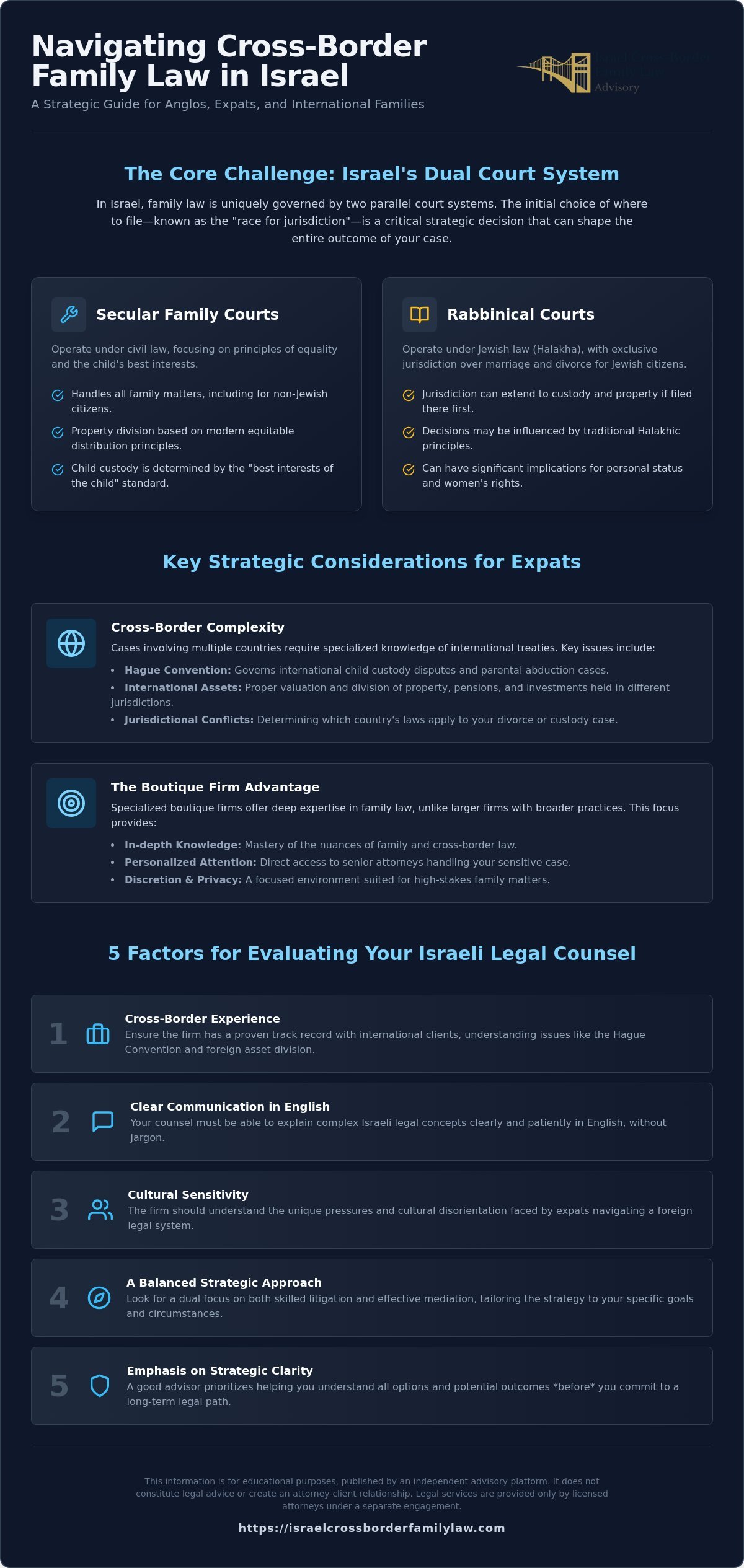
The Matat Plesner Law Firm provides a comprehensive suite of services that address the specific legal challenges of life in Israel. One of the most significant hurdles for international families is the dual court system. In Israel, divorce and family matters are managed by both the civil Family Affairs Court and the Rabbinical Court. Because these two systems operate under different principles, the initial decision of where to file can dictate the entire course of a case. This firm assists clients in navigating this “race for jurisdiction,” ensuring that their rights are protected regardless of which court eventually hears the matter.
Strategic planning is another core pillar of the firm’s work. This includes drafting detailed financial, prenuptial, and parenting agreements. For expats and foreign nationals, these documents must account for assets located in multiple countries and the potential for future relocation. Handling sensitive issues like common-law spouse rights (Yeduim BaTzibur) and alimony requires a nuanced understanding of how Israeli law views non-traditional or international family structures.
Litigation vs. Mediation: The Firm’s Approach
In Israel, the law mandates a dispute resolution process before litigation can begin. This process usually involves meetings with the court’s Assistance Unit to encourage settlement. As an “Authorized Mediator,” the lead attorney at Matat Plesner Law Firm helps families reach agreements without the high emotional and financial costs of a courtroom battle. Mediation is often the preferred path for cross-border cases because it allows parents to create flexible arrangements that a rigid court ruling might overlook. However, when a consensus isn’t possible, the firm transitions into aggressive litigation to defend a client’s interests in court. This is particularly vital in high-stakes scenarios involving the Hague Abduction Convention, where immediate and decisive action is required to ensure a child’s safety and return.
Property and Financial Asset Disputes
Managing wealth across borders involves more than just simple division. It requires sophisticated asset valuation and an understanding of how Israeli support calculations, such as alimony and child support, interact with foreign income. The firm handles complex property division, succession planning, and the drafting of wills to protect an individual’s legacy. For those navigating these complexities for the first time, it’s helpful to understand how the system applies to expats. Before making any legal commitments, it’s wise to discuss your specific situation with an advisor who understands both the local and international landscape.
Handling Cross-Border Complexity: Hague Convention and International Assets
International families often face legal hurdles that local residents never encounter. When a family has roots in both Israel and another country, such as the United States, a simple divorce can quickly evolve into a multi-jurisdictional dispute. The Matat Plesner Law Firm addresses these complexities by managing cases where assets, children, and legal residence are spread across different borders. This requires more than just a knowledge of local statutes. It demands a strategic understanding of how Israeli court rulings will be viewed by foreign authorities and how international treaties apply on the ground in Israel.
The Hague Convention in Israel
Israel is a signatory to the Hague Convention on the Civil Aspects of International Child Abduction. This treaty provides a legal framework for the prompt return of children who have been wrongfully removed from their country of habitual residence. In 2024, for example, the Ministry of Justice reported that four U.S.-related return cases were successfully resolved under this framework. These proceedings are urgent and technically demanding. The Matat Plesner Law Firm manages these high-stakes cases by navigating the specific evidentiary requirements of the Israeli Family Court. Speed is essential in these matters, as the court’s primary goal is to restore the status quo and protect the child’s best interests. Learn more about Hague Convention child abduction to understand the procedural timelines involved.
International Custody and Relocation
Relocation, or “hagira,” is one of the most contested areas of family law for expats. If a parent wishes to move back to their home country with a child, they must obtain either the other parent’s consent or a court order. The Israeli legal system prioritizes the child’s welfare, but it also considers the parent’s right to move and the existing custody arrangements. Enforcing a foreign custody order within Israel is another layer of complexity that requires formal recognition by the local courts. Navigating international custody and relocation requires a clear plan that addresses visitation schedules across time zones and travel costs. Without a comprehensive agreement, parents may find themselves trapped in a cycle of litigation that spans multiple continents.
Managing international assets also requires multi-jurisdictional awareness. This is especially true for US-based holdings like 401(k) accounts, social security benefits, or real estate. Israeli courts have the authority to divide global property, but the practical enforcement of these orders abroad is rarely straightforward. A strategic approach ensures that the division of assets is recognized by both legal systems, preventing future tax liabilities or ownership disputes. Seeking clarity on these issues early in the process is the only way to protect your long-term financial stability.
Due Diligence: 5 Factors for Evaluating an Israeli Family Law Practice
Choosing a law firm in Israel is a high-stakes decision for international families. You shouldn’t rely solely on directory rankings or general reputations. Instead, use a specific set of criteria to ensure the firm can handle the unique pressures of a US-Israel case. When you evaluate a practice like Matat Plesner Law Firm, consider these five essential factors:
- Rabbinical Court Proficiency: In March 2026, the Knesset expanded the authority of religious courts to include various civil matters. Your firm must have deep experience in these venues, as they operate under different rules than secular courts.
- Communication Accessibility: It isn’t enough for a lawyer to speak English. They must be able to translate complex Hebrew legal concepts into plain English that you can actually use to make decisions.
- Mediation vs. Litigation Balance: Verify the firm’s track record in both areas. A firm that only litigates might miss opportunities for a peaceful settlement, while a firm that only mediates might not be prepared for a courtroom battle.
- Jurisdictional Expertise: The firm should demonstrate a clear understanding of how an Israeli ruling will impact your assets or legal status in the United States.
- Fee Transparency: Legal costs in Israel vary widely. Look for a firm that provides clear billing structures and explains the court filing fees, such as the NIS 1,030 fee for ratifying divorce agreements.
Cultural Competency for Anglos and Expats
Being an expat in the Israeli legal system often feels like walking through a maze. Language is just the first barrier. You also need an advocate who understands the “Israeli way” of negotiation, which is typically more direct and fast-paced than Anglo norms. Effective representation requires a bridge between these two cultures. If your lawyer doesn’t understand your cultural background, they may struggle to represent your priorities accurately in an Israeli courtroom. You can find more details on services for expats and foreign nationals to see how these needs are addressed.
The Importance of Early Strategic Decisions
The “Race of Jurisdiction” remains a defining feature of local law. The court where you file first often determines which legal principles apply to your property and support. This makes your choice of firm critical from day one. An experienced practitioner, such as those at Matat Plesner Law Firm, will help you weigh the risks of each forum before a single document is signed. Early agreements carry immense weight and are difficult to change later. If you’re feeling overwhelmed by these choices, reach out to us for help evaluating your legal strategy before you commit.
Strategic Clarity: Moving Forward with Your US-Israel Legal Matter
Legal transitions are rarely simple. When your family life spans two countries, the complexity doesn’t just double; it multiplies. Many expats feel an urgent pressure to retain a lawyer the moment a dispute arises. While speed is sometimes necessary, rushing into a long term commitment without a clear strategy often leads to irreversible errors. An independent advisory serves as a bridge, helping you understand how firms like Matat Plesner Law Firm fit into your broader international goals. Before you sign a retainer, you need to know which legal path serves your specific interests in both Israel and your home jurisdiction.
This content is published on an independent advisory platform, not a law firm. We focus on strategy, risks, and decision making guidance. Legal representation is only provided by licensed attorneys under a separate engagement.
Clarity Before Commitment
Rushing into representation can lead to strategic errors, especially regarding the choice of court. Because the initial filing often dictates which laws apply to your assets and custody, a mistake here is difficult to correct. You shouldn’t make these decisions under duress. Using an advisory platform allows you to map out risks and opportunities before you engage a litigator. This process helps you evaluate whether a boutique practice or a larger firm matches your needs. You can learn more about how the advisory process works to help you gain a foothold in the system.
Reducing the risks associated with multi-jurisdictional family law requires a calm, methodical approach. You’re dealing with different legal cultures and languages. A strategic framework ensures that your Israeli legal team and your foreign professional advisors are working toward the same objective. This collaborative mindset prevents conflicting orders from different countries, which is a common pitfall for international families.
Educational Resources and Videos
Visual guidance is often the best way to demystify the Israeli court system. We recommend visiting the Israel Family Law YouTube channel for detailed explanations of local procedures. Specifically, the video “Understanding the Israeli Court System” provides a foundational look at how the Family Affairs and Rabbinical courts interact. This knowledge allows you to ask more informed questions when interviewing a firm like Matat Plesner Law Firm.
Your next steps should involve gathering information and assessing your financial and parental priorities. Don’t let the “race for jurisdiction” force you into a strategy you don’t fully understand. Knowledge is your best defense against the anxiety of the unknown. Get clarity before you commit. Request a confidential consultation.
Securing Your Future in the US-Israel Legal Landscape
Understanding the intersection of two different legal systems is a prerequisite for any successful family law outcome in Israel. We’ve explored how a boutique practice like Matat Plesner Law Firm provides specialized focus on sensitive matters, from the “race for jurisdiction” to complex international child relocation cases. The weight of your early decisions, specifically regarding which court system to enter, will define your legal and financial landscape for years to come. It’s a high-stakes environment where cultural nuances and technical expertise are equally important.
Our independent advisory platform is dedicated to providing international families with the strategic framework they need to evaluate their options objectively. We focus on risk management and cross-border dynamics, ensuring you aren’t forced into a strategy you don’t fully understand. Your priority should be gathering all necessary facts before making a formal commitment to representation. Get clarity before you commit. Request a confidential consultation today to discuss your jurisdictional strategy. You don’t have to face these complexities alone.
Frequently Asked Questions
This FAQ section is provided by an independent advisory platform for informational purposes. It does not constitute legal advice or an attorney-client relationship. Legal services are only provided by licensed attorneys under a separate engagement.
What is Matat Plesner Law Firm’s main area of expertise?
Matat Plesner Law Firm specializes exclusively in family law, mediation, and divorce proceedings within Israel. Since its founding in 2006, the firm has focused on managing complex domestic and international family disputes. This includes drafting prenuptial agreements, managing property division, and addressing alimony. By limiting their practice to this specific field, they provide deep technical expertise in matters that are often both legally and emotionally intricate.
Does Matat Plesner Law Firm handle cases for English-speaking expats?
Yes, the firm is specifically structured to handle cases for English-speaking expats and international families living in Israel. They understand that language barriers and unfamiliarity with the local legal culture create significant anxiety for foreign nationals. Their communication style is designed to provide clarity for those who need Hebrew legal concepts explained in plain English, ensuring clients can participate fully in their own strategic decision-making.
Is Matat Plesner Law Firm a large firm or a boutique practice?
Matat Plesner Law Firm operates as a boutique practice, which means it maintains a smaller, highly specialized team rather than a large, multi-departmental staff. This model allows for a high level of personal service and direct involvement from the lead attorney. Clients often choose boutique firms for sensitive family matters because they offer a more discreet and tailored approach compared to the impersonal nature of larger corporate legal entities.
Can this firm represent me in both the Family Court and the Rabbinical Court?
The firm represents clients in both the civil Family Affairs Court and the Rabbinical Court system. Navigating these two systems is a core requirement for family law in Israel, as the “race for jurisdiction” often determines which legal principles apply to a case. Having representation that is proficient in both venues is essential for protecting your rights regarding property division, custody, and the final religious divorce decree.
Does the firm have experience with international child custody and the Hague Convention?
The firm has extensive experience managing international child custody disputes and urgent return-of-child proceedings under the Hague Convention. These cases are technically demanding and require immediate action to protect a child’s welfare. For families with ties to the United States or other jurisdictions, the firm handles the complexities of enforcing foreign orders and managing relocation requests within the Israeli legal framework.
How does mediation work at a firm like Matat Plesner Law Office?
Mediation at a specialized family law firm involves structured, confidential meetings designed to reach an amicable settlement without the need for litigation. As an authorized mediator, the lead attorney helps parties find common ground on issues like parenting plans and asset division. This process is often preferred for international families because it allows for more flexible, culturally sensitive arrangements than a rigid court ruling might provide.
What are the benefits of hiring a boutique family law firm in Israel?
Hiring a boutique family law firm in Israel provides several advantages, including increased privacy and a higher degree of personalized attention. Because these firms specialize in a single area, their practitioners possess a deep understanding of the local court’s nuances. For high-stakes disputes, the direct involvement of an experienced partner ensures that your strategy is consistent and that your case doesn’t get lost in a large firm’s hierarchy.
How do I know if Matat Plesner is the right fit for my US-Israel divorce?
Determining the right fit for a US-Israel divorce involves evaluating a firm’s specific experience with cross-border jurisdictional conflicts. You should assess whether their communication style matches your needs and if they understand the interplay between Israeli and American legal requirements. Seeking an independent strategic review before you commit can help you determine if a firm’s philosophy aligns with your long-term financial and parental goals.

Article by
Gabriel Lior
A Personal Journey That Became a Mission
The advisory was founded by an American father Gabriel Lior, LLB, MBA , global entrepreneur, and cross-border advisor who spent more than a decade navigating the Israeli family court system firsthand and now lives in Singapore with his son.
As a divorced parent in a cross-border family, Gabriel faced nearly every legal challenge a foreign parent can encounter in Israel — including child custody disputes, child support proceedings, property matters in Israel and abroad, false accusations, and complex immigration and relocation proceedings.
Over the years, he learned the hard way how difficult it is for non-Israeli parents to understand the system, identify the right legal strategy, and choose the right legal representation — especially when language, culture, and jurisdictional differences are involved. He also witnessed how foreign parents and new immigrants are often disadvantaged or taken advantage of by service providers and institutions simply because they lack local knowledge or fluency.
From Client to Advisor
To truly understand — and survive — the system, Gabriel pursued formal legal education in Israel, completing two Israeli law degrees, alongside a BA and MBA earned in the United States. This was never about becoming a practicing attorney, but about gaining a deep, structural understanding of how the system works — and where it breaks down for foreign parents.
This rare combination of:
Firsthand client experience
Israeli legal and US business education
International business and negotiation training
Decades of commercial execution
created a unique perspective – one that understands both sides of the table.
After years of litigation, persistence, and at times self-representation, he ultimately succeeded in securing custody of his son and relocating abroad through a rare legal victory in the Israeli Supreme Court — becoming one of the first fathers in Israel to do so under these circumstances.
Disclaimer
Important Disclaimer:
The information provided on this website and in its content is for general informational and educational purposes only and does not constitute legal advice, legal opinion, or legal representation.
Gabriel Lior is not licensed to practice law in Israel (nor is he interested in doing so) and does not provide legal services, despite having completed 2 Law Degrees. The services offered are advisory in nature and are intended to provide general guidance, strategic insight, and information regarding cross-border family law considerations.
No attorney-client relationship is formed by accessing this website, reading its content, or communicating with us.
Any decisions made based on this information are at your own discretion and risk. For legal advice specific to your situation, you should consult a licensed attorney in the relevant jurisdiction.
Where appropriate, we may refer clients to independent, licensed attorneys or professionals. Such referrals do not constitute legal representation and no liability is assumed for services provided by third parties.