This article is published on an independent advisory platform and is not a law firm. The content provided is for informational and advisory purposes only and does not constitute legal representation or an attorney-client relationship. A plane ticket and a signed custody agreement from your home country are often not enough to legally move your children to Israel. When considering Moving Abroad with Children: Legal Requirements, many parents mistakenly assume that having primary custody in the US or UK grants them unilateral authority to relocate. Without the correct framework, a move intended to be a fresh start can quickly escalate into a legal crisis involving international parental abduction charges.
We understand the anxiety that comes with navigating a foreign legal system, especially when definitions of custody and guardianship in Israel differ so significantly from what you may be used to. You want to ensure your children are settled and safe without the fear of unexpected court intervention. This article provides a clear roadmap for your transition, helping you understand the specific legal frameworks and consent requirements needed to avoid international pitfalls. We will explore the nuances of the Israeli court system, the reality of the Hague Convention, and how to secure valid consent that protects your family’s future.
Key Takeaways
- Understand how the Hague Abduction Convention and the concept of “habitual residence” determine which country holds legal jurisdiction over your child’s relocation.
- Identify the critical differences between US “best interests” standards and the Israeli principle of “Parental Responsibility” to better prepare your legal strategy.
- Learn the specific Moving Abroad with Children: Legal Requirements that must be met before filing a relocation petition when parental consent is withheld.
- Discover why “self-help” measures or moving without formal permission can destroy your legal standing and lead to serious international consequences.
- Gain a strategic roadmap for navigating cross-border complexity by focusing on informed decision-making and risk mitigation before committing to a move.
This article is published on an independent advisory platform and is not a law firm. The content provided is for informational and advisory purposes only and does not constitute legal representation or an attorney-client relationship.
The Legal Framework of International Child Relocation
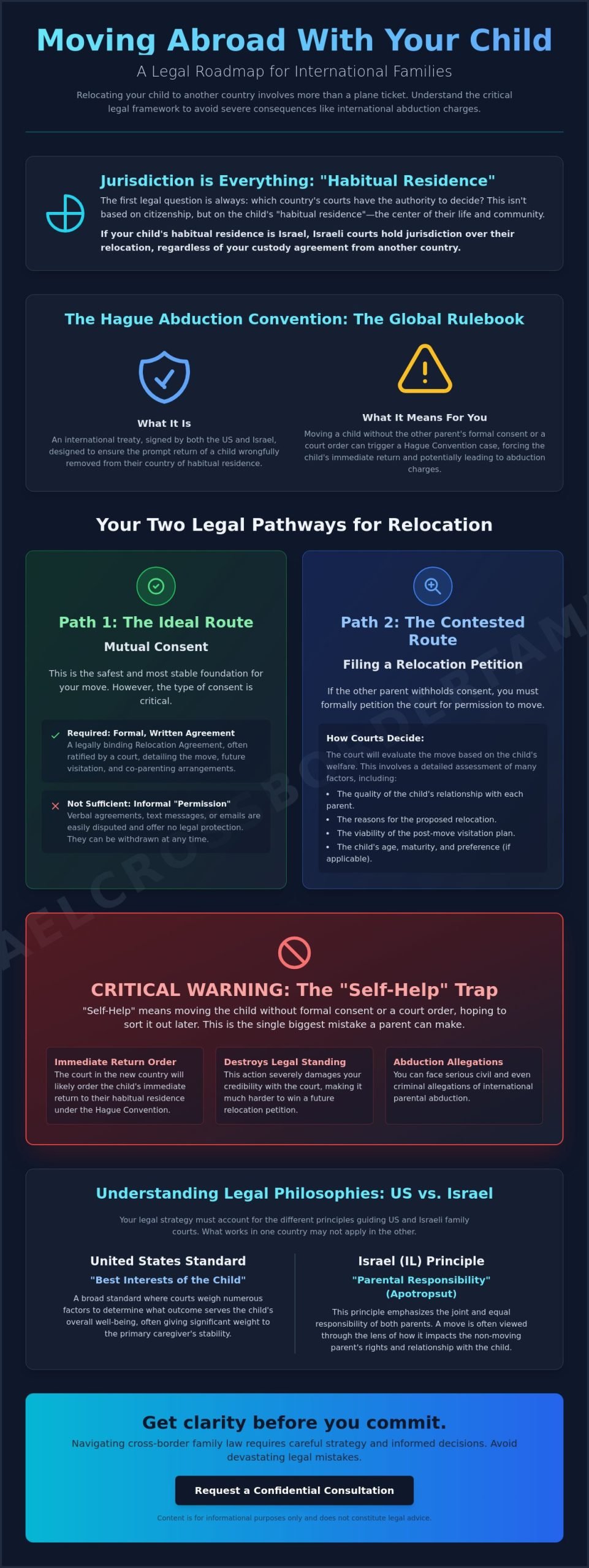
International relocation is a multi-layered legal process governed by a complex set of treaties and local statutes. When you are considering Moving Abroad with Children: Legal Requirements, the first hurdle is understanding which country’s laws actually apply to your family. This is determined by the child’s “habitual residence,” which is essentially the place where the child has integrated into a community and lives their daily life. It is the legal “home” that dictates which court system has the authority to make decisions regarding the child’s welfare.
Legal jurisdiction depends on this residence rather than the parents’ citizenship or personal preferences. If a child lives in IL, the Israeli courts usually hold the authority to decide if they can leave. Moving a child to the US without formal permission from the other parent or the court can be classified as an “unlawful removal.” This applies even if there is no existing custody order in place. The Hague Convention on International Child Abduction is the primary international mechanism for handling these disputes and returning children to their home jurisdiction.
To better understand this concept, watch this helpful video:
It is vital to distinguish between temporary travel and permanent relocation. Taking a child on a three-week vacation to visit family in the US is generally permitted under standard visitation rights. However, if that trip turns into a permanent stay without the other parent’s consent, it becomes a legal violation. The courts look at the intent, the child’s integration into the new location, and the duration of the stay to determine if a relocation has occurred. To explore the specifics of how these rules apply to your situation, you can review our guide on international custody and relocation.
What is the Hague Abduction Convention?
The Hague Convention is an international treaty designed to ensure the prompt return of children who have been wrongfully removed from their country of habitual residence. Since both the US and IL are signatories, they have agreed to a standardized process for resolving these cross-border conflicts. If a parent moves a child without authorization, they risk a court order for the child’s immediate return and potential criminal allegations of parental abduction. The convention focuses on where the child should live, not who is the “better” parent.
The Role of Consent in Moving Abroad
In the context of Moving Abroad with Children: Legal Requirements, a verbal agreement or a casual text message from the other parent is never sufficient protection. To mitigate the risk of litigation, you must secure a formal, written Relocation Agreement that clearly outlines the terms of the move and future visitation schedules. If a court order already exists, any move that violates its terms is considered a breach of law. Seeking clarity through a structured agreement is the most effective way to ensure your move is legally recognized and sustainable for the long term.
This article is published on an independent advisory platform and is not a law firm. The content provided is for informational and advisory purposes only and does not constitute legal representation or an attorney-client relationship.
Comparing Parental Responsibility: US vs. Israel (IL)
Understanding the fundamental differences between American and Israeli legal philosophies is essential when planning a cross-border move. In the United States, custody is often viewed through the lens of individual parental rights and the “Best Interests of the Child” standard. Conversely, Israeli law operates under the Legal Capacity and Guardianship Law, which views “Parental Responsibility” as an inherent, shared right that exists from birth. This means that in IL, neither parent can unilaterally decide to relocate the child because both parents are legal guardians by default. Navigating Moving Abroad with Children: Legal Requirements requires recognizing that this shared guardianship remains intact even after a divorce, necessitating explicit consent or a court order for any significant change in the child’s residence.
The Israeli system also features a unique dual-court structure. Family matters can be heard in either the civil Family Court or the Rabbinical Court. For Jewish families, the Rabbinical Court may apply religious principles alongside civil law, which can significantly influence the outcome of a relocation case. While modern Israeli courts increasingly prioritize the child’s welfare, the “Tender Years” doctrine still holds weight in certain scenarios, suggesting that children under age six should ideally remain with their mother. This contrasts with the more gender-neutral approach typically found in many US states. To navigate these complexities, Israel’s Central Authority for Hague cases provides resources for parents caught in jurisdictional disputes.
Jurisdictional Complexities in the US and Israel
In the US, family law is managed at the state level, creating a patchwork of different rules across 50 jurisdictions. Israel, however, follows a unified national law. This difference often leads to “forum shopping,” where one parent attempts to file in the jurisdiction they believe will be more favorable to their case. Determining which court holds primary authority is a critical first step. If a child has established “habitual residence” in Israel, the Israeli courts will likely claim jurisdiction over any relocation request, regardless of where the parents were married or where their original divorce decree was issued.
Cultural and Systemic Differences
Israeli courts recognize that an expat parent may have a legitimate desire to “start over” or return to their support network in their home country. However, this personal need is always balanced against the child’s right to maintain a meaningful relationship with the parent staying behind. The court often relies on court-appointed experts, such as social workers or psychologists, to evaluate the potential impact of the move. These experts carry significant influence in the Israeli system. For those navigating these transitions, our resources For Expats and Foreign Nationals offer further guidance on managing Moving Abroad with Children: Legal Requirements effectively. If you are unsure how these systemic differences might affect your specific case, you can reach out for a preliminary discussion on your strategic options.
This article is published on an independent advisory platform and is not a law firm. The content provided is for informational and advisory purposes only and does not constitute legal representation or an attorney-client relationship.
The Relocation Application Process: How Courts Decide
When a parent in IL wishes to move but the other parent objects, the legal path forward begins with a formal Petition for Relocation. This is a high-stakes process where the burden of proof rests solely on the parent who wants to move. You must prove that the relocation is not just a personal preference but a necessity that serves the child’s welfare. In the context of Moving Abroad with Children: Legal Requirements, the court’s primary concern is the “Best Interests of the Child” standard, which acts as the ultimate deciding factor in every case.
A successful application requires a comprehensive Relocation Plan. This document should detail every aspect of the child’s future life, including specific schools, housing arrangements, and the availability of extended family support. Judges in IL are wary of vague promises; they require concrete evidence that the child’s standard of living and social integration will be maintained or improved in the new country. The court’s goal is to ensure that the child’s transition is as seamless as possible while minimizing the disruption to their existing emotional bonds.
Key Factors in a Relocation Decision
The court examines several critical elements before granting permission to move. First is the quality of the child’s relationship with the parent staying behind. If the move would effectively sever that bond, the application is likely to fail. Second, the court evaluates the educational and social opportunities available in the new location compared to those in IL. Finally, the “authenticity” of the move is scrutinized. The judge must be convinced that the relocation is motivated by genuine needs, such as a career advancement or returning to a primary support network, rather than an attempt to alienate the other parent.
Maintaining the Bond: The Visitation Schedule
A mandatory component of any relocation petition is a proposed visitation schedule. Without a clear plan for how the child will maintain a relationship with the left-behind parent, the court will not approve the move. This requires creative thinking to bridge the geographic gap. Solutions often include extended summer breaks, alternating winter holidays, and a robust schedule for virtual contact. For a deeper look at these strategies, you can review our guidance on international custody and relocation.
Travel costs are another significant consideration in the Moving Abroad with Children: Legal Requirements framework. Since international flights between IL and the US are expensive, the court must decide how these expenses are shared. Often, the parent who initiates the move is expected to bear a larger portion of the travel costs to ensure the other parent’s visitation rights aren’t financially blocked. Clear financial planning in your application demonstrates a commitment to the child’s ongoing relationship with both parents.
This article is published on an independent advisory platform and is not a law firm. The content provided is for informational and advisory purposes only and does not constitute legal representation or an attorney-client relationship.
Strategic Risk Mitigation for International Families
The most dangerous path a parent can take is “self-help,” which involves moving a child without formal legal authority. In IL, departing without a court order or explicit written consent from the other parent destroys your legal standing almost instantly. It signals to the court that you are bypassing the principles of shared guardianship. This typically results in an immediate return order, which makes any future, legitimate attempt to satisfy Moving Abroad with Children: Legal Requirements significantly more difficult to achieve. Seeking clarity before you make life-altering commitments is the only way to protect your long-term relationship with your children.
One effective tool for cross-border protection is the use of “Mirror Orders.” These are identical legal orders issued by courts in both the US and IL. They ensure that the terms of your relocation or custody agreement are recognized and enforceable in both jurisdictions. This prevents a parent from attempting to use a different legal system to overturn a settled agreement. Documenting all communication is also essential. By keeping a clear record of discussions regarding the move, you can prevent the other parent from later claiming they never agreed to the relocation or that the child was taken without their knowledge.
Preventing Hague Convention Claims
A Hague claim can be filed against you even months after you have successfully relocated and settled your children into a new school. To mitigate this risk, you must maintain a meticulous log of all travel dates and parental consent documents. Using a formal “Consent to Travel” form for temporary trips is a practical way to avoid suspicion and prevent a routine visit from being mischaracterized as an abduction. For more details on these risks, see our guide on Hague Convention and Child Abduction.
Early Strategy and Decision-Making
The first 90 days of your planning phase are the most critical for a successful relocation. This is the period where you should identify “red flags” in the other parent’s behavior, such as a sudden refusal to discuss logistics or withdrawing from established routines. An advisory approach prioritizes these early strategic steps over immediate litigation. It allows you to build a foundation of transparency and legal compliance before you pack a single suitcase. If you are in the early stages of planning a move, you can request a confidential case review to explore your strategic options.
This article is published on an independent advisory platform (not a law firm) and must not imply an attorney-client relationship. Legal services are only provided by licensed attorneys under a separate engagement.
The Cross-Border Advisory: Guidance for Informed Choices
Successfully managing the transition between the US and IL requires more than just local legal knowledge. It demands a strategy-first approach that addresses the multi-jurisdictional complexity of your family’s life. Most generic guides focus solely on courtroom representation, but the real work of Moving Abroad with Children: Legal Requirements happens in the months before any papers are filed. A strategic advisory approach focuses on identifying risks and creating a roadmap that prevents litigation from becoming the only option. By seeking clarity early, you can protect your financial resources and your children’s emotional stability.
The financial and emotional costs of international family disputes are substantial. In 2026, estimated legal fees for complex relocation cases in IL can range from ₪75,000 to over ₪225,000. These figures don’t account for the secondary costs of education, such as private primary school fees in Tel Aviv which can reach 140,000 ₪ per year. Early strategic planning allows families to allocate resources toward their new life rather than exhaustive legal battles. Practitioners who understand both the US state-level nuances and the Israeli national system serve as a critical bridge, ensuring that your decisions in one country don’t create unintended liabilities in the other.
Navigating the Israeli Legal Landscape as an Anglo
For Anglos and expats, the Israeli court system can feel opaque due to language barriers and different cultural expectations. The choice of court, whether civil or rabbinical, is a strategic decision that requires a nuanced understanding of how each system views parental rights. Working with cross-cultural and multi-qualified practitioners who are licensed to practice in multiple jurisdictions ensures that nothing is lost in translation. This integrated professional support is designed to guide you through the systemic differences of the Israeli landscape. You can learn more about how this strategic process works by reviewing how the advisory works.
Next Steps for Your Family
Before you take any concrete steps toward relocation, it is essential to complete a comprehensive checklist. This includes securing valid written consent, drafting a detailed visitation plan, and verifying the habitual residence status of your children. These early decisions have a permanent impact on your legal standing. A confidential case review provides the opportunity to evaluate your specific Moving Abroad with Children: Legal Requirements without the pressure of immediate litigation. This strategy-first method ensures you are moving toward a sustainable future rather than a legal crisis.
This article is published on an independent advisory platform and is not a law firm. The content provided is for informational and advisory purposes only and does not constitute legal representation or an attorney-client relationship.
Securing Your Family’s International Future
Navigating the intersection of US and Israeli family law requires a shift from reactive litigation to proactive strategy. By understanding the foundational principles of habitual residence and shared parental responsibility, you can avoid the common pitfalls that lead to Hague Convention disputes. The process of Moving Abroad with Children: Legal Requirements depends on securing valid, written consent and presenting a comprehensive relocation plan to the court when necessary. Early decisions regarding jurisdiction and documentation will dictate the long-term stability of your family’s transition.
Our advisory focuses on cross-border complexity, providing tailored guidance for international families and expats who need to bridge the gap between two distinct legal systems. Prioritizing risk mitigation and strategic clarity allows you to move forward with confidence rather than uncertainty. We specialize in helping you understand how early choices impact your legal standing in both the US and IL.
Get clarity before you commit. Request a confidential consultation.
You have the power to make informed choices that protect your children’s well-being and your own legal standing during this significant life transition.
This article is published on an independent advisory platform and is not a law firm. The content provided is for informational and advisory purposes only and does not constitute legal representation or an attorney-client relationship. Legal services are only provided by licensed attorneys under a separate engagement.
Frequently Asked Questions
Do I need my ex-spouse’s permission to move if I have sole custody?
Yes, you generally require either written consent or a court order even if you have sole physical custody. In IL, legal guardianship is almost always shared between both parents regardless of the daily living arrangements. This means major decisions, including changing the child’s country of residence, require the involvement of both guardians to satisfy Moving Abroad with Children: Legal Requirements.
What happens if I move my child to Israel without a court order?
Moving a child to IL without a court order or the other parent’s formal consent is classified as a “wrongful removal” under the Hague Convention. The left-behind parent can file a petition for the child’s immediate return to their original country of habitual residence. Such actions often destroy your legal standing in future relocation proceedings and can lead to criminal allegations of international parental abduction.
How long does a relocation case typically take in Israeli courts?
A contested relocation case in the Israeli Family Court typically takes between 12 and 24 months to reach a final decision. This timeline includes the filing of pleadings, the appointment of social workers or psychologists to evaluate the child’s welfare, and several rounds of hearings. Because these cases are complex and involve significant expert testimony, they rarely reach a quick resolution through litigation.
Can my child’s father stop me from moving if we were never married?
Yes, if the father is legally recognized by the state, he holds natural guardianship rights equal to your own. In the Israeli system, the marital status of the parents doesn’t diminish the father’s right to be involved in decisions about the child’s residence. If he objects to the move, you’ll need to follow the same Moving Abroad with Children: Legal Requirements as a married or divorced parent by filing a relocation petition.
What is a ‘Mirror Order’ and why do I need one for a US-Israel move?
A Mirror Order is a court order issued in one country that exactly replicates the terms of an order issued in another country. It’s a critical tool for international families because it ensures your custody and visitation agreement is enforceable in both the US and IL. This prevents a parent from attempting to bypass the agreed terms by claiming the foreign order isn’t valid in the new jurisdiction.
Is it possible to relocate if the other parent is currently in prison or has no contact?
You can still relocate, but you must obtain a court order authorizing the move if you can’t get signed consent. Even if a parent is incarcerated or absent, their legal guardianship remains intact unless a court has specifically terminated those rights. Moving without a court’s permission in these circumstances still carries the risk of being flagged as an unauthorized relocation when crossing international borders.
What are the chances of winning a relocation case in Israel (IL)?
Success depends heavily on the “best interests of the child” and the quality of your proposed relocation plan. The court evaluates whether the move provides genuine benefits for the child and how you intend to maintain the child’s bond with the parent staying behind. Cases with a high level of transparency and a detailed visitation schedule tend to be viewed more favorably by Israeli judges than those motivated by personal preference alone.
How much does an international relocation legal strategy cost?
The cost of an international relocation matter includes court filing fees, expert reports, and professional advisory fees. As of January 2026, the court filing fee (Agrot) for a non-fixed sum claim in Israeli family court is 3,447 NIS. Total costs vary significantly based on the complexity of the cross-border issues and whether the case is settled through mediation or proceeds to a full trial. Investing in an early strategy can often reduce the long-term financial burden of prolonged litigation.
Get clarity before you commit. Request a confidential consultation.

Article by
Gabriel Lior
A Personal Journey That Became a Mission
The advisory was founded by an American father Gabriel Lior, LLB, MBA , global entrepreneur, and cross-border advisor who spent more than a decade navigating the Israeli family court system firsthand and now lives in Singapore with his son.
As a divorced parent in a cross-border family, Gabriel faced nearly every legal challenge a foreign parent can encounter in Israel — including child custody disputes, child support proceedings, property matters in Israel and abroad, false accusations, and complex immigration and relocation proceedings.
Over the years, he learned the hard way how difficult it is for non-Israeli parents to understand the system, identify the right legal strategy, and choose the right legal representation — especially when language, culture, and jurisdictional differences are involved. He also witnessed how foreign parents and new immigrants are often disadvantaged or taken advantage of by service providers and institutions simply because they lack local knowledge or fluency.
From Client to Advisor
To truly understand — and survive — the system, Gabriel pursued formal legal education in Israel, completing two Israeli law degrees, alongside a BA and MBA earned in the United States. This was never about becoming a practicing attorney, but about gaining a deep, structural understanding of how the system works — and where it breaks down for foreign parents.
This rare combination of:
Firsthand client experience
Israeli legal and US business education
International business and negotiation training
Decades of commercial execution
created a unique perspective – one that understands both sides of the table.
After years of litigation, persistence, and at times self-representation, he ultimately succeeded in securing custody of his son and relocating abroad through a rare legal victory in the Israeli Supreme Court — becoming one of the first fathers in Israel to do so under these circumstances.
Disclaimer
Important Disclaimer:
The information provided on this website and in its content is for general informational and educational purposes only and does not constitute legal advice, legal opinion, or legal representation.
Gabriel Lior is not licensed to practice law in Israel (nor is he interested in doing so) and does not provide legal services, despite having completed 2 Law Degrees. The services offered are advisory in nature and are intended to provide general guidance, strategic insight, and information regarding cross-border family law considerations.
No attorney-client relationship is formed by accessing this website, reading its content, or communicating with us.
Any decisions made based on this information are at your own discretion and risk. For legal advice specific to your situation, you should consult a licensed attorney in the relevant jurisdiction.
Where appropriate, we may refer clients to independent, licensed attorneys or professionals. Such referrals do not constitute legal representation and no liability is assumed for services provided by third parties.