What if the court that hears your case is decided not by logic, but by who files a single application first? For many international families, the realization that Israel operates under a dual legal system of Civil and Rabbinical courts often comes with a sense of sudden urgency. You likely moved to Tel Aviv for professional opportunity, yet you now find yourself facing a legal landscape that feels starkly different from your home jurisdiction. It is natural to feel anxious about how your foreign assets or parental rights will be treated under local law.
This guide is designed to help you understand these unique complexities and show you how to protect your interests in a cross-border context. By consulting a family lawyer for expats in tel aviv, you can move from a state of confusion to one of strategic clarity. We will examine the critical differences between court systems, the realities of international asset division, and the essential protections provided by the Hague Convention regarding child relocation. This content is published on an independent advisory platform and is intended for informational purposes only; it does not constitute legal representation or formal legal advice.
Key Takeaways
- Understand the “race to jurisdiction” and how the choice between Family and Rabbinical courts impacts your financial and parental rights.
- Learn how your US or foreign citizenship affects the enforcement of international court orders and support obligations within the Israeli system.
- Identify how a family lawyer for expats in tel aviv can help you manage risks like “No-Exit” (Tzav Ikur) orders and international child custody disputes.
- Discover why specialized wills and prenuptial agreements are essential for protecting assets that span multiple jurisdictions and legal systems.
- Note that this content is published on an independent advisory platform to provide strategic guidance rather than formal legal representation.
Understanding the Israeli Family Law Landscape for Expats
Living in Tel Aviv offers a vibrant lifestyle, but the legal framework governing family life remains deeply rooted in tradition and specific jurisdictional rules. For foreign nationals, the Israeli system is unique because it operates under a dual-court structure. This means that family matters may be heard in either the civil Family Court or the religious Rabbinical Court. Understanding how Israeli Marriage and Divorce Laws apply to your specific situation is the first step in protecting your interests. This complexity is particularly relevant for those who married abroad in a civil ceremony, as IL recognizes these marriages for registration but applies local religious laws during divorce proceedings for Jewish residents.
To better understand how to manage your financial interests within this system, watch this helpful video:
As an independent advisory platform, we focus on providing strategic guidance to help you make informed decisions. This content is for informational purposes and does not replace the need for professional legal representation. You should consult a licensed attorney for specific legal advice regarding your case.
Civil vs. Religious Courts: The Expat Dilemma
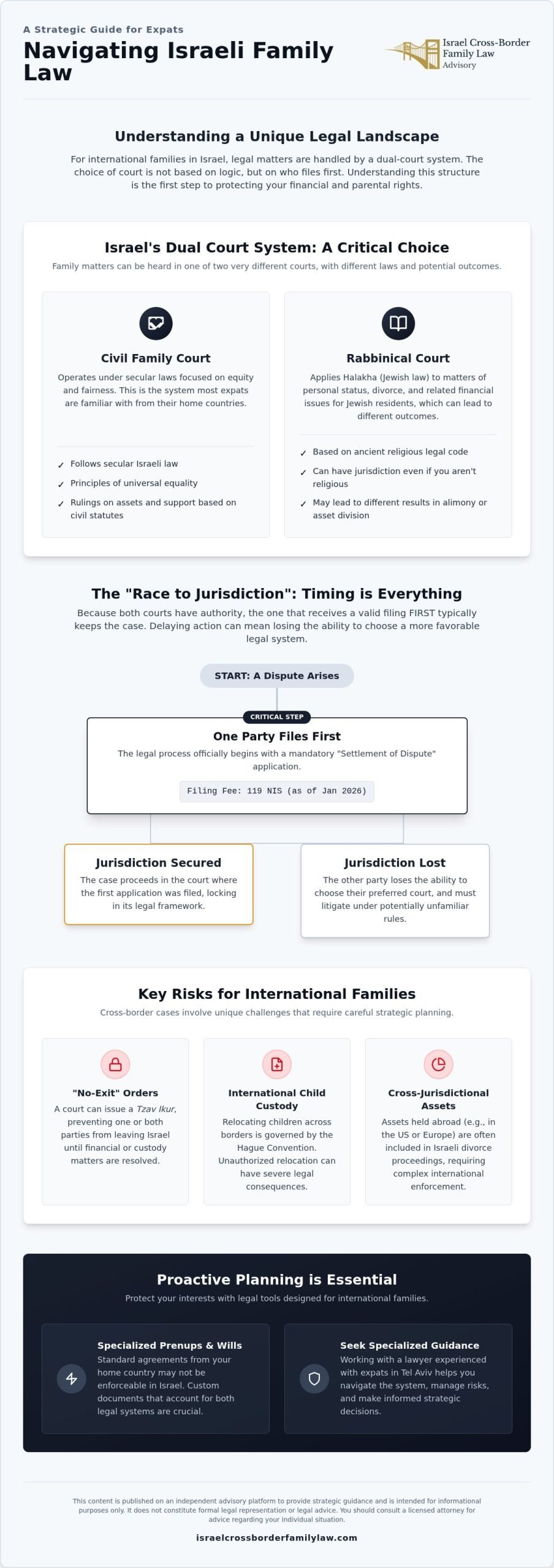
The Rabbinical Court often surprises expats with its reach. Even if you aren’t religious, this court can gain jurisdiction over your divorce and related financial matters if one party files there first. A significant legislative change on November 17, 2025, temporarily expanded the authority of rabbinical courts to rule on child support matters for a two-year period. This shift highlights why working with a family lawyer for expats in tel aviv is essential. The two systems have different legal philosophies; the civil court follows secular laws of equity, while the religious court applies Halakha (Jewish law), which may lead to different outcomes regarding alimony or asset division.
The “Race to Jurisdiction” Explained
Timing is everything in Israeli family law. The “Race to Jurisdiction” refers to the strategic advantage gained by the party who files their claim first in their chosen court. Because the civil and religious courts share concurrent jurisdiction, the first court to receive a valid filing typically retains the case. Securing a family lawyer for expats in tel aviv ensures you have a guide who understands how local courts handle jurisdictional challenges from foreign residents. For expats, this race might even extend across borders. If your spouse files in Tel Aviv while you are preparing to file in your home country, you could find yourself litigating under a system you didn’t fully understand.
The process usually begins with a mandatory “Settlement of Dispute” application, which carries a filing fee of 119 NIS as of January 2026. This step is designed to encourage mediation, but it also marks the official start of the legal timeline. Delaying action when a cross-border dispute arises can result in losing the ability to litigate in a more favorable jurisdiction. The Ministry of Justice also plays a role here, acting as the central authority for international matters, especially when cases involve the Hague Convention or foreign enforcement.
The Intersection of US and Israeli Family Law
For American citizens living in the Mediterranean hub, family law disputes rarely stay within a single set of borders. Your US citizenship brings a layer of federal reporting and legal obligations that persist regardless of your physical residency. When you face a divorce or support dispute in Israel, your decisions must account for how US courts and tax authorities will view the final outcome. This intersection requires a strategy that bridges two distinct legal cultures. It ensures that an agreement reached in Tel Aviv doesn’t create an unforeseen liability in the United States. This content is published on an independent advisory platform to help you navigate strategy and is not a substitute for formal legal representation by a licensed attorney.
Enforcing Foreign Orders in Tel Aviv
A common concern for expats is whether a support order issued by a US state court holds weight in Israel. The Israeli legal system allows for the enforcement of foreign judgments through a specific recognition process. To validate a US order, the local court must confirm that the original judgment is final and that the issuing court had the proper authority. This is a critical component of Child Support Cross-Border Enforcement. However, challenges often arise with alimony. While child support is generally straightforward due to international cooperation, Israeli courts may interpret alimony obligations differently than a court in Delaware or Texas. This discrepancy can lead to delays or the need for a new filing within the local system.
US-Israel Tax Treaty and Family Support
The financial side of a divorce is where multi-jurisdictional complexity becomes most apparent. The US-Israel tax treaty provides some relief from double taxation, yet it doesn’t cover every nuance of family support. For instance, the IRS changed its stance on the deductibility of alimony for agreements signed after 2018. Israeli tax authorities may still view these payments through a different lens. If you are dividing assets like real estate or high-tech equity, you risk triggering capital gains taxes in both countries if the transfer isn’t structured correctly. Strategic drafting is essential to satisfy both the Israeli Family Court and the IRS. A family lawyer for expats in tel aviv can help you identify these risks early. This allows you to seek specialized tax advice before signing a binding agreement.
Managing these cross-border issues requires a high degree of coordination between your legal teams in both jurisdictions. Because the stakes involve your global financial standing and parental rights, it’s helpful to request a confidential consultation to review your specific jurisdictional risks. Strategy and foresight are your best tools in these cases.
Navigating Divorce and Custody as a Foreign National
Expats in Israel often encounter legal risks that local citizens might not fully anticipate. One of the most significant is the “No-Exit” order, known as Tzav Ikur. This order can legally prevent a parent from leaving Israel during an active legal dispute. It’s a mechanism used by the courts to ensure that proceedings aren’t avoided by relocating abroad. Because this can disrupt professional obligations and family connections, understanding how these orders are issued and lifted is vital. This content is published on an independent advisory platform to help you navigate strategy and is not a substitute for formal legal representation by a licensed attorney.
Calculating child support also presents a unique challenge for international families. Israeli courts look at the needs of the children while considering the earning capacity of both parents. For expats, this means local standards are applied to incomes that may be significantly higher than the local average. Throughout this process, the court often appoints a social worker, or Pkidat Saad. These professionals interview the family and provide the judge with a report on the best interests of the children. Their recommendations carry significant weight in final rulings, so it’s essential to approach these interactions with a clear, child-centered strategy.
International Custody and the Hague Convention
Relocating with children after a divorce requires a deep understanding of international treaties. Israel is a signatory to the Hague Convention, which governs cases of international child abduction. A central issue in these disputes is determining the child’s “habitual residence.” If your children have lived in Tel Aviv for a significant period, the court may view Israel as their permanent home, regardless of their nationality or where they were born. This makes the guidance of a family lawyer for expats in tel aviv crucial when negotiating relocation terms or visiting rights. You can find more detailed information on these protections in our guide on Hague Convention & Child Abduction.
Asset Division: Foreign Property and Pensions
The division of marital property in Israel follows the principle of “Balancing of Resources.” This generally mandates an equal split of assets acquired during the marriage. For expats, this often includes complex foreign holdings such as 401ks, IRAs, and real estate located in the United States or Europe. While Israeli courts have the authority to include these in a divorce settlement, the actual division of a US-based pension requires specific legal steps to be enforceable abroad. Protecting pre-marital assets or inheritances held outside of Israel is equally important. Early strategic planning helps ensure that your global financial interests are treated fairly under both legal systems.
Strategic Planning: Prenups and Wills for International Families
Strategic planning serves as a vital bridge between your professional life in Tel Aviv and your long term global security. For international families, early decisions regarding marital agreements and estate distribution carry immense weight. These choices dictate how assets are protected and how your legacy is managed across different legal systems. Proactive planning is not just about preparing for a dispute; it’s about creating a clear roadmap that respects the laws of both Israel and your home country. This content is published on an independent advisory platform and is intended for informational purposes rather than formal legal representation.
Drafting Cross-Border Prenuptial Agreements
A prenuptial agreement drafted in New York or London may not be sufficient for the Israeli court system. To be enforceable in Tel Aviv, an agreement signed after marriage must receive formal approval from a Family Court judge. Agreements signed before marriage require certification by a licensed notary or a marriage registrar. Essential clauses must be included to ensure the document is recognized in both jurisdictions. This is particularly vital for protecting family-owned businesses or high-tech equity, which are common in the local innovation-driven economy. Consulting a family lawyer for expats in tel aviv allows you to structure these agreements with both local and international compliance in mind.
Estate Planning for Expats in Tel Aviv
Many expats assume a standard US will is enough to cover their local assets. However, the Israeli probate process differs significantly from US estate administration. While Israel currently has no inheritance or estate tax, your US heirs may still face federal tax obligations on their global inheritance. Structuring a will to cover assets in multiple jurisdictions requires a nuanced approach to avoid legal gridlock and ensure that local real estate or bank accounts are distributed according to your wishes. You can explore more about these specific requirements in our overview for expats and foreign nationals.
The complexity of managing property across borders means that a single mistake in drafting can lead to years of litigation for your loved ones. To ensure your estate plan or marital agreement is robust and enforceable, it’s wise to request a confidential consultation to discuss your specific cross-border needs. Taking this step early provides the clarity needed to protect your family’s future.
Choosing the Right Family Lawyer for Expats in Tel Aviv
Selecting a family lawyer for expats in tel aviv requires a focus on more than just local credentials. While many practitioners understand the basics of the Israeli Family Court, few possess the multi-jurisdictional perspective necessary to navigate the intersection of two legal systems. For an international family, the right representative acts as a strategic bridge, ensuring that decisions made in Tel Aviv are enforceable and beneficial in your home country. This content is published on an independent advisory platform to provide strategic guidance and is not a substitute for formal legal representation by a licensed attorney.
When evaluating a potential representative, you should ask specific questions regarding their jurisdictional strategy. For instance, how do they handle the division of US-based retirement accounts or the implications of the US-Israel tax treaty on alimony? Understanding the fee structure is also vital for managing your expectations. In Tel Aviv, the hourly rate for an experienced practitioner typically ranges from ₪800 to ₪1,800 plus VAT, depending on the complexity of the cross-border elements involved. Seeking clarity on these costs early prevents financial surprises during an already challenging time.
Why Local Expertise is Not Enough
A lawyer who lacks a deep understanding of foreign tax treaties or international custody laws can inadvertently put your global interests at risk. “Anglos” often face cultural misunderstandings in court that can affect the judge’s perception of their intentions or lifestyle. A cross-border specialist understands these nuances and can frame your case in a way that resonates with the Israeli system while protecting your rights abroad. The value of a lawyer who understands both the local Rabbinical system and the requirements of foreign courts cannot be overstated. Without this dual perspective, you may find that an Israeli court order is difficult to enforce once you return to your home country.
Next Steps: Seeking Clarity
The most effective way to begin is by gaining a comprehensive overview of your situation. You can learn more about how this advisory process assists international families by reviewing How It Works. Strategic guidance at the outset allows you to identify risks, such as the “Race to Jurisdiction” or potential “No-Exit” orders, before they become irreversible legal hurdles. Early intervention is often the difference between a protracted dispute and a controlled, strategic resolution that protects your assets and your children’s future.
Get clarity before you commit. Request a confidential consultation.
Securing Your Family’s Global Future
Managing family law in Israel requires more than just local knowledge; it demands a strategy that bridges two distinct legal systems. You now understand that early decisions, such as where you file or how you structure your cross-border assets, carry significant long term weight. Whether you are navigating the complexities of the Hague Convention or seeking to protect retirement accounts across borders, the key is to act with clarity rather than urgency. This content is published on an independent advisory platform to provide strategic guidance and is not a substitute for formal legal representation by a licensed attorney.
By consulting a family lawyer for expats in tel aviv, you can ensure that your parental rights and financial interests are recognized in both Israel and your home country. Our advisory-first approach provides authoritative guidance on jurisdictional disputes and the specific nuances of US-Israel cross-border law. Taking the time to understand these differences now will prevent costly legal hurdles in the future.
Get clarity before you commit. Request a confidential consultation. You don’t have to navigate these multi-jurisdictional challenges alone; professional support is available to help you move forward with confidence.
Frequently Asked Questions
Can a US citizen get divorced in an Israeli Rabbinical court?
Yes, a US citizen can be divorced in a Rabbinical court if they are Jewish and residing in Israel. This court has exclusive jurisdiction over the act of divorce for Jewish residents, even if the original marriage was a civil ceremony performed in the United States. It is important to understand that religious law will govern the divorce itself, while financial matters and custody may be handled by either the civil or religious system depending on where the case is filed first.
What is a “No-Exit” order and how does it affect expats in Tel Aviv?
A “No-Exit” order, or Tzav Ikur, is a legal restriction that prevents an individual from leaving Israel until a specific legal matter is resolved. For expats in Tel Aviv, these orders are often issued during divorce or child support disputes to ensure a party remains in the country to fulfill their legal and financial obligations. These orders can be issued very quickly and may disrupt international travel or professional commitments, making it essential to seek strategic guidance as soon as a dispute arises.
How is child support calculated in Israel for high-earning expats?
Child support in Israel is calculated by evaluating the actual needs of the children alongside the income and earning potential of both parents. For high-earning expats, the court may apply local standards to their international income levels, which can lead to support obligations that differ significantly from those in their home country. A family lawyer for expats in tel aviv can help you present a clear financial picture to the court to ensure the final calculation is fair and sustainable for your specific circumstances.
Are US prenuptial agreements valid in Israel?
US prenuptial agreements are generally recognized in Israel, but they often require formal validation by an Israeli court to be fully enforceable. If the agreement was signed before the marriage, it may need to be authenticated by a notary or a marriage registrar. If it was signed after the wedding, a Family Court judge must approve the document to ensure it meets local legal standards, particularly regarding the division of assets located within Israel and the rights of both parties.
What happens to my US-based 401k during an Israeli divorce?
Your US-based 401k is considered a marital asset under the Israeli principle of “Balancing of Resources” and is subject to division during a divorce. While an Israeli court can order the value of the account to be split, the actual transfer of funds usually requires a separate legal order in the United States, such as a Qualified Domestic Relations Order (QDRO). Consulting a family lawyer for expats in tel aviv ensures that the Israeli ruling is drafted in a way that US financial institutions will recognize and process.
Do I need a separate will for my assets in Israel?
Yes, having a separate will for your Israeli assets is highly recommended to avoid the complexities and delays of international probate. While Israeli courts may eventually recognize a foreign will, the process of translation and validation can be costly and time-consuming for your heirs. A local will ensures that assets like Tel Aviv real estate or Israeli bank accounts are handled efficiently according to local law without complicating the estate plan you have established in your home country.
How does the Hague Convention protect my children in a relocation dispute?
The Hague Convention protects your children by providing a legal framework for their return if they are wrongfully removed from their country of “habitual residence.” In a relocation dispute, the treaty ensures that custody decisions are made by the courts in the country where the children actually live rather than where one parent chooses to take them. This prevents one party from gaining a tactical advantage by moving children across international borders without the consent of the other parent or the court.
Can I enforce an Israeli custody ruling in the United States?
You can generally enforce an Israeli custody ruling in the United States through the principle of international comity and specific state laws like the Uniform Child Custody Jurisdiction and Enforcement Act (UCCJEA). US courts typically respect foreign custody orders as long as the proceedings in Israel provided both parties with due process and a fair opportunity to be heard. However, the order must be formally registered and recognized by a US court to be legally active and enforceable within that specific state jurisdiction.

Article by
Gabriel Lior
A Personal Journey That Became a Mission
The advisory was founded by an American father Gabriel Lior, LLB, MBA , global entrepreneur, and cross-border advisor who spent more than a decade navigating the Israeli family court system firsthand and now lives in Singapore with his son.
As a divorced parent in a cross-border family, Gabriel faced nearly every legal challenge a foreign parent can encounter in Israel — including child custody disputes, child support proceedings, property matters in Israel and abroad, false accusations, and complex immigration and relocation proceedings.
Over the years, he learned the hard way how difficult it is for non-Israeli parents to understand the system, identify the right legal strategy, and choose the right legal representation — especially when language, culture, and jurisdictional differences are involved. He also witnessed how foreign parents and new immigrants are often disadvantaged or taken advantage of by service providers and institutions simply because they lack local knowledge or fluency.
From Client to Advisor
To truly understand — and survive — the system, Gabriel pursued formal legal education in Israel, completing two Israeli law degrees, alongside a BA and MBA earned in the United States. This was never about becoming a practicing attorney, but about gaining a deep, structural understanding of how the system works — and where it breaks down for foreign parents.
This rare combination of:
Firsthand client experience
Israeli legal and US business education
International business and negotiation training
Decades of commercial execution
created a unique perspective – one that understands both sides of the table.
After years of litigation, persistence, and at times self-representation, he ultimately succeeded in securing custody of his son and relocating abroad through a rare legal victory in the Israeli Supreme Court — becoming one of the first fathers in Israel to do so under these circumstances.
Disclaimer
Important Disclaimer:
The information provided on this website and in its content is for general informational and educational purposes only and does not constitute legal advice, legal opinion, or legal representation.
Gabriel Lior is not licensed to practice law in Israel (nor is he interested in doing so) and does not provide legal services, despite having completed 2 Law Degrees. The services offered are advisory in nature and are intended to provide general guidance, strategic insight, and information regarding cross-border family law considerations.
No attorney-client relationship is formed by accessing this website, reading its content, or communicating with us.
Any decisions made based on this information are at your own discretion and risk. For legal advice specific to your situation, you should consult a licensed attorney in the relevant jurisdiction.
Where appropriate, we may refer clients to independent, licensed attorneys or professionals. Such referrals do not constitute legal representation and no liability is assumed for services provided by third parties.