Engaging in a family law matter within a foreign jurisdiction is an inherently complex and often overwhelming challenge. For foreign nationals confronting this situation in Israel, the intricate legal framework, characterized by its dual system of civil and religious courts, presents a significant barrier to clarity and confidence. Understanding the specific procedures, jurisdictional rules, and cultural nuances is paramount. This guide was created to provide a clear and authoritative overview of the israeli family court process for foreigners, transforming uncertainty into a strategic understanding of the path forward.
This comprehensive resource will demystify the system by navigating you through each critical stage, from the initial filing and document submission to court proceedings and final resolutions. We will clarify the pivotal distinctions between the Family Court and the Rabbinical Court, helping you determine which authority has jurisdiction over your case. By the end of this guide, you will be equipped with the foundational knowledge necessary to feel prepared, understand your obligations, and make an informed decision when seeking the expert legal representation required to protect your interests in this sophisticated, cross-border legal environment.
Understanding Jurisdiction: The First Crucial Step for Foreigners
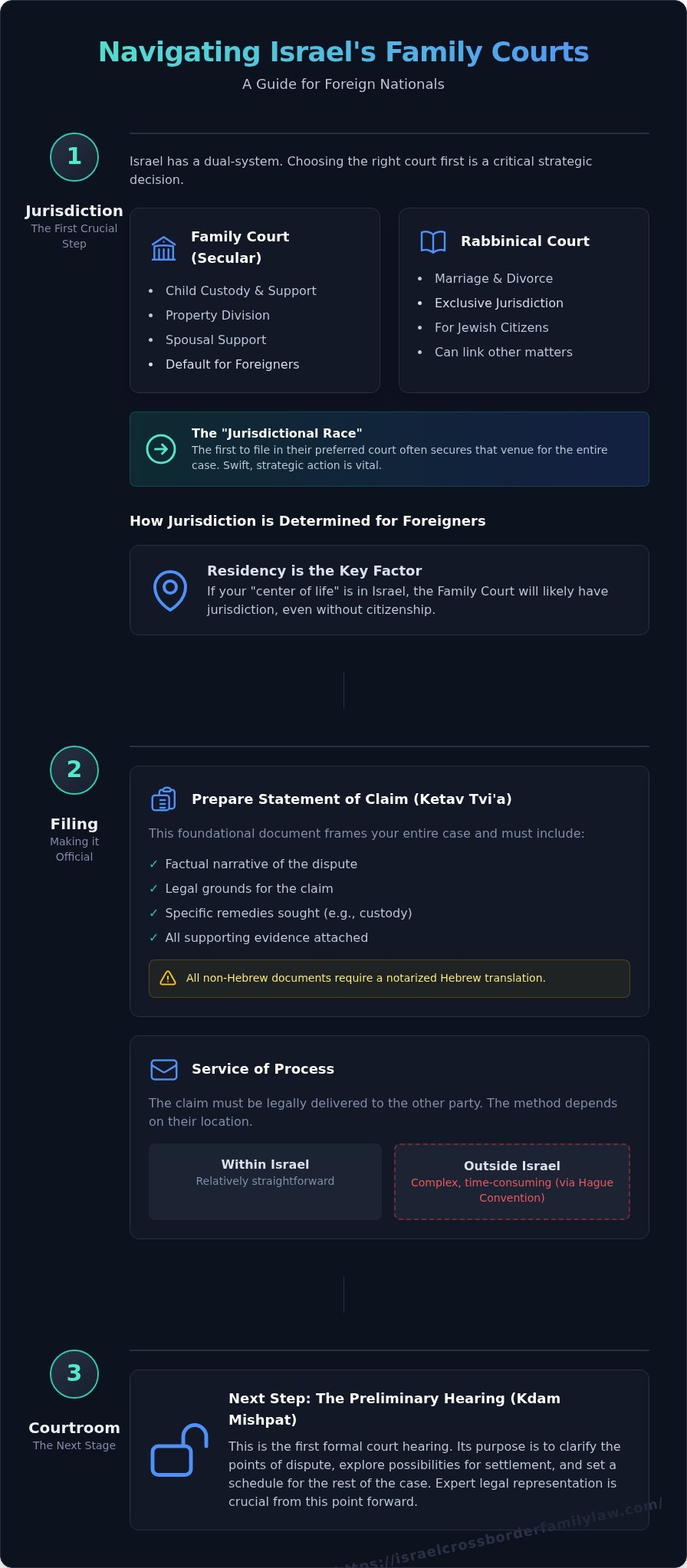
For foreign nationals confronting family law matters in Israel, the initial and most critical challenge is determining jurisdiction. Israel operates a unique parallel legal system, comprising both secular Family Courts and religious courts. Understanding where your case belongs and acting decisively is fundamental to successfully navigating the complex israeli family court process for foreigners.
To provide a foundational understanding of initiating proceedings, this video explains a key early step in the process:
The Family Court vs. The Rabbinical Court
The Family Court is a state-run, secular institution with broad authority over all family-related disputes, including child custody, visitation rights, spousal and child support, and the equitable distribution of marital assets. Conversely, the religious court system, most notably the Rabbinical Court for Jewish citizens, holds exclusive jurisdiction over the acts of marriage and divorce themselves. The intricate relationship between these systems is detailed in the Marriage and Divorce Laws in Israel. Ancillary matters such as property division and custody can be linked to a divorce proceeding in the Rabbinical Court, creating a “jurisdictional race.” The party who files first in their preferred venue often secures that court’s jurisdiction over the entire dispute, a strategic decision with profound implications for the case’s outcome.
How Jurisdiction is Determined for a Foreign National
For foreign nationals, jurisdiction is typically established in the secular Family Court, provided a sufficient connection to Israel exists. The primary factor is residency. If the parties have established their “center of life” in Israel, even if they are not citizens, the Family Court will generally accept jurisdiction. This principle applies in several cross-border scenarios:
- Mixed-Nationality Couples: If one spouse is Israeli and the other is foreign, but they reside together in Israel, the Family Court has clear jurisdiction.
- Two Foreign Nationals: When both parties are foreigners but have been living in Israel for a significant period, their residency can be sufficient to grant the court authority over their family dispute.
Furthermore, international treaties, such as the Hague Convention on the Civil Aspects of International Child Abduction, are integral to the israeli family court process for foreigners, particularly in complex cases involving parental kidnapping or custody disputes across borders.
The Initial Stages: Filing a Claim and Service of Process
Initiating a family law matter in Israel requires a formal, structured approach. The process formally commences not with a simple conversation, but with the meticulous preparation and submission of a foundational legal document to the court. For individuals unfamiliar with the jurisdiction, understanding these initial steps is critical to establishing a strong legal position from the outset and successfully navigating the complex israeli family court process for foreigners.
Preparing and Filing the Statement of Claim
The cornerstone of any family law action is the Statement of Claim (Ketav Tvi’a). This comprehensive document must be drafted with precision, as it frames the entire case. It typically includes three core components:
- A detailed narrative of the relevant facts leading to the dispute.
- The specific legal grounds and statutes upon which the claim is based.
- The explicit relief or remedies sought from the court (e.g., divorce, custody, child support).
All supporting evidence, such as marriage certificates, birth certificates, or financial statements, must be appended. A critical requirement is that all non-Hebrew documents must be accompanied by a notarized or certified Hebrew translation. The procedural requirements, as dictated by Israel’s Family Courts, are exacting. Upon completion, the claim is filed with the appropriate court secretariat, a process that involves the payment of a court fee, typically amounting to several hundred shekels (₪).
Service of Process: Notifying the Other Party
Once filed, the claim must be legally delivered to the opposing party in a procedure known as ‘service of process.’ This is not a mere formality; it is a fundamental requirement of due process, ensuring the respondent is officially notified of the legal action and has the opportunity to reply. While serving a party within Israel is a relatively straightforward matter, international service presents significant complexities. For respondents residing abroad in signatory countries, service is often governed by the Hague Service Convention, a multi-step process involving central authorities in both nations that can be time-consuming. Failure to execute proper service can result in substantial delays or, in severe cases, the dismissal of your claim, making expert guidance in these cross-border procedures indispensable.
Inside the Courtroom: Key Proceedings and Hearings
Once a statement of claim has been filed and properly served, the formal litigation phase commences. This stage is not a single event but a structured sequence of hearings and procedural steps designed to define the dispute, gather evidence, and facilitate resolution. Understanding these subsequent stages is critical to successfully navigating the israeli family court process for foreigners, as each step presents strategic opportunities and potential challenges that demand expert legal guidance.
The Preliminary Hearing (Kdam Mishpat)
The first substantive step in the process is the preliminary hearing, known as the Kdam Mishpat. This is a crucial preparatory stage where the judge takes an active, inquisitorial role. The primary objectives are to precisely define the points of contention, identify areas of potential agreement, and explore possibilities for an early settlement. The judge will set strict deadlines for the submission of all further documents, affidavits, and evidence, thereby establishing a clear and binding timetable for the case’s progression.
Mandatory Mediation and Dispute Resolution
Parallel to formal court proceedings, Israeli law mandates that most parties engage in a dispute resolution process. This is often facilitated by the Family Court Assistance Unit (Yechidat Hasivua), a professional body of social workers and therapists operating within the court system. The explicit goal is to guide the parties toward an amicable, out-of-court agreement on complex issues like child custody or financial support. The benefits of this approach are significant:
- Confidentiality: Discussions remain private and off the public record.
- Cost-Effectiveness: Successful mediation can be substantially less expensive than protracted litigation.
- Control: Parties retain control over the final outcome, rather than ceding it to a judge.
Any agreement reached through this process can be submitted to the court to be given the full legal force of a judgment.
Evidence, Discovery, and Hearings
If mediation does not resolve all outstanding issues, the case proceeds to the evidence and discovery phase. This involves each party submitting detailed affidavits (sworn written testimony) and all supporting documentation. The discovery process allows for the formal request of information from the opposing party, including comprehensive financial disclosures and responses to questionnaires. This stage can be particularly complex in cross-border cases where evidence originates from multiple jurisdictions, sometimes requiring an understanding of international protocols for Enforcing Foreign Judgments in Israel. This phase culminates in evidentiary hearings, where parties and their expert witnesses-such as child psychologists or forensic accountants-are cross-examined on their submitted testimony.
The structured nature of the israeli family court process for foreigners demands meticulous preparation. Contact our firm to ensure your rights are protected by experienced counsel throughout this intricate process.
Final Judgments, Appeals, and International Enforcement
The culmination of proceedings in the Israeli Family Court results in a resolution that legally defines the future obligations and rights of all parties involved. This conclusion can be reached either through a mutually agreed-upon settlement, which is then ratified by the court to give it the force of a judgment, or through a final ruling delivered by the judge after all evidence and arguments have been presented.
Receiving the Final Judgment (Psak Din)
The final judgment, known in Hebrew as a Psak Din, is a comprehensive and binding legal instrument that officially resolves the dispute. This written decision meticulously outlines the court’s determinations and is legally enforceable. A typical judgment will include definitive orders concerning:
- Child custody and visitation schedules (parenting time)
- Child support and spousal support (alimony) amounts and payment terms
- The equitable division of marital property, assets, and debts
- Any other specific matters that were contested during the proceedings
Upon issuance, the Psak Din creates immediate legal obligations that both parties must adhere to, with non-compliance potentially leading to enforcement actions.
The Appeals Process
Should a party believe the court has made a significant error in its decision, there is a right to appeal. It is critical to understand that this process is governed by strict deadlines; an appeal must typically be filed with the relevant District Court within 45 days of the judgment being rendered. An appeal is not an opportunity to re-litigate the case; rather, it must be founded upon specific grounds, such as a demonstrable error of law or a clear and significant misinterpretation of the factual evidence by the Family Court judge.
Enforcing Judgments Across Borders
For foreign nationals, the israeli family court process for foreigners does not end with receiving a judgment. The subsequent challenge is ensuring that the orders-particularly those related to child support, custody, or asset division-are recognized and enforceable in your home country. This multi-jurisdictional complexity is managed through international treaties, such as the Hague Convention, and bilateral agreements between Israel and other nations. Navigating the procedural requirements of both legal systems is a sophisticated task that demands specialized expertise to ensure the Israeli judgment has practical effect internationally.
Facing a complex cross-border case involving final judgments or enforcement? Consult with our experts for guidance.
Expert Guidance for Your Cross-Border Family Law Matter in Israel
As this guide has illustrated, the israeli family court process for foreigners is a multi-faceted journey, laden with unique jurisdictional challenges and procedural complexities. From establishing the court’s authority to navigating hearings and seeking international enforcement of judgments, each stage demands a sophisticated understanding of both Israeli and international legal frameworks. Successfully managing these proceedings requires strategic, informed navigation from the very beginning.
Protecting your rights and your family’s future requires seasoned counsel. Our team of bilingual attorneys brings decades of focused experience in US-Israel cross-border legal matters, offering a proven track record in the most complex international divorce and custody cases. We provide the nuanced guidance necessary to bridge the gap between two distinct legal systems. To ensure your case is handled with the requisite expertise, we invite you to schedule a confidential consultation to discuss your case with an experienced cross-border family lawyer. Taking this decisive step can provide the clarity and confidence needed to move forward.
Frequently Asked Questions
Do I need to be physically present in Israel for the court process?
While initial appearances may be mandated, your continuous physical presence in Israel is not always a prerequisite for the duration of the case. Through a legally executed Power of Attorney, your designated Israeli legal counsel can represent you in most proceedings. In certain circumstances, and subject to court approval, testimony or participation via video conference may be permissible, streamlining the process for international clients who are unable to remain in the country for extended periods.
Are the court proceedings conducted in English for foreigners?
The official language of all Israeli courts, including the Family Court, is Hebrew. While many judges and legal professionals possess English proficiency, all official proceedings are conducted in Hebrew. Consequently, any non-Hebrew speaking party is legally entitled to a certified translator during hearings. Furthermore, all foreign documents submitted as evidence must be accompanied by a notarized Hebrew translation to be considered admissible by the court, a critical step in the legal process.
How long does a typical family law case take in the Israeli court system?
The duration of a family law case in the Israeli court system is highly variable and contingent upon the complexity of the matter and the level of cooperation between the parties. Uncontested, straightforward cases may be resolved within several months. However, complex, multi-jurisdictional disputes involving significant assets or contested child custody can extend for one to three years or more. Effective legal strategy is paramount to navigating the proceedings efficiently and mitigating unnecessary delays.
What kind of visa or legal status do I need to participate in a court case in Israel?
To participate in a court case, you do not necessarily require a long-term residency visa. Foreign nationals can typically enter Israel on a B/2 tourist visa to attend initial hearings or consult with legal counsel. However, if the nature of the case, such as child custody arrangements, requires your prolonged presence in Israel, our firm can provide strategic guidance on applying for the appropriate legal status to ensure compliance with immigration regulations throughout the legal proceedings.
How are foreign prenuptial agreements treated by Israeli Family Courts?
Israeli Family Courts generally recognize and uphold foreign prenuptial agreements, provided the agreement was validly executed under the laws of its original jurisdiction and its terms do not contravene Israeli public policy. A crucial part of the israeli family court process for foreigners involves having the document expertly reviewed to confirm its enforceability. The court will scrutinize the agreement to ensure both parties entered into it freely and with full comprehension of its implications.
Can a decision from the Israeli Family Court be enforced in the United States?
Yes, a final judgment from an Israeli Family Court can be enforced in the United States, though the process is not automatic. Enforcement is governed by the principle of comity and specific state laws, such as the Uniform Foreign-Country Money Judgments Recognition Act. A U.S. court will review the Israeli judgment to ensure it was rendered with proper jurisdiction and that due process was observed before domesticating it for enforcement against U.S.-based assets or individuals.

Article by
Gabriel Lior
A Personal Journey That Became a Mission
The advisory was founded by an American father Gabriel Lior, LLB, MBA , global entrepreneur, and cross-border advisor who spent more than a decade navigating the Israeli family court system firsthand and now lives in Singapore with his son.
As a divorced parent in a cross-border family, Gabriel faced nearly every legal challenge a foreign parent can encounter in Israel — including child custody disputes, child support proceedings, property matters in Israel and abroad, false accusations, and complex immigration and relocation proceedings.
Over the years, he learned the hard way how difficult it is for non-Israeli parents to understand the system, identify the right legal strategy, and choose the right legal representation — especially when language, culture, and jurisdictional differences are involved. He also witnessed how foreign parents and new immigrants are often disadvantaged or taken advantage of by service providers and institutions simply because they lack local knowledge or fluency.
From Client to Advisor
To truly understand — and survive — the system, Gabriel pursued formal legal education in Israel, completing two Israeli law degrees, alongside a BA and MBA earned in the United States. This was never about becoming a practicing attorney, but about gaining a deep, structural understanding of how the system works — and where it breaks down for foreign parents.
This rare combination of:
Firsthand client experience
Israeli legal and US business education
International business and negotiation training
Decades of commercial execution
created a unique perspective – one that understands both sides of the table.
After years of litigation, persistence, and at times self-representation, he ultimately succeeded in securing custody of his son and relocating abroad through a rare legal victory in the Israeli Supreme Court — becoming one of the first fathers in Israel to do so under these circumstances.
Disclaimer
Important Disclaimer:
The information provided on this website and in its content is for general informational and educational purposes only and does not constitute legal advice, legal opinion, or legal representation.
Gabriel Lior is not licensed to practice law in Israel (nor is he interested in doing so) and does not provide legal services, despite having completed 2 Law Degrees. The services offered are advisory in nature and are intended to provide general guidance, strategic insight, and information regarding cross-border family law considerations.
No attorney-client relationship is formed by accessing this website, reading its content, or communicating with us.
Any decisions made based on this information are at your own discretion and risk. For legal advice specific to your situation, you should consult a licensed attorney in the relevant jurisdiction.
Where appropriate, we may refer clients to independent, licensed attorneys or professionals. Such referrals do not constitute legal representation and no liability is assumed for services provided by third parties.