This article is published on an independent advisory platform (not a law firm). It focuses on strategy, risks, and decision-making guidance rather than legal representation or specific legal advice.
What if the estate plan you carefully crafted in the United States is treated as a non-binding suggestion by an Israeli court? Moving to IL is a monumental transition, and it’s natural to believe that your existing legal protections remain fully intact after you land. However, the reality is that nearly 100% of foreign wills face some level of scrutiny under the Israeli Succession Law of 1965. Updating your will after an international move is not just a formality; it’s a critical step in preventing your heirs from facing double taxation or a 12 month delay in the local probate process.
You’ll learn why your current plan might be at risk and how to strategically align your legacy with complex cross-border requirements. We’ll examine the specific steps needed to secure guardianship for your children and ensure your assets are distributed according to your wishes, not local default statutes. For more visual guidance on these transitions, visit our YouTube channel at https://www.youtube.com/@IsraelCrossBorderLawFirm. This guide provides a clear roadmap to help you achieve total peace of mind in your new home.
Get clarity before you commit. Request a confidential consultation.
Key Takeaways
Understand why your existing US estate plan may become a liability in Israel due to the critical distinction between formal document validity and the practical enforcement of asset distribution.
Evaluate the strategic pros and cons of updating your will after an international move using either a single worldwide document or separate jurisdictional wills to avoid cross-border probate bottlenecks.
Identify essential updates for your new life in Israel, specifically regarding the recognition of foreign guardians for minor children and the practical requirements for appointing an effective local estate manager.
Learn why generic online will kits often fail to address the complexities of US-Israel cross-border requirements and how "system fluency" helps bridge the gap between two different legal cultures.
Gain the strategic clarity needed to protect your family’s legacy by aligning your estate plan with Israeli succession laws before administrative challenges or legal conflicts arise.
Table of Contents
Why an International Move to IL Makes Your Current Will a Liability
Understanding the Legal Conflict: Formal Validity vs. Practical Enforcement
Strategic Approaches: Single Worldwide Will vs. Jurisdictional Wills
Essential Checklist: Critical Elements to Update After Moving to IL
Navigating the Transition: Achieving Clarity Before You Commit
This article is published on an independent advisory platform (not a law firm). Do NOT use language that implies attorney-client relationship, legal representation, or giving legal advice. Focus on strategy, risks, and decision-making guidance. Soft CTA to advisory call / WhatsApp.
Why an International Move to IL Makes Your Current Will a Liability
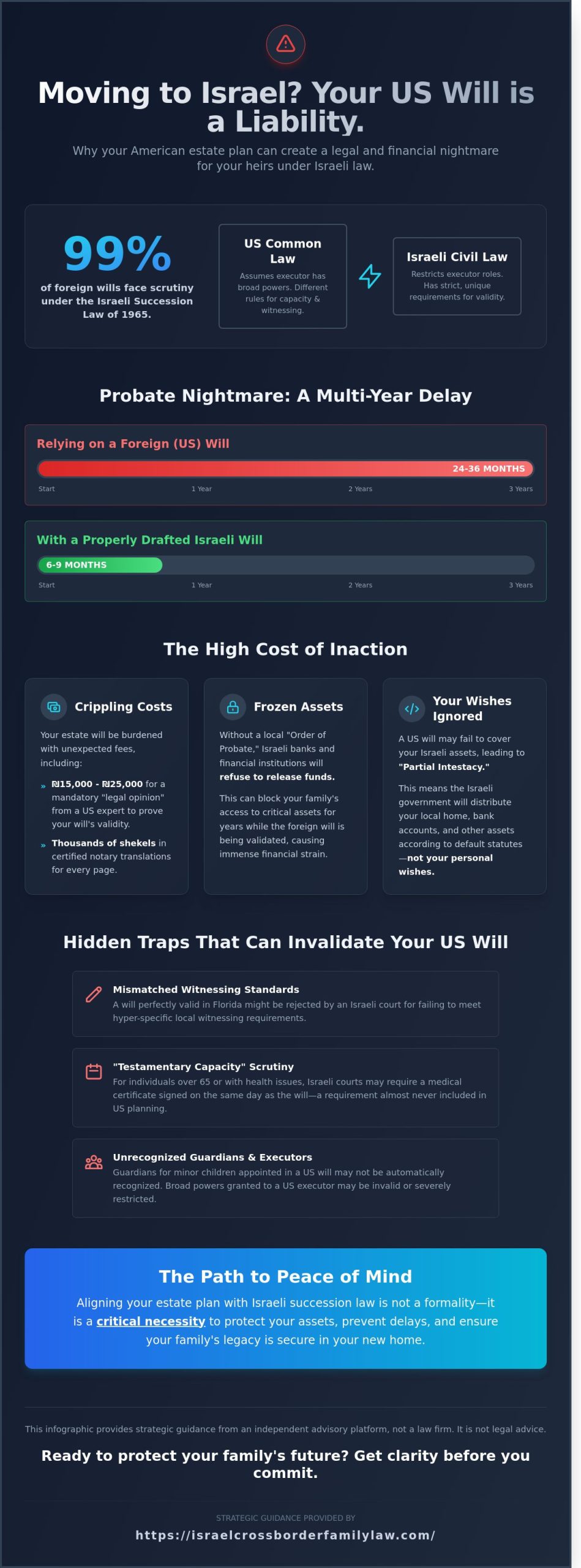
Moving your life to Israel involves more than just physical relocation; it creates a fundamental shift in your legal identity. International will updating is the strategic process of aligning your legacy plan with the specific succession laws of your new country of residence. If you rely on a document drafted in a US state, you may be walking into a trap of "Partial Intestacy." This occurs when your existing will covers your US-based brokerage accounts but fails to legally address your new Israeli home or local bank accounts. Without a localized strategy, the Israeli government may distribute your local assets according to statutory formulas rather than your personal wishes.
The core challenge lies in the conflict of laws that arises when two different legal systems claim jurisdiction over your estate. Israel operates under a civil law-influenced system that differs significantly from US Common Law principles. This cultural and legal friction can lead to unintended consequences for your heirs. For example, US wills often grant executors broad powers that don’t exist in the same way under Israeli law. It’s vital to distinguish between your "residency" for tax purposes and your "domicile" for legal purposes. If the Israeli courts determine you’re domiciled in Israel, they’ll apply Israeli law to all your "movable" assets worldwide, regardless of where your will was signed.
The Myth of the ‘Universal Will’
Many people believe a legally valid document in New York or Florida is globally portable. It’s a dangerous misconception. A document that meets every procedural requirement in the US might be rejected by an Israeli court for failing to meet local witnessing standards. Your "testamentary capacity" is also judged by local standards. If you’re over 65 or have health issues, Israeli courts may require a medical certificate signed on the same day as the will, a requirement often overlooked in the US. This is a common pitfall for expats and foreign nationals who assume their existing paperwork remains bulletproof after Aliyah.
How IL Law Views Foreign Wills
The Israeli Succession Law of 1965 governs how estates are handled for residents. While Israel recognizes the validity of foreign wills in theory, the practical application is burdensome. The Registrar of Inheritance Affairs manages these filings, and they often demand a "legal opinion" from an expert in the foreign jurisdiction to prove the will is valid there. This requirement alone can add ₪15,000 to ₪25,000 in administrative costs. Updating your will after an international move is the most effective way to bypass these hurdles. Consider these common risks of relying on a foreign document:
Extended Probate Timelines: Probating a foreign will in Israel can take 24 to 36 months, whereas a local will often clears in 6 to 9 months.
Translation Costs: Every page of a foreign document must be translated by a certified notary, costing thousands of shekels for complex trusts.
Execution Barriers: Israeli banks often refuse to freeze or release funds based on foreign probate orders without a local "Order of Probate."
Don’t leave your family to navigate a multi-year legal maze. Proactive planning ensures your assets remain under your control. Get clarity before you commit. Request a confidential consultation.
This article is published on an independent advisory platform (not a law firm). Do NOT use language that implies attorney-client relationship, legal representation, or giving legal advice. Focus on strategy, risks, and decision-making guidance. Soft CTA to advisory call / WhatsApp.
Understanding the Legal Conflict: Formal Validity vs. Practical Enforcement
When you move to Israel, the legal standing of your estate documents undergoes a fundamental shift. The 1961 Hague Convention on the Form of Testamentary Dispositions provides a baseline of protection by ensuring that if your will was validly executed in your home country, Israel should recognize it as a legal document. However, this treaty only covers "formal validity," which refers to the physical paperwork, the number of witnesses, and the signing process. It does not guarantee "substantive validity," which governs the actual distribution of your assets.
An Israeli court might acknowledge that your document is a legitimate will but still refuse to enforce its specific instructions. This conflict often arises when a foreign will contradicts local public policy or specific provisions of the Israeli Succession Law of 1965. Many expats find the complications of living abroad stem from the assumption that a valid signature equals an enforceable plan. In reality, updating your will after an international move is the only reliable way to ensure your intent aligns with the local legal framework.
The challenge of "Forced Heirship" is another critical factor. While the US system prioritizes total freedom of disposition, allowing you to disinherit almost anyone, other legal systems or religious courts in Israel may impose different expectations. Proactive steps like updating your will after an international move help bridge the gap between your original expectations and the practical realities of the Israeli probate office.
The Problem of Foreign Assets in Local Probate
Israeli courts handle real estate, known as "immovable property," differently than bank accounts or "movable property." While the "Unity of Succession" principle suggests one law should govern the entire estate, the practical application is often fragmented. Real estate is almost always subject to the laws of the jurisdiction where the land is located. Despite formal validity under the Hague Convention, a local bank may not accept a foreign probate order without additional litigation. If you hold a ₪750,000 balance in a local Israeli bank, that institution may freeze the account and demand an Israeli Grant of Probate, regardless of what a court in New York or London has decreed.
Navigating Multi-Jurisdictional Tax Exposure
Israel currently imposes no inheritance or estate tax, which is a significant benefit for many residents. However, US citizens remain subject to the US Federal Estate Tax regardless of their physical location. The risk for Anglo families in Israel is not just the tax itself but the complex reporting requirements. Heirs may face severe penalties if they fail to comply with FBAR (Foreign Bank Account Report) or FATCA regulations when inheriting Israeli assets. You should coordinate your distribution strategy with a clear understanding of these cross-border obligations. If you are concerned about how your move affects your family’s inheritance, you can explore strategic planning options to mitigate these risks.
Navigating these cross-border tax challenges can be complex, and for expert assistance with any IRS and state tax disputes that may arise, many high-net-worth individuals turn to specialists like Neil Jesani Tax Resolution.
Get clarity before you commit. Request a confidential consultation.
This article is published on an independent advisory platform (not a law firm). Do NOT treat this as legal representation or legal advice. We focus on strategy, risks, and decision-making guidance for international families. For specific legal actions, please consult with a licensed attorney in the relevant jurisdiction.
Strategic Approaches: Single Worldwide Will vs. Jurisdictional Wills
Deciding how to structure your testamentary documents is a critical step when updating your will after an international move. You generally face two paths: a single worldwide will that covers every asset you own globally, or "situs" wills, which are separate documents drafted for specific countries. Both strategies aim to ensure a seamless transition of wealth, but they carry different risks regarding probate speed and administrative costs. While a single document might seem simpler, it often creates a multi-jurisdictional bottleneck. If you own a home in Tel Aviv and a brokerage account in the U.S., a single will must be validated in one country before the other can even begin its process. This sequential probate can delay asset distribution by 12 to 18 months.
Professional advisors often suggest reviewing a comprehensive estate planning guide for moving abroad to understand how these choices impact your specific tax residency. In Israel, the Registrar of Inheritance Matters requires precise documentation. If your only will is a U.S. document, you’ll likely need a formal Hebrew translation and a professional legal opinion on foreign law. These requirements can easily add ₪8,000 to ₪15,000 to your legal expenses in Israel alone.
The Case for a Worldwide Will
A single worldwide will is often appropriate for families with simple asset structures, such as those who have moved entirely to Israel and only maintain a small, residual bank account abroad. To make this document effective, it should ideally follow the "International Will" format established by the 1973 Washington Convention. This treaty allows a will to be recognized in both the U.S. and Israel if it meets specific witnessing and registration criteria. However, even an International Will can face friction. If the language used is too grounded in U.S. common law concepts that don’t exist in the Israeli civil-style system, the Israeli court may struggle to interpret your intent, leading to costly litigation between heirs.
When to Use Separate Wills for the US and IL
For most "Anglo" expats, separate wills are the more sophisticated choice. This strategy is particularly effective when managing high-value real estate in Israel while maintaining significant investment portfolios in the U.S. By having a dedicated Israeli will and a separate U.S. will, your executors can file for probate in both countries simultaneously. This "parallel processing" can save your family a year of waiting. To make this work, you must avoid the "Revocation Clause" trap. Most standard will templates include a line that says, "I hereby revoke all prior wills." If you sign a new U.S. will without a limited jurisdiction clause, you might accidentally cancel your Israeli will. Your documents must explicitly state they only apply to assets within a specific territory.
Limited Jurisdiction Clauses: These ensure your U.S. will only governs U.S. assets and your Israeli will only governs Israeli assets.
Simultaneous Filings: Separate documents allow the ₪2,000,000 apartment in Jerusalem to be handled by an Israeli professional while the U.S. executor manages the 401(k).
International Trusts: For those seeking to bypass probate entirely, placing assets into a cross-border trust can be a powerful tool, though it requires careful coordination with Israeli tax authorities to avoid "exit tax" complications.
The complexity of updating your will after an international move shouldn’t be underestimated. Small errors in wording can lead to significant delays and unexpected taxes. For more detailed visual guides on how Israeli courts handle foreign documents, the Israel Family Law YouTube channel provides several educational breakdowns on these specific cross-border challenges.
Get clarity before you commit. Request a confidential consultation.
This article is published on an independent advisory platform (not a law firm). Do NOT use language that implies attorney-client relationship, legal representation, or giving legal advice. Focus on strategy, risks, and decision-making guidance. Soft CTA to advisory call / WhatsApp.
Essential Checklist: Critical Elements to Update After Moving to IL
Relocating to Israel involves more than just a change of scenery; it requires a fundamental shift in how you view your estate planning. Updating your will after an international move is a strategic necessity to ensure your wishes align with the Israeli Succession Law of 1965. Relying on an old document drafted under different jurisdictional rules can lead to expensive delays for your heirs.
Guardianship and Minor Children
In Israeli law, there is a distinct difference between a "Legal Guardian" who manages assets and a "Physical Custodian" who provides daily care. While your US will might name a sibling in California as a guardian, an Israeli court might hesitate to allow a child to be moved across the globe immediately. You must designate a local temporary guardian for the transition period. Under Section 17 of the Legal Capacity and Guardianship Law, Israeli courts prioritize the "Best Interests of the Child" over any written testamentary wishes. If your chosen guardian hasn’t been updated to reflect your life in Israel, the court may intervene to appoint someone they deem more suitable for the child’s local stability.
Appointing Executors Across Borders
Appointing a US-based executor to manage assets in Israel presents significant logistical hurdles. Managing a property in Tel Aviv or Haifa from a timezone seven hours away is rarely efficient for the beneficiaries. Beyond the distance, there are financial barriers. Israeli courts often require foreign executors to post a bond, which is a financial guarantee often exceeding ₪50,000, to protect the estate from mismanagement. It’s often more strategic to appoint a local co-executor who understands the Israeli banking system and the Registrar of Inheritance Affairs. This ensures that administrative tasks, like paying local taxes or utilities, don’t stall for months while documents are mailed back and forth for signatures.
Life changes also trigger the need for a document refresh. While some US jurisdictions automatically revoke parts of a will upon certain events, Israeli law has its own specific triggers. A divorce or separation necessitates an immediate review of estate documents to ensure an ex-spouse isn’t left in a position of authority over your assets. Similarly, marriage in Israel can complicate existing plans if the new spouse’s statutory rights under the 1965 law haven’t been accounted for in your strategy. You don’t want your family to discover these conflicts during the probate process.
Proactive planning is the only way to avoid the high costs of cross-border legal disputes. You can learn more about building a cross-border estate strategy that protects your family in both jurisdictions.
Get clarity before you commit. Request a confidential consultation.
This article is published on an independent advisory platform (not a law firm). Do NOT use language that implies attorney-client relationship, legal representation, or giving legal advice. Focus on strategy, risks, and decision-making guidance. Soft CTA to advisory call / WhatsApp.
Navigating the Transition: Achieving Clarity Before You Commit
The temptation to use DIY online will kits is high for families looking to save time. However, these templates are built for domestic scenarios and often fail when applied to international lives. For families in Israel, using a generic US-based online kit can lead to catastrophic failures in probate. These kits don’t account for the Israeli Succession Law of 1965 or the specific way the Israeli Registrar of Inheritance Affairs handles foreign documents. Relying on a ₪350 software package to protect an estate worth millions is a high-stakes gamble that rarely pays off. When updating your will after an international move, you aren’t just changing an address; you’re switching legal universes.
This challenge isn’t limited to personal estate planning; entrepreneurs face similar complexities when establishing a business in a new country. For example, specialized consulting firms like Dubai Setup exist solely to guide founders through the specific regulatory landscape of the UAE, underscoring the universal need for local expertise in any major international move.
True security requires "System Fluency." This means working with advisors who understand the friction points between US and IL legal cultures. It’s about knowing how a New York probate court views a document versus how a judge in Jerusalem interprets it. For more in-depth analysis of these cross-border hurdles, you can explore the Israel Family Law YouTube channel, which provides educational context on these specific issues.
Investing in an early advisory session is a form of risk mitigation. A botched estate plan often results in probate litigation that can cost upwards of ₪60,000 to ₪150,000 in Israeli legal fees alone. By identifying conflicts between your US assets and your IL residency now, you save your heirs from years of court delays and significant financial depletion.
Coordinating with Professionals in Both Jurisdictions
A common failure in estate planning is the "definition gap." A US estate attorney and an IL advisor might use the same word to mean two different things. For example, the concept of a "Trust" is treated very differently by the Israeli Tax Authority than by the IRS. Without a unified strategy, you risk conflicting instructions that freeze your assets. An "Advisory Platform" serves as the essential bridge, ensuring that your US documents and your Israeli requirements function as a single, cohesive unit. You can learn more about the advisory and how we help families synchronize these complex choices.
The Advisory Process: Clarity Before Commitment
The first step is always a Strategic Review. This phase isn’t about drafting documents; it’s about identifying red flags in your existing US paperwork. We look for clauses that might be unenforceable in Israel or tax triggers that could cost your family ₪100,000 or more in avoidable levies. You must make informed choices about whether to use Situs Wills (separate wills for each country) or complex multi-jurisdictional Trusts before you ever engage a drafting attorney. This proactive approach ensures that updating your will after an international move is handled with precision rather than guesswork. Making these decisions early allows you to control the outcome rather than leaving it to a probate judge. In cross-border law, the most expensive mistake is the one you didn’t know you were making until it was too late to fix.
Get clarity before you commit. Request a confidential consultation.
This article is published on an independent advisory platform (not a law firm). This content is for informational and advisory purposes only, not legal representation or legal advice. Legal services are provided separately by licensed attorneys. We focus on strategy, risks, and decision-making guidance.
Protect Your Legacy with a Cross-Border Strategy
Relocating to Israel shifts the legal landscape for your estate. Your current US documents might remain formally valid, but they often face significant hurdles during practical enforcement in local courts. You don’t want your heirs to deal with frozen bank accounts or probate complications that can easily cost ₪30,000 or more in avoidable fees. Updating your will after an international move is the most effective way to align your intentions with the specific requirements of the Israeli system. Our bilingual advisors provide the sophisticated cross-border expertise needed to mitigate these risks. We help you evaluate whether jurisdictional wills or a single worldwide document best serves your family’s needs. For more insights on navigating these transitions, visit our YouTube channel at https://www.youtube.com/@IsraelFamilyLaw. Making these decisions early ensures your transition remains a positive milestone for your entire family. Get clarity before you commit. Request a confidential consultation.
This article is published on an independent advisory platform (not a law firm). Do NOT use language that implies attorney-client relationship, legal representation, or giving legal advice. Focus on strategy, risks, and decision-making guidance. Soft CTA to advisory call / WhatsApp.
Frequently Asked Questions
Is my US will legally valid in Israel after I move?
Your US will is generally recognized as valid in Israel under the Succession Law of 1965 if it met the legal requirements of the state where it was executed. However, updating your will after an international move is highly recommended to avoid the Israeli Registrar of Inheritance Affairs requiring costly expert opinions on foreign law. Without a local update, your heirs might face 12 months of procedural delays and high translation fees.
Do I need a separate will for my assets in the US and my assets in Israel?
You don’t strictly need two wills, but creating a "situs will" specifically for your Israeli assets is often the most efficient strategy. This approach allows the Israeli probate process to move forward independently of the US proceedings. It saves your family from paying ₪4,000 or more for certified translations of your entire US estate plan just to access a local bank account.
What happens to my Israeli property if I die without a local will?
If you die without a will, the Israeli Succession Law of 1965 dictates exactly how your estate is divided. Usually, your spouse receives 50% of the estate and your children split the other 50%. This rigid formula doesn’t care about your personal preferences or the tax implications for your beneficiaries in the United States. It’s a default system that often creates unnecessary friction for expat families.
Can I appoint my sister in the US as the guardian of my children in Israel?
You can name a foreign guardian in your will, but the Israeli Family Court makes the final decision based on the "best interests of the child." The court is often hesitant to send children abroad if there’s no clear, pre-arranged plan. It’s vital to document your reasoning clearly. You should also name a local temporary guardian to provide immediate care while the court processes the move to the US.
Does Israel have inheritance tax for foreign citizens?
Israel currently maintains a 0% inheritance tax rate for all residents and foreign citizens as of 2024. This makes it a favorable jurisdiction for transferring wealth. However, US citizens must stay aware that the IRS taxes global assets. Even if Israel takes nothing, your Israeli home still counts toward your US federal estate tax exemption, which sits at $13.61 million for 2024.
How much does it cost to update a will for an international move?
A basic, single will in Israel typically costs between ₪2,500 and ₪5,500 depending on the complexity of your assets. If you require a reciprocal will with a spouse or sophisticated cross-border planning, fees can range from ₪7,000 to ₪15,000. While these upfront costs exist, they’re much lower than the ₪25,000+ in legal fees often required to fix an estate that wasn’t properly localized.
What is an ‘International Will’ under the Washington Convention?
An International Will is a specific format established by the 1973 Washington Convention, which Israel ratified in 1978. It’s designed to be recognized in any country that signed the treaty, regardless of where the document was written. Using this format can simplify the process of updating your will after an international move because it bypasses many of the traditional "choice of law" hurdles in probate court.
How do I ensure my US executor can access my Israeli bank accounts?
Your US executor won’t have immediate authority in Israel because local banks don’t recognize US letters testamentary. They’ll need to apply for an Israeli Probate Order, which can take several months. To speed things up, you can appoint an Israeli co-executor or a local representative in your will. This ensures someone on the ground can manage the ₪20,000 or ₪200,000 sitting in your local account without waiting for a foreign court’s validation.
For more insights on navigating the Israeli legal system as an expat, visit our YouTube channel: https://www.youtube.com/@IsraelFamilyLaw
Get clarity before you commit. Request a confidential consultation.

Article by
Gabriel Lior
A Personal Journey That Became a Mission
The advisory was founded by an American father Gabriel Lior, LLB, MBA , global entrepreneur, and cross-border advisor who spent more than a decade navigating the Israeli family court system firsthand and now lives in Singapore with his son.
As a divorced parent in a cross-border family, Gabriel faced nearly every legal challenge a foreign parent can encounter in Israel — including child custody disputes, child support proceedings, property matters in Israel and abroad, false accusations, and complex immigration and relocation proceedings.
Over the years, he learned the hard way how difficult it is for non-Israeli parents to understand the system, identify the right legal strategy, and choose the right legal representation — especially when language, culture, and jurisdictional differences are involved. He also witnessed how foreign parents and new immigrants are often disadvantaged or taken advantage of by service providers and institutions simply because they lack local knowledge or fluency.
From Client to Advisor
To truly understand — and survive — the system, Gabriel pursued formal legal education in Israel, completing two Israeli law degrees, alongside a BA and MBA earned in the United States. This was never about becoming a practicing attorney, but about gaining a deep, structural understanding of how the system works — and where it breaks down for foreign parents.
This rare combination of:
Firsthand client experience
Israeli legal and US business education
International business and negotiation training
Decades of commercial execution
created a unique perspective – one that understands both sides of the table.
After years of litigation, persistence, and at times self-representation, he ultimately succeeded in securing custody of his son and relocating abroad through a rare legal victory in the Israeli Supreme Court — becoming one of the first fathers in Israel to do so under these circumstances.
Disclaimer
Important Disclaimer:
The information provided on this website and in its content is for general informational and educational purposes only and does not constitute legal advice, legal opinion, or legal representation.
Gabriel Lior is not licensed to practice law in Israel (nor is he interested in doing so) and does not provide legal services, despite having completed 2 Law Degrees. The services offered are advisory in nature and are intended to provide general guidance, strategic insight, and information regarding cross-border family law considerations.
No attorney-client relationship is formed by accessing this website, reading its content, or communicating with us.
Any decisions made based on this information are at your own discretion and risk. For legal advice specific to your situation, you should consult a licensed attorney in the relevant jurisdiction.
Where appropriate, we may refer clients to independent, licensed attorneys or professionals. Such referrals do not constitute legal representation and no liability is assumed for services provided by third parties.