This article, presented by Israel Cross Border Law Firm, offers general information and does not constitute specific legal advice for your individual circumstances. Comprehensive legal services are provided by our licensed attorneys only under a separate, formal engagement.
What if the legal protections you rely on in the United States vanish the moment you establish residency in Israel? For most international couples, the thought of the Israeli Rabbinical court system feels overwhelming and unpredictable. You’ve worked hard to build your career and savings, so it’s natural to assume that a standard contract from back home will stay valid. However, when considering a prenuptial agreement US citizen israel, one must navigate two very different legal cultures that don’t always communicate well. Under the 1973 Sp
Key Takeaways
- Understand how a prenuptial agreement US citizen israel serves as a critical legal bridge to protect global assets and navigate two distinct legal systems.
- Identify the fundamental differences between US “equitable distribution” and the Israeli “resource balancing” system to ensure your separate property remains protected.
- Learn how to manage the complexities of Israel’s parallel court jurisdictions and the “race to the court” to mitigate future legal risks.
- Discover the essential requirements for full financial disclosure and bilingual documentation to ensure your agreement is enforceable in both countries.
- Gain clarity on why early strategic consultation is vital for moving beyond a US-centric mindset toward a comprehensive cross-border strategy.
This article is published on an independent advisory platform and does not imply an attorney-client relationship. Legal services are only provided by licensed attorneys under a separate engagement.
Understanding the Cross-Border Prenuptial Agreement for US Citizens
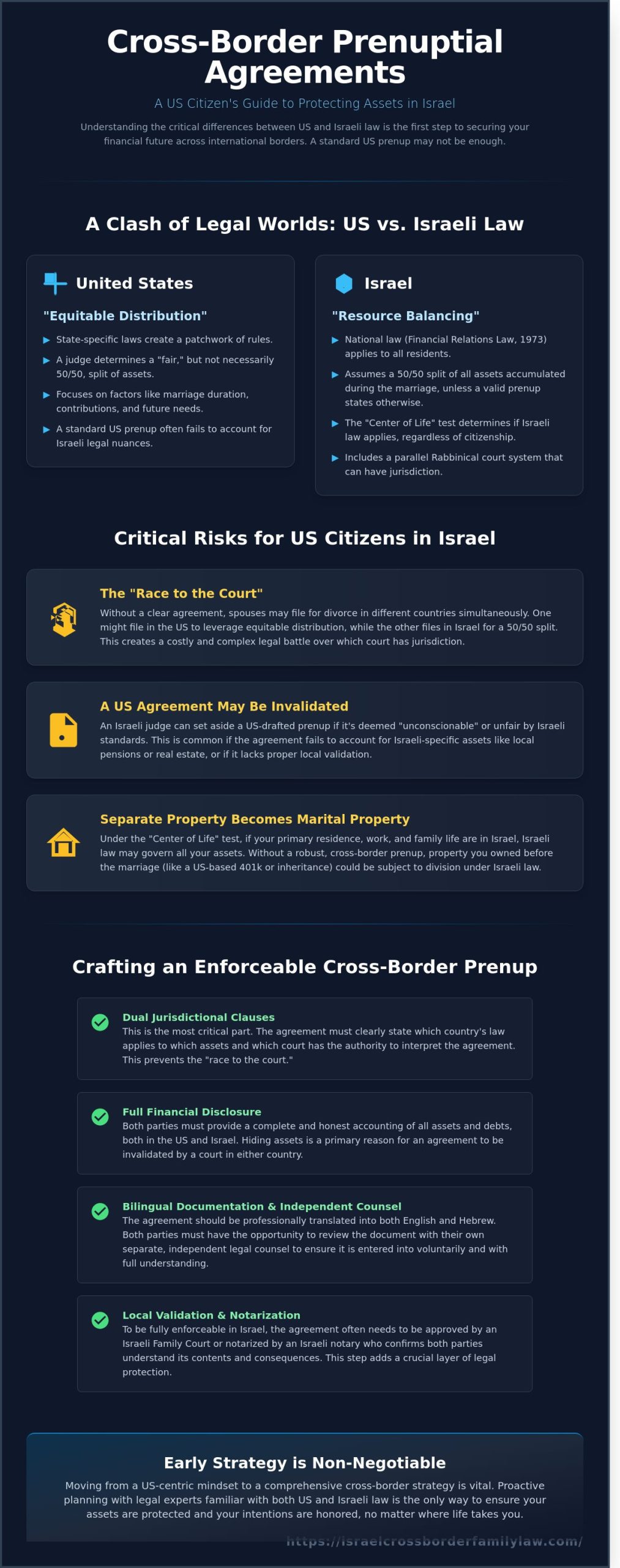
A prenuptial agreement US citizen israel is a sophisticated legal contract designed to manage asset distribution and financial support for couples with ties to both nations. It’s more than just a standard financial document. It acts as a bridge between two distinct legal systems. For Americans, this means balancing the specific laws of their home state with the national statutes of Israel. Understanding international prenuptial agreements is vital because US citizens face unique risks. You aren’t just dealing with federal law; you’re navigating the intersection of state-level US rules and Israeli national law, which can lead to conflicting outcomes if not handled with care.
The Israeli legal system uses the “Center of Life” test to determine which country’s law applies to your marriage. If you live, work, and raise children in Israel, a court may decide that Israeli law governs your marital assets, even if you signed your documents in the US. Proactive planning before you relocate or make Aliyah is the only way to avoid jurisdictional “races.” These races occur when one spouse files for divorce in the US while the other files in Israel, creating a complex and expensive legal battle over which court has the right to decide your future. Getting ahead of these issues ensures you maintain control over your financial destiny.
To gain a deeper perspective on the complexities of these agreements, watch this helpful interview with a legal expert:
Why a Standard US Agreement May Fall Short
Many couples assume a document drafted in New York or California will automatically hold up in Tel Aviv. This is a risky assumption. Israeli courts apply different “fairness” standards than many US states. Under the Israeli Financial Relations Law of 1973, assets are typically shared equally unless a specific, locally recognized agreement says otherwise. If an Israeli judge views a US-only document as unconscionable or biased, they may set it aside entirely. This is particularly common when the agreement doesn’t account for Israeli pension rights or local real estate valued in Israeli Shekels (₪). Without local validation, your US assets and your Israeli home could be subject to laws you never intended to apply.
The Role of Jurisdictional Clauses
Jurisdictional clauses are the most critical components of a prenuptial agreement US citizen israel. These clauses specify which court has the authority to interpret the agreement and which country’s laws should be used. Choosing the right forum impacts everything from divorce and separation for international families to future inheritance rights. A well-drafted clause balances enforcement needs in both countries. For example, you may need the agreement to be enforceable in a US court to protect a 401k, while also ensuring it meets the requirements of an Israeli family court to protect property in Jerusalem. Without this dual-focus, you may find yourself with a document that is valid in one country but useless in the other.
Get clarity before you commit. Request a confidential consultation.
This article is published on an independent advisory platform and does not constitute legal representation or legal advice. It is for informational purposes only. Legal services are only provided by licensed attorneys under a separate engagement. No attorney-client relationship is formed by reading this content.
Marital Property Laws: US State Law vs. Israeli National Law
Relocating between jurisdictions creates a significant shift in how your assets are viewed by the court. In many US states, courts follow “equitable distribution,” where a judge decides what is fair based on various factors. Israel operates under a different framework known as the Financial Relations Law of 1973. This law applies to all couples residing in Israel, regardless of where they were married or their citizenship status. For a prenuptial agreement US citizen israel strategy to be effective, it must bridge the gap between these two distinct legal philosophies.
When a couple moves to Israel, assets that were once considered safe under US state law may become vulnerable. This is particularly true for high-growth assets common in the “start-up nation” economy, such as RSU grants, stock options, and pension funds. Without a clear, proactive strategy, the default Israeli legal regime takes over, which can lead to unexpected results during a divorce or separation for international families.
The Israeli ‘Resource Balancing’ Principle
The default legal regime in Israel is “Resource Balancing.” This principle dictates that all assets acquired by either spouse during the marriage are split 50/50 upon the termination of the union. While this sounds straightforward, it includes complex assets like the increase in value of a business or professional reputation. There are specific exceptions for:
- Property owned by one party prior to the marriage
- Inheritances received during the marriage
- Gifts received from third parties
However, these protections are fragile. If pre-marital funds are used to pay off a mortgage on a shared home or are deposited into a joint account, they may lose their “separate” status through commingling. An agreement is the only reliable way to opt-out of this 50/50 default and ensure your specific intentions are honored.
Validation (Ishur): The Critical Missing Step
A common mistake for Americans is assuming a US-signed document is automatically valid in Israel. Under Israeli law, a prenuptial agreement US citizen israel usually requires “validation” (known as Ishur) to be binding. This process involves appearing before a judge or a qualified notary who confirms that both parties entered the agreement of their own free will and fully understand the legal consequences. This step is also a key component cited by the U.S. State Department on Israeli prenuptial agreements as a method to address religious legal complexities.
Relying on a document that hasn’t been validated in an Israeli court carries high risks. If the agreement is challenged, an Israeli judge might view an unvalidated US document as a mere “statement of intent” rather than a binding contract. This can lead to costly litigation where the court applies the 1973 law instead of your original agreement. Taking the time to validate the document ensures your cross-border interests are protected in both systems.
Get clarity before you commit. Request a confidential consultation to discuss your specific situation.
This article is published on an independent advisory platform and does not constitute legal representation or an attorney-client relationship. Legal services are provided only by licensed attorneys under a separate engagement.
The Rabbinical Court Factor and Religious Jurisdiction in Israel
Israel’s legal landscape features a unique dual-court system that often surprises expats. While Civil Family Courts handle most domestic issues, the Rabbinical Courts maintain exclusive authority over the actual act of marriage and divorce for Jewish citizens. For a prenuptial agreement US citizen israel, understanding the “race to the court” (Merotz Samchuyot) is essential. This legal doctrine means the first spouse to file a comprehensive divorce claim in the Rabbinical Court can effectively pull property and alimony issues into that religious forum. This often results in outcomes that differ significantly from civil law standards.
The Rabbinical Court’s involvement isn’t just a formality; it’s a powerful jurisdictional reality. If you don’t define your preferred forum in advance, you might find your US-based assets being scrutinized under religious law interpretations rather than the civil standards you expected. Strategy is key here. By addressing these jurisdictional overlaps early, you reduce the risk of a protracted legal battle across two different court systems.
Navigating Religious vs. Civil Authority
A well-drafted agreement acts as a jurisdictional shield. Under the 1973 Spouses (Property Relations) Law, couples can explicitly state that the Civil Family Court remains the sole authority for all financial and property distributions. This prevents one party from unilaterally moving assets into the Rabbinical system to gain a tactical advantage. For US citizens, this clarity is vital. Rabbinical Courts might not always recognize specific US state law concepts like “separate property” or “commingling” in the same way a civil judge would. Establishing the Civil Court as your primary forum ensures that your financial future stays governed by predictable, secular statutes.
The ‘Respectful Divorce’ Clause
The most sensitive issue in Israeli divorce is the “Get,” or religious writ of divorce. Without it, a person cannot remarry under Jewish law in Israel. Research into cross-border divorce denial shows that religious barriers are frequently used as leverage during financial negotiations. To prevent this, modern agreements include “Respectful Divorce” clauses. These provisions often mandate a daily payment, such as ₪1,500, if one spouse refuses to grant or receive a Get after a civil separation. These financial incentives are generally enforceable in Israeli civil courts. They provide a vital layer of protection against “Get-refusal” and extortion during an already difficult transition.
Get clarity before you commit. Request a confidential consultation.
Drafting Considerations for International Families
Creating a prenuptial agreement US citizen israel requires a meticulous approach to dual legal systems. You can’t simply take a standard US template and expect it to hold weight in an Israeli Family Court. The document must bridge two distinct legal cultures and sets of statutes to remain enforceable over decades. A failure to account for the specific requirements of the 1973 Financial Relationships Act in Israel can render even the most expensive US-drafted document useless in a local court.
- Bilingual Documentation: Clarity is non-negotiable. Agreements should be drafted in both English and Hebrew, or accompanied by certified translations. This prevents a spouse from later claiming they didn’t understand the specific legal nuances of the terms.
- Independent Counsel: Both parties must have their own legal representation. For cross-border couples, this often means consulting with attorneys in both jurisdictions to ensure the agreement doesn’t violate mandatory laws in either the US or Israel.
- Future-Proofing: A well-drafted document accounts for life changes. This includes the birth of children, the receipt of an inheritance, or the acquisition of Israeli real estate, such as a ₪4,200,000 apartment in Tel Aviv.
Asset Disclosure Standards
Full and fair disclosure is the bedrock of any valid agreement. Hiding a ₪550,000 Israeli pension or a $200,000 US 401k is a fast track to having the entire contract voided. Both Israeli and US courts view lack of transparency as a sign of bad faith. You must create a comprehensive schedule of assets that lists every global holding, from high-tech stock options to foreign bank accounts. Cross-border valuation experts are often brought in to provide a precise financial snapshot, ensuring all values are accurate and defensible before a judge.
This process of asset disclosure often highlights the need for a cohesive international wealth management plan. For those seeking institutional-grade advisory services, it can be helpful to check out Neil Jesani Wealth.
Special Provisions for Expats
Expats face unique challenges, particularly regarding Aliyah and potential relocation. Your agreement should explicitly state what happens if the family leaves Israel. If you move back to the US, you need to know which court will handle child custody or support. These provisions act as a jurisdictional roadmap. Addressing these issues early helps avoid the complexities associated with divorce for international families. Without these clauses, a move can trigger a “race to the courthouse” in two different countries, significantly increasing legal costs.
Get clarity before you commit. Request a confidential consultation.
Strategic Next Steps: Getting Clarity Before You Commit
Securing your financial future requires moving beyond a standard US-centric mindset. Many Americans moving to Tel Aviv or Jerusalem assume their existing legal documents carry over automatically. This isn’t the case. A prenuptial agreement US citizen israel must specifically account for the Spouses (Property Relations) Law of 1973. This law governs how assets are divided if the relationship ends while you’re living in the country, and it often surprises those used to US equitable distribution rules.
Early consultation helps you identify jurisdictional risks before they become expensive mistakes. You’re moving from a local legal perspective to a sophisticated cross-border strategy. This transition is less about finding a template and more about understanding how two different legal systems interact. Strategic advisory services focus on these interactions, helping you weigh options before you hire a litigator. It’s about risk-based decision-making rather than just filling out forms. It’s a proactive way to manage a multi-jurisdictional life.
Open communication between partners is the most sustainable foundation. Discussing the technicalities of ₪5,000 in validation fees or the specifics of real estate in Haifa might feel clinical, but it prevents future conflict. Getting these details right early saves thousands of shekels in future litigation costs. Get clarity before you commit. Request a confidential consultation.
The Advisory Process
An independent advisory platform provides a neutral space to evaluate your global footprint. You can see how it works for international families who need to reconcile US state laws with Israeli civil court requirements. Before your consultation, gather your current financial statements and any existing US drafts. This preparation ensures your time is spent on strategy rather than basic data collection. Professionals can then help you identify if your US assets, like a 401(k) or a Delaware LLC, are protected under local standards.
Final Checklist for US Citizens
Before finalizing any documents, use this checklist to ensure your prenuptial agreement US citizen israel remains enforceable across borders:
- Verify if your current US prenup requires an Israeli ‘Addendum’ to meet local validation standards.
- Confirm whether you need validation from an Israeli Family Court or a Notary, as the requirements change depending on whether you are already married.
- Ensure all pension funds and US-based retirement accounts are explicitly mentioned in terms the Israeli system understands.
- Check that the document includes a choice of law clause that is valid in both your US home state and the Israeli district where you reside.
For more detailed support, review our specialized guidance for expats and foreign nationals navigating the local system. This ensures your strategy is built on local reality rather than international assumptions.
Strategic Protection for Your International Future
Navigating the intersection of US state statutes and Israeli national law requires more than a standard template. For an expat in the Start-up Nation, a prenuptial agreement US citizen israel must account for the 1973 Spouses (Property Relations) Law and the potential for Rabbinical Court intervention. These jurisdictional overlaps often create complex conflicts that standard domestic agreements simply don’t address. We’ve seen how early decisions regarding asset characterization and choice of law clauses provide the certainty needed for a multi-jurisdictional life.
Waiting until a conflict arises is a high-risk strategy. Our team brings deep expertise in cross-border US-Israel dynamics, offering a calm, advisory-first approach tailored to the specific needs of global families. You can find detailed explanations of these legal intersections on our YouTube channel. We understand the bicultural nuances required to bridge the gap between US and Israeli legal systems effectively.
Before you sign any document, ensure it reflects the reality of your international footprint and protects your long-term interests. Get clarity before you commit. Request a confidential consultation to discuss your options today. Taking this step now ensures your global assets remain secure regardless of where life takes you.
This article is published on an independent advisory platform and does not constitute a law firm or an attorney-client relationship. The information provided is for educational purposes only. Legal services are only provided by licensed attorneys under a separate, formal engagement.
Frequently Asked Questions
Is my US prenuptial agreement automatically valid in Israel?
Your US prenuptial agreement isn’t automatically valid or enforceable in Israel. To ensure it holds weight, the document must be ratified by an Israeli Family Court or a Rabbinical Court according to the Spouses (Property Relations) Law of 1973. Without this formal approval, Israeli courts might ignore your US contract and apply local laws to your assets instead. It’s a common mistake for expats to assume a foreign document is sufficient without local legal intervention.
Do I need an Israeli lawyer if I already have a US lawyer for my prenup?
You definitely need an Israeli lawyer even if you already have representation in the United States. A US attorney isn’t trained in the specific requirements of the Israeli Spouses (Property Relations) Law and can’t ensure the document meets the “fairness” standards required for ratification here. Engaging a bicultural professional helps bridge the gap between two different legal systems. This ensures your prenuptial agreement US citizen israel strategy covers both jurisdictions effectively and protects you in both countries.
What happens if we sign a prenup in the US but then move to Israel (Aliyah)?
Moving to Israel changes your “center of life,” which gives Israeli courts jurisdiction over your marital property and potential divorce proceedings. If your US agreement wasn’t drafted with international mobility in mind, it might be challenged or deemed “unconscionable” under Israeli public policy. Data from 2022 indicates that many cross-border disputes arise because couples didn’t update their legal standing after making Aliyah. You should have your agreement reviewed by an expert to ensure it remains robust under local law.
Can an Israeli prenuptial agreement protect my US-based inheritance?
An Israeli prenuptial agreement can specifically protect your US-based inheritance from being classified as “communal property” during a divorce. While Israeli law generally excludes inheritances from property division, a clear “separate property” clause provides an essential layer of security. This is vital because commingling inheritance funds in an Israeli bank account can lead to a 50% claim by a spouse under the “intent to incorporate” doctrine. Defining these boundaries early prevents costly litigation later.
What is the difference between a prenuptial and a postnuptial agreement in Israel?
The main difference is the timing of the signing and which authority must approve the document. A prenuptial agreement is signed before the wedding and can be ratified by a notary or a marriage registrar. A postnuptial agreement is signed after you’re already married and must be approved by a judge in the Family Court or Rabbinical Court. Both documents define property rights, but the procedural requirements for a postnuptial agreement are more rigorous because the judge must ensure both parties understand the consequences.
How much does it typically cost to draft a cross-border agreement?
Drafting a comprehensive cross-border agreement typically costs between ₪8,000 and ₪25,000. These fees vary based on the complexity of your international assets and whether the document requires professional translation or dual-jurisdiction review. While a basic local agreement might be cheaper, a prenuptial agreement US citizen israel requires specialized expertise to handle multi-jurisdictional tax and property implications. Investing in a high-quality draft now prevents much higher legal costs if the agreement is ever contested.
Does a prenup in Israel affect child support or custody?
A prenup in Israel can’t legally bind a court regarding child support or custody arrangements. Israeli judges always prioritize the “best interests of the child” at the time of separation rather than following a contract signed years earlier. Any clause that attempts to set fixed support amounts or custody schedules is usually considered void by the court. You can outline your general intentions in the document, but the court maintains the final authority to decide these matters based on the family’s current circumstances.
Can we change our prenuptial agreement after we are already married?
You can change your prenuptial agreement after marriage by creating a written amendment or a new postnuptial agreement. This update must be signed by both parties and approved by an Israeli Family Court judge to be legally binding. It’s common for couples to revise their terms after 5 or 10 years of marriage or after significant financial shifts, such as selling a business. Don’t assume a verbal agreement to change terms will hold up; you must follow the formal court ratification process.
Get clarity before you commit. Request a confidential consultation. For more information on navigating these complex family matters, you can view educational resources at https://www.youtube.com/@IsraelFamilyLaw.

Article by
Gabriel Lior
A Personal Journey That Became a Mission
The advisory was founded by an American father Gabriel Lior, LLB, MBA , global entrepreneur, and cross-border advisor who spent more than a decade navigating the Israeli family court system firsthand and now lives in Singapore with his son.
As a divorced parent in a cross-border family, Gabriel faced nearly every legal challenge a foreign parent can encounter in Israel — including child custody disputes, child support proceedings, property matters in Israel and abroad, false accusations, and complex immigration and relocation proceedings.
Over the years, he learned the hard way how difficult it is for non-Israeli parents to understand the system, identify the right legal strategy, and choose the right legal representation — especially when language, culture, and jurisdictional differences are involved. He also witnessed how foreign parents and new immigrants are often disadvantaged or taken advantage of by service providers and institutions simply because they lack local knowledge or fluency.
From Client to Advisor
To truly understand — and survive — the system, Gabriel pursued formal legal education in Israel, completing two Israeli law degrees, alongside a BA and MBA earned in the United States. This was never about becoming a practicing attorney, but about gaining a deep, structural understanding of how the system works — and where it breaks down for foreign parents.
This rare combination of:
Firsthand client experience
Israeli legal and US business education
International business and negotiation training
Decades of commercial execution
created a unique perspective – one that understands both sides of the table.
After years of litigation, persistence, and at times self-representation, he ultimately succeeded in securing custody of his son and relocating abroad through a rare legal victory in the Israeli Supreme Court — becoming one of the first fathers in Israel to do so under these circumstances.
Disclaimer
Important Disclaimer:
The information provided on this website and in its content is for general informational and educational purposes only and does not constitute legal advice, legal opinion, or legal representation.
Gabriel Lior is not licensed to practice law in Israel (nor is he interested in doing so) and does not provide legal services, despite having completed 2 Law Degrees. The services offered are advisory in nature and are intended to provide general guidance, strategic insight, and information regarding cross-border family law considerations.
No attorney-client relationship is formed by accessing this website, reading its content, or communicating with us.
Any decisions made based on this information are at your own discretion and risk. For legal advice specific to your situation, you should consult a licensed attorney in the relevant jurisdiction.
Where appropriate, we may refer clients to independent, licensed attorneys or professionals. Such referrals do not constitute legal representation and no liability is assumed for services provided by third parties.