In the complex realm of international family law, the threat of a child’s wrongful removal represents one of the most significant challenges a parent can face. For those in a high-conflict separation with a partner possessing strong ties to Israel, this fear is a tangible and immediate concern. Navigating the intricate legal frameworks of two sovereign nations requires sophisticated guidance and decisive action. Therefore, understanding the proactive legal strategy for preventing parental kidnapping to Israel is not merely advisable-it is paramount to safeguarding your parental rights and, most importantly, your child’s well-being. This guide serves as your authoritative resource, designed to move you from a position of anxiety and confusion to one of empowered control. We will delineate the crucial legal instruments and practical measures available, from obtaining explicit court orders restricting international travel to engaging with central authorities under the Hague Convention. You will learn the exact steps required to build a formidable legal shield around your child, ensuring you have a clear, actionable plan to protect your family across any border.
Understanding the Risk: Warning Signs and Legal Realities
In the complex landscape of multi-jurisdictional family law, the threat of international parental child abduction is a grave concern for parents with ties to both the United States and Israel. Understanding the distinction between a contentious custody dispute and an illegal abduction is the foundational first step in protecting your child. This section provides a critical overview of the legal definitions, specific risk factors, and the formidable challenges of recovery, underscoring why a proactive strategy for preventing parental kidnapping to Israel is not just advisable, but essential. To better understand the preventative measures available, the following overview from the U.S. Department of State is highly informative:
What Legally Constitutes International Parental Abduction?
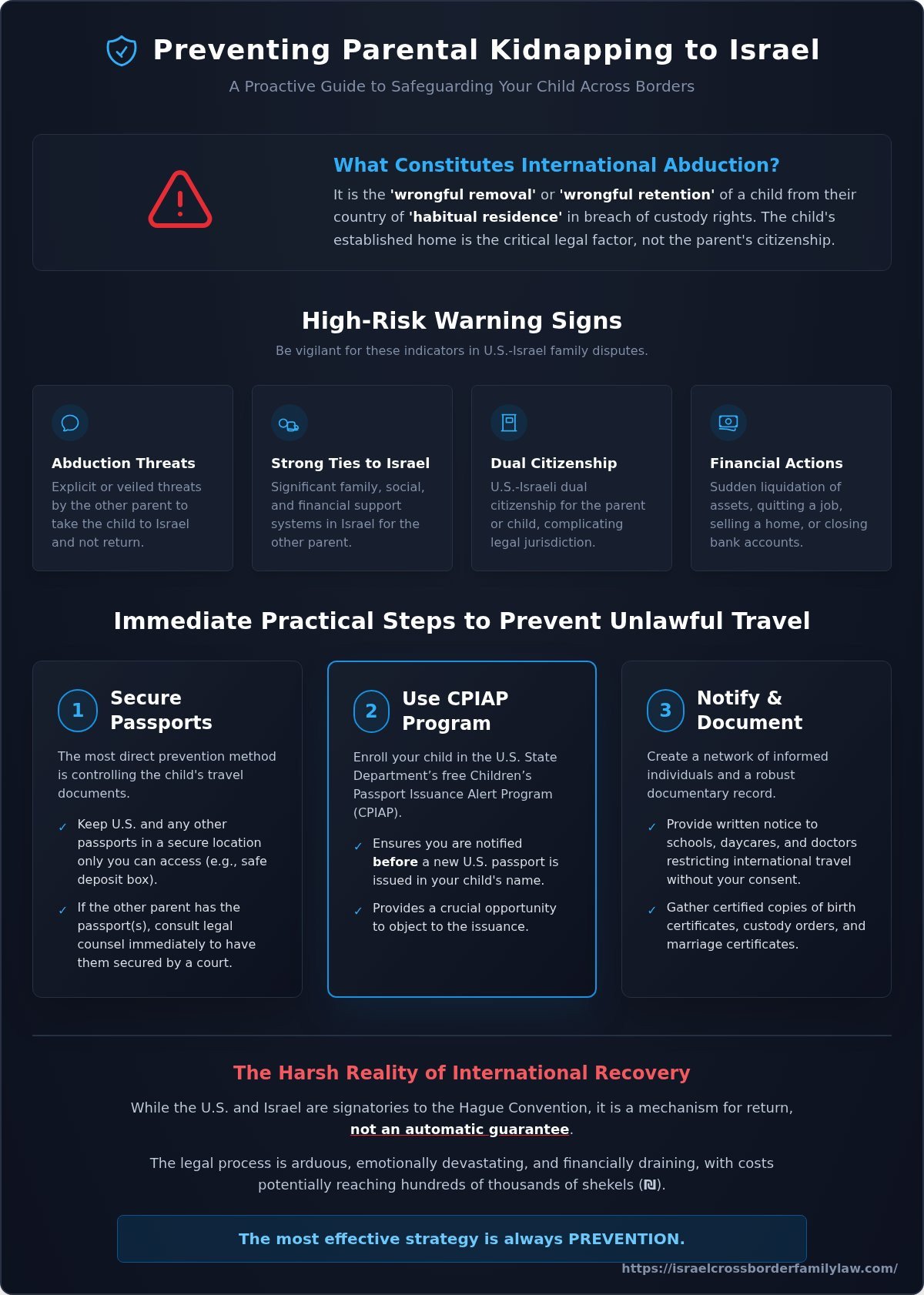
International parental child abduction is not merely a family disagreement; it is a legally defined act. Under international treaties, it is characterized by the ‘wrongful removal’ or ‘wrongful retention’ of a child from their country of ‘habitual residence’ in breach of custody rights. This means that if a parent takes a child from the U.S. to Israel in violation of a court-ordered custody agreement, it constitutes an abduction, regardless of the parent’s intentions. The child’s established home, or habitual residence, is the critical legal determinant, not the parent’s citizenship.
High-Risk Factors in US-Israel Family Disputes
Recognizing warning signs is a cornerstone of prevention. Certain indicators significantly elevate the risk of a potential cross-border abduction in families with U.S. and Israeli connections. Be vigilant for:
- Explicit or veiled threats by the other parent to take the child to Israel and never return.
- Strong family, social, and financial support systems in Israel that could sustain the parent and child indefinitely.
- Dual U.S.-Israeli citizenship for either the parent or the child, which can complicate jurisdictional matters.
- Sudden, unexplained actions such as quitting a job, selling a home, liquidating financial assets, or closing bank accounts.
The Harsh Reality of International Recovery Proceedings
While both the U.S. and Israel are signatories to the Hague Convention on the Civil Aspects of International Child Abduction, this treaty is a mechanism for return, not an automatic guarantee. The legal process is arduous, emotionally devastating for both the left-behind parent and the child, and financially draining. Pursuing a Hague case can incur legal and logistical costs amounting to tens or even hundreds of thousands of shekels (₪). The profound trauma and complexity involved reinforce a critical truth: the most effective strategy is always focused on preventing parental kidnapping to Israel before it ever occurs.
Immediate Practical Steps to Prevent Unlawful Travel
When facing the complex threat of international child abduction, immediate, practical measures are a critical first line of defense. While formal legal proceedings are essential, the non-legal actions you take today can create significant barriers to unlawful travel. A proactive approach focused on controlling travel documents and establishing a clear paper trail is fundamental to any strategy for preventing parental kidnapping to Israel. These steps are designed to be implemented swiftly to safeguard your child’s welfare and secure your parental rights.
Securing Your Child’s Passport(s)
The most direct method of preventing unauthorized international travel is controlling the child’s travel documents. Keep your child’s U.S. passport, and any other passports they may hold, in a secure location to which only you have access, such as a bank safe deposit box. For dual-citizen children, it is imperative to be aware of any Israeli passport, as it can be used for entry into Israel. If the other parent currently possesses the child’s passport(s), you must consult with legal counsel immediately to explore options for having the documents secured by a court or a neutral third party. Always maintain high-quality, certified copies of your child’s passports and birth certificate for your records.
Using the Children’s Passport Issuance Alert Program (CPIAP)
The U.S. Department of State offers a free and vital service called the Children’s Passport Issuance Alert Program (CPIAP). Enrolling your child in this program ensures you are notified before a U.S. passport is issued in their name. This provides a crucial opportunity to object to the issuance. For comprehensive guidance and enrollment, we advise clients to consult the official U.S. State Department Prevention Program. It is important to understand the program’s limitations: CPIAP does not track an existing, valid passport and cannot prevent a child from traveling on a foreign passport.
Notifying Key Parties and Assembling Documents
Creating a network of informed individuals and a robust documentary record is an essential component of preventing parental kidnapping to Israel. This involves formally communicating your concerns and organizing key evidence. We advise clients to take the following steps:
- Provide written, formal notice to your child’s school, daycare, doctors, and other caretakers. The notice should explicitly state that the child is not to be released to the other parent for any international travel without your express written consent.
- Gather and secure certified copies of all relevant legal documents, including the child’s birth certificate, your marriage certificate, and any existing custody orders or agreements.
- Maintain a file with several recent, clear, color photographs of both your child and the other parent. These are invaluable for law enforcement and immigration authorities in the event of an abduction.
Legal Instruments: Using the Court System to Prohibit Travel
When facing a credible threat of international child abduction, relying on verbal agreements or informal promises is insufficient. The Israeli family court system provides robust legal instruments designed to proactively safeguard your child’s welfare. These court-ordered mechanisms are the strongest and most enforceable tools for preventing parental kidnapping to Israel or any other country. Securing these orders requires clear, unambiguous language in all filings to ensure that law enforcement and border authorities can act decisively.
Obtaining Custody Orders with Specific Travel Restrictions
Your custody agreement is the foundational document for protecting your parental rights. It is critical to petition the court to include explicit clauses that directly address and restrict international travel. These provisions should mandate that:
- No international travel is permitted without a prior, specific court order.
- Written, notarized consent is required from the non-traveling parent for any passport application or travel.
- The child’s Israeli and any foreign passports be surrendered to the court or a neutral third-party attorney.
- Clear financial and custodial penalties are defined for any violation of these travel restrictions.
Seeking a ‘Ne Exeat’ Order to Prevent Departure
A ‘Ne Exeat’ order (צו עיכוב יציאה מן הארץ) is an urgent injunction that commands an individual not to leave the jurisdiction of Israel. To obtain this powerful order, you must present credible evidence demonstrating a significant flight risk. Once granted, the order is registered with the Ministry of Interior and Israeli Border Control, effectively preventing the parent and child from passing through any port of exit. This is a critical legal step for preventing parental kidnapping when the threat is imminent.
Requesting a Financial Security Bond for Travel
In cases where international travel is deemed necessary but a risk of non-return exists, the court may order the traveling parent to post a substantial financial bond. This travel or Hague Convention bond requires the parent to deposit a significant sum-often ranging from ₪100,000 to over ₪500,000-with the court. These funds are forfeited if the child is not returned by the specified date. This creates a powerful financial disincentive against abduction, a practice supported by principles outlined by Israel’s Central Authority for the Hague Convention. [ Download ](https://getautoseo.com/screenshots/getautoseocom_1769307165_p8yq9ZBV.jpg) Feedback & Recreate Delete 
The Role of Israeli Law and the Hague Convention in Prevention
A comprehensive strategy for preventing parental kidnapping to Israel requires a sophisticated understanding of both international treaties and domestic Israeli law. While international agreements provide a framework for response, Israeli legal mechanisms offer powerful, proactive tools for prevention. Navigating this multi-jurisdictional landscape is critical to safeguarding your parental rights and protecting your child.
Israel’s Adherence to the Hague Convention
Israel is a signatory to the 1980 Hague Convention on the Civil Aspects of International Child Abduction and generally complies with its mandates. The treaty’s objective is to secure the prompt return of a child wrongfully removed to, or retained in, any signatory state. In Israel, cases are managed by a designated Central Authority within the Ministry of Justice. However, it is crucial to recognize two realities: proceedings can be lengthy and legally complex, and the Convention is a reactive remedy designed for a child’s return, not their prevention from being abducted in the first place.
Key Concepts in Israeli Family Law
Understanding the principles guiding Israeli family courts is essential for building a strong preventative case in the United States. Israeli courts are governed by the overriding principle of the “best interests of the child” (tovat hayeled). While the influence of the “Tender Years Doctrine” (presuming custody of young children with the mother) is evolving, it can still factor into judicial thinking. A significant risk is that the longer a child remains in Israel, the more an abducting parent can argue the child has established a new life, making a return disruptive. This knowledge strengthens your ability to argue for strict travel restrictions in a US court by highlighting the specific legal risks within Israel.
Using Israeli ‘Stop Orders’ (Tzav Ikuv Yetzia)
One of the most effective domestic legal tools is the Israeli “Stop Order,” or Tzav Ikuv Yetzia Me’Haaretz. This is a court order that physically prevents a child from leaving the borders of Israel. If your child is in Israel for a legitimate visit and you develop a credible fear they will not be returned, you can petition the Israeli Family Court for an emergency Stop Order. This is a powerful, direct action that can be initiated by a parent residing abroad through local Israeli counsel. The order is lodged with border control, effectively blocking any attempted departure. Successfully petitioning for such an order from overseas involves complex procedural and evidentiary requirements. Navigating these complexities requires expert guidance. Contact us.
Building a Comprehensive Prevention Strategy with Expert Counsel
Successfully protecting your child from international abduction requires more than isolated actions; it demands a cohesive, multi-faceted strategy that integrates legal safeguards with practical vigilance. The preceding sections have outlined specific steps, from securing passports to obtaining court orders. Now, we must synthesize these elements into a comprehensive plan, architected and executed with the guidance of sophisticated legal counsel. An effective approach to preventing parental kidnapping to Israel is proactive, not reactive, and is built on a foundation of expert legal advice that bridges the complexities of both U.S. and Israeli law.
Why a Cross-Border Specialist is Non-Negotiable
Navigating the intricate landscape of international family law is a task for which domestic attorneys are seldom equipped. A lawyer specializing in U.S.-Israel cross-border disputes provides indispensable advantages. They possess a deep understanding of the Hague Convention on the Civil Aspects of International Child Abduction, Israeli family court procedures, and the subtle cultural nuances that influence legal outcomes. This dual expertise is critical for anticipating arguments, liaising with Israeli legal professionals, and drafting court orders that are not only valid in the United States but are fully enforceable within Israel’s legal system. Their role is to serve as your strategic bridge between two distinct jurisdictions.
Proactive Planning: Prenuptial and Postnuptial Agreements
The most robust prevention strategies are implemented long before a conflict arises. Marital agreements, such as prenuptial or postnuptial contracts, can serve as powerful deterrents. By formally addressing the possibility of international disputes, you establish a clear record of intent. We advise clients to incorporate specific clauses, including:
- Jurisdictional Stipulations: Clearly defining which country’s courts will have exclusive jurisdiction over custody matters.
- Travel Consent Protocols: Requiring notarized, written consent from both parents for any international travel with the child.
- Financial Penalties: Outlining significant financial consequences, such as the forfeiture of assets, in the event of a wrongful removal or retention.
While not an absolute guarantee, these provisions create a formidable legal obstacle and demonstrate premeditated intent to any court reviewing the case.
When to Act: The Urgency of Seeking Legal Advice
Time is the most critical factor in preventing parental kidnapping to Israel. The moment you perceive a credible threat-whether through veiled comments, sudden financial changes, or the liquidation of assets-is the moment to seek legal counsel. Waiting for an overt act, such as a purchased plane ticket, can narrow your legal options dramatically. An initial consultation with an experienced cross-border family law attorney can provide a clear assessment of your risk and a definitive roadmap for immediate protective measures. Do not delay in securing your child’s future. If you fear for your child’s safety, schedule a confidential consultation today.
Proactive Legal Counsel: The Cornerstone of Prevention
The threat of international child abduction is a complex, multi-jurisdictional challenge that demands a sophisticated and proactive response. This guide has underscored the critical importance of identifying early warning signs and strategically leveraging the U.S. court system to secure preventative orders. A comprehensive understanding of both Israeli law and the Hague Convention is paramount for successfully preventing parental kidnapping to Israel. Navigating this intricate legal landscape alone is a significant risk. Our firm provides the strategic guidance required for high-conflict international cases, built upon a proven track record in complex cross-border custody disputes and deep, dual-qualified expertise in both U.S. and Israeli family law. Protect your child and your rights. Schedule a confidential consultation with our US-Israel family law experts. With the right legal partner, you can take decisive action to safeguard your parental rights and ensure your child’s stability and security.
Frequently Asked Questions: International Parental Kidnapping to Israel
My ex-spouse is Israeli military or government. Does that affect my ability to prevent abduction?
Yes, this presents a sophisticated legal challenge. An ex-spouse with connections to the Israeli military or government may have access to resources and influence that can complicate preventative measures and recovery efforts. Navigating this multi-jurisdictional issue requires experienced counsel with a deep understanding of both U.S. family law and the intricacies of the Israeli administrative and legal systems. Proactive, strategic legal action is paramount to mitigate these heightened risks and enforce protective court orders effectively.
What if my custody agreement is silent on international travel?
A custody agreement that is silent on international travel creates a significant vulnerability. Without explicit restrictions, the other parent may argue they have the right to travel with the child. It is critical to petition the court to modify the order to include specific, unambiguous terms. These should mandate written, notarized consent from both parents for any international travel, require the surrender of the child’s passport, and detail a full itinerary for any approved trips.
Can I get my child’s name on an airport watch list to prevent them from leaving the US?
Yes, under specific circumstances through the U.S. Department of Homeland Security’s Prevent Departure Program. This is not a measure you can implement directly; it requires a valid court order that explicitly prohibits the child’s removal from the United States. Your legal counsel must ensure the order contains the precise language required by federal authorities. This program is a powerful tool, but it is contingent upon first obtaining the necessary judicial mandate to restrict the child’s travel.
If my child is abducted, how long does a Hague Convention case typically take in Israel?
While the Hague Convention on the Civil Aspects of International Child Abduction aims for an expeditious process, cases in Israel typically take between six months to over a year. The timeline is influenced by numerous factors, including the complexity of the evidence, the potential for appeals by the abducting parent, and the court’s calendar. Securing experienced Israeli counsel is essential to navigate the proceedings efficiently and advocate for the swift return of your child to their habitual residence.
Does it matter if our marriage was or was not recognized in Israel?
For the purposes of a Hague Convention return petition, the legal status of the parents’ marriage is generally not the central issue. The primary focus is on the child’s “habitual residence” and whether the removal or retention was wrongful under the laws of that residence. However, the recognition of your marriage can become a relevant and complex factor in parallel proceedings within the Israeli family court system concerning matters of custody, divorce, or support.
What role does the FBI play in preventing international parental kidnapping?
The FBI’s primary role is investigative and prosecutorial after an abduction occurs, enforcing the International Parental Kidnapping Crime Act (IPKCA). While their direct involvement in prevention is limited, they can become involved once a state-level warrant is issued for custodial interference, escalating it to a federal Unlawful Flight to Avoid Prosecution (UFAP) warrant. Effective strategies for preventing parental kidnapping to Israel focus on proactive civil court orders rather than relying solely on law enforcement intervention.
Can a parent be criminally charged for taking their child to Israel against a court order?
Yes, unequivocally. Removing a child from the United States in violation of a valid custody order is a federal felony under the International Parental Kidnapping Crime Act (IPKCA). This can result in the issuance of a federal arrest warrant, which is filed with Interpol and can lead to significant criminal penalties, including imprisonment. These criminal charges are a separate and distinct legal action from the civil Hague Convention proceedings aimed at securing the child’s return.

Article by
Gabriel Lior
A Personal Journey That Became a Mission The advisory was founded by an American father Gabriel Lior, LLB, MBA , global entrepreneur, and cross-border advisor who spent more than a decade navigating the Israeli family court system firsthand and now lives in Singapore with his son.
As a divorced parent in a cross-border family, Gabriel faced nearly every legal challenge a foreign parent can encounter in Israel — including child custody disputes, child support proceedings, property matters in Israel and abroad, false accusations, and complex immigration and relocation proceedings. Over the years, he learned the hard way how difficult it is for non-Israeli parents to understand the system, identify the right legal strategy, and choose the right legal representation — especially when language, culture, and jurisdictional differences are involved. He also witnessed how foreign parents and new immigrants are often disadvantaged or taken advantage of by service providers and institutions simply because they lack local knowledge or fluency. From Client to Advisor To truly understand — and survive — the system, Gabriel pursued formal legal education in Israel, completing two Israeli law degrees, alongside a BA and MBA earned in the United States. This was never about becoming a practicing attorney, but about gaining a deep, structural understanding of how the system works — and where it breaks down for foreign parents. This rare combination of: Firsthand client experience Israeli legal and US business education International business and negotiation training Decades of commercial execution created a unique perspective – one that understands both sides of the table. After years of litigation, persistence, and at times self-representation, he ultimately succeeded in securing custody of his son and relocating abroad through a rare legal victory in the Israeli Supreme Court — becoming one of the first fathers in Israel to do so under these circumstances.
Disclaimer
Important Disclaimer: The information provided on this website and in its content is for general informational and educational purposes only and does not constitute legal advice, legal opinion, or legal representation. Gabriel Lior is not licensed to practice law in Israel (nor is he interested in doing so) and does not provide legal services, despite having completed 2 Law Degrees. The services offered are advisory in nature and are intended to provide general guidance, strategic insight, and information regarding cross-border family law considerations. No attorney-client relationship is formed by accessing this website, reading its content, or communicating with us. Any decisions made based on this information are at your own discretion and risk. For legal advice specific to your situation, you should consult a licensed attorney in the relevant jurisdiction. Where appropriate, we may refer clients to independent, licensed attorneys or professionals. Such referrals do not constitute legal representation and no liability is assumed for services provided by third parties.