This article is published on an independent advisory platform and does not constitute a law firm relationship or legal advice.
Most international families assume a foreign will automatically grants control over assets in Israel. In reality, without specific local validation, those assets often remain frozen. You’re likely feeling the weight of managing an estate from thousands of miles away, perhaps confused by Hebrew legal terms or worried about unexpected tax liabilities. Finding a qualified probate lawyer in Tel Aviv is essential to bridge the gap between different legal cultures and satisfy the strict requirements of the Israeli Inheritance Law of 1965.
You deserve a clear path forward. This guide provides an authoritative roadmap for the Israeli probate process in 2026. You’ll gain a clear understanding of how to secure a Succession Order and manage Tel Aviv real estate without the stress of trying to navigate a foreign system alone. We’ll examine the critical differences between legal jurisdictions and provide a strategy for the efficient transfer of assets. For more visual insights, you can visit the Israel Family Law YouTube channel at https://www.youtube.com/@IsraelFamilyLaw. Get clarity before you commit. Request a confidential consultation.
Key Takeaways
- Learn how to navigate the Israeli probate process, from gathering essential documents like apostilles to the final distribution of assets through the Tel Aviv Land Registry.
- Understand the legal conflicts between international and Israeli law, specifically regarding forced heirship and how these differences affect your testamentary freedom.
- Discover why engaging a qualified probate lawyer in tel aviv is essential for bridging the gap between different legal systems and managing complex administration from abroad.
- Identify how making strategic, risk-based decisions early in the process can significantly minimize long-term costs and prevent unnecessary litigation.
- Gain clarity on the transition of real estate assets from the probate stage to official registration in the Tel Aviv Land Registry (Tabu).
This article is published on an independent advisory platform and does not constitute an attorney-client relationship. Legal services are only provided by licensed attorneys under a separate engagement.
Understanding Probate in Israel for International Families
Probate in IL is the formal legal process used to validate a deceased person’s will or to legally declare the rightful heirs to an estate. When a family member passes away leaving assets in Israel, the state requires a formal order to transfer ownership of bank accounts, real estate, or business interests. The Tel Aviv district is particularly unique because it manages the highest volume of international estate cases in the country. Because so many global citizens own property or hold investments in the “Start-up Nation,” the local authorities are accustomed to dealing with foreign documents and multi-jurisdictional complexities. Navigating these inheritance laws requires a strategic approach, especially when assets are spread across different continents.
To better understand this concept, watch this helpful video:
Most cases begin at the Inheritance Registrar, known in Hebrew as Rasham HaYerusha. This administrative body handles standard applications. However, if a case involves a dispute, complex legal questions, or specific international conflicts, it’s transferred to the Family Court. Engaging a probate lawyer in tel aviv early in the process helps families determine which track their case will follow. You can learn more about how this process is managed by visiting our how it works page.
Probate Order vs. Inheritance Order
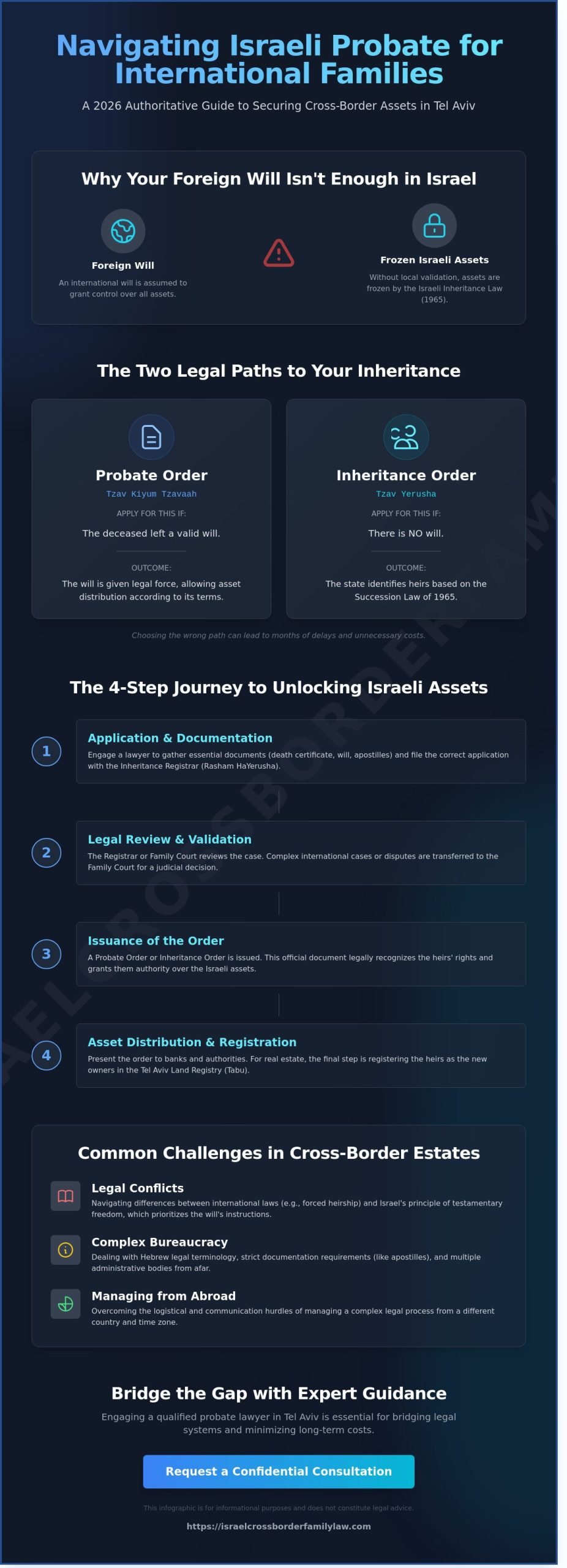
International families must quickly identify which of the two primary orders they need. If the deceased left a valid will, you apply for a Tzav Kiyum Tzavaah (Probate Order). This document gives the will legal force in Israel. If there’s no will, you must apply for a Tzav Yerusha (Inheritance Order), which asks the state to identify heirs based on the Succession Law of 1965. Choosing the wrong path can lead to months of delays and unnecessary administrative costs.
Key Terminology for Expats
The Israeli legal system uses specific terms that don’t always align perfectly with Anglo-American concepts. An “Estate” refers to all assets and debts left behind. An “Heir” is someone entitled to a portion of the estate by law, while a “Successor” is someone named specifically in a will. An “Executor” (Menahel Izavon) isn’t always mandatory in Israel; the court only appoints one if the estate is complex or requires active management. It’s vital to seek clarity before signing any Hebrew documents, as early signatures often dictate the entire legal strategy. The Israeli Succession Law of 1965 remains the primary statute governing these matters, including how the state treats assets owned by foreign nationals. A probate lawyer in tel aviv can help translate these legal requirements into a clear roadmap for your family.
Get clarity before you commit. Request a confidential consultation.
This article is published on an independent advisory platform and does not constitute an attorney-client relationship. Legal services are only provided by licensed attorneys under a separate engagement.
The Israeli Probate Process: From Application to Asset Distribution
The Israeli probate system operates under the jurisdiction of the Inheritance Registrar (Rasham HaYerusha). For international families, the process begins by engaging a probate lawyer in tel aviv to bridge the gap between foreign estate documents and Israeli statutory requirements. The procedure follows a specific four step sequence designed to ensure the legal transfer of assets while protecting the rights of all potential heirs.
Step 1 requires the collection of primary evidence. This includes the original death certificate and the original will. If the decedent passed away outside IL, these documents must be authenticated for use in Israeli courts. Step 2 involves filing the formal application with the Inheritance Registrar in Tel Aviv. This is now a digital process, yet it requires precise legal phrasing to avoid immediate rejection.
Step 3 triggers the public notice phase. The Registrar publishes a notice in a daily newspaper and the Official Gazette. This opens a mandatory 14 day window for any party to file an objection. Step 4 is the final review by the Administrator General (Apoutropus Haklali). If no objections arise and the documentation is sound, the Registrar issues a Succession Order or a Probate Order. This decree acts as the keys to the estate, allowing the probate lawyer in tel aviv to facilitate the transfer of bank accounts and real estate titles.
Document Preparation and Authentication
Documents issued in the United States or Europe aren’t automatically valid in IL. Under the 1961 Hague Convention, foreign public documents must carry an Apostille stamp to be recognized. Without this, the Registrar cannot accept the filing. Additionally, the Israeli legal system operates in Hebrew. All foreign language documents, including the will itself, require a notarized Hebrew translation. Precision in translation is vital; a single misinterpreted clause regarding “per stirpes” or “residuary estate” can alter the distribution of millions in assets. Watch “How Probate Works in Israel” for a visual walkthrough of these requirements.
Timeline and Expectations in Tel Aviv
As of 2026, the average duration for an uncontested probate order in Tel Aviv ranges from four to eight months. Complexities often arise from missing heirs or poorly structured foreign wills. If the Registrar identifies a conflict, the file is transferred to the Family Court. This shift can extend the timeline by 12 to 18 months. Proactive strategy, such as providing a detailed family tree and clear affidavits at the start, helps keep the file within the administrative track rather than the judicial one. Strategic planning reduces the risk of long term delays in asset liquidation.
Get clarity before you commit. Request a confidential consultation.
Common Challenges in Cross-Border Estate Administration
Managing an estate across international borders introduces a layer of complexity that often surprises foreign beneficiaries. While the United States generally prioritizes testamentary freedom, allowing individuals to disinherit almost anyone, the Israeli Succession Law of 1965 creates a different framework. If a case moves into the jurisdiction of religious courts, specific rules regarding “forced heirship” might apply, potentially conflicting with the deceased’s original intentions in a US-based will.
One of the most frequent hurdles involves Tel Aviv real estate. Moving from a probate decree to a clean title at the Land Registry, known as the Tabu, is not automatic. Since the 2023 updates to the Israeli Land Registry’s digital interface, the system has become more efficient for locals, but foreign documents still require manual verification. You’ll need to ensure that the probate order is specifically registered against the property block and parcel numbers to prevent future sale delays.
Many clients ask if they must fly to Israel to handle these matters. The short answer is no. Most procedures can be managed through a Power of Attorney signed at an Israeli consulate or via an apostille process in your home country. However, having a probate lawyer in tel aviv acts as your “team on the ground.” Physical presence is often required to recover “lost” assets from Israeli banks that don’t respond to international mail or to inspect the physical condition of inherited apartments before they are liquidated.
Validity of US Wills in Israel
Taxation and Financial Restrictions
Israel abolished inheritance tax in 1981, which remains a significant benefit for beneficiaries. However, the US-Israel Tax Treaty creates strict reporting requirements for US citizens. If you inherit an Israeli bank account that exceeds $10,000 at any point during the year, you must file an FBAR (Foreign Bank Account Report). Failure to coordinate these filings can result in heavy penalties from the IRS, regardless of the tax-free status in IL. For more details on these complexities, see our Guidance for Expats and Foreign Nationals.
Get clarity before you commit. Request a confidential consultation.
Strategic Decisions: Managing an Israeli Estate from Abroad
Managing an Israeli estate from a distance requires more than simple administrative filing; it demands a sophisticated risk management strategy. When a dispute arises among heirs, the primary decision is whether to settle or litigate in the Tel Aviv Family Court. Data from the Israeli Courts Administration in 2024 indicates that contested inheritance cases often take 18 to 36 months to reach a final verdict. Heirs living abroad frequently find that settling early preserves the estate’s value. This approach avoids the high costs of prolonged litigation and the ongoing maintenance fees of vacant property in the center of the country.
Early decisions have a compounding effect on the long-term cost of estate administration. Engaging a probate lawyer in tel aviv at the outset allows for a realistic assessment of these risks. A qualified probate lawyer in tel aviv can identify potential jurisdictional conflicts before they become expensive legal hurdles. For non-residents, the management of inherited property must be structured to account for local tax obligations and maintenance. Without a team on the ground, assets can quickly become a burden rather than a benefit. Our YouTube channel provides a helpful resource on this topic in the video titled “Managing Inheritance from Abroad.”
Choosing Your Legal Representative
Communication is the bridge between two distinct legal systems. A bilingual and bicultural professional understands both the Israeli legal pace and the specific expectations of international families. There’s a significant difference between a local Tel Aviv litigator focused on domestic court battles and a cross-border advisor who prioritizes global strategy. You can learn more about how the advisory process works to ensure your interests are protected across jurisdictions.
Transparency and Cost Management
Cost management is a primary concern for international families dealing with the IL legal system. Fee structures in Israel are typically based on hourly rates or a percentage of the estate’s total value. A clear engagement letter is the most effective tool to prevent financial surprises. It’s essential to understand these structures before work begins to maintain control over the budget. We provide detailed information on transparent pricing for legal services to help you plan effectively.
Get clarity before you commit. Request a confidential consultation.
Seeking Professional Guidance for Tel Aviv Probate Matters
Early consultation is the most effective way to prevent costly procedural errors. For example, failing to secure a proper apostille or neglecting specific translation standards for a foreign will can delay the probate process by 6 to 12 months. These mistakes often lead to increased administrative costs and frozen bank accounts. Clarity is the best protection for your inheritance. By identifying potential conflicts in the early stages, you can ensure that the distribution of assets like Tel Aviv real estate or Israeli investment portfolios proceeds without unnecessary friction.
The Advisory Approach to Probate
The transition from confusion to a clear, documented strategy is vital for international families. An advisory approach focuses on creating a transparent roadmap for all heirs. This transparency is often the primary factor in protecting family relationships during a stressful time. When every party understands the legal timeline and the specific requirements of the Israeli courts, the risk of disputes decreases significantly.
Heirs with assets in Tel Aviv should begin by organizing their documentation. This includes proof of kinship and any existing foreign probate orders. Moving forward with a strategy based on risk assessment allows you to make informed decisions rather than reacting to bureaucratic hurdles as they arise. A structured plan ensures that the “team on the ground” in Israel can execute the process efficiently.
Requesting a Confidential Review
To prepare for an initial consultation with a cross-border expert, you should gather all relevant death certificates, lists of Israeli assets, and copies of any existing wills. Identifying the specific risks associated with your case is the first priority. These risks might include complex tax implications or the need to prove foreign law to an Israeli judge. A probate lawyer in tel aviv can analyze these variables to provide a realistic outlook on your case timeline and requirements.
Strategic decision-making is only possible when you have access to accurate information. You can request a confidential consultation to begin evaluating your specific situation. This step allows you to understand the procedural landscape before you commit to a full legal engagement. Get clarity before you commit.
Moving Forward With Your Israeli Estate Strategy
Managing an estate in Israel involves navigating a legal system that functions differently than those in the US or UK. Early decisions regarding jurisdiction and asset valuation carry significant weight. It’s important to understand that cross-border probate isn’t just about filing forms. It’s about anticipating how different legal cultures interact. Using a strategy-based approach helps minimize the risks of delays or tax complications that arise in international inheritance matters.
Our bicultural and bilingual team on the ground provides a steady hand during these complex transitions. With decades of cross-border US-Israel experience, we focus on providing the clarity needed to make informed choices from abroad. If you need to coordinate with a probate lawyer in tel aviv, ensure they have the specific expertise to bridge the gap between jurisdictions. This ensures your family’s interests remain protected throughout the entire distribution process.
Get clarity before you commit. Request a confidential consultation. Taking proactive steps today can simplify the path for your heirs tomorrow.
This article is published on an independent advisory platform and does not constitute a law firm. The content provided is for informational and educational purposes only and does not establish an attorney-client relationship. Legal representation and services are only provided by licensed attorneys under a separate, formal engagement agreement.
Frequently Asked Questions
How long does the probate process typically take in Tel Aviv?
The probate process in Tel Aviv typically takes between 4 and 8 months from the initial filing to the issuance of a final decree. This timeline depends heavily on the current caseload at the Registrar of Inheritance Affairs (Rasham HaYerusha) and whether the application is for a succession order or the probate of a will. Cross-border cases involving foreign assets or heirs often require additional time for document verification and translation.
Is there an inheritance tax in Israel for US beneficiaries?
Israel doesn’t currently impose an inheritance or estate tax on beneficiaries, a policy that has remained consistent since the tax was abolished in 1981. While the Israeli government doesn’t tax the transfer of assets, US citizens and residents must still comply with IRS reporting requirements. You’ll likely need to file Form 3520 if the inheritance exceeds specific thresholds to avoid significant penalties from US authorities.
Can I handle an Israeli probate case without traveling to Israel?
You can manage the entire Israeli probate process remotely by appointing a probate lawyer in Tel Aviv through a notarized and apostilled Power of Attorney. This legal document allows your representative to file applications, communicate with the Registrar, and manage bank accounts on your behalf. Most international clients complete the succession process without ever setting foot in the country, relying on digital communication and secure document delivery.
What happens if someone dies in Tel Aviv without a will?
If a person dies without a valid will, their estate is distributed according to the Israeli Succession Law of 1965. Under these rules, the surviving spouse typically receives the deceased’s movable property, including cars, and 50 percent of the remaining estate. The children of the deceased inherit the other 50 percent, divided equally among them. If there are no children, the distribution hierarchy extends to parents, siblings, and other relatives.
Is a US-drafted will legally valid in Israel?
A US-drafted will is generally recognized as valid in Israel under the 1961 Hague Convention, provided it meets the legal requirements of the jurisdiction where it was signed. However, the document must undergo a formal “validation” process in the Israeli family court system. This often requires a legal opinion from an expert in US law to confirm the will’s validity in its home state before the Israeli Registrar will issue a probate order.
What documents are required to start the probate process in IL?
To initiate the process, you must provide the original death certificate, the original will, and verified copies of the heirs’ identification documents. If the death occurred outside of Israel, the certificate needs an apostille and a professional translation into Hebrew. You’ll also need to submit proof of payment for the statutory filing fees, which are updated annually by the Ministry of Justice.
What are the costs associated with hiring a probate lawyer in Tel Aviv?
Legal fees for a probate lawyer in Tel Aviv vary based on the estate’s complexity and the number of jurisdictions involved in the distribution. Beyond professional fees, you should budget for government filing costs, which typically range from 500 to 600 NIS for the initial application. Additional expenses often include professional Hebrew translations, apostille certifications, and mandatory newspaper advertisements required by Israeli law to notify potential creditors.
How do I transfer inherited Israeli bank funds to the US?
Transferring inherited funds requires a certified copy of the Israeli Succession Order or Order of Probate and strict adherence to anti-money laundering (AML) protocols. Israeli banks are highly regulated and will request extensive documentation regarding the source of funds and the identity of the beneficiaries. It’s vital to coordinate with both the local bank and your US financial institution to ensure the transfer complies with international wire regulations and tax reporting standards.
For more detailed visual guides on navigating these processes, you can view educational resources at https://www.youtube.com/@IsraelFamilyLaw.
Get clarity before you commit. Request a confidential consultation.

Article by
Gabriel Lior
A Personal Journey That Became a Mission
The advisory was founded by an American father Gabriel Lior, LLB, MBA , global entrepreneur, and cross-border advisor who spent more than a decade navigating the Israeli family court system firsthand and now lives in Singapore with his son.
As a divorced parent in a cross-border family, Gabriel faced nearly every legal challenge a foreign parent can encounter in Israel — including child custody disputes, child support proceedings, property matters in Israel and abroad, false accusations, and complex immigration and relocation proceedings.
Over the years, he learned the hard way how difficult it is for non-Israeli parents to understand the system, identify the right legal strategy, and choose the right legal representation — especially when language, culture, and jurisdictional differences are involved. He also witnessed how foreign parents and new immigrants are often disadvantaged or taken advantage of by service providers and institutions simply because they lack local knowledge or fluency.
From Client to Advisor
To truly understand — and survive — the system, Gabriel pursued formal legal education in Israel, completing two Israeli law degrees, alongside a BA and MBA earned in the United States. This was never about becoming a practicing attorney, but about gaining a deep, structural understanding of how the system works — and where it breaks down for foreign parents.
This rare combination of:
Firsthand client experience
Israeli legal and US business education
International business and negotiation training
Decades of commercial execution
created a unique perspective – one that understands both sides of the table.
After years of litigation, persistence, and at times self-representation, he ultimately succeeded in securing custody of his son and relocating abroad through a rare legal victory in the Israeli Supreme Court — becoming one of the first fathers in Israel to do so under these circumstances.
Disclaimer
Important Disclaimer:
The information provided on this website and in its content is for general informational and educational purposes only and does not constitute legal advice, legal opinion, or legal representation.
Gabriel Lior is not licensed to practice law in Israel (nor is he interested in doing so) and does not provide legal services, despite having completed 2 Law Degrees. The services offered are advisory in nature and are intended to provide general guidance, strategic insight, and information regarding cross-border family law considerations.
No attorney-client relationship is formed by accessing this website, reading its content, or communicating with us.
Any decisions made based on this information are at your own discretion and risk. For legal advice specific to your situation, you should consult a licensed attorney in the relevant jurisdiction.
Where appropriate, we may refer clients to independent, licensed attorneys or professionals. Such referrals do not constitute legal representation and no liability is assumed for services provided by third parties.