This article is published on an independent advisory platform and does not constitute a law firm or an attorney-client relationship. All information is for educational purposes only.
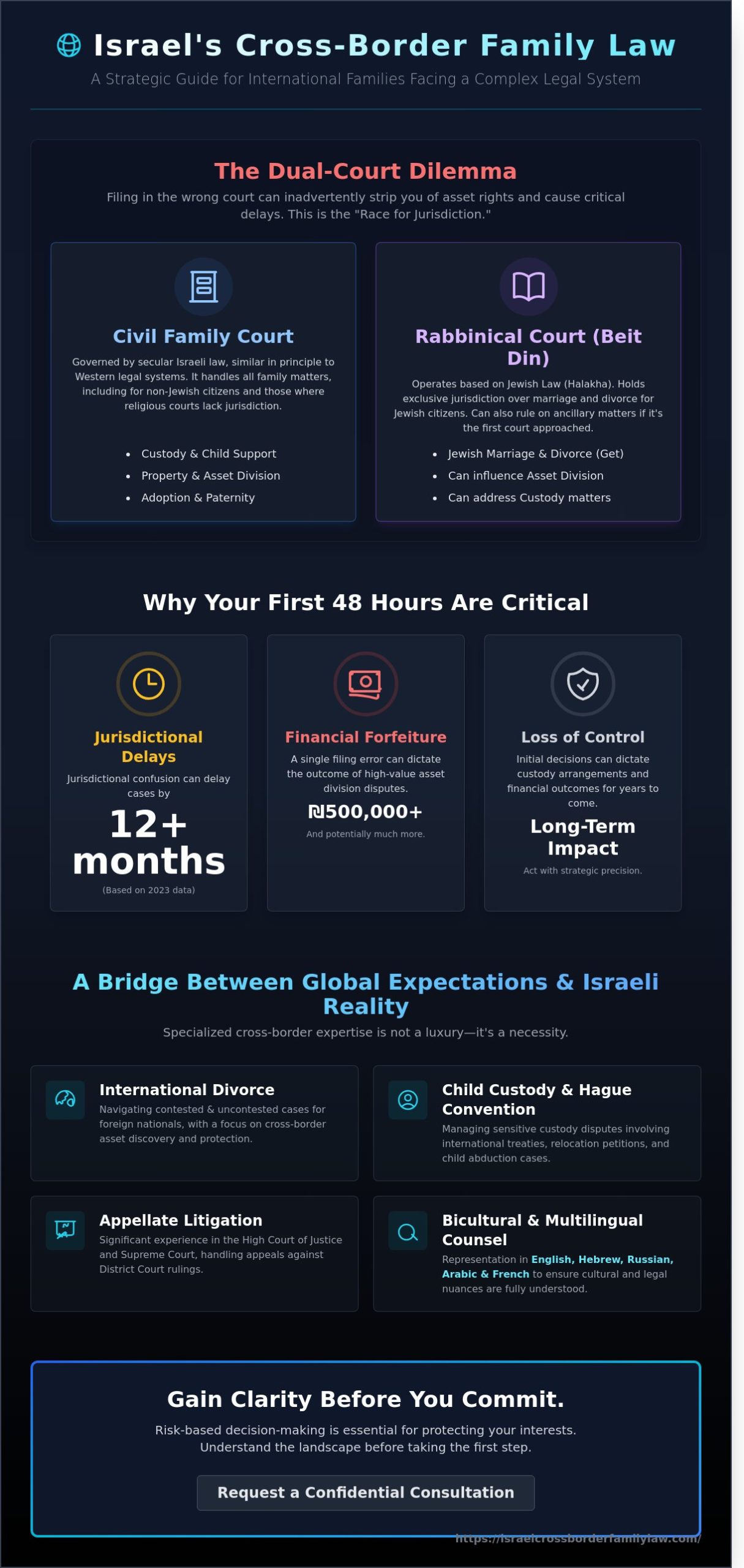
Did you know that filing a case in the wrong Israeli court could inadvertently strip you of rights to assets you’ve held for decades? Most international families expect a familiar legal framework but find themselves caught between the competing jurisdictions of Rabbinical and Civil courts. Language barriers and unfamiliar procedures can quickly turn a personal matter into a strategic minefield. It’s common to find the legal landscape complex, which is why Israel Cross Border Law Firm provides a bridge for those used to foreign systems. 2023 data shows jurisdictional confusion can delay cases by over 12 months.
This guide provides an objective overview of how Israel Cross Border Law Firm helps you manage these complexities, ensuring you understand the risks and opportunities inherent in cross-border litigation. You’ll learn about the firm’s specialized expertise in international family law and how their bicultural approach helps clients resolve the friction between global expectations and Israeli reality. We’ll walk through the essential steps for protecting your interests while managing the dual-court system. For more insights, you can also explore the Israel Family Law YouTube channel. Get clarity before you commit. Request a confidential consultation.
Key Takeaways
- Understand how specialized legal counsel helps international families manage the unique challenges of the Israeli legal landscape.
- Learn how the Segal Simchauve firm navigates complex cross-border divorce and child custody cases involving international treaties like the Hague Convention.
- Gain clarity on the dual-court system in Israel, specifically how the Rabbinical Court (Beit Din) interacts with the Civil Family Court.
- Discover why risk-based decision-making is essential for protecting your interests in multi-jurisdictional family law matters.
- Identify the critical questions to ask when evaluating whether a law firm possesses the bicultural understanding necessary for your specific case.
This article is published on an independent advisory platform and is not a law firm. The information provided is for educational purposes and does not constitute legal advice or an attorney-client relationship. Legal services are only provided by licensed attorneys under a separate engagement.
Understanding the Role of Segal Simchauve & Partners in Tel Aviv
Segal Simchauve & Partners operates as a specialized family law practice based in the heart of Tel Aviv. Led by partners Asi Segal and Shai Simchauve, the firm focuses on complex litigation that frequently involves high stakes and multi-jurisdictional elements. For foreigners dealing with IL courts, having a “team on the ground” isn’t just a convenience; it’s a strategic necessity. The Israeli legal system operates with unique procedural rules that can surprise those accustomed to Western courts. This review serves as an independent advisory overview to help you understand your options. It’s not legal advice.
The firm positions itself as a bridge between the “start-up nation” and global markets. They’ve built a reputation for advising clients through the intricate web of Israeli family law, which includes both civil and religious court components. This dual system often creates a “race for jurisdiction” that requires immediate, calculated action. Decisions made in the first 48 hours of a dispute can dictate the financial outcome for years to come.
A Focus on International and Anglo Families
The firm specifically addresses the needs of English speaking expats and international residents. Their team provides multilingual representation in English, Hebrew, Russian, Arabic, and French. This linguistic breadth helps bridge the gap between Western legal expectations and the specific realities of Israeli family courts. When families move between countries, they often face complex divorce and separation issues that require a nuanced understanding of both local laws and international treaties. Their bicultural approach ensures that clients don’t just hear a translation of the law, but understand the cultural context behind court rulings.
Litigation and Appellate Experience
Segal Simchauve maintains a significant presence in the High Court of Justice and various district courts across IL. Their experience includes handling intricate motions, petitions, and appeals in family matters. In a contested divorce, the quality of litigation often dictates the long term outcome of asset division or custody arrangements. Whether a case involves a ₪500,000 asset dispute or a complex jurisdictional challenge, the firm focuses on technical precision in the courtroom. They handle various aspects of family law, including:
- Appeals against District Court rulings in the Supreme Court.
- Petitions for stays of proceedings in international custody disputes.
- Complex motions for the discovery of hidden assets in cross-border cases.
- Defense against enforcement of foreign judgments within IL.
Get clarity before you commit. Request a confidential consultation.
This article is published on an independent advisory platform and does not constitute a law firm or an attorney-client relationship.
Core Specializations: International Divorce and Child Custody
The legal practice at Segal Simchauve focuses on the complex intersection of Israeli domestic law and international treaties. Families moving between jurisdictions face unique hurdles that traditional local firms often overlook. Early legal strategy isn’t just a recommendation; it’s a necessity. A single filing in the wrong court can permanently alter the outcome of a ₪500,000 asset division or a custody arrangement. Segal Simchauve provides the technical expertise required to manage these high-stakes variables before they become irreparable liabilities.
Navigating International Divorce in Israel
Handling divorce and separation for international families involves managing both contested and uncontested cases for foreign nationals living in Israel. Asset discovery is a critical component here, often involving private investigators to locate hidden property or offshore accounts that a spouse might try to shield. The Race to Jurisdiction in Israel occurs when one spouse files for divorce in the Rabbinical Court while the other files in the Family Court, as the first to file typically determines which legal system governs the division of assets and alimony.
Child Custody and International Relocation
Protecting parental rights in cross-border disputes requires a nuanced understanding of how Israeli judges evaluate the child’s best interest. Addressing international custody and relocation challenges means presenting a strategy that balances the desire to move with the legal right of the child to maintain a relationship with both parents. The firm assists clients in establishing legal remedies for visitation violations and identifying signs of parental alienation, which often intensify when parents live in different countries.
Hague Convention and Child Abduction
High-stakes cases involving the Hague Convention and Child Abduction demand immediate, decisive action. Within the Israeli legal framework, the Hague Abduction Convention is applied with strict adherence to timelines. When a child is moved across borders without consent, the urgency of seeking legal clarity cannot be overstated. Segal Simchauve has experience managing these sensitive situations where every day matters for the child’s eventual return. To understand the specific risks associated with your situation, you can get clarity before you commit by requesting a confidential consultation.
This article is published on an independent advisory platform and does not constitute an attorney-client relationship. Legal services are only provided by licensed attorneys under a separate engagement.
The Complexity of the Israeli Court System: Civil vs. Rabbinical
Israel’s legal landscape for family matters is unique because it operates under a dual-court system. Expats often find themselves caught between the Civil Family Court and the Rabbinical Court, known as the Beit Din Rabani. While both courts have the authority to settle disputes, they apply different principles. The Civil Court follows secular laws passed by the Knesset; the Rabbinical Court applies Halakha, or Jewish law. This intersection creates a complex environment where religious and civil authorities overlap, particularly regarding marriage and divorce.
Comparing Civil and Rabbinical Jurisdictions
The primary difference lies in how each court handles financial and personal matters. The Civil Family Court typically focuses on equitable distribution of assets and secular child support guidelines. In contrast, the Rabbinical Court holds exclusive jurisdiction over the act of divorce itself, known as the Gett. It also considers the Ketubah, the marriage contract, which may involve payments ranging from ₪18,000 to over ₪500,000 depending on the specific agreement. A firm like Segal Simchauve helps clients understand these distinctions, ensuring that rights are protected regardless of which door they enter. They manage proceedings by coordinating legal arguments that respect religious traditions while upholding civil rights.
The “Race to Jurisdiction” Strategy
In Israel, the “Race to Jurisdiction” is a critical tactical reality. The court that first receives a comprehensive claim usually gains the authority to rule on all related issues, including property division and alimony. Timing is everything. If one spouse files in the Rabbinical Court before the other files in the Civil Court, the entire trajectory of the case shifts. For international families, delaying action by even 24 hours can lead to a loss of strategic advantage. Early decisions impact long-term stability, especially when cross-border assets or foreign citizens are involved. Segal Simchauve provides the necessary oversight to help families determine which venue aligns with their specific goals.
Understanding these systems is vital for anyone living in the “start-up nation” who faces a family crisis. The interplay between religious laws and secular statutes requires a steady, knowledgeable guide to prevent costly errors.
Get clarity before you commit. Request a confidential consultation.
Strategic Considerations for Cross-Border Legal Matters
Standard legal advice often fails when a family’s life spans two or more countries. A lawyer focused only on local statutes might overlook how an Israeli court ruling impacts a US tax obligation or a custody agreement in New York. This narrow focus creates blind spots that can lead to expensive mistakes. Successful outcomes in these scenarios require risk-based decision-making that accounts for the friction between different legal systems. It’s about looking at the entire chess board, not just the immediate move.
Managing expectations is a core part of the process. Legal cultures in Israel differ significantly from those in the US or Europe. For example, the dual system of civil and religious courts creates a unique dynamic often called the “race to jurisdiction.” Firms like Segal Simchauve work to bridge this gap by coordinating with legal teams in other countries. This ensures that a strategy used in Tel Aviv doesn’t accidentally undermine a case pending in a foreign court. You need a team that acts as a translator between these two worlds, ensuring your global interests remain protected.
Enforcing Support and Financial Orders
Obtaining a court order for maintenance is only the first step. There are many challenges in cross-border child support enforcement that can stall the process for years. While Israel recognizes many foreign judgments under the 2007 Hague Convention, the technical requirements are strict. If an order isn’t drafted with Israeli enforcement standards in mind, the Enforcement and Collection Authority may refuse to process it. Protecting assets across borders requires a proactive strategy. This might include filing for temporary injunctions to prevent the liquidation of Israeli real estate while a foreign divorce is finalized. Using a firm like Segal Simchauve helps ensure that financial orders are actually collectible, rather than just being “paper wins.”
Wills and Inheritance for Foreigners
Inheritance matters become complex when assets are split between Israel and abroad. Under the Israeli Succession Law of 1965, the location of the asset often dictates which law applies. If you’re a beneficiary living outside of Israel, defending your rights requires a local representative who understands the nuances of the Israeli Registrar of Inheritance Affairs. Whether you’re contesting a will or defending one, the goal is to protect your rightful inheritance from local legal challenges that you might not even be aware of from 5,000 miles away. Professional guidance ensures your interests are represented in the Israeli court system without you needing to be physically present for every hearing.
Get clarity before you commit. Request a confidential consultation.
Moving Forward: How to Evaluate Your Legal Representation
Selecting the right legal advocate in Israel is a decision that impacts your financial future and family dynamics for years. While reading a Segal Simchauve review provides a helpful starting point, your evaluation must go deeper into the specific mechanics of cross-border law. You aren’t just hiring a person to speak in court. You’re choosing a partner to navigate a dual-court system where the Rabbinical and Civil tracks often overlap. Before committing to a firm, you should verify their specific experience with international treaties and bicultural communication.
- Does the firm have bicultural attorneys who understand both Israeli and Western legal expectations?
- Can they explain the specific risks of the “race to court” in your situation?
- Do they provide a clear breakdown of costs in Israeli Shekels (ILS)?
- How many cases have they handled involving the Hague Convention or foreign asset division?
Seeking Clarity and Strategy
There is a vital distinction between a litigator and a strategic advisor. A litigator focuses on the immediate battle in the courtroom. A strategic advisor looks at the entire map, including international assets and jurisdictional advantages. Data suggests that 85% of cross-border family cases in Israel involve jurisdictional disputes that require this high-level planning. Before you sign a retainer, you must understand the pricing and process involved in Israeli litigation. Initial retainers for complex family matters often start at ₪35,000 and can scale depending on the case’s complexity. You can find detailed guidance on these choices by watching the @IsraelFamilyLaw YouTube channel, which explains how to vet potential counsel effectively.
Next Steps for International Families
Confusion is the greatest risk in the Israeli legal market. Most expats feel overwhelmed by the Hebrew documentation and the aggressive pace of local proceedings. Moving from a state of uncertainty to a structured plan requires a confidential review of your specific facts. This independent perspective helps you weigh the pros and cons of different firms, including Segal Simchauve, without the pressure of immediate litigation. You don’t have to navigate this complex environment alone. Professional guidance ensures your first move isn’t your last mistake.
Get clarity before you commit. Request a confidential consultation.
Securing Your Family’s Future in the Israeli Legal Landscape
Navigating the “race to court” between the Family Court and the Rabbinical Court requires a strategic approach. Decisions made in the first 24 to 48 hours of a legal dispute often dictate the trajectory of a case for years. For international families, these jurisdictional conflicts can lead to significant financial strain if handled without specialized oversight. Engaging with Segal Simchauve provides the authoritative guidance needed to bridge the gap between US and Israeli legal expectations. This independent advisory helps expats and Anglos understand the nuances of the 1980 Hague Convention and cross-border asset division before they commit to a permanent legal path. It’s essential to make choices based on rigorous risk assessment rather than impulse. You don’t have to navigate these multi-jurisdictional complexities alone. Professional support ensures your strategy aligns with both local regulations and international standards. Taking the right steps now prevents the common pitfalls that many international families face in the Israeli system.
Get clarity before you commit. Request a confidential consultation today to protect your family’s interests.
This article is published on an independent advisory platform and is not a law firm. The content provided is for informational and advisory purposes only and does not create an attorney-client relationship. Legal services are only provided by licensed attorneys under a separate, formal engagement.
Frequently Asked Questions
Is Segal Simchauve a law firm or an advisory platform?
Segal Simchauve operates as an independent advisory platform rather than a traditional law firm. It focuses on providing strategic guidance and international case management for families navigating the Israeli legal system. While reading Segal Simchauve reviews, you’ll find that the platform helps clients build a strategy before they engage a licensed litigator for courtroom representation.
Can an English-speaking expat get a fair trial in the Rabbinical courts?
Expats can receive a fair trial, but the procedural environment follows Halakhic law which differs significantly from Western civil standards. All proceedings occur in Hebrew, and the 1953 Rabbinical Courts Jurisdiction Law governs the process. You’ll need a bilingual advocate to ensure the three-judge panel correctly interprets your testimony and cultural context during the hearing.
How does the Hague Convention work for child custody in Israel?
The Hague Convention functions as a procedural mechanism to return children to their country of “habitual residence” after a wrongful removal. Israel has been a signatory since 1991 and treats these cases with extreme urgency. The Israeli Family Court typically aims to reach a final decision within 42 days of the initial filing to minimize the child’s displacement.
What is the “Race to Jurisdiction” in Israeli divorce law?
The “Race to Jurisdiction” occurs when one spouse files for divorce in the Rabbinical Court while the other files in the Family Court. Under Israeli law, the court where the valid claim is filed first generally gains the authority to decide on related issues like property division and alimony. This initial filing can influence the eventual distribution of marital assets by 15% to 30% depending on the venue.
Can I enforce a US child support order if the payer lives in Israel?
You can enforce a US order by filing for the recognition of a foreign judgment under the 1958 Law for the Enforcement of Foreign Judgments. Once the Israeli court confirms the order, you can utilize the Enforcement and Collection Authority (Reshut Ha’achifa Ve’hagviya) to collect funds. The opening fee for such a file at the enforcement office is approximately ₪254 plus applicable percentages of the debt.
Do I need a bicultural lawyer for my cross-border case?
A bicultural lawyer is essential because they understand the specific nuances of both the Israeli and foreign legal systems. Segal Simchauve emphasizes this because roughly 25% of international cases encounter delays due to misunderstandings about foreign assets like 401(k) plans or offshore trusts. A lawyer who speaks both languages fluently ensures that your financial interests aren’t lost in translation during court reporting.
What happens if I sign a legal document in Israel that I don’t fully understand?
If you sign a document in Israel, the law presumes you’ve read, understood, and agreed to every word. Courts rarely void a contract based on a language barrier alone, citing the “Heavy Burden of Proof” on the person who signed it. You should never sign a “Zichron Devarim” or any settlement agreement without a written translation and a consultation with your own advisor.
How long does a contested divorce typically take in the Israeli Family Court?
A contested divorce in Israel usually lasts between 14 and 24 months from the initial filing to the final judgment. If the case involves complex business valuations or international custody disputes, the timeline can extend beyond 30 months. Engaging in mandatory mediation (Mahut) sessions at the start can sometimes resolve disputes in under 4 months, significantly reducing legal costs.
Get clarity before you commit. Request a confidential consultation.
For more information on navigating the Israeli legal system, visit our YouTube channel: https://www.youtube.com/@IsraelFamilyLaw

Article by
Gabriel Lior
A Personal Journey That Became a Mission
The advisory was founded by an American father Gabriel Lior, LLB, MBA , global entrepreneur, and cross-border advisor who spent more than a decade navigating the Israeli family court system firsthand and now lives in Singapore with his son.
As a divorced parent in a cross-border family, Gabriel faced nearly every legal challenge a foreign parent can encounter in Israel — including child custody disputes, child support proceedings, property matters in Israel and abroad, false accusations, and complex immigration and relocation proceedings.
Over the years, he learned the hard way how difficult it is for non-Israeli parents to understand the system, identify the right legal strategy, and choose the right legal representation — especially when language, culture, and jurisdictional differences are involved. He also witnessed how foreign parents and new immigrants are often disadvantaged or taken advantage of by service providers and institutions simply because they lack local knowledge or fluency.
From Client to Advisor
To truly understand — and survive — the system, Gabriel pursued formal legal education in Israel, completing two Israeli law degrees, alongside a BA and MBA earned in the United States. This was never about becoming a practicing attorney, but about gaining a deep, structural understanding of how the system works — and where it breaks down for foreign parents.
This rare combination of:
Firsthand client experience
Israeli legal and US business education
International business and negotiation training
Decades of commercial execution
created a unique perspective – one that understands both sides of the table.
After years of litigation, persistence, and at times self-representation, he ultimately succeeded in securing custody of his son and relocating abroad through a rare legal victory in the Israeli Supreme Court — becoming one of the first fathers in Israel to do so under these circumstances.
Disclaimer
Important Disclaimer:
The information provided on this website and in its content is for general informational and educational purposes only and does not constitute legal advice, legal opinion, or legal representation.
Gabriel Lior is not licensed to practice law in Israel (nor is he interested in doing so) and does not provide legal services, despite having completed 2 Law Degrees. The services offered are advisory in nature and are intended to provide general guidance, strategic insight, and information regarding cross-border family law considerations.
No attorney-client relationship is formed by accessing this website, reading its content, or communicating with us.
Any decisions made based on this information are at your own discretion and risk. For legal advice specific to your situation, you should consult a licensed attorney in the relevant jurisdiction.
Where appropriate, we may refer clients to independent, licensed attorneys or professionals. Such referrals do not constitute legal representation and no liability is assumed for services provided by third parties.