What if you could present your case in an Israeli courtroom without the logistical burden of international travel? Many expats and international families believe that testifying from abroad in israeli family court is a last resort that inevitably weakens their standing. It’s understandable to feel that a remote appearance might hurt your credibility or that the technical requirements are simply too complex to manage from another country.
This guide offers a clear look at the legal framework and strategic implications of giving remote testimony. You’ll gain a better understanding of how to obtain court permission, the specific technical standards for video conferencing, and how to prepare for cross-examination from your home jurisdiction. We’ll break down the shift in judicial attitudes and the practical steps required to satisfy the court’s expectations. Please note that this information is published on an independent advisory platform, not a law firm, and focuses on strategy and risk management rather than formal legal representation. We’ll explore how to navigate these multi-jurisdictional complexities so you can make informed decisions about your case before you commit to a specific course of action.
Key Takeaways
- Explore the modern legal framework under Regulation 72 that defines how evidence is formally collected through secure technological visual links in Israeli proceedings.
- Compare the traditional requirements of testifying at an Israeli Consulate with the specific technical standards and flexibility of modern video conferencing.
- Understand the strategic implications of testifying from abroad in israeli family court, specifically how remote presence affects a judge’s perception of your credibility and demeanor.
- Learn how to manage the unique technical hurdles of a digital hearing, including the swearing-in process and conducting a dry run to ensure audio and lighting quality.
- Recognize why making early strategic decisions regarding your testimony method is vital for managing the inherent risks and complexities of cross-border litigation.
The Legal Basis for Testifying from Abroad in Israel
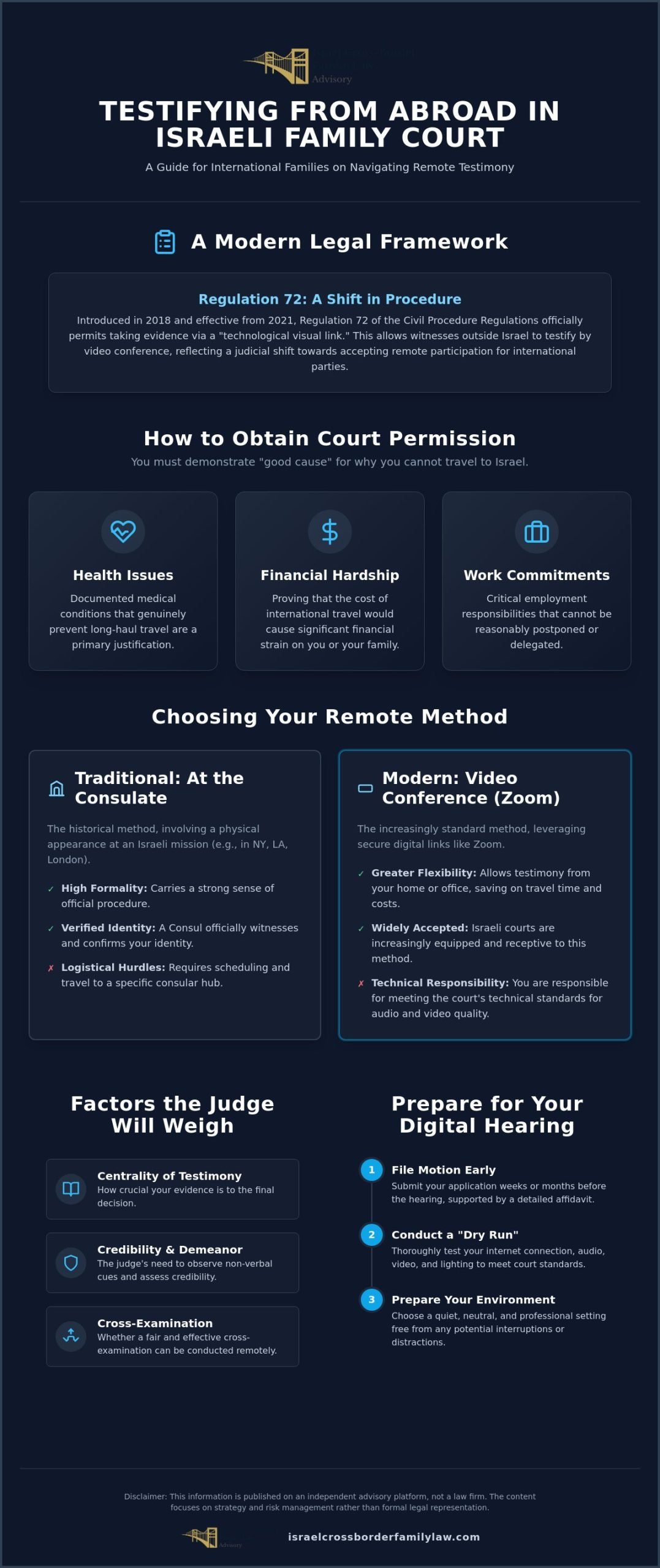
The foundation for testifying from abroad in israeli family court changed significantly with the introduction of the Civil Procedure Regulations in 2018, which became effective on January 1, 2021. Regulation 72 specifically addresses the “taking of evidence by means of a technological visual link.” This regulation allows a witness or party located outside of Israel to provide testimony via video conference, provided certain legal and technical conditions are met. While the court previously preferred physical presence, the digitalization of the Ministry of Justice and the impact of global travel disruptions have made judges increasingly receptive to remote participation for international parties.
To better understand the atmosphere and expectations of these proceedings, watch this helpful video:
The court doesn’t grant remote testimony as an automatic right. You must demonstrate “good cause” for staying abroad. This usually involves proving that traveling to Israel would cause genuine hardship. Common justifications include documented health issues that prevent long-haul travel, significant financial burdens, or employment obligations that cannot be reasonably set aside. When evaluating these requests, judges apply specific rules of evidence to ensure the integrity of the proceeding remains intact despite the physical distance. This shift reflects a broader trend toward recognizing the multi-jurisdictional complexity inherent in modern family life.
Criteria the Judge Will Consider
Judges carefully weigh the nature of the testimony before approving a remote link. If your testimony is central to the case and requires the judge to closely observe non-verbal cues, the court might be more hesitant. They also consider whether an effective cross-examination can be conducted via a digital platform. If the other party objects, the judge will look for a balance between your personal hardship and the opponent’s right to a fair trial. Consent from both sides often simplifies the process, but the final decision always rests with the court’s discretion.
The Application Process
Timing is a critical factor in your strategy. You should file your motion to testify remotely weeks or even months before the scheduled hearing. This application must be supported by detailed affidavits explaining your circumstances and the reasons you cannot travel. A common reason for denial is a vague or late request that doesn’t provide enough evidence of hardship. For those managing cases for expats and foreign nationals, early preparation helps mitigate these risks and ensures the court has sufficient time to coordinate the technical requirements through the “Net HaMishpat” system. Taking these steps early allows you to focus on the content of your testifying from abroad in israeli family court rather than last-minute procedural hurdles.
Consulate vs. Zoom: Choosing Your Remote Method
Once the court grants permission for testifying from abroad in israeli family court, the focus shifts to the specific method of delivery. Historically, the Israeli legal system relied exclusively on the “consular route,” which involves the witness appearing physically at an Israeli mission. Today, however, the modern digital link is becoming the standard. Choosing between these two paths requires a balance of logistical ease and the preservation of your legal standing. While a judge may technically accept either, the degree of supervision and the formality of the environment can influence how your testimony is perceived during cross-examination.
Testifying at the Israeli Consulate
In the traditional route, you must schedule an appointment at a major hub like New York, Los Angeles, or London. The Consul acts as an official witness to your identity, ensuring that the person speaking is indeed the party named in the suit. This method carries a high level of formality, making it difficult for the opposing party to raise “credibility” objections based on the environment. However, this path is often constrained by limited administrative slots and strict fees. As of 2026, the standard fee for authenticating an affidavit at an Israeli mission is $18 or €16, with additional services priced at $9 or €8. You must also factor in the travel time to the consulate itself, which can be significant depending on your location.
Digital Testimony (Zoom/Video Link)
The modern alternative involves a secure video link, typically conducted through Zoom or Skype. Unlike a casual video call, these hearings are accessed through the “Net HaMishpat” court system and require a high-speed internet connection and a neutral, quiet background. Israeli regulations generally require participants to join from a computer rather than a mobile phone to ensure stability and a clear view of the witness. To further bolster the integrity of the process, it’s often advisable to have a local lawyer or notary present at your remote site to verify that no unauthorized persons are in the room. This method is particularly useful when navigating U.S.-Israel child support agreements or other complex matters where physical travel is impossible.
Time zone differences present a consistent hurdle. If you’re located on the U.S. East Coast, Tel Aviv is seven hours ahead, meaning a morning hearing in Israel might require you to be online at 2:00 AM. Managing these shifts in energy and focus is a strategic necessity. Because every choice in a cross-border case carries long-term weight, you should speak with an advisor to determine which method aligns best with your specific goals and the judge’s expectations. This early decision-making process is vital to ensuring your testimony is given the full weight it deserves without unnecessary technical or administrative delays.
Strategic Pros and Cons of Remote Testimony
Choosing to testify via video link involves more than just skipping a flight; it’s a strategic decision that directly affects how a judge perceives your truthfulness. In the Israeli family court system, judges rely heavily on “demeanor” to assess credibility. When testifying from abroad in israeli family court, the visual and auditory “flattening” of a screen can mask subtle cues like breathing patterns, slight hesitations, or micro-expressions that a judge would typically notice in person. This distance can sometimes make it harder for you to build a personal connection or project sincerity to the court.
There is also a significant psychological component to consider. Being in your own home or office provides a familiar, controlled environment that can lower your stress levels during a difficult cross-examination. This comfort often leads to clearer, more composed answers. However, this same lack of “courtroom gravity” can backfire if your tone appears too casual or detached. You must maintain the same level of formality you would show if you were standing in a Tel Aviv courtroom. Additionally, technical glitches present a unique risk. If your connection drops or lags exactly when you’re asked a challenging question, a judge might interpret the delay as “stalling” or an attempt to evade the answer, even if the issue is purely mechanical.
Impact on Credibility and Cross-Examination
Cross-examination over video often feels slower due to the natural lag in digital communication. This rhythm can actually work in your favor by giving you an extra second to process questions. To maintain credibility, you must practice looking directly into the camera lens rather than at the judge’s face on your screen. This creates the illusion of eye contact for the court. Handling evidence also requires advanced planning; you won’t be able to physically hand a document to the judge. Every exhibit must be digitally organized and pre-filed to ensure you can reference it instantly without fumbling with files, which can make you look unprepared or dishonest.
Cost-Benefit Analysis for Expats
For many, the decision comes down to a simple trade-off between financial cost and judicial engagement. While saving thousands of dollars on airfare and hotels is a clear advantage, you must weigh this against the potential “cost” of a judge feeling less personally invested in your testimony. In high-stakes scenarios, such as intense custody battles or complex asset divisions, the physical presence of a party can often carry more weight. We frequently advise clients to look at the specific nuances of their case through our resources for expats and foreign nationals to determine if the risk of remote testimony is worth the logistical convenience. Deciding whether to travel is one of the most impactful early choices you’ll make in your case strategy.
Preparing for Your Day in (Digital) Court
Success in testifying from abroad in israeli family court depends on meticulous preparation that goes beyond just knowing your facts. You must treat the digital space with the same reverence as a physical courtroom. This starts with drafting a “technical protocol” for the court’s approval. This document outlines exactly how the link will be established, who will be present at the remote site, and how exhibits will be displayed. It’s a proactive step that demonstrates your commitment to the integrity of the proceedings and helps prevent the opposing side from claiming the setup is unfair.
Managing the swearing-in process from a foreign jurisdiction requires specific attention to detail. Since you aren’t physically in Israel, the judge or a local notary at your location must verify your identity before you’re sworn in. If you aren’t fluent in Hebrew, an official interpreter will be involved. This adds another layer of complexity to the rhythm of the hearing. You’ll need to coordinate with your legal team to ensure the interpreter is properly briefed on the technical setup so that communication remains fluid. Remember that this content is published on an independent advisory platform, and these steps are part of a broader strategy to manage the risks of remote litigation.
The Technical Setup
Hardware choice isn’t just about convenience; it’s a procedural requirement. Israeli courts generally expect participants to use a laptop or desktop computer rather than a mobile phone. A stable, wired internet connection is always preferable to Wi-Fi to prevent embarrassing lags that could be misinterpreted by the judge. Privacy is non-negotiable. You must be alone in a quiet room, and the court may ask you to rotate your camera to prove no one is coaching you off-screen. Before the hearing, agree on emergency procedures with your team. If the connection drops, you should have a pre-arranged phone number to call the court’s secretariat or your counsel immediately.
Behavioral Guidance for Video Hearings
Your appearance should reflect the formality of an Israeli family court. Dress modestly and professionally, as if you were walking into the courthouse in Jerusalem or Tel Aviv. One of the biggest challenges is the digital lag. Always wait two full seconds after a question is asked before you begin your answer. This allows the audio to catch up and gives the interpreter time to finish their translation. For visual examples of how these hearings look and feel, you can visit the Israel Family Law YouTube channel. Because the technical and procedural requirements are so specific, it’s helpful to reach out for a strategy session to ensure your setup meets the court’s high standards.
Navigating the Complexity of Cross-Border Litigation
The choice of testifying from abroad in israeli family court is rarely an isolated event; it’s the culmination of a much larger jurisdictional strategy. Every decision made at the beginning of a case, from the way you respond to the initial summons to how you frame your residency status, influences whether a judge will ultimately permit a remote link. If you fail to address these issues early, you may find yourself forced to choose between an expensive flight to IL or forfeiting your right to be heard in court. Remote testimony is a tool for managing complexity, but it cannot fix a fundamentally flawed legal position.
The intersection of IL law and international treaties, such as the Hague Convention, adds significant difficulty to these proceedings. These frameworks often dictate where a case should be heard and how evidence must be collected across borders. A unified strategy between your US and IL legal advisors is essential to ensure that the testimony you provide remotely doesn’t inadvertently create contradictions in your local jurisdiction. Without this coordination, you risk falling into “jurisdictional traps” where a decision in an IL family court could have unintended consequences for your assets or custody rights in the United States.
The Weight of Early Decisions
Your initial response to a lawsuit often dictates your ability to testify remotely months later. If you inadvertently submit to the court’s jurisdiction without the proper procedural safeguards, you might lose the leverage needed to request a digital hearing. This is particularly relevant in high-stakes cases involving International Custody & Relocation, where the physical location of the parties is a central point of contention. US citizens often assume that their domestic legal protections will follow them into an IL courtroom, but the two systems operate under very different cultural and legal standards. Seeking clarity on these differences before you commit to a specific path is vital.
Next Steps for International Parties
Before moving forward, you should carefully review your case to determine if you meet the specific eligibility requirements for remote testimony under the 2026 regulations. This involves consulting with an advisor who understands the specific friction points between US and IL law. Please be aware that this content is published on an independent advisory platform and is intended for informational and strategic purposes only. It does not constitute legal representation or formal legal advice, which can only be provided by a licensed attorney under a separate engagement. Focusing on decision-making guidance now can prevent costly procedural errors later in the process.
Get clarity before you commit. Request a confidential consultation.
Securing Your Standing in a Digital Courtroom
Successfully testifying from abroad in israeli family court requires more than just a stable internet connection. It demands a proactive approach to Regulation 72 and a clear choice between the formality of an Israeli Consulate and the flexibility of a private digital link. You’ve seen how early decisions regarding your testimony method carry significant weight, impacting both the judge’s perception of your credibility and the overall rhythm of your cross-examination. By prioritizing technical precision and strategic coordination between your US and IL advisors, you can navigate these multi-jurisdictional hurdles with confidence.
As an independent cross-border advisory specialized in Anglo/Expat needs, we focus on strategic risk management rather than just paperwork. We bring experience to complex US-Israel family law disputes, helping you avoid jurisdictional traps that could jeopardize your case. This content is published on an independent advisory platform, not a law firm, and focuses on strategy rather than an attorney-client relationship. While the process is complex, the right preparation ensures your voice is heard without the need for international travel.
Get clarity before you commit. Request a confidential consultation today to review your case’s remote eligibility. You don’t have to navigate these differences between legal systems alone.
Frequently Asked Questions
Can the judge force me to fly to Israel if I have requested to testify remotely?
Yes, the court retains full discretion to deny your request and require your physical presence. While judges are increasingly open to remote links, they may force you to travel if they believe the case’s complexity or your credibility requires in-person observation. You must prove “good cause,” such as medical issues or extreme financial hardship, to justify staying abroad. If the judge isn’t convinced, you’ll need to decide between traveling or potentially losing the opportunity to testify.
Is testimony given via Zoom considered as legally binding as in-person testimony?
Yes, testimony via video link is fully binding and holds the same legal weight as in-person statements. Under the 2021 updates to the Family Court Regulations, a digital hearing is a formal legal proceeding. When testifying from abroad in israeli family court, you’re under oath, and any false statements carry the same legal consequences as if you were standing in the courtroom in Tel Aviv. The integrity of the record is maintained through the “Net HaMishpat” system.
Do I need a lawyer present with me in the US while I testify for an Israeli court?
While IL law doesn’t strictly mandate a local lawyer’s presence, having a notary or legal professional with you is a strong strategic move. This individual can formally verify your identity to the judge and confirm that you aren’t being coached by anyone off-camera. This setup minimizes the risk of the opposing party challenging the validity of your testimony. It’s a proactive way to maintain the “courtroom gravity” required for a successful remote appearance.
What happens if the internet connection fails during my cross-examination?
If your connection fails, the judge will typically pause the proceedings until the link is restored. You should have an emergency protocol in place, including a direct phone number for the court’s secretariat. However, frequent technical issues can be detrimental. A judge might interpret repeated drops as an attempt to evade difficult questions during cross-examination. This is why using a wired connection and a reliable computer is essential for testifying from abroad in israeli family court.
How much does it cost to testify from an Israeli Consulate in the US?
As of July 2026, the Israeli Consulate charges a standard fee of $18 for the authentication of an affidavit. If you require additional notarial services during the same visit, the rate is $9. These are government administrative fees and don’t include any costs for your own legal advisors or travel to the mission. Scheduling these appointments early is vital, as slots at busy consulates like New York or Los Angeles are often limited.
Can I testify in English, or must I have an interpreter?
You may testify in English, but the official court record will be in Hebrew. Since Hebrew is the language of the court, you’re entitled to a certified interpreter who will translate the judge’s questions and your responses. Any documents you reference must also be accompanied by notarized Hebrew translations. This process adds time to the hearing, so you must practice pausing to allow the interpreter to finish before you continue speaking.
Will testifying from abroad make me look less committed to my child custody case?
It’s a strategic risk that must be managed carefully. In high-stakes custody cases, some judges feel that a parent’s physical presence demonstrates a higher level of commitment to the child’s welfare. However, the court also recognizes modern realities like flight cancellations or security concerns. If you can provide a clear, documented reason for your absence, you can mitigate this perception. The focus should remain on the quality and sincerity of your evidence.
Is there a specific form I need to fill out to request remote testimony?
There isn’t a single “standard form” for this request. Instead, your legal team must file a formal motion or application to the court. This filing must include detailed affidavits that explain your specific circumstances and why traveling to IL constitutes a genuine hardship. Because the court’s secretariat reviews these applications case-by-case, your request should be filed weeks in advance to allow for technical coordination and potential objections from the other party.
Disclaimer: This content is published on an independent advisory platform and focuses on strategy, risks, and decision-making guidance. It does not constitute legal representation or formal legal advice. Legal services are only provided by licensed attorneys under a separate engagement.
Get clarity before you commit. Request a confidential consultation.

Article by
Gabriel Lior
A Personal Journey That Became a Mission
The advisory was founded by an American father Gabriel Lior, LLB, MBA , global entrepreneur, and cross-border advisor who spent more than a decade navigating the Israeli family court system firsthand and now lives in Singapore with his son.
As a divorced parent in a cross-border family, Gabriel faced nearly every legal challenge a foreign parent can encounter in Israel — including child custody disputes, child support proceedings, property matters in Israel and abroad, false accusations, and complex immigration and relocation proceedings.
Over the years, he learned the hard way how difficult it is for non-Israeli parents to understand the system, identify the right legal strategy, and choose the right legal representation — especially when language, culture, and jurisdictional differences are involved. He also witnessed how foreign parents and new immigrants are often disadvantaged or taken advantage of by service providers and institutions simply because they lack local knowledge or fluency.
From Client to Advisor
To truly understand — and survive — the system, Gabriel pursued formal legal education in Israel, completing two Israeli law degrees, alongside a BA and MBA earned in the United States. This was never about becoming a practicing attorney, but about gaining a deep, structural understanding of how the system works — and where it breaks down for foreign parents.
This rare combination of:
Firsthand client experience
Israeli legal and US business education
International business and negotiation training
Decades of commercial execution
created a unique perspective – one that understands both sides of the table.
After years of litigation, persistence, and at times self-representation, he ultimately succeeded in securing custody of his son and relocating abroad through a rare legal victory in the Israeli Supreme Court — becoming one of the first fathers in Israel to do so under these circumstances.
Disclaimer
Important Disclaimer:
The information provided on this website and in its content is for general informational and educational purposes only and does not constitute legal advice, legal opinion, or legal representation.
Gabriel Lior is not licensed to practice law in Israel (nor is he interested in doing so) and does not provide legal services, despite having completed 2 Law Degrees. The services offered are advisory in nature and are intended to provide general guidance, strategic insight, and information regarding cross-border family law considerations.
No attorney-client relationship is formed by accessing this website, reading its content, or communicating with us.
Any decisions made based on this information are at your own discretion and risk. For legal advice specific to your situation, you should consult a licensed attorney in the relevant jurisdiction.
Where appropriate, we may refer clients to independent, licensed attorneys or professionals. Such referrals do not constitute legal representation and no liability is assumed for services provided by third parties.