For foreign nationals confronting sensitive family law matters in Israel, the legal landscape can appear uniquely complex and intimidating. The existence of a parallel system, with both civil and religious courts, frequently creates significant uncertainty, raising critical questions about jurisdiction and whether your rights will be adequately protected within a foreign legal framework. This ambiguity is precisely why a comprehensive understanding of the israeli family court is not merely beneficial-it is essential for safeguarding your interests in sophisticated, multi-jurisdictional disputes. This definitive guide is engineered to provide that clarity. We will deliver a detailed examination of the court’s fundamental structure, its specific jurisdiction over international and cross-border cases, and the procedural steps involved from initiation to final resolution. By demystifying the crucial distinctions between the Family Court and the Rabbinical Courts, this article will empower you with the strategic knowledge required to confidently navigate your legal proceedings and make fully informed decisions about your case.
Key Takeaways
- Understand the critical distinction between Israel’s civil Family Courts and its religious courts to determine the correct jurisdiction for your cross-border family law matter.
- Identify which specific legal issues, from child custody to complex property disputes, fall under the exclusive jurisdiction of the Israeli Family Court.
- Gain a clear, procedural roadmap of the litigation process, from filing an initial claim to final judgment, allowing you to confidently navigate the proceedings.
- Anticipate the unique challenges and multi-jurisdictional complexities that foreign nationals face, including the application of international treaties and the enforcement of foreign judgments.
Israel’s Dual System: Understanding the Family Court vs. The Rabbinical Court
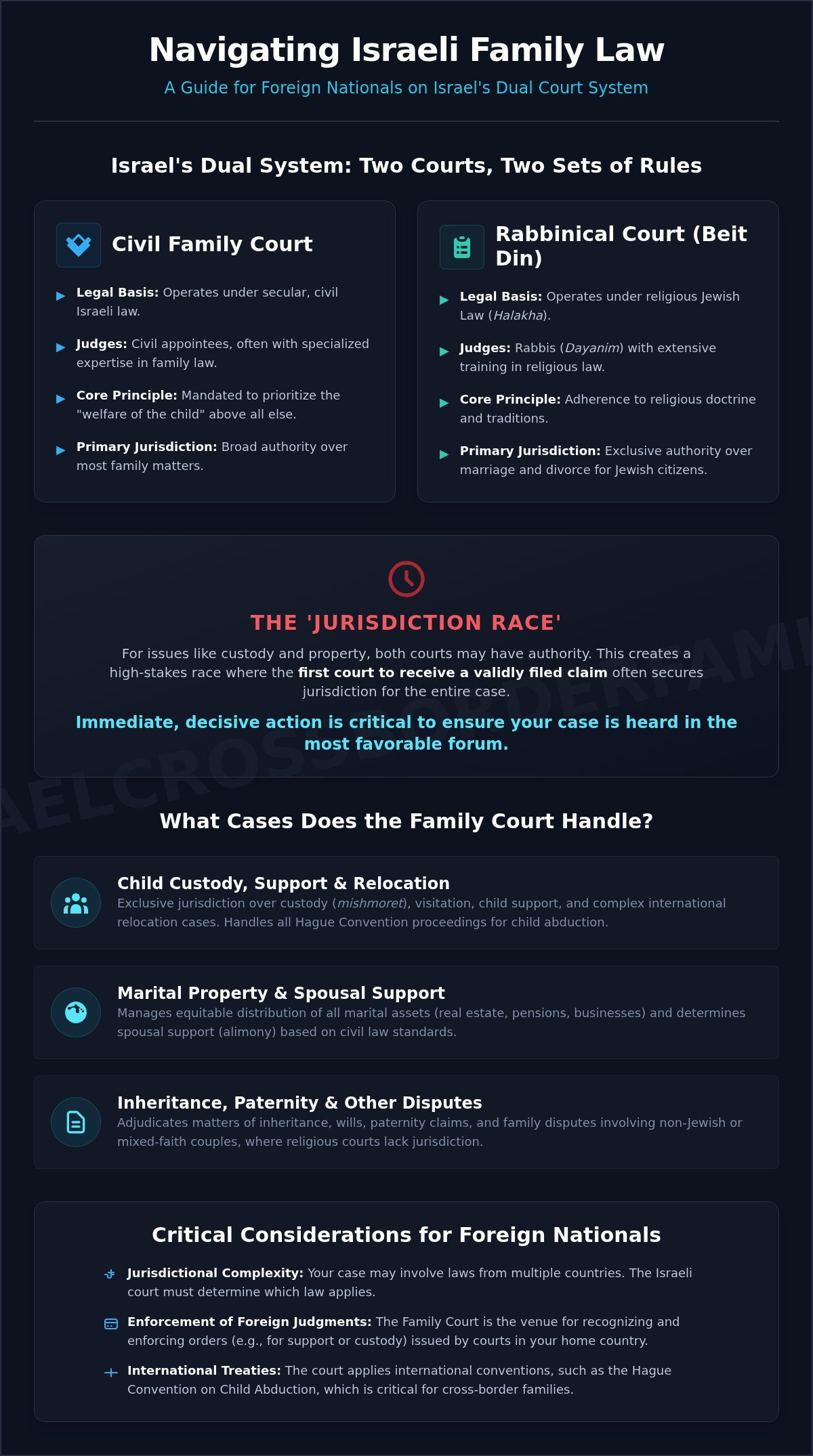
Israel’s legal framework for personal status matters presents a complex landscape that is often a significant source of confusion for international clients and foreign nationals. Unlike many Western countries, Israel operates a dual system where two parallel judicial bodies-the civil Family Courts and the religious courts-hold authority over family law. This unique structure means that the choice of venue is not merely a procedural step but a critical strategic decision that can fundamentally impact the outcome of a case. To better understand the procedural nuances involved, the following video provides a helpful overview:
The Role and Authority of the Family Court
The israeli family court system was established as a secular, civil institution designed to handle the broad spectrum of family-related legal issues. Its jurisdiction is extensive, covering matters such as child custody, spousal and child support, equitable distribution of property, and inheritance. Operating under the principles of Israeli civil law, these courts are mandated to prioritize the welfare of the child above all other considerations. Judges are civil appointees, typically with specialized expertise and significant experience in family law.
The Role and Authority of the Rabbinical Court (Beit Din)
In parallel, the Rabbinical Court, or Beit Din, operates as a religious tribunal under the authority of Jewish Law (Halakha). As part of the wider Israeli Judicial System, this court holds exclusive jurisdiction over the marriage and divorce of Jewish citizens. While its primary mandate is narrow, its authority can be expanded to include ancillary matters like property division and support if both parties grant their consent. Its judges, known as Dayanim, are rabbis with extensive training in religious law, not necessarily in civil jurisprudence.
The ‘Jurisdiction Race’: Why Filing First Matters
A critical and often perilous feature of this dual system is the concept of concurrent jurisdiction. For many issues ancillary to divorce, such as child custody and asset division, both the Family Court and the Rabbinical Court may have the authority to adjudicate. This creates a high-stakes ‘race to the courthouse,’ where the court that first receives a validly filed claim often secures jurisdiction for the entire case. This strategic imperative underscores the critical need for immediate, decisive action and expert legal counsel to ensure your case is heard in the most favorable forum.
Jurisdiction: What Specific Cases Does the Israeli Family Court Handle?
The israeli family court possesses broad and comprehensive jurisdiction over a wide spectrum of family-related legal disputes. As the state’s primary civil forum for these matters, it is empowered to adjudicate complex personal and financial conflicts. A critical feature of the Israeli system is the distinction between matters where the Family Court has exclusive authority and those where it shares concurrent jurisdiction with religious tribunals, most notably the Rabbinical Court. Understanding this division is fundamental to developing an effective legal strategy, particularly for international families with multi-jurisdictional concerns.
Child Custody, Support, and Relocation
The court holds exclusive jurisdiction over all matters concerning minors under Israel’s civil law. This authority encompasses adjudicating physical custody (mishmoret), legal guardianship, and detailed visitation schedules (hesderei re’iya). It determines child support amounts based on civil law standards and is the designated forum for navigating complex cases of international custody and relocation. Furthermore, it exclusively handles Hague Convention proceedings involving international child abduction, a critical function for cross-border families.
Division of Marital Property and Spousal Support (Alimony)
A significant portion of the court’s mandate involves the equitable distribution of all assets and liabilities accumulated during a marriage. This includes high-value and complex assets such as real estate, pensions, stock options, and business interests. The court also rules on claims for spousal support based on established criteria like financial need and earning capacity. This area represents a key sphere of concurrent jurisdiction, allowing Jewish couples to choose whether to litigate these financial matters in the civil Family Court or the Rabbinical Court.
Other Family Matters
The extensive mandate of the israeli family court also covers a diverse range of other critical family law issues. These proceedings require sophisticated legal guidance to navigate correctly and include:
- Paternity suits, adoption proceedings, and inheritance disputes.
- Petitions for restraining orders and other protections related to domestic violence.
- Cases concerning the validity and enforcement of prenuptial and postnuptial agreements.
- Complex matters of divorce and separation for international families, which often proceed in parallel with, or are influenced by, concurrent proceedings in the Rabbinical Court.
The Court Process: A Step-by-Step Guide for Foreign Litigants
For foreign nationals, the procedural landscape of the israeli family court can appear formidable and complex. A clear understanding of the chronological progression of a case is paramount for strategic planning and managing expectations in high-stakes international disputes. This guide provides a structured overview of the typical litigation path, from the initial filing to a final judgment, demystifying the key stages and the roles of various professionals involved.
Filing a Claim and Initial Procedures
Litigation formally commences when the claimant files a comprehensive Statement of Claim (Ktav Tvi’a), which must meticulously detail the factual background, legal arguments, and specific relief sought. Following this submission, the claimant is legally obligated to serve the documents upon the defendant, a critical step governed by strict domestic and international procedural rules. The defendant is then allotted a specific timeframe to file a detailed Statement of Defense (Ktav Hagana), responding directly to the allegations. Strict adherence to these deadlines is imperative.
The Role of the Family Court Assistance Unit
A distinctive and integral feature of the system is the Family Court Assistance Unit (Yechidat HaSiyua). In most disputes, the court mandates that parties attend preliminary meetings with this unit before litigation can proceed. Staffed by qualified social workers and psychologists, its primary objective is to de-escalate conflict and explore avenues for settlement outside the courtroom. This confidential process is designed to help families, especially those with children, reach mutually acceptable agreements, thereby avoiding the significant financial and emotional costs of a full trial.
Hearings, Evidence, and Judgment
If settlement through the Assistance Unit is not achieved, the case proceeds to formal judicial hearings. The process typically includes:
- Pre-Trial Hearings (Kdam Mishpat): The judge holds conferences to define the contested issues, set schedules, and manage the case’s trajectory toward resolution.
- Discovery Process: Parties engage in the formal exchange of relevant documents, affidavits, and other information critical to their respective cases.
- Evidentiary Hearing (Hokhahot): This is the main trial where witnesses testify, present evidence, and undergo cross-examination by opposing counsel.
Following the evidentiary hearing, the judge will deliberate on the law and facts before issuing a final, binding judgment (Psak Din). Successfully navigating these sophisticated procedures requires counsel with deep experience in the israeli family court system. Our firm provides the authoritative guidance necessary to represent your interests effectively in complex cross-border family law matters.
Critical Considerations for US Citizens and Foreign Nationals
For US citizens and other foreign nationals, family law matters in Israel are inherently more complex. The intersection of different legal systems, languages, and cultures introduces significant challenges that require sophisticated, multi-jurisdictional legal expertise. Navigating the israeli family court system without a deep understanding of these cross-border dynamics can lead to unforeseen complications and unfavorable outcomes.
Recognition and Enforcement of Foreign Orders
A frequent and critical question is whether a US divorce decree or custody order holds legal weight in Israel. Such orders are not automatically enforceable. They must first undergo a process of recognition, or “domestication,” by the Israeli courts. This process involves a detailed review to ensure the foreign order does not contradict Israeli public policy. Matters become particularly intricate with issues like cross-border child support enforcement, where differing calculation methods and legal standards between the US and Israel must be expertly reconciled.
Language, Evidence, and Cultural Nuances
All official proceedings in the israeli family court are conducted in Hebrew. This necessitates that every foreign document-from marriage certificates and financial statements to prior court orders-be accompanied by a certified Hebrew translation. Beyond simple translation, effective representation requires navigating subtle cultural differences in judicial expectations and testimonial styles. Having a bilingual, bicultural legal team that understands both the American and Israeli mentalities provides a decisive strategic advantage, ensuring your evidence is presented clearly and persuasively.
Why Specialized Cross-Border Counsel is Essential
Engaging legal counsel without specific US-Israel expertise is a significant risk. A local attorney may be unfamiliar with crucial international treaties, US state laws, or the complex tax implications of dividing assets across borders. Effective strategy requires a holistic approach that coordinates legal actions in both countries. Our firm provides this essential bridge, offering:
- Expertise in international family law treaties and conventions.
- Coordinated legal strategies that protect your interests in both Israel and the United States.
- A deep understanding of the sophisticated financial and tax implications of international divorce and asset division.
To address the unique complexities of your situation with a team well-versed in these high-stakes matters, we encourage you to request a confidential case review.
Strategic Guidance for Your Cross-Border Family Law Matter
Understanding the intricacies of Israel’s legal system is paramount for any foreign national facing a family dispute. As this guide has outlined, the critical distinction between the Family Court and the Rabbinical Court, coupled with specific procedural requirements for international litigants, presents a complex legal landscape. These are not minor hurdles; they are foundational elements that can determine the trajectory and outcome of your case, requiring precise and experienced navigation. Successfully litigating within the israeli family court demands more than a general understanding of the law; it requires sophisticated counsel with proven expertise in complex US-Israel cross-border disputes. Our firm is distinguished by its team of bilingual attorneys, qualified in multiple jurisdictions, who provide authoritative strategic guidance on navigating Israel’s dual court system. We are committed to ensuring your rights are protected at every stage of the process. If you require dedicated legal representation for your international family law case, we invite you to take the next decisive step. Schedule a Confidential Consultation to Discuss Your Case and let our experience provide the clarity and confidence you need. You do not have to face this complex journey alone.
Frequently Asked Questions About the Israeli Family Court
Do I have to be Jewish to have a case in the Rabbinical Court?
Yes, for matters of marriage and divorce, the jurisdiction of the Rabbinical Court is exclusively reserved for Jewish Israeli citizens and residents. For a divorce proceeding, both spouses must be recognized as Jewish under Halakha (Jewish law). In certain complex inheritance or conversion-related matters, its authority may extend to non-Jewish parties, but these are exceptional circumstances that demand sophisticated legal analysis from experienced counsel to determine the appropriate legal venue.
What happens if my spouse and I file in different courts at the same time?
This scenario, known as the “jurisdictional race” (merotz samchuyot), is a critical strategic element in Israeli family law. The court in which a claim is first validly filed-whether the Rabbinical Court or the Family Court-generally acquires jurisdiction over all ancillary matters, including child custody, support, and property division. Therefore, the timing and precision of the initial filing can fundamentally shape the legal framework and ultimate outcome of the entire dispute.
Are proceedings in the Israeli Family Court confidential?
Yes, confidentiality is a foundational principle of the israeli family court system. To protect the privacy of the individuals involved, particularly minors, all hearings are conducted “in camera” (badlatayim sgurot), meaning they are closed to the public and press. All court filings, documents, and judgments are sealed by law. This strict protocol is designed to safeguard sensitive personal and financial information and encourage candid disclosure within the legal proceedings.
How long does a typical family law case take in Israel?
The timeline for a family law case in Israel is highly variable and depends on the complexity of the issues and the level of cooperation between the parties. An amicable, uncontested divorce may conclude within several months. However, a contentious case involving significant cross-border assets, high-conflict custody disputes, or complex financial valuations can extend from one to three years, or longer, contingent upon court dockets and the necessity for expert evaluations.
Can a decision from the Israeli Family Court be appealed?
Absolutely. A final judgment rendered by the israeli family court is subject to appeal at the District Court. A party wishing to contest a ruling must file a notice of appeal, typically within 45 days of the judgment’s issuance. This is a complex legal process where the appellate court reviews the lower court’s decision for material errors of law or fact. Successfully navigating an appeal requires a comprehensive and strategic approach to legal argumentation.
Is mediation mandatory before going to the Family Court in Israel?
Yes, in the vast majority of cases, a preliminary dispute resolution process is mandatory. The Family Dispute Settlement Law requires parties to first file a “request for dispute settlement” before submitting a substantive legal claim. This initiates a series of meetings with the court’s Family Assistance Unit, which are designed to explore amicable solutions through mediation or other collaborative methods before engaging in formal, and often more contentious, court litigation.

Article by
Gabriel Lior
A Personal Journey That Became a Mission The advisory was founded by an American father Gabriel Lior, LLB, MBA , global entrepreneur, and cross-border advisor who spent more than a decade navigating the Israeli family court system firsthand and now lives in Singapore with his son.
As a divorced parent in a cross-border family, Gabriel faced nearly every legal challenge a foreign parent can encounter in Israel — including child custody disputes, child support proceedings, property matters in Israel and abroad, false accusations, and complex immigration and relocation proceedings. Over the years, he learned the hard way how difficult it is for non-Israeli parents to understand the system, identify the right legal strategy, and choose the right legal representation — especially when language, culture, and jurisdictional differences are involved. He also witnessed how foreign parents and new immigrants are often disadvantaged or taken advantage of by service providers and institutions simply because they lack local knowledge or fluency. From Client to Advisor To truly understand — and survive — the system, Gabriel pursued formal legal education in Israel, completing two Israeli law degrees, alongside a BA and MBA earned in the United States. This was never about becoming a practicing attorney, but about gaining a deep, structural understanding of how the system works — and where it breaks down for foreign parents. This rare combination of: Firsthand client experience Israeli legal and US business education International business and negotiation training Decades of commercial execution created a unique perspective – one that understands both sides of the table. After years of litigation, persistence, and at times self-representation, he ultimately succeeded in securing custody of his son and relocating abroad through a rare legal victory in the Israeli Supreme Court — becoming one of the first fathers in Israel to do so under these circumstances.
Disclaimer
Important Disclaimer: The information provided on this website and in its content is for general informational and educational purposes only and does not constitute legal advice, legal opinion, or legal representation. Gabriel Lior is not licensed to practice law in Israel (nor is he interested in doing so) and does not provide legal services, despite having completed 2 Law Degrees. The services offered are advisory in nature and are intended to provide general guidance, strategic insight, and information regarding cross-border family law considerations. No attorney-client relationship is formed by accessing this website, reading its content, or communicating with us. Any decisions made based on this information are at your own discretion and risk. For legal advice specific to your situation, you should consult a licensed attorney in the relevant jurisdiction. Where appropriate, we may refer clients to independent, licensed attorneys or professionals. Such referrals do not constitute legal representation and no liability is assumed for services provided by third parties.