This article is published on an independent advisory platform and does not constitute legal representation or legal advice. It is for informational and advisory purposes only. Legal services are only provided by licensed attorneys under a separate engagement.
What if the most prestigious law firm in Tel Aviv is actually the wrong choice for your US-Israel divorce? When you’re managing cross-border custody or complex assets, a firm’s local size matters less than its ability to bridge two different legal cultures. Many expats feel a valid sense of anxiety over jurisdictional conflicts and the fear of being misunderstood in a Hebrew-speaking court. Identifying the top international family law firms in Israel requires looking for dual-qualified practitioners who can navigate both systems with authority.
It’s natural to feel overwhelmed by recent 2026 legislative changes that have expanded the role of religious courts in IL civil disputes. You need a strategic roadmap to avoid costly procedural mistakes before you commit to a path. This guide will show you how to evaluate qualified legal representation for complex international matters. We’ll explore how to find English-speaking experts who provide clarity on the cultural and systemic differences you’ll face, ensuring your family’s interests are protected on both sides of the ocean.
Key Takeaways
- Learn how to identify the top international family law firms in Israel that possess the specific expertise required for multi-jurisdictional asset and custody matters.
- Understand why dual-qualified practitioners, licensed in both the US and Israel, are essential for navigating cross-border enforcement and jurisdictional conflicts.
- Discover how to evaluate whether a boutique international specialist or a large full-service firm better serves your unique family law objectives.
- Identify common pitfalls in US-Israel cases, including the risk of hiring “local-only” counsel who may miss critical international tax treaty implications.
- Gain clarity on the value of strategic advisory as a first step to ensure you have a clear roadmap before committing to formal legal representation.
This article is published on an independent advisory platform and does not constitute legal representation or legal advice. It is for informational and advisory purposes only. Legal services are only provided by licensed attorneys under a separate engagement.
What Defines a Top International Family Law Firm in Israel?
Identifying the top international family law firms in Israel requires looking beyond standard litigation experience. A firm’s true value lies in its ability to manage cases where assets, custody arrangements, and legal enforcement span multiple borders. These firms don’t just understand local statutes; they master the mechanics of multi-jurisdictional complexity. This includes handling US-based assets like 401(k) accounts or managing the enforcement of Israeli orders in foreign jurisdictions.
While many practitioners claim to be English-speaking, this is merely a baseline requirement for an international family. A qualified firm must provide deep strategic insight into how Israeli law interacts with foreign legal systems. This involves managing the cultural and language barriers inherent in the Israeli court system while protecting a client’s rights abroad. It also requires a mastery of the Hague Convention and other international treaties that govern cross-border disputes.
To better understand how specialized legal teams prioritize family stability in complex cases, watch this helpful video:
The Intersection of US and Israeli Legal Systems
The complexity of concurrent jurisdiction between US and IL courts creates a unique set of challenges for expats. Within Israel’s judicial system, the Rabbinical Courts hold exclusive authority over the status of a Jewish divorce. This dual-court structure means a firm must be adept at preventing jurisdictional conflicts that could leave a client stranded between two legal systems. Effective representation also requires experience in cross-border evidence collection. This ensures that financial or personal data from the US is admissible and persuasive in an Israeli court. Strategy here often involves understanding the “race to the court” and how initial filings impact future leverage.
Specialized Expertise vs. General Practice
General litigation firms often lack the granular focus needed for transnational family disputes. A firm specializing in divorce and separation for international families will prioritize international treaties over general civil procedure. They understand the nuances of the US-Israel tax treaty and how it affects the division of retirement accounts or real estate. You should look for firms that maintain a physical presence or established strategic partnerships in both jurisdictions. This connectivity ensures your strategy remains consistent across both legal landscapes. In 2026, with the expanded authority of religious courts in IL, having a practitioner who understands both secular and religious dynamics is no longer optional.
This article is published on an independent advisory platform and does not constitute legal representation or legal advice. It is for informational and advisory purposes only. Legal services are only provided by licensed attorneys under a separate engagement.
Key Criteria for Evaluating International Family Lawyers
Selecting from the top international family law firms in Israel requires a framework that accounts for the unique pressures of living between two cultures. You aren’t just looking for a litigator; you’re looking for a strategist who understands the long-term impact of cross-border decisions. Dual-qualification is perhaps the most significant differentiator. Lawyers licensed to practice in both the US and Israel possess an inherent understanding of how a move or a filing in one country will trigger consequences in the other. This expertise is vital for the cross-border enforcement of child support and alimony, where orders must often be recognized by foreign authorities to be effective.
Experience with the Hague Convention on Civil Aspects of International Child Abduction is another non-negotiable criterion. These cases move with extreme speed and require a firm that has a proven track record in both the Family Court and appellate levels. Beyond litigation, evaluate a firm’s ability to coordinate with your existing US-based counsel. Parallel proceedings are common in international divorce, and a lack of synchronization between your legal teams can lead to conflicting orders. Finally, look for transparency in fee structures. Multi-jurisdictional work involves complex administrative layers, and you should have a clear understanding of costs before you commit to a specific path.
Communication and Cultural Fluency
Effective representation goes beyond speaking English; it involves understanding the “Anglo” mindset and the expectations that come with it. In the Israeli legal system, cultural nuances often dictate how a judge perceives a case. A firm that bridges this gap can prevent strategic errors in court filings that might arise from simple linguistic misunderstandings. Prompt and clear communication is essential in high-stress international matters. You shouldn’t have to wait days for an update when your family’s future is being decided in a court thousands of miles away. If you feel uncertain about your current trajectory, it may be helpful to request a confidential case review to gain a second perspective.
Strategic Depth in Jurisdictional “Races”
The “Race to Court” is a critical tactical phase in US-Israel divorce where the first party to file in a specific jurisdiction often gains significant procedural and substantive advantages. Understanding the official role of the Family Court is essential here, as these courts handle everything from guardianship to the division of global assets. A top-tier firm must be able to act with precision to secure a favorable jurisdiction, especially when the other party might attempt to move the case to a religious tribunal. This strategic depth ensures that your case is heard in the forum best equipped to handle international complexities, such as the Hague Convention or complex asset distribution.
This article is published on an independent advisory platform and does not constitute legal representation or legal advice. It is for informational and advisory purposes only. Legal services are only provided by licensed attorneys under a separate engagement.
Understanding the Landscape of Family Law Firms in Israel
Choosing the right legal structure is as important as the strategy itself. In IL, the legal landscape is divided among large multi-department firms, boutique specialists, and individual practitioners. Large firms offer a sense of institutional security and broad resources. However, international families often find that their personal matters are delegated to junior staff who may lack the specific experience required for cross-border nuances. The top international family law firms in Israel are frequently those that maintain a narrower focus, allowing senior partners to remain deeply involved in every strategic decision.
Individual practitioners can be excellent for localized, straightforward cases. They often provide a more intimate experience, but they might struggle with the heavy lifting required for global asset tracing or forensic accounting. This is where the top international family law firms in Israel provide a distinct advantage. Israel Cross Border Law Firm bridges this gap by offering the specialized resources of a larger entity with the personalized focus of a boutique practice. This ensures that your case isn’t just processed, but strategically managed across both the US and IL legal systems.
Boutique Firms and Personal Attention
Privacy and focus are the primary reasons many expats choose boutique environments. When you’re dealing with divorce and separation for international families, you need a lawyer who isn’t distracted by corporate litigation or real estate deals. A dedicated specialist understands that your case involves more than just local law; it involves protecting your reputation and financial standing in two different countries. This level of attention is essential for building a strategy that accounts for the emotional and financial complexities of cross-border life.
Recognizing Top-Tier Expertise in Child Relocation
Custody disputes involving relocation require a firm with a proven record of success in the Israeli Family Court. You need a team that understands how to present a relocation plan that a judge will find compelling and sustainable. It’s also vital to work with experts who understand the technical guidance provided for U.S.-Israel cross-border cases. When managing international custody and relocation, your legal team must ensure that any agreement reached is enforceable in both jurisdictions. This prevents future legal battles and provides your children with a clear, stable path forward.
This article is published on an independent advisory platform and does not constitute legal representation or legal advice. It is for informational and advisory purposes only. Legal services are only provided by licensed attorneys under a separate engagement.
Common Pitfalls When Choosing Representation for US-Israel Cases
Many expats mistakenly believe that any reputable Israeli lawyer can handle their case. This assumption often leads to hiring a “local-only” practitioner who, while skilled in domestic law, lacks experience with US legal nuances. Winning a case in IL is only half the battle. If your attorney doesn’t understand how to structure an order so it’s recognized by US authorities, you may find yourself with a judgment that is functionally useless abroad. The top international family law firms in Israel distinguish themselves by anticipating these cross-border hurdles before they arise.
Another frequent oversight involves the US-Israel tax treaty. Asset division in a divorce isn’t just about who gets what; it’s about the tax implications of transferring those assets across borders. Failing to account for these rules can lead to unexpected liabilities that significantly diminish the value of your settlement. Early decisions also carry heavy weight. A choice made in the first week of a case can dictate whether you can enforce child support or custody orders years later. In 2026, with the expanded authority of religious courts to arbitrate civil disputes, understanding the role of the Rabbinical Court in “Gett” proceedings is more critical than ever.
The Risk of Incomplete Strategy
A common objection is that a local lawyer is cheaper and knows the judge. While local rapport is valuable, it doesn’t solve the problem of international enforcement. Specialized knowledge of child support cross-border enforcement is non-negotiable for families with ties to the US. Without this, you risk securing an order that a US court might refuse to honor due to procedural or jurisdictional flaws. A strategy that only looks at the Israeli courtroom is inherently incomplete. You need a professional who understands how these two systems interact to ensure your long-term security.
Cultural Misalignments in Legal Representation
Israeli litigation styles are often more aggressive and confrontational than what many Anglos are used to. This can create a disconnect if you prefer a strategy focused on mediation or collaborative resolution. Finding a firm that acts as a bridge between these two legal cultures is essential for your peace of mind. Cultural fluency prevents misunderstandings between client and counsel that could otherwise derail a sensitive case. If you’re concerned about how your case is being handled, you can reach out for a confidential advisory call to explore your options.
This article is published on an independent advisory platform and does not constitute legal representation or legal advice. It is for informational and advisory purposes only. Legal services are only provided by licensed attorneys under a separate engagement.
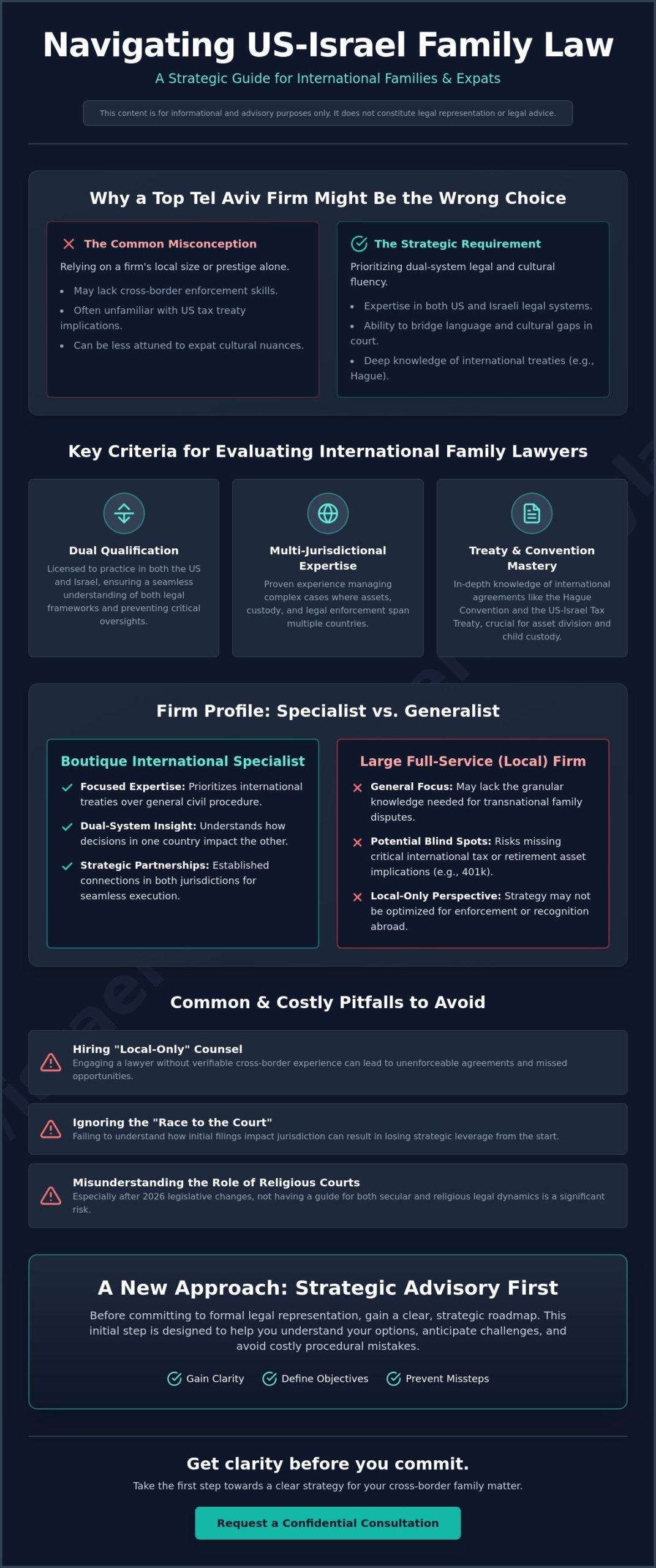
Strategic Advisory: A New Approach to International Family Law
Selecting a legal team is often the most critical decision an expat will make, yet it’s frequently done under extreme emotional pressure. While the top international family law firms in Israel are designed to win in the courtroom, a strategic advisory approach focuses on the architecture of your case before a single motion is filed. This process distinguishes between legal representation and high-level strategy. Israel Cross Border Law Firm provides this independent perspective, helping families vet potential firms and manage the multi-jurisdictional complexities of their cases. This approach ensures that your legal team is following a roadmap designed for your specific US-Israel objectives rather than a generic litigation path.
An advisory layer acts as a bridge between your expectations and the realities of the Israeli legal system. It provides the clarity needed to evaluate whether a firm’s regional proficiency actually matches your financial or custodial goals. By prioritizing strategy over immediate action, you gain the upper hand in jurisdictional disputes and asset protection. This foresight is what separates a successful cross-border resolution from a years-long legal battle that exhausts both your finances and your emotional well-being.
Why Get Clarity Before You Commit?
The financial and emotional cost of switching lawyers in the middle of a case is a risk many international families underestimate. It often results in lost momentum and inconsistent legal arguments that can confuse a judge. By taking the time to understand how the advisory works, you can build a comprehensive roadmap for your representation. This pre-litigation phase allows you to identify potential conflicts between US and IL laws before they become irreversible mistakes in court.
Vetting Your Legal Team
When you interview a firm, ask about their specific experience with the 2026 laws regarding religious court arbitration and their success with US-based asset division. Resources like the Israel Family Law YouTube channel are excellent for learning which questions will reveal a firm’s true level of expertise. Your final choice should prioritize strategic depth and cultural fluency over mere firm size. A well-vetted team that understands the “Anglo” mindset will always be more effective than a prestigious firm that lacks cross-border nuances.
Get clarity before you commit. Request a confidential consultation or reach out via WhatsApp for an advisory call.
This article is published on an independent advisory platform and does not constitute legal representation or legal advice. It is for informational and advisory purposes only. Legal services are only provided by licensed attorneys under a separate engagement.
Securing Your Family’s Cross-Border Future
Navigating the intersection of US and Israeli legal systems requires more than just a local attorney. Success in these complex matters depends on identifying top international family law firms in Israel that prioritize multi-jurisdictional enforcement and strategic depth. By focusing on dual-qualified practitioners and avoiding the common pitfalls of “local-only” representation, you protect your assets and your children’s stability across borders. Early decisions in IL often dictate the outcome of enforcement actions in the US, making your initial choice of counsel a critical turning point.
As an independent advisory platform, our focus is on providing you with specialized US-Israel cross-border expertise. We help you develop a strategic roadmap before you commit to a specific firm or path. This independent vetting process ensures your legal team is perfectly aligned with your unique international needs. Taking the time to seek clarity now prevents costly procedural mistakes later and ensures you move forward with confidence.
Get clarity before you commit. Request a confidential advisory call or reach out via WhatsApp to secure your strategy today.
This article is published on an independent advisory platform and does not constitute legal representation or legal advice. It is for informational and advisory purposes only. Legal services are only provided by licensed attorneys under a separate engagement.
Frequently Asked Questions
What makes a family law firm truly “international” in Israel?
A truly international firm in IL is defined by its ability to navigate multiple legal systems simultaneously. This goes beyond basic English fluency; it requires practitioners who understand the procedural requirements of both Israeli and foreign courts. The top international family law firms in Israel typically have experience with the US-Israel tax treaty and the nuances of cross-border asset division.
Are top Israeli family law firms always located in Tel Aviv?
While many prominent firms are headquartered in Tel Aviv, specialized practitioners also operate in Jerusalem, Haifa, and other major hubs. In 2026, a firm’s physical office location is often less important than its strategic connectivity and experience with international families. You should focus on a firm’s track record with cross-border cases rather than its proximity to a specific city center.
Can a US-based lawyer represent me in an Israeli family court?
No, a lawyer licensed only in the US cannot appear in an Israeli court. Only attorneys who are members of the Israel Bar Association have the legal standing to represent clients before judges in IL. However, your US-based counsel can act as a vital consultant to your Israeli team to ensure that parallel proceedings in both countries stay synchronized.
How do I know if a firm has experience with the Hague Convention?
You can verify this by asking for specific examples of past cases or looking for published rulings where the firm was involved. Hague Convention matters are highly technical and move with extreme speed, so you need a team that demonstrates a mastery of the treaty’s strict rules. Reputable firms will often highlight their history with international child abduction cases on their professional profiles.
What should I expect to pay for a top-tier international divorce lawyer in Israel?
Fees for high-level representation in IL vary based on the complexity of your global assets and the level of conflict. Most firms utilize a combination of an initial retainer and hourly billing for ongoing litigation. It is best to request a transparent fee structure that accounts for the extra administrative layers involved in multi-jurisdictional work and coordination with foreign counsel.
Do top firms handle both secular and religious court cases?
Yes, most top-tier firms are equipped to manage cases in both the secular Family Court and the Rabbinical Courts. This dual capability is necessary because a Jewish divorce in IL requires a “Gett” from a religious tribunal. A comprehensive strategy must account for the different jurisdictional rules of both systems to prevent conflicting orders or legal deadlocks.
Is it better to hire a large firm or a boutique specialist for an international custody case?
Boutique specialists often provide more personalized, partner-level attention, which is critical for sensitive custody matters. Large firms have vast resources, but your case might be assigned to junior associates who lack deep international experience. For high-stakes family disputes, the focused expertise and agility of a boutique firm often result in a more cohesive cross-border strategy.
How can I verify the reputation of an Israeli family law firm from abroad?
Get clarity before you commit. Request a confidential consultation.

Article by
Gabriel Lior
A Personal Journey That Became a Mission
The advisory was founded by an American father Gabriel Lior, LLB, MBA , global entrepreneur, and cross-border advisor who spent more than a decade navigating the Israeli family court system firsthand and now lives in Singapore with his son.
As a divorced parent in a cross-border family, Gabriel faced nearly every legal challenge a foreign parent can encounter in Israel — including child custody disputes, child support proceedings, property matters in Israel and abroad, false accusations, and complex immigration and relocation proceedings.
Over the years, he learned the hard way how difficult it is for non-Israeli parents to understand the system, identify the right legal strategy, and choose the right legal representation — especially when language, culture, and jurisdictional differences are involved. He also witnessed how foreign parents and new immigrants are often disadvantaged or taken advantage of by service providers and institutions simply because they lack local knowledge or fluency.
From Client to Advisor
To truly understand — and survive — the system, Gabriel pursued formal legal education in Israel, completing two Israeli law degrees, alongside a BA and MBA earned in the United States. This was never about becoming a practicing attorney, but about gaining a deep, structural understanding of how the system works — and where it breaks down for foreign parents.
This rare combination of:
Firsthand client experience
Israeli legal and US business education
International business and negotiation training
Decades of commercial execution
created a unique perspective – one that understands both sides of the table.
After years of litigation, persistence, and at times self-representation, he ultimately succeeded in securing custody of his son and relocating abroad through a rare legal victory in the Israeli Supreme Court — becoming one of the first fathers in Israel to do so under these circumstances.
Disclaimer
Important Disclaimer:
The information provided on this website and in its content is for general informational and educational purposes only and does not constitute legal advice, legal opinion, or legal representation.
Gabriel Lior is not licensed to practice law in Israel (nor is he interested in doing so) and does not provide legal services, despite having completed 2 Law Degrees. The services offered are advisory in nature and are intended to provide general guidance, strategic insight, and information regarding cross-border family law considerations.
No attorney-client relationship is formed by accessing this website, reading its content, or communicating with us.
Any decisions made based on this information are at your own discretion and risk. For legal advice specific to your situation, you should consult a licensed attorney in the relevant jurisdiction.
Where appropriate, we may refer clients to independent, licensed attorneys or professionals. Such referrals do not constitute legal representation and no liability is assumed for services provided by third parties.