Navigating the dissolution of a marriage presents significant financial challenges; when that process is a multi-jurisdictional matter involving both the United States and Israel, the complexity and potential for unforeseen expenditure can become overwhelming. For couples with sophisticated assets, business interests, and families spanning two continents, the fear of hidden expenses and the uncertainty of a prolonged legal battle can be paralyzing. Understanding the true cost of international divorce in Israel is the first critical step toward regaining financial control and clarity.
This comprehensive guide is designed to provide that clarity. We will deconstruct every financial component of a US-Israel divorce, from core legal retainers and court fees in both jurisdictions to the nuanced expenses of international asset valuation, forensic accounting, and cross-border tax implications. Our objective is to equip you with the strategic knowledge to manage your budget effectively, demand transparency from your legal partners, and protect your financial future without compromising on a fair and just outcome.
Breaking Down the Bill: The Primary Costs of an Israeli Divorce
Understanding the final bill for a divorce in Israel is much like estimating the cost to build a bespoke home: the final price depends entirely on the complexity of the design and the quality of the materials used. A straightforward, amicable separation is the equivalent of a simple blueprint, whereas a contentious, multi-jurisdictional case involving significant assets and child custody disputes becomes a complex architectural project. The overall cost of international divorce in israel is comprised of both fixed, predictable expenses and highly variable professional fees, which we will dissect below.
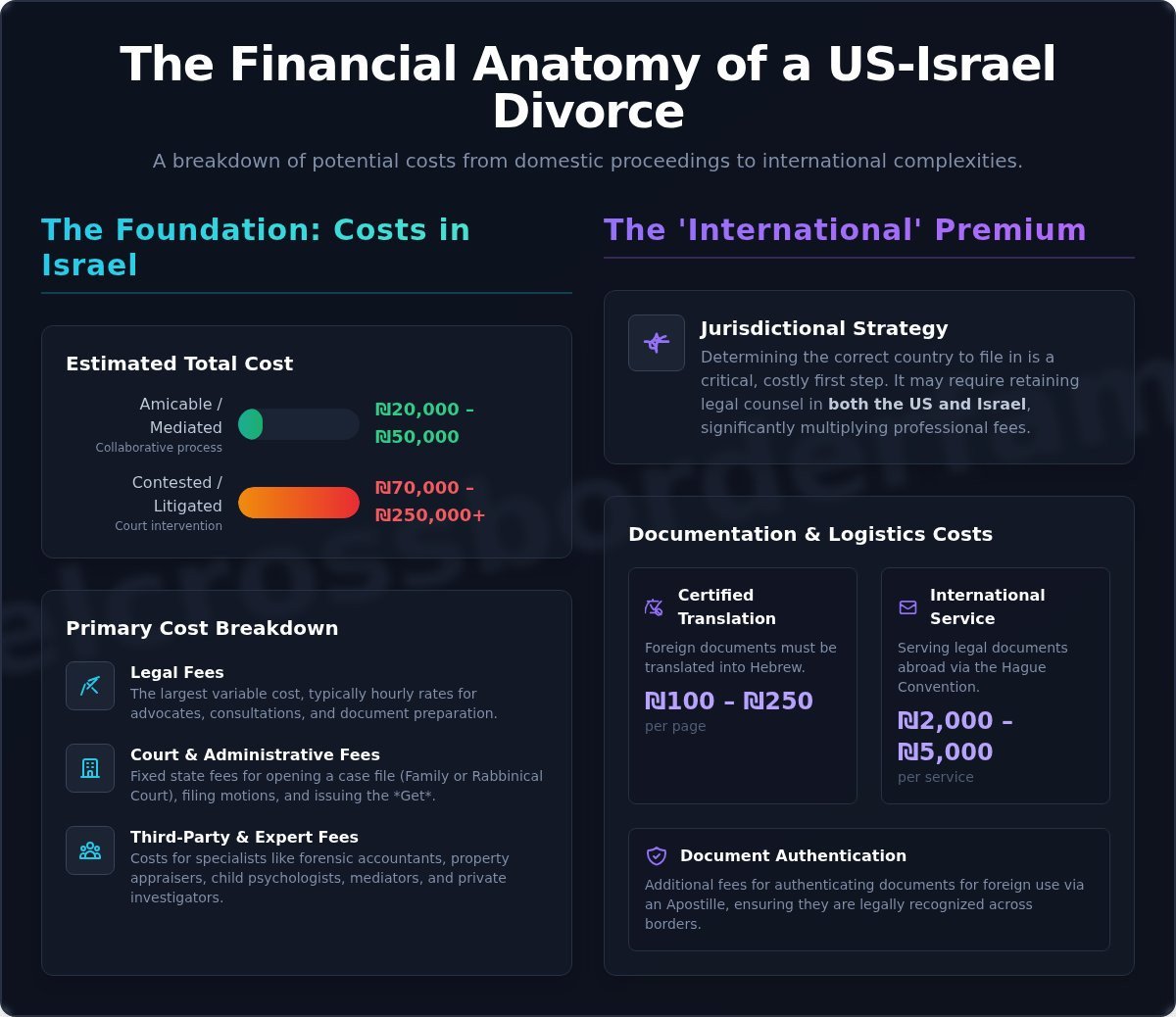
To provide a foundational understanding of the cross-border challenges, consider the following overview:
While every case is unique, the following table provides a general estimate to help set expectations. These figures represent total potential costs and are not a quote for services.
| Divorce Type | Estimated Total Cost (ILS) |
|---|---|
| Amicable / Mediated Divorce | ₪20,000 – ₪50,000 |
| Contested / Litigated Divorce | ₪70,000 – ₪250,000+ |
Legal Fees: Your Advocate’s Compensation
The most substantial variable cost is your legal representation. In Israeli family law, most advocates work on an hourly rate, charging for all time dedicated to your case, including consultations, document preparation, and court appearances. You will typically be asked to provide an initial retainer-a deposit held in trust-from which your advocate will draw their fees as they are incurred. To manage costs, routine tasks may be delegated to junior associates or paralegals at a lower hourly rate.
Court & Administrative Fees
These are fixed, non-negotiable costs set by the state. Opening a case file in either the Family Court or the Rabbinical Court requires a standard fee, currently several hundred shekels. Additional fees apply for filing specific motions or applications throughout the proceedings. The unique legal framework for divorce in Israel, which operates through these religious and civil courts, dictates these administrative requirements. If your divorce is processed through the Rabbinical Court, there is also a nominal fee for the issuance of the Get (Jewish divorce decree).
Third-Party & Expert Fees
Complex international cases often require the input of third-party experts to ensure a fair and equitable division of assets and to protect the best interests of any children involved. These professional fees are separate from your legal counsel and can include:
Financial Experts: Forensic accountants to trace assets or business valuators for shared enterprises.
Property Appraisers: To determine the value of real estate in Israel or abroad.
Child Psychologists: To provide assessments in custody disputes.
Mediators & Parenting Coordinators: To facilitate negotiations and co-parenting plans outside of court.
Private Investigators: In circumstances where there are concerns about hidden assets or undisclosed income.
The ‘International’ Premium: Why Cross-Border Cases Cost More
Navigating a divorce is inherently complex; introducing an international dimension elevates this complexity exponentially. The higher cost of international divorce in Israel is not merely an inflation of standard fees but a necessary investment in multi-jurisdictional legal strategy. Securing a favorable and, more importantly, an enforceable outcome requires sophisticated counsel with demonstrated expertise in both Israeli and foreign legal frameworks, such as those in the United States or Europe. These initial investments are critical to prevent future legal challenges and ensure the final judgment is recognized across borders.
Jurisdictional Strategy and Multiple Proceedings
The initial and most critical phase involves determining the proper jurisdiction-whether the case should be heard in an Israeli Family Court or a foreign court. This decision alone can cost thousands of shekels in legal analysis and consultations. It often precipitates a "race to the courthouse," a strategic maneuver where the first party to file can secure a more favorable legal forum. Consequently, parties may need to retain legal counsel in both jurisdictions, leading to a significant multiplication of professional fees and costs associated with enforcing orders, such as child support, internationally.
Documentation, Translation, and Service of Process
The administrative and procedural requirements of a cross-border case add another layer of expense. Israeli courts mandate that all foreign documents-from marriage certificates to financial statements-be accompanied by a certified Hebrew translation, typically costing ₪100-₪250 per page. Furthermore, formally serving legal documents on a spouse residing abroad is governed by international treaties like the Hague Convention, a process far more intricate and expensive (often ₪2,000-₪5,000) than domestic service. Authenticating these documents for foreign use often requires an apostille, a process managed through official government bodies that provide consular services for Israelis abroad.
Valuation of International Assets
The equitable distribution of a marital estate spanning multiple countries presents a formidable challenge. Valuing disparate assets such as a U.S.-based 401(k) alongside an Israeli pension fund (Keren Pensia) or real estate in Tel Aviv and London demands specialized financial expertise. Engaging forensic accountants and international valuation experts, whose fees can range from ₪10,000 to over ₪50,000, is often non-negotiable to trace assets, understand disparate tax implications, and ensure a fair division of property under both legal systems.
Key Factors That Inflate Divorce Costs (And How to Anticipate Them)
While the procedural costs of filing for divorce in Israel are fixed, the final financial outlay is dictated by several critical, and often interconnected, variables. For clients with international ties, anticipating these factors is the first step toward mitigating financial risk and achieving a predictable outcome. The total cost of international divorce in Israel is less about court fees and more about the complexity and conflict inherent in your specific circumstances.
The Level of Conflict Between Spouses
The single most significant determinant of legal expenditure is the level of acrimony between the spouses. A direct correlation exists: higher conflict necessitates more legal intervention, including court filings, hearings, and protracted negotiations, all of which are billed by the hour. Emotionally-driven decisions to litigate over assets of sentimental rather than significant monetary value can result in legal bills that far exceed the asset’s worth. A high-conflict case proceeding through the Family Court or Rabbinical Court can cost hundreds of thousands of shekels, whereas a mediated or collaborative agreement can achieve the same result for a fraction of that price.
Complexity of Financial Affairs and Assets
Multi-jurisdictional and sophisticated marital estates significantly increase the scope and cost of a divorce. Key complexities include:
Business Valuations: Valuing a privately-held company, start-up equity, or professional practice requires forensic accountants and business valuation experts.
Hidden Assets: If one party suspects the other is concealing assets in Israel or abroad, a costly and time-consuming discovery process is required to trace and document these funds.
Spousal and Child Support: Disputes over the amount and duration of spousal support (mezonot isha) and child support, especially when incomes are generated in different currencies, can prolong litigation and increase expenses.
Contentious Child Custody and Relocation Cases
Disputes involving children are invariably the most emotionally and financially taxing aspect of a cross-border divorce. When parents cannot agree, the court often requires expert intervention, such as custody evaluations conducted by court-appointed psychologists or social workers (pkidat sa’ad), which can cost from ₪15,000 to over ₪50,000. The costs escalate dramatically in cases of proposed international relocation (hagira), which require extensive expert testimony. The worst-case financial scenario involves international child abduction allegations under the Hague Convention, a situation demanding immediate, highly specialized, and exceptionally expensive legal action across multiple jurisdictions.
Effectively managing the cost of international divorce in Israel begins with a strategic assessment of these potential challenges. To understand how these factors apply to your unique situation, we invite you to consult with our experienced legal team.
[
Download
](https://getautoseo.com/screenshots/getautoseocom_1769045436_sYUY8R6D.jpg)
Feedback & Recreate
Delete

Strategic Cost Management: How to Achieve a Fair Outcome Affordably
Navigating a cross-border divorce requires a significant investment of time, emotion, and financial resources. However, proactive and strategic decisions can substantially mitigate the final expense. We partner with our clients to implement effective cost-control measures, ensuring that legal fees are an investment in an efficient, fair, and durable resolution, not an uncontrolled expenditure. Your active participation is a powerful tool in managing the overall cost of international divorce in Israel.
Explore Amicable Resolution: Mediation & Collaborative Divorce
Contentious litigation is the single most significant driver of high legal costs. We strongly advise clients to explore alternative dispute resolution (ADR) methods, such as mediation or collaborative divorce. In mediation, a neutral third party facilitates negotiations, empowering you and your spouse to craft a bespoke agreement outside the courtroom. Collaborative divorce involves a team-based approach where both parties and their lawyers commit to resolving issues without litigation. These methods not only save substantial sums in court fees and billable hours but often result in more satisfactory and lasting outcomes.
The Power of Preparation and Organization
An organized client is an empowered client. The time we spend gathering and sorting basic financial information is time billed to your case. By preparing a comprehensive file of essential documents before our initial consultations, you can dramatically reduce these administrative costs. Efficient communication, such as consolidating questions into a single, detailed email rather than multiple brief calls, also streamlines the process and respects your budget.
We recommend compiling the following:
Complete financial statements for all bank and investment accounts.
Deeds and recent valuations for all real property in Israel and abroad.
Documentation related to business ownership, partnerships, or stock options.
Statements for pension plans, retirement funds, and insurance policies.
Investing in a Specialized Cross-Border Lawyer
While engaging a lawyer with a lower hourly rate may seem economical initially, it can prove to be a costly error in complex international cases. A specialist with deep expertise in multi-jurisdictional family law commands a higher rate precisely because they possess the knowledge to resolve intricate issues efficiently. An expert avoids procedural mistakes, navigates conflicting international laws adeptly, and anticipates challenges that a general practitioner might miss, ultimately reducing the total hours required to secure your interests. This focused expertise is the most effective strategy for controlling the total cost of international divorce in Israel. Schedule a consultation to discuss a cost-effective strategy for your case.
Securing Your Financial Future: A Strategic Conclusion
Navigating a cross-border divorce requires a sophisticated understanding of both the legal and financial landscapes. As we have explored, the final cost of international divorce in Israel is not a fixed sum but a dynamic figure influenced by multi-jurisdictional complexities, the nature of marital assets, and the level of cooperation between parties. The key takeaway is that proactive, strategic management is paramount to protecting your financial interests and achieving an equitable outcome without incurring unnecessary expense.
Our firm provides the specialized guidance required for these complex cases. With decades of experience in high-value US-Israel financial settlements and proven expertise in valuing and dividing international assets, we offer the strategic counsel you need. We are committed to transparent billing practices and advising clients on effective cost-management from the outset, ensuring you maintain control over the financial proceedings.
While the path ahead may seem daunting, a secure and equitable financial future is achievable. Contact our firm for a confidential consultation and a clear assessment of your potential divorce costs.
Frequently Asked Questions
Can my spouse be ordered to pay for my legal fees in Israel?
Yes, Israeli family courts possess the authority to order one spouse to cover the other’s legal expenses. This outcome is not automatic but is determined by the court’s assessment of each party’s financial capacity, conduct during the proceedings, and the overall fairness of the situation. An application for legal costs is a standard component in complex cross-border litigation, particularly where a significant economic disparity exists between the parties, and requires strategic representation to achieve a favorable ruling.
Is mediation always cheaper than going to court for a divorce?
While mediation is generally a more cost-effective route than litigation, this is not guaranteed in sophisticated international cases. If parties are cooperative and reach a swift agreement, the savings can be substantial. However, should mediation become protracted or ultimately fail, the cumulative expense of both the failed mediation and subsequent court proceedings can exceed the cost of initiating litigation from the start. A careful strategic analysis of the potential for success is critical before committing to this path.
How long does an international divorce in Israel typically take, and how does that affect cost?
The timeline for a cross-border divorce in Israel can range from several months for an amicable resolution to multiple years for contentious cases involving multi-jurisdictional asset division or child custody disputes. Duration is a primary driver of the overall cost of international divorce in israel, as extended proceedings directly correlate with increased billable hours for legal counsel, discovery, expert consultations, and court appearances. Proactive and efficient case management is therefore essential to controlling expenditures.
What is a retainer fee and is it refundable?
A retainer fee is an advance payment, often ranging from ₪20,000 to ₪60,000 or more for complex international family law matters, used to secure a law firm’s services. These funds are held in a client trust account and billed against as legal work is performed. Typically, the initial retainer is not refundable as it covers the firm’s engagement and preliminary work. However, any unused portion of the retainer at the final conclusion of your case may be returned, as specified in your fee agreement.
Are there any government legal aid options for foreigners divorcing in Israel?
Israel’s Legal Aid Department (Siyua Mishpati) offers legal assistance, but eligibility for foreign nationals is exceptionally limited and subject to stringent means and merits tests. The service is primarily designed for Israeli citizens and permanent residents. For most individuals navigating a cross-border divorce, especially those with assets located outside of Israel, private legal representation is the only practical option for securing the sophisticated, specialized counsel required for such complex international matters.
How can I budget for my divorce when the total cost is so uncertain?
Budgeting for the uncertain cost of international divorce in israel requires a transparent and strategic partnership with your legal team. We provide a detailed assessment of potential expenses after an initial in-depth consultation, outlining a projected cost range based on the case’s complexities. Establishing a clear fee structure, such as a retainer with detailed hourly billing and regular, transparent invoicing, provides the framework needed to monitor and manage legal expenditures effectively throughout the duration of the proceedings.

Article by
Gabriel Lior
A Personal Journey That Became a Mission
The advisory was founded by an American father Gabriel Lior, LLB, MBA , global entrepreneur, and cross-border advisor who spent more than a decade navigating the Israeli family court system firsthand and now lives in Singapore with his son.
As a divorced parent in a cross-border family, Gabriel faced nearly every legal challenge a foreign parent can encounter in Israel — including child custody disputes, child support proceedings, property matters in Israel and abroad, false accusations, and complex immigration and relocation proceedings.
Over the years, he learned the hard way how difficult it is for non-Israeli parents to understand the system, identify the right legal strategy, and choose the right legal representation — especially when language, culture, and jurisdictional differences are involved. He also witnessed how foreign parents and new immigrants are often disadvantaged or taken advantage of by service providers and institutions simply because they lack local knowledge or fluency.
From Client to Advisor
To truly understand — and survive — the system, Gabriel pursued formal legal education in Israel, completing two Israeli law degrees, alongside a BA and MBA earned in the United States. This was never about becoming a practicing attorney, but about gaining a deep, structural understanding of how the system works — and where it breaks down for foreign parents.
This rare combination of:
Firsthand client experience
Israeli legal and US business education
International business and negotiation training
Decades of commercial execution
created a unique perspective – one that understands both sides of the table.
After years of litigation, persistence, and at times self-representation, he ultimately succeeded in securing custody of his son and relocating abroad through a rare legal victory in the Israeli Supreme Court — becoming one of the first fathers in Israel to do so under these circumstances.
Disclaimer
Important Disclaimer:
The information provided on this website and in its content is for general informational and educational purposes only and does not constitute legal advice, legal opinion, or legal representation.
Gabriel Lior is not licensed to practice law in Israel (nor is he interested in doing so) and does not provide legal services, despite having completed 2 Law Degrees. The services offered are advisory in nature and are intended to provide general guidance, strategic insight, and information regarding cross-border family law considerations.
No attorney-client relationship is formed by accessing this website, reading its content, or communicating with us.
Any decisions made based on this information are at your own discretion and risk. For legal advice specific to your situation, you should consult a licensed attorney in the relevant jurisdiction.
Where appropriate, we may refer clients to independent, licensed attorneys or professionals. Such referrals do not constitute legal representation and no liability is assumed for services provided by third parties.