This article is published on an independent advisory platform (not a law firm) and does not imply an attorney-client relationship.
What if the simple act of being the first to file a document at a courthouse determined whether your assets are divided by a civil judge or a religious tribunal? For many expats and international families living in Israel, the sudden realization that two parallel court systems exist can be deeply unsettling. You likely feel that the legal process should be predictable and transparent, yet the intersection of civil and religious authority often creates a sense of profound uncertainty. Understanding the nuances of hait law and how it intersects with international civil proceedings is vital for anyone managing a multi-jurisdictional family life.
This guide provides the strategic clarity you need to navigate the Israeli family law system without the fear of losing custody or international assets due to a lack of information. You’ll learn how the “Race to Court” dynamic works in practice and how to protect your interests across multiple jurisdictions. We will examine the differences between Rabbinical and Civil courts, ensuring you can achieve a fair resolution while minimizing emotional escalation. This information is for educational purposes and does not constitute legal representation. Get clarity before you commit. Request a confidential consultation.
Key Takeaways
- Understand the “parallel jurisdiction” of Israeli civil and rabbinical courts to navigate the critical “race to court” that often determines your legal venue.
- Learn how Israeli courts interpret “habitual residence” under the Hague Convention to protect your parental rights in cross-border custody matters.
- Discover why international families need “mirror wills” and dual-jurisdiction estate plans to bridge the gap between Israeli law and overseas assets.
- Adopt a strategic “advisory first” approach to assess risks and gain legal clarity before committing to any binding family law agreements in Israel.
- Leverage a hait law framework to simplify complex Hebrew-centric statutes into actionable strategies tailored for the Anglo community.
This article is published on an independent advisory platform (not a law firm) and does not imply an attorney-client relationship.
The Landscape of Family Law for English Speakers in Israel
Relocating to Israel or managing a family life across borders involves more than just a change of geography. For English speakers, the Israeli legal framework often feels like a maze of Hebrew-centric statutes and unfamiliar customs. Understanding the nuances of hait law and how it interacts with international standards is the first step toward protecting your family’s interests. It’s not just about language; it’s about a fundamental cultural shift from Western common law systems to the unique IL framework.
To better understand the role of a dedicated legal team in this landscape, watch this helpful video:
Gaining clarity is vital before making any life-altering decisions. While many statutes are available in translation, a literal translation rarely captures the actual legal weight of the words. For instance, Israel’s religious marriage laws create a dual court system that frequently surprises expats. This guide provides informational and advisory content to help you understand these risks. It’s not legal representation or direct legal advice. Licensed attorneys provide legal services only under separate engagement. This is why hait law experts emphasize the need for a strategic roadmap before entering any formal proceedings.
Why Cross-Border Situations Are Inherently Complex
The Role of Independent Advisory in Family Law
There’s a clear distinction between an independent advisory platform and a traditional law firm. This platform serves as a strategic bridge, helping you build a comprehensive plan before you ever step into a courtroom or engage a litigator. By focusing on risk-based decision-making, you can avoid common pitfalls that many Anglos face when they react emotionally rather than strategically. Learn more about how the advisory works to see how this approach provides a bicultural perspective on complex matters.
Get clarity before you commit. Request a confidential consultation.
The Dual Court System: Rabbinical vs. Civil Jurisdictions
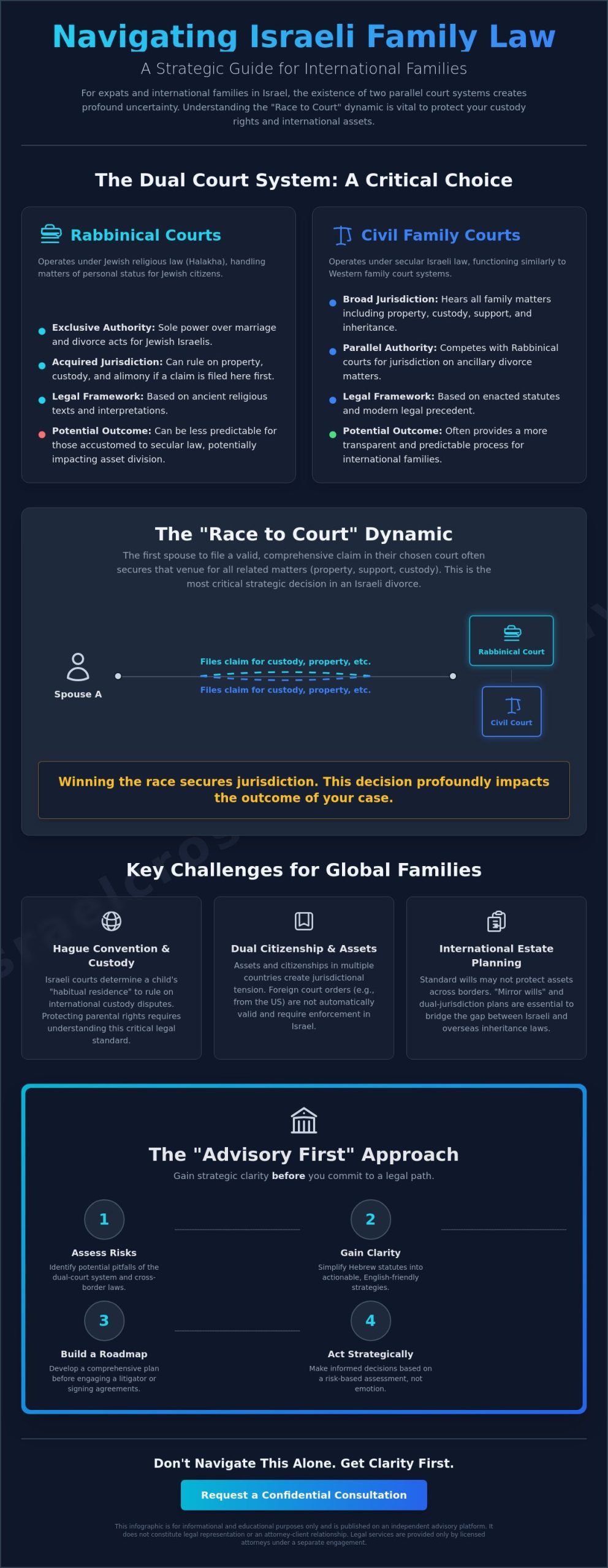
Israel’s legal landscape for domestic relations is unique due to its system of parallel jurisdiction. This means two separate court systems, the Rabbinical Courts and the Civil Family Courts, possess the authority to hear family law cases. While the Rabbinical Court has exclusive authority over the act of marriage and divorce itself for Jewish residents, other matters like property division, alimony, and child custody can be heard in either system. Understanding how these two bodies interact is a foundational element of hait law and strategy for English speakers living in Israel.
The choice of venue often leads to what’s known as the “race to court.” In many instances, the court where the first valid claim is filed gains the authority to decide the ancillary issues of the divorce. This procedural reality means that the initial decision of where to file can significantly alter the trajectory of a case. A spouse might prefer the civil system for its predictable application of modern property laws, while another might see advantages in the religious court’s traditional approach. Strategic planning is essential because once a jurisdiction is established, it’s very difficult to move the case elsewhere.
The Rabbinical Court (Beit Din Rabbinic)
The Rabbinical Court is presided over by Dayanim, who are judges trained in Jewish law (Halakha). A common misconception among expats is that these courts only deal with religious rituals. In reality, they’re powerful state institutions that handle complex financial disputes and custody battles. While they must follow certain civil laws, such as the Women’s Equal Rights Law of 1951, their perspective on “fault” or the “Get” (the religious writ of divorce) can influence proceedings. For example, a wife’s right to her Ketubah (marriage contract) amount, which might be a significant sum in ₪, is a matter handled exclusively here.
The Family Court (Civil System)
The Israeli Family Courts operate under civil statutes passed by the Knesset. These courts focus heavily on the principle of “The Best Interests of the Child” when determining custody and visitation. Unlike the religious courts, the civil system generally applies the Spousal Property Relations Law of 1973, which dictates an equal distribution of assets acquired during the marriage. For those navigating divorce for international families, the civil court is often viewed as more aligned with Western legal expectations regarding child support and gender-neutral asset division.
The interplay between these systems creates a complex environment where religious and civil laws overlap. For instance, even if a civil court decides on property division, the Rabbinical Court still maintains the power to grant the actual divorce. If one party refuses to give or receive the Get, it can create a legal deadlock that impacts civil outcomes. Navigating this requires a clear understanding of how hait law principles apply to your specific cross-border circumstances.
Get clarity before you commit. Request a confidential consultation.
Cross-Border Complexities: Hague Convention and Custody
The 1980 Hague Convention serves as the primary international framework for resolving disputes where a child is removed from their home country without consent. In Israel, this is often navigated through the lens of hait law, which refers to the domestic implementation of these global standards. The core objective of these proceedings isn’t to decide which parent is superior. Instead, the court focuses on determining which country holds the proper jurisdiction to hear the custody case. This process is designed to be expedited, often reaching a conclusion within six weeks to prevent the “creation of facts” on the ground.
Israeli courts interpret “habitual residence” for expat children by examining the center of the child’s life. Judges look at specific data points, such as the duration of the stay in IL, school enrollment records, and the child’s social integration. For example, a child who has attended a school in Ra’anana for more than 12 months is often considered a habitual resident of Israel, even if the family originally planned a temporary relocation from the US. The court prioritizes the child’s current stability over the parents’ long-term immigration status.
Traveling abroad during a pending divorce carries significant legal risks. Israeli courts frequently issue stay-of-exit orders, known as Tzav Ikur Yetziah Min Ha’aretz, to ensure children remain in the country until custody is settled. Attempting to leave IL with a child while a case is active can trigger an immediate hait law petition. This can lead to the parent being flagged at Ben Gurion Airport and potentially facing criminal charges for parental kidnapping.
International Custody and Relocation
Relocation is a legal process involving court-approved movement, while abduction is the unilateral removal of a child without a legal mandate. If you’re a parent wishing to move back to the US, you must prove that the move serves the child’s best interests and doesn’t sever the bond with the other parent. You can find more details on understanding international custody laws to prepare for this complex transition. Obtaining a formal relocation judgment is the only way to move legally.
Enforcement of Support Orders
The Israeli Enforcement and Collection Authority (Rashut Ha’achifa Ve’hagviya) handles the implementation of foreign support orders. Since Israel and the US have reciprocal agreements, a child support order issued in a US state court can often be enforced in IL. Challenges arise when tracking income across borders. Courts may require a comprehensive audit of both US and Israeli bank accounts to calculate support in ₪. For a deeper look at these mechanisms, see our guide on cross-border child support enforcement.
Get clarity before you commit. Request a confidential consultation.
Future Planning: Wills, Estates, and Elder Law for Global Families
Global families often face a jurisdictional gap when an estate plan designed in California or London meets the Israeli legal system. Under the 1965 Succession Law, which forms the basis of hait law principles regarding inheritance, the Israeli courts prioritize specific formalities that foreign documents often lack. If you own a home in Jerusalem or Tel Aviv, a foreign will might trigger a lengthy contest in an Israeli probate court. This usually results in delays of six to twelve months while the court verifies the document’s validity against local standards.
Managing assets across borders is complex. It requires more than a standard will. It requires a strategy that acknowledges the 2016 reforms in Israeli guardianship and the specific requirements of the Land Registry. Families who fail to align their international documents often find their beneficiaries trapped in a cycle of bureaucratic requests for translations, apostilles, and expert legal opinions on foreign law.
Drafting Wills for Assets in Two Countries
A common mistake is assuming a single US will effectively covers Israeli real estate. To ensure a smooth transfer at the Tabu (Land Registry Office), you need a “mirror will” or a dual-jurisdiction plan. These documents are drafted to comply with local statutes while remaining consistent with your US tax obligations. Without specific clauses that address the hait law requirements for clarity and intent, beneficiaries might face unexpected legal hurdles.
- Probate Challenges: US wills often use “trust” language that doesn’t translate directly into the Israeli legal framework.
- Tabu Requirements: The Land Registry requires specific identification numbers and descriptions that must match the deed exactly.
- Tax Efficiency: Inheriting assets in IL can have tax implications for US-based beneficiaries if the structure isn’t planned correctly.
Elder Law and Future Care
The 2016 amendment to the Israeli Legal Capacity and Guardianship Law introduced a vital tool: the Yipuy Koach Mitgashem (Continuous Power of Attorney). This document allows you to appoint a trusted person to manage your affairs if you lose mental capacity. For expats, this is significantly more effective than a standard US Power of Attorney. Israeli banks and medical institutions frequently reject foreign documents, even when notarized.
Strategic planning is vital for families with aging parents moving to IL. The Israeli system handles long-term care through a mix of private insurance and National Insurance Institute (Bituach Leumi) benefits. Early decisions prevent the need for court-appointed guardians. These court processes can be expensive and often lead to family litigation when members disagree on care. Taking action while parents are still healthy ensures their wishes are respected and assets are protected.
Get clarity before you commit. Request a confidential consultation.
Strategic Decision-Making: Clarity Before Commitment
The most critical phase of any international family dispute happens before a single document is filed in court. Adopting an advisory first approach ensures that strategy dictates the litigation, rather than the other way around. Rushing into the Israeli court system without a clear roadmap often leads to procedural traps that are difficult to escape. By prioritizing strategy, you can determine whether your objectives are better served in the Family Court or the Rabbinical Court, or if a different jurisdiction altogether provides a more favorable framework.
Early procedural mistakes in cross-border cases carry a heavy financial burden. Filing in the wrong venue or failing to account for international treaties can result in wasted legal fees ranging from ₪15,000 to ₪40,000 just to rectify jurisdictional errors. These costs don’t include the potential loss of long-term financial rights or custody arrangements. Professional guidance from experts familiar with hait law and international standards helps mitigate these risks by identifying the most efficient path forward before you commit to a specific legal course.
Choosing an attorney requires finding a professional who bridges the gap between US and Israeli legal cultures. You need a team on the ground that understands the “start-up nation” pace while respecting the emotional nuances of Anglo families. This bicultural expertise ensures that your legal representation isn’t just translating words, but also translating expectations and strategies across different legal systems.
Building a Risk-Based Strategy
Success begins by identifying your primary objective, whether it’s securing child relocation or protecting specific assets. You must evaluate the cost-benefit ratio of different jurisdictional paths. For example, the 2016 Mandatory Mediation Law in Israel requires most families to attend initial dispute resolution sessions. Understanding the nuances of hait law in this context allows families to use these sessions as a strategic tool rather than a mere formality. Mediation is often the most effective way to handle international assets and complex visitation schedules without the volatility of a courtroom.
Next Steps for International Families
Preparation is your most effective tool. Start by gathering essential documentation, including marriage certificates from your home country, foreign bank statements, and any existing prenuptial agreements. These documents serve as the foundation for your case. Once your records are organized, seeking a confidential case review is the next logical step to determine which jurisdiction holds authority over your matter. Knowledge acts as your best defense when dealing with a foreign legal system. It’s the difference between being reactive to the court and being proactive in your family’s future. To understand how it works, focus on building a foundation of facts before taking action.
Get clarity before you commit. Request a confidential consultation.
Navigating Your Path Forward with Strategy and Clarity
Navigating the intersection of two legal systems requires more than just filling out forms. It demands a deep understanding of how Israeli civil and rabbinical courts interact, especially when international assets or child custody are involved. Decisions made today often have long-term consequences for global families. For those seeking expert guidance, hait law provides a specialized advisory approach that bridges the gap between US and Israeli legal cultures.
Whether you’re managing a complex Hague Convention matter or drafting a multi-jurisdictional will, early strategy is your most effective tool. It’s not enough to simply translate documents; you must understand the cultural and procedural nuances that drive judicial outcomes. Our focus is on providing the clarity you need to protect your family’s future across borders. We help you identify risks before they become crises, ensuring you’re never making commitments without a full picture of the legal landscape. You can find more educational resources on our YouTube channel.
Don’t leave your family’s security to chance in an unfamiliar system. Get clarity before you commit. Request a confidential consultation to discuss your specific situation. Taking this step ensures you’re moving forward with a plan built on professional expertise and strategic foresight.
This article is published on an independent advisory platform and does not constitute a law firm or an attorney-client relationship. Legal services are only provided by licensed attorneys under a separate engagement.
Frequently Asked Questions
What is the ‘Race to Court’ in Israeli divorce law?
The ‘Race to Court’ refers to the unique dual jurisdiction system where both the civil Family Court and the religious Rabbinical Court have authority to handle divorce. The first party to file a claim in one court generally secures that system’s jurisdiction over related issues like property division and alimony. This tactical move is significant because the two courts apply different legal principles, which can lead to vastly different outcomes for each spouse.
Can a US prenuptial agreement be enforced in Israel?
A US prenuptial agreement is not automatically binding in Israel and requires formal validation by an Israeli court or marriage registrar to be enforceable. Under the Spouses (Property Relations) Law of 1973, any agreement regarding asset division must be approved to ensure it was made with full consent and understanding. Without this local confirmation, the agreement may not hold up during divorce proceedings in an Israeli court, regardless of its validity in the United States.
How does the Hague Convention apply if I want to move back to the US with my child?
The Hague Convention prevents one parent from unilaterally relocating a child to the US without the other parent’s written consent or a court order. If you move without authorization, the other parent can petition for the child’s immediate return to Israel. According to 2022 data from the Israeli Ministry of Justice, these cases are prioritized to ensure a swift resolution, as the law focuses on maintaining the child’s status quo in their habitual residence.
Do I need a separate will for my property in Israel if I already have a US will?
Maintaining a separate Israeli will for local assets is highly recommended to avoid the administrative delays associated with the Succession Law of 1965. While Israel recognizes foreign wills, the probate process for a US document requires professional translations and expert legal opinions to prove foreign law. Creating a local will specifically for Israeli real estate or bank accounts ensures a smoother transfer of assets and reduces costs for your heirs after you pass away.
Is child support in Israel higher or lower than in the United States?
Child support in Israel is often higher than in many US states because it includes specific obligations for “necessary needs” and housing costs. Since the 2017 Supreme Court ruling 919/15, support for children over age six is calculated based on the relative income of both parents and the time spent with each child. However, for younger children, fathers may still face basic monthly payments starting around ₪1,600 per child, excluding additional costs for education and extracurricular activities.
What happens if my spouse files for divorce in the Rabbinical court first?
If your spouse files first in the Rabbinical court, they may “bind” matters like the division of assets and spousal maintenance to that religious tribunal. This often occurs in cases involving hait law where international couples must navigate the traditional “Get” process alongside civil matters. You should act quickly to determine if the filing was done in good faith, as it’s sometimes possible to challenge the jurisdiction if the claim doesn’t meet specific legal requirements.
How long does a typical cross-border family law case take in Israel?
A typical cross-border family law case in Israel usually takes between 12 and 24 months to reach a final judgment. Data from the Israeli Courts Administration shows that cases involving international assets or foreign legal experts often require more time for discovery and testimony. While urgent matters like temporary custody or restraining orders can be handled in days, the full litigation process for complex international families requires a long term strategic approach to reach a conclusion.
Can I enforce an Israeli custody order if the other parent moves to the US?
You can enforce an Israeli custody order in the US through the Uniform Child Custody Jurisdiction and Enforcement Act (UCCJEA), which is recognized by 49 US states. This act requires US courts to treat foreign custody orders as if they were issued by a local court, provided the original proceedings followed due process. Utilizing hait law strategies and international treaties ensures that the US court recognizes the Israeli order as the governing authority over the child’s welfare and residence.
Get clarity before you commit. Request a confidential consultation.
For more detailed insights, you can view our educational resources on the Israel Family Law YouTube channel.

Article by
Gabriel Lior
A Personal Journey That Became a Mission
The advisory was founded by an American father Gabriel Lior, LLB, MBA , global entrepreneur, and cross-border advisor who spent more than a decade navigating the Israeli family court system firsthand and now lives in Singapore with his son.
As a divorced parent in a cross-border family, Gabriel faced nearly every legal challenge a foreign parent can encounter in Israel — including child custody disputes, child support proceedings, property matters in Israel and abroad, false accusations, and complex immigration and relocation proceedings.
Over the years, he learned the hard way how difficult it is for non-Israeli parents to understand the system, identify the right legal strategy, and choose the right legal representation — especially when language, culture, and jurisdictional differences are involved. He also witnessed how foreign parents and new immigrants are often disadvantaged or taken advantage of by service providers and institutions simply because they lack local knowledge or fluency.
From Client to Advisor
To truly understand — and survive — the system, Gabriel pursued formal legal education in Israel, completing two Israeli law degrees, alongside a BA and MBA earned in the United States. This was never about becoming a practicing attorney, but about gaining a deep, structural understanding of how the system works — and where it breaks down for foreign parents.
This rare combination of:
Firsthand client experience
Israeli legal and US business education
International business and negotiation training
Decades of commercial execution
created a unique perspective – one that understands both sides of the table.
After years of litigation, persistence, and at times self-representation, he ultimately succeeded in securing custody of his son and relocating abroad through a rare legal victory in the Israeli Supreme Court — becoming one of the first fathers in Israel to do so under these circumstances.
Disclaimer
Important Disclaimer:
The information provided on this website and in its content is for general informational and educational purposes only and does not constitute legal advice, legal opinion, or legal representation.
Gabriel Lior is not licensed to practice law in Israel (nor is he interested in doing so) and does not provide legal services, despite having completed 2 Law Degrees. The services offered are advisory in nature and are intended to provide general guidance, strategic insight, and information regarding cross-border family law considerations.
No attorney-client relationship is formed by accessing this website, reading its content, or communicating with us.
Any decisions made based on this information are at your own discretion and risk. For legal advice specific to your situation, you should consult a licensed attorney in the relevant jurisdiction.
Where appropriate, we may refer clients to independent, licensed attorneys or professionals. Such referrals do not constitute legal representation and no liability is assumed for services provided by third parties.