The first person to file for divorce often controls where the case is heard, and in a US-Israel marriage, that single decision can reshape everything that follows. International divorce: where should you file? It’s a question that sounds procedural, but the answer carries real consequences for your assets, your children, and your future.
If you’re an expat or part of an international family living between two countries, you already sense how complicated this is. Two legal systems. Two sets of rules. And in Israel, a Rabbinical court system that operates in ways most English speakers have never encountered and never expected to face.
The confusion is understandable. So is the anxiety. Many people in your situation don’t realize they have a choice, or that making the wrong move early, even unintentionally, can lock them into a legal process that doesn’t work in their favor.
This guide is here to change that. You’ll learn how jurisdictional choices between the US and Israel fundamentally alter the outcome of your divorce, from asset division to child custody, and why acting strategically before you file is far more important than most people realize.
Key Takeaways
- When it comes to international divorce: where should you file? — the answer depends on far more than convenience; jurisdiction determines which country’s laws govern your assets, your children, and your financial future.
- Israel operates a dual-court system, and the “race to the court” (Merotz Samchuyot) means that whoever files first can significantly influence which legal framework applies to the entire divorce.
- Asset division rules differ substantially between US states and Israel, and child support calculations follow entirely different methodologies — understanding both systems before you act is essential.
- Custody jurisdiction is typically tied to where your children habitually reside, and international treaties like the Hague Convention impose strict limits on relocating children without consent or court approval.
- Early, strategic decision-making — before any filing occurs — is the single most important step you can take to protect your interests across both legal systems.
Understanding Jurisdiction in International Divorce
Jurisdiction is the legal authority a court holds to hear a case and issue orders that the parties are bound to follow. In a purely domestic divorce, this is rarely a point of contention. In an international divorce, it can become the central battleground before any substantive issues are even addressed.
Here’s the part that surprises most people: more than one country can have a legitimate legal claim to handle your divorce at the same time. The US and Israel may both qualify, and neither system automatically defers to the other. That overlap is where complexity lives, and where early decisions carry the most weight.
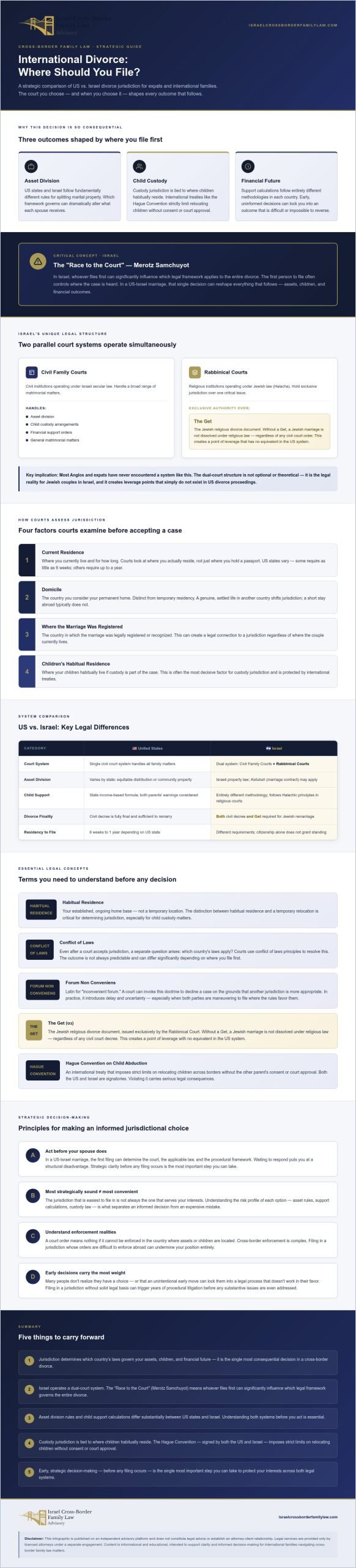
Courts typically look at several factors when assessing whether they have jurisdiction:
- Where you currently reside and for how long
- Where you are domiciled, meaning the country you consider your permanent home
- Where the marriage was registered or legally recognized
- Where your children habitually live, if custody is part of the case
Filing in a jurisdiction that lacks a solid legal basis to hear your case doesn’t just waste time. It can trigger years of procedural litigation over whether the court has authority at all, before any asset or custody questions are resolved.
Residency Requirements and Legal Standing
US states vary in how long you must reside there before filing. Some require as little as six weeks; others require up to a year. Israel’s requirements differ again, and your citizenship alone, whether American, Israeli, or both, doesn’t automatically grant you standing in either system. Courts look at where you actually live, not just where you hold a passport. The distinction between habitual residence (your established, ongoing home base) and a temporary relocation is critical. A short stay abroad doesn’t shift jurisdiction. A genuine, settled life in another country often does.
The Conflict of Laws: Which System Governs?
Even after a court accepts jurisdiction, a separate question arises: which country’s laws apply to divide your assets, calculate support, or determine custody? Courts use a body of rules called conflict of laws principles to resolve this. The outcome isn’t always predictable, and it can differ significantly depending on where you file first.
There’s also a doctrine called Forum Non Conveniens, a Latin phrase meaning “inconvenient forum.” A court can invoke it to decline a case on the grounds that another jurisdiction is clearly more appropriate. This sounds protective, but in practice it introduces delay and uncertainty, especially when both parties are actively maneuvering to file where the rules favor them.
When asking International Divorce: Where Should You File?, the honest answer is that the most strategically sound jurisdiction isn’t necessarily the most convenient one. Understanding the risk profile of each option, before any filing occurs, is what separates an informed decision from an expensive mistake.
For expats and international families navigating the US-Israel corridor, a clear-eyed assessment of jurisdictional exposure is the logical starting point. Learn more about how cross-border strategy works at Israel Cross Border Family Law’s expat and foreign nationals resource.
The Unique Landscape of Divorce in Israel
Israel’s legal system doesn’t operate the way most Anglos expect. Unlike the United States, where family matters are handled exclusively through civil courts, Israel runs two parallel legal systems for divorce, and understanding which one applies to your situation is foundational to any cross-border strategy. For anyone asking International Divorce: Where Should You File?, this dual structure is one of the most important factors to understand before any decision is made.
Civil Family Courts vs. Rabbinical Courts
Israel’s Family Courts operate as civil institutions and handle a broad range of matrimonial matters, including asset division, child custody, and financial support. The Rabbinical Courts, by contrast, are religious institutions operating under Jewish law (Halacha), and they hold exclusive jurisdiction over one critical issue: the Get, the Jewish religious divorce document.
Without a Get, a Jewish marriage is not dissolved under religious law, regardless of what any civil court orders. This creates a dynamic with no real equivalent in the US system. A civil court can divide your property and establish custody arrangements, but it cannot compel a religious divorce. That authority belongs solely to the Rabbinical Court. For Jewish couples, both proceedings may ultimately be necessary, and the relationship between them is rarely straightforward.
On financial matters, the two systems diverge significantly:
- Civil Family Courts apply a framework closer to equitable distribution principles, weighing contributions, circumstances, and economic need.
- Rabbinical Courts approach asset division and alimony through the lens of Halachic obligations, which can produce materially different outcomes, particularly regarding spousal support.
Most English-speaking clients, and many Israeli attorneys who work with international families, prefer the Civil Family Court for financial matters. The reasoning is practical: the civil framework is more transparent, more predictable, and more accessible to those unfamiliar with religious legal doctrine.
Why Timing is Everything in Israeli Filings
Israel’s version of the jurisdictional race has a name: Merotz Samchuyot, which translates roughly as “race to the court.” The principle is direct. Whichever court, civil or Rabbinical, receives the first filing typically gains authority over the connected issues in that proceeding. File in Civil Family Court first, and that court is positioned to handle property and support. File in the Rabbinical Court first, and those matters may shift there instead.
This isn’t a technicality. It’s a strategic variable with real financial consequences. A spouse who understands the system can file preemptively in the forum most favorable to their position, before the other party has even consulted an attorney. Waiting is a risk. If your spouse is aware of their options and you’re not, the filing decision may already be made for you.
The same dynamic applies across borders. An Israeli filing can, under certain conditions, pre-empt or complicate a subsequent US filing, and vice versa. That intersection is precisely where cross-border strategy matters most, and where early advice is worth far more than reactive damage control.
To build a clearer picture of how these systems interact with your specific situation, request a confidential case review before any filing takes place.
Comparing US and Israeli Legal Outcomes
Where you file doesn’t just determine which court hears your case. It determines which rules govern the outcome. And when the question is International Divorce: Where Should You File?, the financial gap between US and Israeli frameworks can be substantial enough to reshape your long-term security.
Financial Division: US States vs. Israel
US states fall into two broad camps. Community property states, including California, Texas, and Arizona, treat most assets acquired during marriage as equally owned by both spouses. Equitable distribution states, which make up the majority, divide assets based on fairness rather than strict equality, weighing factors like income, contributions, and future earning capacity.
Israel takes a different approach. Israeli civil law applies a principle called Resource Balancing (איזון משאבים), which broadly resembles equitable distribution but operates under its own distinct rules. Assets brought into the marriage or received as gifts or inheritance are generally excluded from division. Assets accumulated during the marriage are subject to balancing, but the methodology and what courts consider relevant can diverge significantly from what a US judge would weigh.
Real estate illustrates this clearly. A property owned jointly in Israel is subject to Israeli law regardless of where the divorce is filed, as a practical matter. But how that property’s value is assessed, offset, or divided may differ depending on which court is directing the process. US courts handling an Israeli property must often rely on Israeli valuations and legal instruments, which creates friction and delay.
Retirement assets add another layer of complexity:
- US 401(k) plans are typically divided through a Qualified Domestic Relations Order (QDRO), a specific court instrument that US plan administrators require.
- Israeli pension funds operate under different regulatory frameworks and require separate Israeli legal procedures to divide.
- Keren Hishtalmut, a common Israeli savings vehicle for employees, occupies a gray area. Depending on when contributions were made and how the fund is structured, it may or may not be treated as a marital asset subject to division.
Spousal Support and Alimony Variations
US courts approach alimony pragmatically. Duration, amount, and structure vary by state, but the general trend in recent decades has moved toward time-limited support tied to the recipient’s ability to become financially independent. Long-term or permanent alimony is increasingly rare and typically reserved for long marriages where one spouse has significantly diminished earning capacity.
Israeli law introduces a concept with no direct US equivalent: Mezonot Isha, or wife support under religious law. In Rabbinical Court proceedings, a husband may carry an obligation to support his wife that is grounded in Halachic doctrine rather than civil equity principles. The calculation and duration of this obligation can differ materially from anything a US court would order, and it interacts with the Get process in ways that create strategic leverage for either party.
In civil family court proceedings in Israel, spousal support is assessed through a more familiar lens of need and capacity, but the cultural and legal baseline still differs from US norms. The result is that the same marriage, the same assets, and the same circumstances can produce genuinely different financial outcomes depending on where proceedings are initiated.
For expats and international families weighing these variables, understanding both frameworks before committing to a filing strategy is not optional. It’s the foundation of any sound decision. Learn more about how cross-border considerations affect your specific position at Israel Cross Border Family Law’s expat and foreign nationals resource.
Get clarity before you commit. Request a confidential case review to assess how these frameworks apply to your situation.
Critical Factors: Children, Assets, and Enforcement
Jurisdictional strategy doesn’t stop at the divorce filing. For international families, the most consequential legal battles often involve children, cross-border assets, and the hard reality that a court order is only as useful as your ability to enforce it in another country. These three areas deserve careful attention before any decision is made, and they sit at the heart of the question: International Divorce: Where Should You File?
International Child Custody and the Hague Convention
Custody jurisdiction follows the child, not the parents. Courts in both the US and Israel apply the principle of habitual residence, meaning the country where the child has genuinely been living is typically the country whose courts hold authority over custody decisions. A parent who relocates a child internationally without the other parent’s consent, or without court approval, doesn’t gain a jurisdictional advantage. They trigger a legal crisis.
The Hague Convention on the Civil Aspects of International Child Abduction governs exactly this scenario. Both the United States and Israel are signatories. Under the Convention, a child wrongfully removed from their country of habitual residence must generally be returned, promptly, regardless of which parent believes they have the stronger custody case. The merits of custody are a separate matter from the return order itself.
Israeli courts do have discretion to refuse return in limited circumstances. The most significant is the grave risk exception: if returning the child would expose them to physical or psychological harm, or place them in an intolerable situation, an Israeli court may decline to order the return. In practice, Israeli courts apply this exception narrowly. A parent arguing grave risk faces a high evidentiary threshold. General claims of instability or parental conflict are unlikely to meet it.
Relocation disputes, even when no abduction has occurred, carry their own complexity. A parent wishing to move a child from Israel to the US, or vice versa, typically requires either the other parent’s written consent or a court order permitting the move. Learn more about how these cases unfold at Israel Cross Border Family Law’s Hague Convention resource.
Enforceability of Foreign Divorce Decrees
A court order is not self-executing across borders. Getting a judgment in one country and enforcing it in another are two entirely different legal exercises, and the gap between them surprises many people who assumed the hard part was over once the decree was issued.
The legal principle governing cross-border recognition is called comity. Under comity, a court in one country may choose to honor a foreign court’s order, but it is not automatically required to do so. Recognition typically depends on whether the original court had proper jurisdiction, whether the parties received adequate notice and an opportunity to be heard, and whether the foreign order conflicts with the enforcing country’s public policy.
For US child support orders being enforced in Israel, the process involves a formal recognition application through the Israeli courts. The order must meet specific procedural standards, including what’s known as proper service: the respondent must have been formally notified of the proceedings in a manner the Israeli court considers legally valid. An order issued without proper service may be unenforceable, regardless of its merits.
Asset location adds another layer of practical constraint:
- Bank accounts held in Israel can only be frozen or accessed through Israeli court orders or orders formally recognized by Israeli courts.
- Real property in Israel requires Israeli legal proceedings to transfer, encumber, or enforce against, even if a US court has issued a division order.
- US-based retirement accounts remain subject to US court authority and require US-specific instruments to divide.
The practical implication is direct: where your assets are located often determines where enforcement must happen, irrespective of where the divorce was filed. A favorable decree in one jurisdiction may deliver far less than expected if the assets sit beyond that court’s effective reach.
For a clear picture of how cross-border support enforcement works in the US-Israel context, visit Israel Cross Border Family Law’s child support enforcement resource.
Get clarity before you commit. Request a confidential case review to understand how enforcement realities affect your specific situation.
Making a Strategic Decision: Where to File First
Every factor covered in this guide, jurisdictional overlap, Israel’s dual-court system, asset division rules, child custody frameworks, and enforcement realities, converges at a single practical question: what should you actually do before taking any formal legal step? The answer starts with an honest assessment of your own situation, not a generic checklist.
Where your primary assets are located matters more than most people initially assume. If you own real estate in Israel, hold an Israeli pension, or have a business interest registered there, those assets will ultimately require Israeli legal proceedings to divide or transfer, regardless of where the divorce is filed. The same logic applies in reverse for US-based retirement accounts, property, or business equity. Mapping your global asset picture before filing tells you where enforcement leverage actually exists, and that shapes which jurisdiction is worth pursuing.
Children’s living arrangements carry equal weight. If your children are enrolled in school in Israel, have established friendships, and have lived there for a meaningful period, Israeli courts are likely to assert custody jurisdiction regardless of where you file for divorce. Trying to circumvent that through a US filing rarely succeeds and often creates additional conflict. Accepting where your children’s habitual residence sits, and planning around it, is more productive than fighting a jurisdictional reality.
Cultural and procedural differences between US and Israeli courtrooms are real and shouldn’t be underestimated. US family court proceedings are generally more transparent, more document-driven, and more familiar to English-speaking litigants. Israeli proceedings, particularly in Rabbinical Court, operate under different evidentiary norms, different timelines, and a different relationship between legal argument and religious doctrine. Neither system is inherently superior, but one may serve your specific circumstances better than the other.
Assessing Your Long-Term Goals
Whether you plan to remain in Israel or return to the US after the divorce directly affects which jurisdiction makes strategic sense. A parent who intends to relocate with the children faces a different legal landscape than one who plans to stay. Relocation requests, whether framed as Aliyah or a return to the US, require court approval in most circumstances and are evaluated under standards that vary between systems. Understanding how each jurisdiction handles relocation before you file is essential, not something to address after the fact. Learn more about how these decisions are assessed at Israel Cross Border Family Law’s international custody and relocation resource.
The Importance of Early Cross-Border Strategy
Consulting a multi-jurisdictional advisor before filing is fundamentally different from hiring a local litigator after the fact. A local attorney in either country will naturally default to the tools and frameworks they know best. That’s appropriate once proceedings are underway, but it’s not the same as a strategic assessment of which jurisdiction positions you most effectively across both legal systems simultaneously.
One of the most common and costly mistakes in international divorce is what practitioners call “accidental jurisdiction”: filing in the most convenient location, or simply where you happen to be, without understanding the downstream consequences. Convenience and strategy rarely point in the same direction. Acting without cross-border guidance, even with good intentions, can lock you into a framework that doesn’t serve your interests before you realize what’s happened.
When asking International Divorce: Where Should You File?, the most honest answer is: not before you understand what each option actually means for your assets, your children, and your future. That understanding requires advice that spans both systems, not just one.
The content on this platform is published for informational and educational purposes only. It does not constitute legal advice and does not create an attorney-client relationship. Israel Cross Border Family Law is an independent advisory platform, not a law firm. For legal representation, consult a licensed attorney in the relevant jurisdiction.
Get clarity before you commit. Request a confidential case review to assess your position across both legal systems before any filing takes place.
Your Next Step Starts Before Any Filing Does
International divorce between the US and Israel isn’t a single legal problem. It’s a layered set of decisions, each one shaping what comes next. Where you file determines which rules govern your assets. Which court receives the first petition in Israel can shift financial outcomes significantly. Where your children live shapes who holds custody jurisdiction, regardless of your preferences.
The central question, International Divorce: Where Should You File?, doesn’t have a universal answer. It has your answer, built from your asset profile, your children’s circumstances, and your long-term plans across both countries.
Israel Cross Border Family Law focuses specifically on the US-Israel corridor, helping international families think through these decisions before any formal step is taken. Confidential case reviews are available for families who need strategic clarity, not just local legal advice.
The earlier you seek that clarity, the more options remain open to you. Reach out today to request a confidential case review and take the first step toward an informed decision.
Frequently Asked Questions
Can I file for divorce in the US if I am currently living in Israel?
Yes, but residency requirements in your chosen US state must be met first. Most states require you to have lived there for a defined period before filing, ranging from six weeks in states like Nevada to up to one year in others. Simply holding US citizenship or owning property in a state isn’t enough. You need to demonstrate genuine residency, meaning an established, ongoing connection to that state rather than a temporary visit.
The practical challenge is that filing in a US state while residing in Israel may invite jurisdictional objections from your spouse or from Israeli courts, particularly if your children live in Israel. A US filing alone doesn’t resolve matters that fall under Israeli court authority, including the religious divorce process. Getting strategic advice before filing remotely is strongly advisable.
Does Israel recognize a US divorce decree?
Israel can recognize a US civil divorce decree, but recognition isn’t automatic. The Israeli court will examine whether the US court had proper jurisdiction, whether both parties received adequate notice of the proceedings, and whether the decree conflicts with Israeli public policy. If those conditions are satisfied, Israeli courts generally apply the principle of comity and honor the foreign judgment.
One critical limitation applies to Jewish couples: a US civil divorce does not dissolve the religious marriage under Israeli law. Even with a recognized US decree, a Get issued through the Rabbinical Court is still required for the marriage to be considered ended under Halacha. Skipping this step creates serious complications, particularly for any future remarriage in Israel.
What is the “Race to the Court” in Israeli divorce law?
Known in Hebrew as Merotz Samchuyot, the “race to the court” refers to the principle that whichever Israeli court receives the first filing, civil or Rabbinical, typically gains jurisdiction over the connected financial and personal status issues in that proceeding. This isn’t a formality. It’s a strategic variable with real financial consequences, because the two court systems apply meaningfully different rules to asset division and spousal support.
A spouse who understands this dynamic can file preemptively in the forum most favorable to their position before the other party has taken any legal steps. In the context of international divorce, where should you file becomes inseparable from this question: which Israeli court, if any, should receive the first petition, and what does that choice mean for your specific asset profile and circumstances?
How long do I need to live in Israel before I can file for divorce there?
Israel doesn’t apply a single uniform residency threshold the way many US states do. Israeli Family Courts generally assess whether you have a genuine, established connection to Israel, typically evaluated through factors like where you live, where your children attend school, and where your primary life is centered. Israeli citizenship or permanent residency status can support a filing, but neither is strictly required in all circumstances.
Because residency requirements in Israel can depend on individual circumstances and are subject to judicial interpretation, this is one area where verifying current requirements with a qualified Israeli family law attorney before filing is essential. Relying on general guidance here carries real risk if your specific situation involves mixed citizenship or recent relocation.
What happens to my US assets if I divorce in Israel?
US-based assets don’t simply fall outside an Israeli court’s consideration. An Israeli court can take US assets into account when calculating the overall marital estate and determining how Israeli-located assets should be divided to achieve balance. However, an Israeli court cannot directly order the transfer or liquidation of assets held in the US. Enforcement of any such order requires separate proceedings in the relevant US jurisdiction.
US retirement accounts present a specific complication. Dividing a 401(k) requires a Qualified Domestic Relations Order issued by a US court and accepted by the plan administrator. An Israeli court order alone won’t accomplish this. Families with assets in both countries typically need coordinated legal steps in both jurisdictions to fully implement a division, which is why understanding your global asset picture before any filing is so important.
Can I stop my spouse from filing for divorce in another country?
There’s no simple mechanism to prevent a spouse from filing in a jurisdiction where they have legal standing. What you can do is act first, or act quickly, to establish jurisdiction in the forum that best serves your interests. Courts generally respect the principle that whichever proceeding was initiated first has priority, though this isn’t absolute and can be contested when jurisdictional grounds are unclear.
In some circumstances, a court in your jurisdiction can issue an injunction restraining a spouse from pursuing parallel proceedings elsewhere, but these orders are difficult to obtain and even harder to enforce across international borders. The more practical approach is proactive: understand your jurisdictional options before your spouse acts, and consult a cross-border advisor as early as possible.
Is child support higher in Israel or the US?
There’s no universal answer, because both systems calculate child support differently and outcomes vary significantly based on income, the number of children, and custody arrangements. US states generally use formula-based guidelines tied to both parents’ incomes and the parenting time each parent holds. Israeli law applies its own methodology, and Rabbinical Court proceedings may introduce Halachic support obligations that have no direct US equivalent.
What’s consistent across both systems is that child support is tied to the child’s needs and the parents’ financial capacity. The more meaningful question for international families isn’t which country pays more in the abstract, it’s which country’s order is enforceable where the paying parent actually holds income and assets. An order that looks favorable on paper but can’t be enforced across borders delivers far less than expected.
Do I need two lawyers if my divorce involves both the US and Israel?
In most cases involving genuine cross-border complexity, yes. A licensed attorney in Israel handles Israeli court proceedings, and a licensed attorney in the relevant US state handles US filings and enforcement. These are separate legal jurisdictions with separate licensing requirements, and no single attorney is typically qualified to represent you in both simultaneously.
What’s often missing, and what makes the biggest difference early in the process, is a cross-border strategic advisor who understands both systems well enough to help you decide where to file before either attorney begins drafting documents. Local litigators naturally default to the tools they know best. A multi-jurisdictional perspective, applied before any filing occurs, is what ensures those local efforts are coordinated toward a coherent strategy rather than working at cross-purposes.

Article by
Gabriel Lior
A Personal Journey That Became a Mission
The advisory was founded by an American father Gabriel Lior, LLB, MBA , global entrepreneur, and cross-border advisor who spent more than a decade navigating the Israeli family court system firsthand and now lives in Singapore with his son.
As a divorced parent in a cross-border family, Gabriel faced nearly every legal challenge a foreign parent can encounter in Israel — including child custody disputes, child support proceedings, property matters in Israel and abroad, false accusations, and complex immigration and relocation proceedings.
Over the years, he learned the hard way how difficult it is for non-Israeli parents to understand the system, identify the right legal strategy, and choose the right legal representation — especially when language, culture, and jurisdictional differences are involved. He also witnessed how foreign parents and new immigrants are often disadvantaged or taken advantage of by service providers and institutions simply because they lack local knowledge or fluency.
From Client to Advisor
To truly understand — and survive — the system, Gabriel pursued formal legal education in Israel, completing two Israeli law degrees, alongside a BA and MBA earned in the United States. This was never about becoming a practicing attorney, but about gaining a deep, structural understanding of how the system works — and where it breaks down for foreign parents.
This rare combination of:
Firsthand client experience
Israeli legal and US business education
International business and negotiation training
Decades of commercial execution
created a unique perspective – one that understands both sides of the table.
After years of litigation, persistence, and at times self-representation, he ultimately succeeded in securing custody of his son and relocating abroad through a rare legal victory in the Israeli Supreme Court — becoming one of the first fathers in Israel to do so under these circumstances.
Disclaimer
Important Disclaimer:
The information provided on this website and in its content is for general informational and educational purposes only and does not constitute legal advice, legal opinion, or legal representation.
Gabriel Lior is not licensed to practice law in Israel (nor is he interested in doing so) and does not provide legal services, despite having completed 2 Law Degrees. The services offered are advisory in nature and are intended to provide general guidance, strategic insight, and information regarding cross-border family law considerations.
No attorney-client relationship is formed by accessing this website, reading its content, or communicating with us.
Any decisions made based on this information are at your own discretion and risk. For legal advice specific to your situation, you should consult a licensed attorney in the relevant jurisdiction.
Where appropriate, we may refer clients to independent, licensed attorneys or professionals. Such referrals do not constitute legal representation and no liability is assumed for services provided by third parties.