NOTICE: This article is published on an independent advisory platform (not a law firm). The following guide is for informational and advisory purposes only; it does not constitute legal representation or legal advice. A formal attorney-client relationship is only established through a separate, signed engagement with a licensed attorney.
What if the simple desire to move your family closer to home resulted in a “Stop Exit Order” that prevents your child from leaving Israel for years? Many expats and international families find themselves asking who is the best child relocation lawyer in israel when they realize that standard legal advice isn’t enough for cross-border cases. It’s common to feel a sense of dread when facing the intersection of the Israeli Family Court and the Rabbinical Court, especially with the weight of the Hague Convention on Child Abduction hanging over the process.
We understand that the fear of a child being stuck in IL is a significant burden for any parent. This guide provides a clear framework for selecting an expert who understands these multi-jurisdictional complexities. You’ll gain a realistic understanding of the risks involved in relocation litigation and how to secure a strategic plan that protects your parental rights. We’ll walk you through the essential qualifications and strategic mindset required to manage these high-stakes decisions effectively.
Key Takeaways
- Learn why the “Best Interests of the Child” is the central legal standard used by Israeli courts to decide relocation cases.
- Understand how the Hague Convention and the concept of “habitual residence” impact families moving between jurisdictions.
- Identify who is the best child relocation lawyer in israel by looking for practitioners with dual licensing and a dedicated focus on international family law.
- Discover the critical questions to ask during an initial call to ensure your representative provides an honest assessment of litigation risks.
- Explore why an independent strategic plan is essential before engaging in formal legal representation to protect your parental rights.
Understanding Child Relocation Law in Israel (IL)
Child relocation in IL is the permanent move of a minor to another country, a transition that fundamentally alters the existing family dynamic and legal custodial arrangements. It is a high-stakes legal process that requires specific judicial approval or the formal consent of both parents within the Israeli legal system. You can’t simply move abroad with your child because you have a job offer or family ties elsewhere; doing so without proper authorization can lead to severe legal consequences. For many expats, the complexity of these rules is what leads them to ask who is the best child relocation lawyer in israel, as the need for a strategist who understands both local and international law becomes clear very quickly.
The “Best Interests of the Child” is the paramount legal standard used by Israeli courts to decide these cases. This isn’t a vague suggestion; it’s a rigorous framework where judges evaluate how a move will affect the child’s emotional, social, and educational well-being. The court must weigh the benefits of the new life abroad against the potential harm of distancing the child from the parent remaining in IL. Because this standard is highly subjective, the way your case is built from day one determines whether a judge sees the move as a positive opportunity or a risk to the child’s stability. You can learn more about how these standards are applied in our guide to international custody and relocation.
To better understand this concept, watch this helpful video:
The Role of the Israeli Family Court vs. Rabbinical Court
Israel operates under a dual legal system where family matters can be heard in either the civil Family Court or the religious Rabbinical Court. This setup creates a “race of jurisdiction,” where the parent who files first often dictates which court will oversee the relocation request. International families and expats generally prefer the Family Court because its procedures and rulings tend to align more closely with Western legal principles and international treaties. The Rabbinical Court applies Jewish law, which can sometimes result in different interpretations of parental roles and custody. Understanding which venue is most appropriate for your specific goals is a critical first step in your strategy.
Common Legal Barriers: No-Exit Orders (Ne-Edeat)
A “No-Exit” order, or Ne-Edeat, is a common and stressful barrier for expat families. This is a court order that prevents a child from leaving the country, often issued as a preventative measure if one parent fears the other might relocate without consent. These orders can stay in place for years, even preventing short family vacations or visits to grandparents abroad. When evaluating who is the best child relocation lawyer in israel, it’s vital to find someone who knows how to navigate these orders or prevent them from being issued in the first place. These cases are often intertwined with the Hague Convention on the Civil Aspects of International Child Abduction, which provides the global framework for addressing unauthorized moves. You can find detailed information on these protections in our section on the Hague Convention and child abduction.
The Hague Convention and Cross-Border Complexity
The Hague Convention on the Civil Aspects of International Child Abduction is the most significant legal hurdle in cross-border relocation cases. It isn’t just a set of guidelines; it’s a binding treaty that Israel enforces strictly to prevent the wrongful removal of children across international borders. If you move a child out of IL without the other parent’s written consent or a court order, you risk an immediate “return order” under the Convention. This can result in the child being forcibly returned to Israel, often with the parent facing legal sanctions. When assessing who is the best child relocation lawyer in israel, it’s essential to find someone who doesn’t just know the Family Court rules but understands the deep mechanics of this international treaty.
A successful relocation strategy requires a lawyer who understands both Israeli law and the laws of the destination country. This dual-jurisdiction perspective ensures that any relocation order granted in IL will be recognized and enforceable once you land. Without this cross-border alignment, you might find yourself in a legal vacuum where your rights as a parent are unprotected in your new home. Identifying who is the best child relocation lawyer in israel requires finding a practitioner who understands that relocation is a multi-jurisdictional chess game where every move must be calculated in advance.
Habitual Residence and the Expat Reality
The central question in many Hague cases is where the child’s “habitual residence” is located. For international families who move frequently between countries, such as the US and IL, this isn’t always clear. Courts look for the child’s “center of life,” examining where they attend school, where their doctors are located, and where their primary social circle exists. A child might have been born in London but, after living in Tel Aviv for eighteen months, an Israeli court might determine that IL has become their habitual residence. Understanding these nuances is vital before you make any move. You can find more details on how these rules apply in our guide to Understanding the Hague Convention in Israel.
Preventing International Child Abduction Claims
The most effective way to avoid an abduction claim is to secure a court-approved relocation plan before you ever book a flight. This plan must address the other parent’s visitation rights and provide financial or legal guarantees that those rights will be respected in the new country. Without such a plan, even a move intended to be “temporary” can be litigated as a wrongful removal. Your representative must ensure that all legal bases are covered to prevent future litigation. If you’re concerned about how these treaties might affect your specific situation, you may want to seek a strategic evaluation to gain clarity on your options.
The intersection of Israeli law and international treaties creates a complex landscape where a single misstep can have lifelong consequences. Choosing a strategist who prioritizes risk mitigation and long-term planning is the only way to navigate these waters safely.
Evaluating Credentials: Who is the Best Child Relocation Lawyer in Israel?
Identifying the right professional requires looking beyond general directories that often prioritize paid visibility over specific expertise. When families ask who is the best child relocation lawyer in israel, they should look for a practitioner whose career is built on the intersection of Israeli statutes and international treaties. A general practice attorney who handles real estate or local traffic violations won’t have the depth required for a high-stakes relocation petition. You need someone who specializes exclusively in international family law and understands the unique pressures facing expat communities.
Communication is another non-negotiable factor. The Israeli legal system operates in Hebrew and follows distinct procedural rules that can feel alien to those raised in common law systems. The best representative is one who can translate these complex IL legal concepts into plain English, ensuring you understand every strategic decision. They should be able to explain the risks of litigation honestly; they won’t give you false hope or a generic sales pitch. Finding who is the best child relocation lawyer in israel means finding a strategist who prioritizes your understanding of the process as much as the legal outcome itself.
The Importance of Multi-Jurisdictional Knowledge
For many expat families, a lawyer who is licensed in both Israel and another jurisdiction, such as the US or UK, is essential. This dual qualification allows the practitioner to spot potential “legal gaps” where an Israeli court order might not be enforceable abroad. It ensures that your parenting plan is robust enough to withstand scrutiny in both countries. This is particularly important when managing Divorce and Separation for International Families, where custody and relocation often overlap with complex asset division across borders.
Assessing Track Record in Relocation Cases
When vetting a professional, ask specific questions about their history with relocation petitions. You want to know how many of their cases resulted in a court-ordered relocation versus a settlement. While winning at trial is impressive, a highly skilled lawyer often identifies a strategic middle ground that allows for a move while maintaining the child’s relationship with the other parent. A negotiated agreement is often more durable and less emotionally taxing than a years-long court battle. Ask how they handle high-conflict scenarios and what their specific strategy is for addressing a parent’s refusal to consent to the move.
Red Flags and Essential Questions for Your Initial Call
The initial consultation is your primary tool for assessing whether a legal professional possesses the strategic depth required for your case. When you’re trying to determine who is the best child relocation lawyer in israel, the first conversation serves as a critical diagnostic phase. This meeting isn’t just about the lawyer assessing your case; it’s about you assessing their transparency and local expertise. A major red flag is any professional who guarantees a successful relocation or minimizes the legal hurdles involved. Israeli courts are historically cautious about allowing children to move abroad. An honest representative will explain these risks without sugarcoating the reality of the process.
Your representative should be able to articulate a clear strategy for addressing the other parent’s objections and demonstrate familiarity with the specific Family Court judges in your district. They should also provide a transparent fee structure. In the complex landscape of IL family law, hidden costs can escalate quickly; you need a professional who provides a detailed breakdown of expected costs from the outset. If you are ready to move from confusion to a concrete plan, you can schedule a strategic evaluation to discuss your specific needs.
5 Questions to Ask Every Relocation Specialist
To gain clarity on a practitioner’s actual experience, you should ask direct, targeted questions during your first meeting. These questions help distinguish between a generalist and a true cross-border strategist:
- “How many relocation cases have you handled specifically involving the US and IL?”
- “What is your strategy if a No-Exit order is filed against my child tomorrow?”
- “How do you handle the intersection of IL law and my home country’s custody rules?”
- “Can you explain the specific criteria this local court uses to define the ‘Best Interests of the Child’?”
- “How do you ensure that an Israeli court order will be recognized and enforced in my destination country?”
Identifying “Litigation-Only” Mindsets
While court experience is vital, a lawyer who only wants to fight may not be the best choice for your child’s long-term well-being. Relocation disputes are high-conflict by nature, but the most effective solutions often come from mediation or collaborative law. A “pitbull” approach can alienate judges and permanently damage the co-parenting relationship, which the court considers a negative factor. The best representatives seek a strategic middle ground that allows for the relocation while preserving the child’s bond with the other parent. You can find more on this balanced approach in our International Custody and Relocation Guidance. Identifying who is the best child relocation lawyer in israel means finding someone who knows when to litigate and when to negotiate.
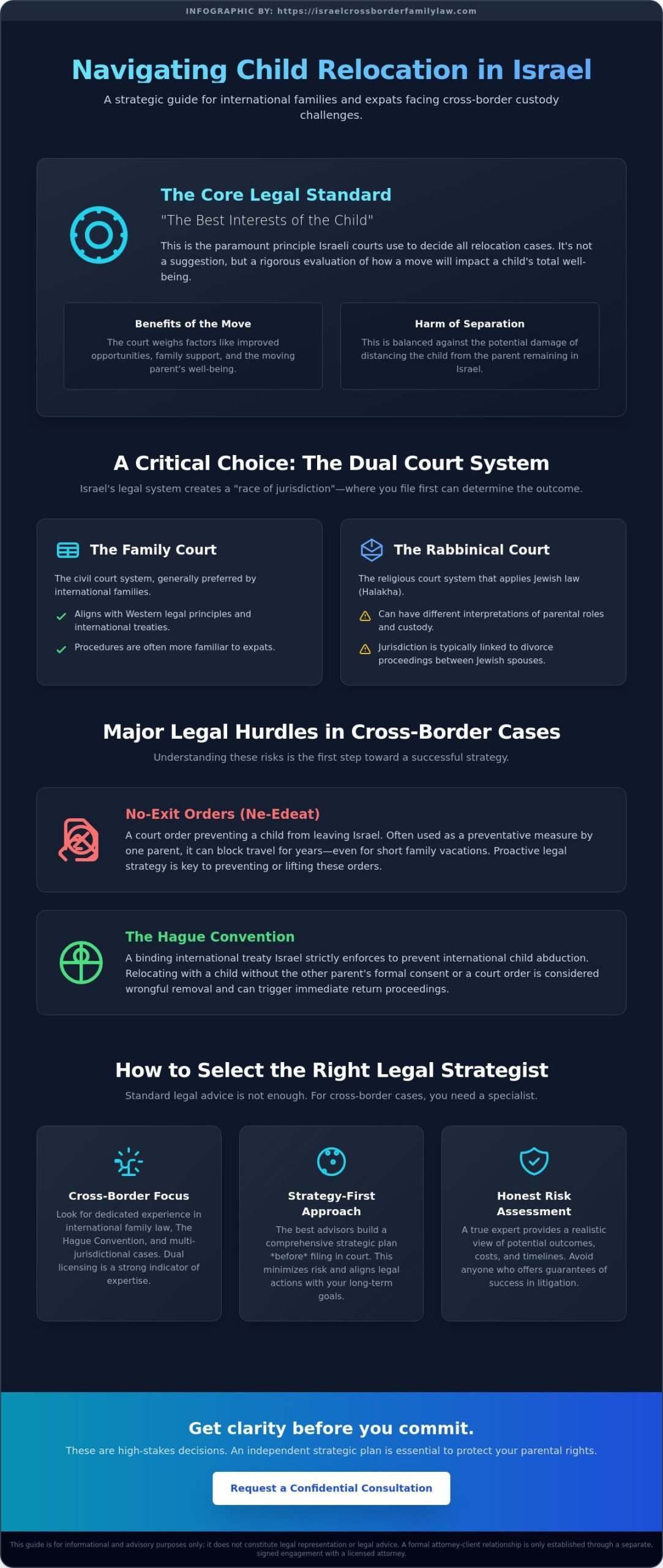
Strategy First: The Advisory Approach to Relocation
Relocation is more than a series of court filings; it’s a high-stakes strategic operation that requires careful planning before any formal legal action is taken. Many parents rush into signing a retainer with the first firm they find, only to realize later that they haven’t fully assessed the cross-border risks. The question of who is the best child relocation lawyer in israel is often answered by identifying a professional who prioritizes strategy over immediate litigation. Early decisions made in IL, such as how you communicate with the other parent or how you frame a temporary visit abroad, can permanently impact your legal standing. Without a roadmap, you risk making procedural errors that are difficult to correct once a case is active in the Family Court.
An independent advisory platform offers a distinct advantage compared to a traditional law firm. While a law firm focuses on representation in court, an advisory focuses on mapping out your options and identifying the risks of relocation litigation before you commit to a costly legal battle. This clarity ensures you don’t enter the Israeli legal system blindly. You need to understand the cultural and systemic differences in IL courts, where the “Best Interests of the Child” standard is applied with specific local nuances that might differ from your home country. Gaining this perspective early allows you to build a stronger case or, in some instances, find a negotiated solution that avoids the uncertainty of a judicial ruling.
Clarity Before Commitment
A confidential case review is the most effective way to evaluate your situation without the pressure of immediate litigation. This process allows you to vet potential legal representatives and understand the strengths and weaknesses of your relocation petition. By using an advisory model, you can gain a neutral perspective on who is the best child relocation lawyer in israel for your specific needs, rather than relying on a firm’s own marketing. Understanding the potential costs and timelines involved helps you make an informed choice. You can learn more about this process and how the advisory works to protect your interests and provide a clear path forward.
Next Steps for International Families
Building a successful relocation case file starts with meticulous documentation. You’ll need to gather evidence regarding your child’s schooling, medical needs, and the social support system awaiting them in the destination country. Avoiding common mistakes, such as making unilateral decisions that could be viewed as “wrongful removal” under the Hague Convention, is vital. The goal is to present a plan that minimizes conflict and demonstrates a clear, documented benefit to the child. Get clarity before you commit. Request a confidential consultation to discuss your strategic options with an international family law specialist.
Securing Your Family’s Future Across Borders
Navigating a child relocation request in Israel requires more than just standard legal filings. It demands a deep understanding of how local Family Court decisions interact with international treaties. By prioritizing a strategic plan before entering formal litigation, you can avoid the common pitfalls that lead to exit orders or prolonged disputes. Finding who is the best child relocation lawyer in israel for your specific situation involves identifying practitioners with specialized expertise in US-Israel cross-border family law and a dedicated focus on risk mitigation for expats.
Our advisory platform provides access to a network of multi-qualified practitioners who understand the unique challenges facing international families. Whether you’re just starting to consider a move or are already facing objections, gaining clarity on your legal standing is the first step toward a successful outcome. You don’t have to navigate these complex systemic differences without a roadmap. Taking the time to build a solid foundation now will protect your parental rights and your child’s well-being for years to come.
Get clarity before you commit. Request a confidential consultation.
Frequently Asked Questions
Can a parent move a child out of Israel without the other parent’s consent?
No, you cannot move a child out of Israel permanently without the written consent of the other parent or a formal court order. Israeli law establishes both parents as natural guardians with equal rights and duties. Attempting to relocate a child unilaterally is considered a breach of these rights and is often litigated as child abduction under international law.
What happens if I take my child out of Israel and the other parent files a Hague Convention claim?
If a child is removed without proper authorization, the other parent can file a petition for their immediate return under the Hague Convention. The court will focus on whether Israel was the child’s habitual residence and if the removal was wrongful. These cases move rapidly through the system and usually result in the child being ordered back to IL to resolve custody disputes locally.
How long does a child relocation case typically take in the Israeli Family Court?
A contested relocation case in the Israeli Family Court typically takes between 12 and 24 months to reach a final judgment. The process involves multiple stages, including the appointment of social workers and psychological experts to evaluate the family dynamic. Because of this lengthy timeline, many families ask who is the best child relocation lawyer in israel to help them explore faster, negotiated settlements.
What is the age of consent in IL for a child to decide where they want to live?
There is no fixed “age of consent” in Israel that allows a child to make the final decision regarding their residence. However, judges generally begin to hear and weigh a child’s preferences starting around age 10 or 12. The court assesses the child’s maturity and ensures their opinion is independent rather than the result of parental alienation or pressure.
Does the Israeli court always favor the mother in relocation and custody disputes?
No, the Israeli legal system has moved away from gender-based presumptions in custody and relocation matters. As of 2026, the “Tender Years Doctrine” which favored mothers for children under age six has been phased out. Courts now prioritize shared parenting and joint custody as the standard starting point, focusing solely on the best interests of the child in each specific case.
Can I enforce a US custody order regarding relocation in Israel?
A US custody order is not automatically enforceable in Israel and must be domesticated or ratified by an Israeli court first. You must file a petition for the recognition of a foreign judgment, proving that the order is final and that both parties were given a fair chance to present their case. This process is essential for expats who want their existing parental rights recognized within the IL legal landscape.
What are the costs associated with hiring a top relocation lawyer in IL?
The costs for handling a relocation case vary based on the intensity of the litigation and the number of expert evaluations required. These cases are among the most complex in family law because they involve international treaties and long term parenting plans. When identifying who is the best child relocation lawyer in israel, you should look for practitioners who provide transparent fee structures that reflect the multi-jurisdictional nature of the work.

Article by
Gabriel Lior
A Personal Journey That Became a Mission
The advisory was founded by an American father Gabriel Lior, LLB, MBA , global entrepreneur, and cross-border advisor who spent more than a decade navigating the Israeli family court system firsthand and now lives in Singapore with his son.
As a divorced parent in a cross-border family, Gabriel faced nearly every legal challenge a foreign parent can encounter in Israel — including child custody disputes, child support proceedings, property matters in Israel and abroad, false accusations, and complex immigration and relocation proceedings.
Over the years, he learned the hard way how difficult it is for non-Israeli parents to understand the system, identify the right legal strategy, and choose the right legal representation — especially when language, culture, and jurisdictional differences are involved. He also witnessed how foreign parents and new immigrants are often disadvantaged or taken advantage of by service providers and institutions simply because they lack local knowledge or fluency.
From Client to Advisor
To truly understand — and survive — the system, Gabriel pursued formal legal education in Israel, completing two Israeli law degrees, alongside a BA and MBA earned in the United States. This was never about becoming a practicing attorney, but about gaining a deep, structural understanding of how the system works — and where it breaks down for foreign parents.
This rare combination of:
Firsthand client experience
Israeli legal and US business education
International business and negotiation training
Decades of commercial execution
created a unique perspective – one that understands both sides of the table.
After years of litigation, persistence, and at times self-representation, he ultimately succeeded in securing custody of his son and relocating abroad through a rare legal victory in the Israeli Supreme Court — becoming one of the first fathers in Israel to do so under these circumstances.
Disclaimer
Important Disclaimer:
The information provided on this website and in its content is for general informational and educational purposes only and does not constitute legal advice, legal opinion, or legal representation.
Gabriel Lior is not licensed to practice law in Israel (nor is he interested in doing so) and does not provide legal services, despite having completed 2 Law Degrees. The services offered are advisory in nature and are intended to provide general guidance, strategic insight, and information regarding cross-border family law considerations.
No attorney-client relationship is formed by accessing this website, reading its content, or communicating with us.
Any decisions made based on this information are at your own discretion and risk. For legal advice specific to your situation, you should consult a licensed attorney in the relevant jurisdiction.
Where appropriate, we may refer clients to independent, licensed attorneys or professionals. Such referrals do not constitute legal representation and no liability is assumed for services provided by third parties.