What if the instinct to act immediately is exactly what jeopardizes your child’s return? In the high-stakes environment of international custody disputes between the US and Israel, the fastest reaction is often the one that creates a permanent legal obstacle. At Israel Cross Border Law Firm, we understand that navigating these complex situations requires expert guidance. Understanding the Common Mistakes Parents Make in Hague Cases is essential for any expat or international family facing this crisis. This content is designed to offer strategic decision-making guidance, drawing on our experience in cross-border family law.
It’s natural to feel a sense of panic and a desperate need to secure your child’s safety, but early decisions carry immense weight in the Israeli court system. We understand that the confusion between US and Israeli procedures can be overwhelming, especially when you fear losing access to your child. This guide promises to show you how to avoid the critical strategic and procedural errors that often derail return petitions. We’ll preview how to navigate the “Habitual Residence” trap, manage sensitive communications, and ensure you meet the strict evidentiary standards required to preserve your rights under the 1980 Hague Convention.
Key Takeaways
- Learn why “Habitual Residence” is a factual question of jurisdiction rather than a custody battle, and how misinterpreting this concept can jeopardize your legal standing.
- Identify the common mistakes parents make in Hague cases concerning the one-year rule to ensure the “now settled” defense is not used against you in an Israeli court.
- Understand the strict age 16 threshold and the specific documentation required to prove you held active “rights of custody” at the time of the child’s removal.
- Recognize the procedural weight of the Israeli Central Authority and the necessity of responding immediately to Hebrew-language legal documents and court summons.
- Gain insights into strategic behavioral choices, including the risks of social media activity and the importance of a composed approach during expedited cross-border litigation.
Understanding the Hague Convention: Why ‘Habitual Residence’ is the Core Concept
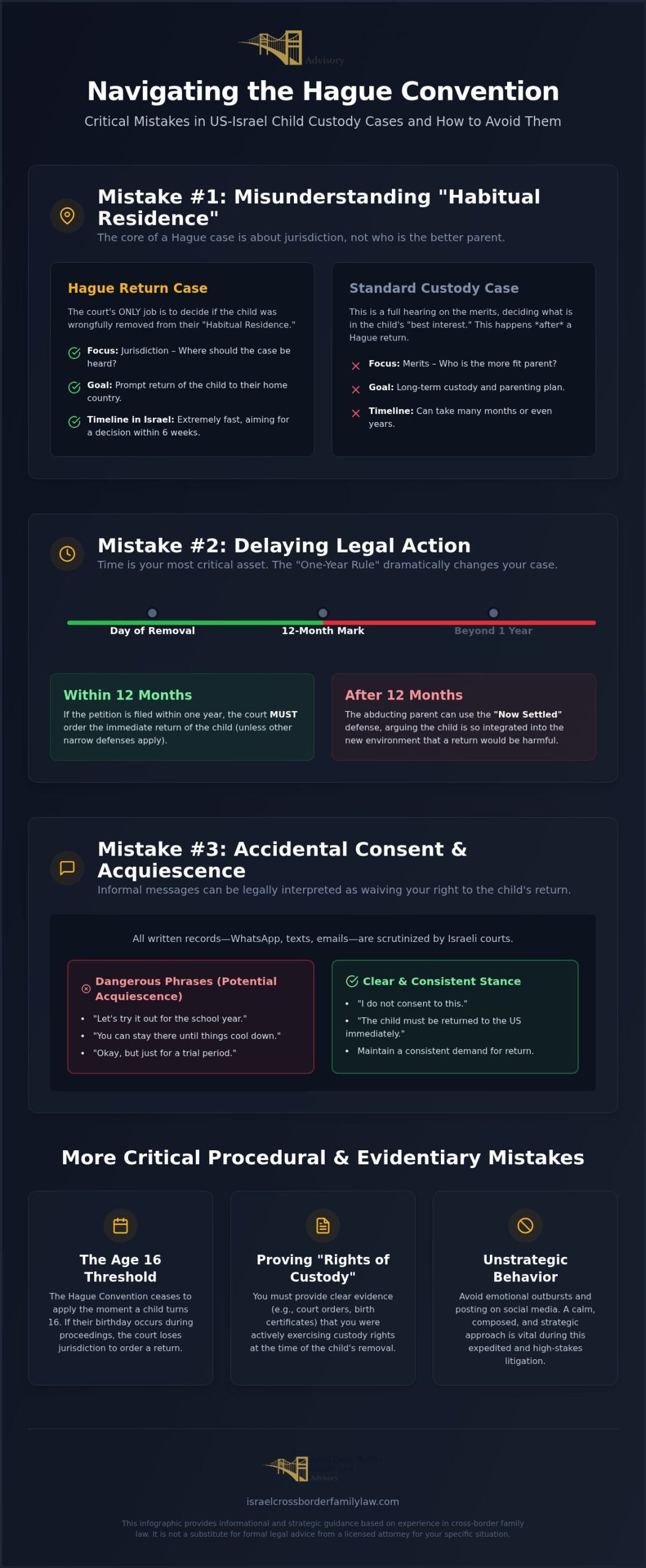
The 1980 Convention focuses on where the child’s “center of gravity” was located prior to the dispute. This is known as Habitual Residence. It is not a legal definition found in a passport or a residency visa; instead, it is a factual determination based on the child’s daily life, including school enrollment, medical history, and social integration. Understanding the Hague Convention requires recognizing that the treaty only applies to children under the age of 16. If a child reaches their 16th birthday during the proceedings, the court loses jurisdiction to order a return under this specific framework, regardless of the merits of the case.
The Difference Between Custody and Return
One of the Common Mistakes Parents Make in Hague Cases is treating the hearing like a standard custody trial. In an Israeli family court, the judge isn’t tasked with deciding which parent is more fit or which home offers a better lifestyle. The court’s role is strictly limited to a jurisdictional question: was the child wrongfully removed from their habitual residence, and should they be returned to that home state so the local courts there can decide custody? Because the scope is so narrow, the proceedings move quickly. Israeli courts aim for a final decision within six weeks, which means there’s no time for the deep psychological evaluations or parenting assessments typical of a domestic divorce case.
Accidental Consent and Acquiescence
Legal rights can be waived through informal communication faster than most parents realize. If you send a message suggesting that a child can stay in Israel “for a trial period” or “until things cool down,” you may be inadvertently consenting to a change in habitual residence. In legal terms, this is called acquiescence. Written records, including WhatsApp messages and emails, are heavily scrutinized in Israeli courts to determine if the left-behind parent agreed to the relocation. This is why managing your communication is vital from day one. You can find more detail on how these early choices impact your case in our guide to Hague Convention child abduction strategy. Maintaining a consistent demand for the child’s return is the only way to ensure your rights remain intact.
The Danger of Delay: How Timing Impacts the One-Year Rule
Time is the most critical asset in an international child abduction case. Under Article 12 of the Convention, as outlined by the Hague Conference on Private International Law, the court must order the immediate return of a child if the petition is filed within one year of the wrongful removal. Once that twelve-month window closes, the legal landscape shifts significantly. The abducting parent can then raise the “Now Settled” defense, arguing that the child has integrated into their new Israeli environment to such a degree that a return would be psychologically harmful.
One of the most frequent Common Mistakes Parents Make in Hague Cases is the belief that waiting for a child to settle down or trying to negotiate an amicable solution for several months is a safer strategy. In reality, every month of delay provides more evidence for the opposing side to claim the child has established a new life. This delay doesn’t just impact the legal mandatory return; it affects the child’s perception of where home truly is, making it harder for a judge to justify a sudden relocation back to the United States.
The 12-Month Threshold in Israel
Israeli courts prioritize the child’s immediate stability and view the passage of time through a lens of psychological attachment. Judges look for concrete evidence of integration, such as enrollment in local schools, participation in youth movements, and Hebrew language acquisition. Filing your petition immediately is a powerful signal to the court that you do not acquiesce to the move. While Israeli courts aim for a final decision within six weeks of filing, every week you wait before initiating the process makes that expedited timeline harder to maintain and strengthens the other parent’s position.
Why ‘Self-Help’ Measures Often Backfire
When faced with the fear of losing access to a child, some parents consider taking matters into their own hands. Attempting to physically retake a child is a dangerous error that can lead to criminal kidnapping charges in Israel. Such actions often result in the immediate loss of your rights under the 1980 Convention and can lead to permanent supervised visitation orders. It’s far more effective to utilize established Hague Convention legal channels to secure a court-ordered return. If you are unsure of your next steps, it’s wise to seek a strategic review before the one-year clock expires.
Common Evidentiary Errors: Documentation and the Age 16 Threshold
Success in an international return petition depends on the quality of your documentation rather than the volume of your emotional pleas. One of the most frequent Common Mistakes Parents Make in Hague Cases is failing to account for the age 16 threshold. The 1980 Convention is strictly limited to minors; its protections expire the moment a child turns 16. If your child is 15, every week of litigation matters. If they reach their 16th birthday while the case is still pending in an Israeli court, the petition will likely be dismissed because the court loses its treaty-based jurisdiction.
Another evidentiary hurdle involves proving “Rights of Custody” under the specific laws of the child’s home state. It isn’t enough to show you are a parent. You must demonstrate that you were actually exercising custody rights at the time of the removal. In Israel, this requires more than just an American court order; you need certified, apostilled documents and professional Hebrew translations. Presenting uncertified English documents is a strategic error that can cause significant delays in a system designed to move toward a final decision within six weeks.
Proving ‘Habitual Residence’ with Paperwork
To secure a child’s return, you must build a factual profile of their life in the United States before the removal. Israeli judges look for hard data rather than anecdotes. Essential evidence includes school attendance records, recent medical or dental appointments, and active lease agreements or utility bills in the home country. This documentation serves two purposes: it establishes the child’s factual center of life and helps demonstrate that any move to Israel was intended to be temporary. Understanding international custody laws is essential for framing these facts correctly, as the court must decide where the child was truly “at home” before the dispute began.
The ‘Grave Risk of Harm’ Defense
Under Article 13b, the court isn’t required to return a child if there’s a “grave risk” that doing so would expose them to physical or psychological harm. A common error is confusing this with a standard “best interests of the child” evaluation used in domestic custody cases. Israeli courts maintain a high bar for this defense. It requires clear and compelling evidence of a serious threat, not just a preference for the lifestyle or family support available in Israel. To counter these claims, you must be prepared to provide evidence that the home country remains safe and that local authorities in your US jurisdiction can provide any necessary protections upon the child’s return.
Navigating the Israeli Legal System: Cultural and Procedural Missteps
Many American parents arrive in the Israeli legal system assuming that because both nations are Western democracies, the court procedures will be identical. This is a significant misunderstanding that can lead to missed opportunities. Israeli family courts operate on a different procedural rhythm, particularly when handling international treaties. While US courts are strictly adversarial, Israeli judges often take a more active, inquisitorial role in the courtroom. One of the Common Mistakes Parents Make in Hague Cases is failing to account for the speed of the Israeli “Hague Track.” The system is designed to reach a final decision within six weeks of filing, a timeline that leaves very little room for administrative errors or late evidence submissions.
Ignoring a Hebrew-language summons or court order is perhaps the most dangerous procedural error a parent can make. In the Israeli system, legal documents served in Hebrew are considered binding from the moment of delivery, regardless of the recipient’s language proficiency. Failing to respond within the narrow windows provided by the court often results in default judgments. These rulings are difficult to overturn and can permanently alter the trajectory of a return petition. Success requires an immediate transition from a defensive posture to a proactive, strategically informed approach that respects the specific rules of the Israeli Family Court.
The Language Barrier and Official Translations
Google Translate is a useful tool for casual conversation, but it is entirely insufficient for evidence submitted to an Israeli judge. Every US-based document, from school records to previous custody orders, must undergo a formal process of notarized translation. The court requires certified accuracy to ensure that the nuances of American legal terms are correctly understood in a Hebrew context. For expats and foreign nationals, managing this paperwork is often the most demanding part of the process. Without professionally translated evidence, your claims regarding habitual residence or rights of custody may be dismissed as unsubstantiated, regardless of their factual truth.
Working with the Israeli Central Authority
The Israeli Central Authority, housed within the Ministry of Justice, serves as the essential bridge between the US State Department and the Israeli court system. Some parents make the mistake of trying to bypass this authority, thinking they can resolve the matter privately or through standard civil litigation. This is a tactical error. The Central Authority oversees the mandatory mediation attempts that are a prerequisite in these cases. These sessions are not a mere formality; they represent a high-stakes environment where the legal issues are narrowed and potential settlements are explored. Understanding how to present your case during these mandatory meetings is a vital component of your overall legal strategy. If you have received a summons or need to initiate a petition, you should request a confidential consultation to ensure your procedural steps are correct from day one.
Strategic Recovery: Avoiding Emotional Outbursts and Planning Your Next Steps
The emotional weight of an international child abduction case is staggering. However, allowing that emotion to dictate your public or digital presence is one of the most frequent Common Mistakes Parents Make in Hague Cases. Social media “venting” often backfires with devastating precision. Opposing counsel in Israel will search for any statement that suggests you’ve accepted the new living arrangement or that you’re emotionally unstable. Every post, comment, or photo can be translated and presented as evidence of your state of mind or your alleged acquiescence to the child’s relocation.
Maintaining a composed, professional demeanor is a strategic advantage in the Israeli courtroom. In cross-border litigation, judges often look for consistency and stability. An Anglo or expat parent who remains calm and focused on the legal requirements of the 1980 Convention presents a stronger case than one who appears reactive or aggressive. If you’ve already waited too long to file or made early errors, recovery is still possible through a disciplined pivot in strategy. This begins with a confidential case review to assess the current damage and map out a viable path forward.
Managing Communication with the Other Parent
Your dialogue with the other parent must be strictly controlled. Every email, text, and WhatsApp message should be treated as a potential court exhibit. Focus exclusively on the logistics of the child’s return and avoid the following pitfalls:
- Empty threats: Aggressive language can be used by the other side to support a “grave risk” defense under Article 13b.
- Admissions of defeat: Saying “just keep the child there” during an emotional argument can be interpreted as legal consent to a change in habitual residence.
- Inconsistency: Changing your demands weakens your argument that the removal was wrongful from the outset.
Use written records to document every instance where you’ve requested the child’s return and the other parent has refused. This creates a clear, undeniable timeline of non-acquiescence for the court.
Building Your Cross-Border Legal Team
A successful Hague petition requires a bridge between two distinct legal systems. You don’t just need an Israeli lawyer; you need a strategy that coordinates between your US-based counsel and your Israeli representatives. This coordination ensures that the evidence gathered in America meets the specific evidentiary standards of the Israeli Family Court. It also prevents conflicting statements in different jurisdictions, which is a common way parents inadvertently undermine their own credibility. Get clarity before you commit. Request a confidential consultation.
Securing Your Rights in US-Israel Cross-Border Disputes
Success in international return petitions depends on technical precision and immediate action rather than emotional appeals. The transition from the US to the Israeli legal system involves significant procedural shifts, from the strict one-year filing window to the technical definition of habitual residence. By understanding the Common Mistakes Parents Make in Hague Cases, you can avoid the strategic blunders that often lead to the permanent loss of jurisdictional rights. Whether you’re facing a recent removal or navigating the complexities of the Israeli Ministry of Justice, your approach must be rooted in hard evidence and a clear understanding of the 1980 Convention.
Our guidance is based on decades of multi-jurisdictional experience, providing a specialized strategy for US-Israel cross-border families. Navigating these high-stakes environments requires a steady hand and a bridge between divergent legal cultures. Don’t let administrative errors or delayed responses jeopardize your relationship with your child. Get clarity before you commit. Request a confidential consultation. You have the power to regain control of your legal narrative with the right strategic support.
Frequently Asked Questions
What is the most common mistake parents make in a Hague case?
The most frequent error is delaying the legal filing while attempting informal negotiations or waiting for the child to settle in. This delay directly enables the abducting parent to argue the child is now integrated into Israel. Among the Common Mistakes Parents Make in Hague Cases, this is the most damaging because it shifts the burden of proof and complicates the mandatory return requirement under Article 12.
Can I still file a Hague petition if I waited more than a year?
You can still file a petition after the 12-month mark, but the legal standard changes significantly. Once a year has passed, the Israeli court has the discretion to refuse a return if the child is “now settled” in their new environment. You’ll need to provide compelling evidence that the child’s integration is superficial or that the home country remains the factual center of their life.
Does the Hague Convention apply if my child is 17 years old?
No, the Hague Convention strictly ceases to apply once a child turns 16. If your child is 17, the treaty no longer provides a mechanism for a summary return. Any legal action regarding a 17-year-old must be handled through standard Israeli family law procedures or international custody relocation protocols rather than the expedited Hague track. This age limit is absolute and applies regardless of when the removal occurred.
Will the Israeli court consider my child’s preference to stay in Israel?
Israeli courts may consider a child’s objection to returning if the child has reached an age and degree of maturity where their views should be taken into account. This is a specific exception under Article 13. However, the court must ensure the child’s preference isn’t the result of parental alienation or pressure from the abducting parent. The judge will typically meet with the child privately to assess their maturity.
What happens if I try to take my child back from Israel myself?
Attempting to physically retake your child is a severe error that can lead to criminal kidnapping charges under Israeli law. These “self-help” measures often result in the immediate dismissal of your Hague petition and the loss of your legal standing. Such actions can lead to permanent supervised visitation orders and may even result in your arrest upon entering or exiting the country.
Is a US custody order automatically enforced in Israel under the Hague Convention?
A US custody order is not automatically enforced through a Hague petition. The Convention’s purpose is to return the child to their habitual residence so the original court can decide custody. While your US order helps prove you had “rights of custody” at the time of removal, the Israeli court won’t simply rubber-stamp a foreign custody arrangement. It focuses strictly on the legality of the child’s removal.
How long does a typical Hague Convention case take in Israel?
Under the treaty guidelines, Israeli courts aim to reach a final decision within six weeks of the petition being filed. While complex evidentiary issues or appeals can extend this timeline, the “Hague Track” is significantly faster than standard Israeli civil litigation. In 2024, Israel handled nearly one million new legal claims, yet Hague cases remain prioritized to ensure the swift resolution of international abduction disputes.
Do I need a lawyer in both the US and Israel for a Hague case?
While not strictly required by law, having coordinated strategy in both jurisdictions is highly beneficial. Your US lawyer ensures that evidence from the child’s home state is gathered correctly, while your Israeli counsel navigates the specific procedural rules of the Ministry of Justice. This collaborative approach helps prevent Common Mistakes Parents Make in Hague Cases, such as providing conflicting testimony in different courts.

Article by
Gabriel Lior
A Personal Journey That Became a Mission
The advisory was founded by an American father Gabriel Lior, LLB, MBA , global entrepreneur, and cross-border advisor who spent more than a decade navigating the Israeli family court system firsthand and now lives in Singapore with his son.
As a divorced parent in a cross-border family, Gabriel faced nearly every legal challenge a foreign parent can encounter in Israel — including child custody disputes, child support proceedings, property matters in Israel and abroad, false accusations, and complex immigration and relocation proceedings.
Over the years, he learned the hard way how difficult it is for non-Israeli parents to understand the system, identify the right legal strategy, and choose the right legal representation — especially when language, culture, and jurisdictional differences are involved. He also witnessed how foreign parents and new immigrants are often disadvantaged or taken advantage of by service providers and institutions simply because they lack local knowledge or fluency.
From Client to Advisor
To truly understand — and survive — the system, Gabriel pursued formal legal education in Israel, completing two Israeli law degrees, alongside a BA and MBA earned in the United States. This was never about becoming a practicing attorney, but about gaining a deep, structural understanding of how the system works — and where it breaks down for foreign parents.
This rare combination of:
Firsthand client experience
Israeli legal and US business education
International business and negotiation training
Decades of commercial execution
created a unique perspective – one that understands both sides of the table.
After years of litigation, persistence, and at times self-representation, he ultimately succeeded in securing custody of his son and relocating abroad through a rare legal victory in the Israeli Supreme Court — becoming one of the first fathers in Israel to do so under these circumstances.
Disclaimer
Important Disclaimer:
The information provided on this website and in its content is for general informational and educational purposes only and does not constitute legal advice, legal opinion, or legal representation.
Gabriel Lior is not licensed to practice law in Israel (nor is he interested in doing so) and does not provide legal services, despite having completed 2 Law Degrees. The services offered are advisory in nature and are intended to provide general guidance, strategic insight, and information regarding cross-border family law considerations.
No attorney-client relationship is formed by accessing this website, reading its content, or communicating with us.
Any decisions made based on this information are at your own discretion and risk. For legal advice specific to your situation, you should consult a licensed attorney in the relevant jurisdiction.
Where appropriate, we may refer clients to independent, licensed attorneys or professionals. Such referrals do not constitute legal representation and no liability is assumed for services provided by third parties.