Did you know that the specific courthouse you enter first could fundamentally change how your US-based retirement accounts or Israeli property are divided? For many expats and international families, getting a divorce in israel as a foreigner feels like navigating a maze where the rules change depending on who reaches the court clerk first. You likely feel the weight of these early decisions, especially when your residency status and global assets are on the line. This uncertainty is a natural response to a legal system that operates quite differently from those in the US or Europe.
This article, published on an independent advisory platform, provides a clear roadmap to help you navigate these complexities and protect your international interests. We’ll explain the mandatory 60-day dispute resolution period, the critical differences between the Rabbinical and Family court systems, and how to safeguard assets located outside of IL. By understanding the strategic risks and legal frameworks involved, you can move forward with the clarity needed to maintain your status and financial security. For more detailed visual guidance on these procedures, you can explore the resources at https://www.youtube.com/@IsraelFamilyLaw.
Key Takeaways
- Understand that this guide is provided by an independent advisory platform to help you navigate cross-border strategy and risk management rather than providing formal legal representation.
- Distinguish between the jurisdictional roles of the Family Court and the Rabbinical Court to see how religious and civil authorities intersect in your specific case.
- Learn how the principle of Balancing of Resources applies to global assets when getting a divorce in israel as a foreigner, ensuring your international interests are correctly valued.
- Identify the immediate risks to your residency or visa status and the necessary protocols for maintaining your legal standing with the Population and Immigration Authority.
- Recognize the weight of early decisions in the “Race for Jurisdiction,” where the first court seized of an issue typically retains authority over the proceedings.
The Dual Court System: Religious vs. Civil Authority in Israel
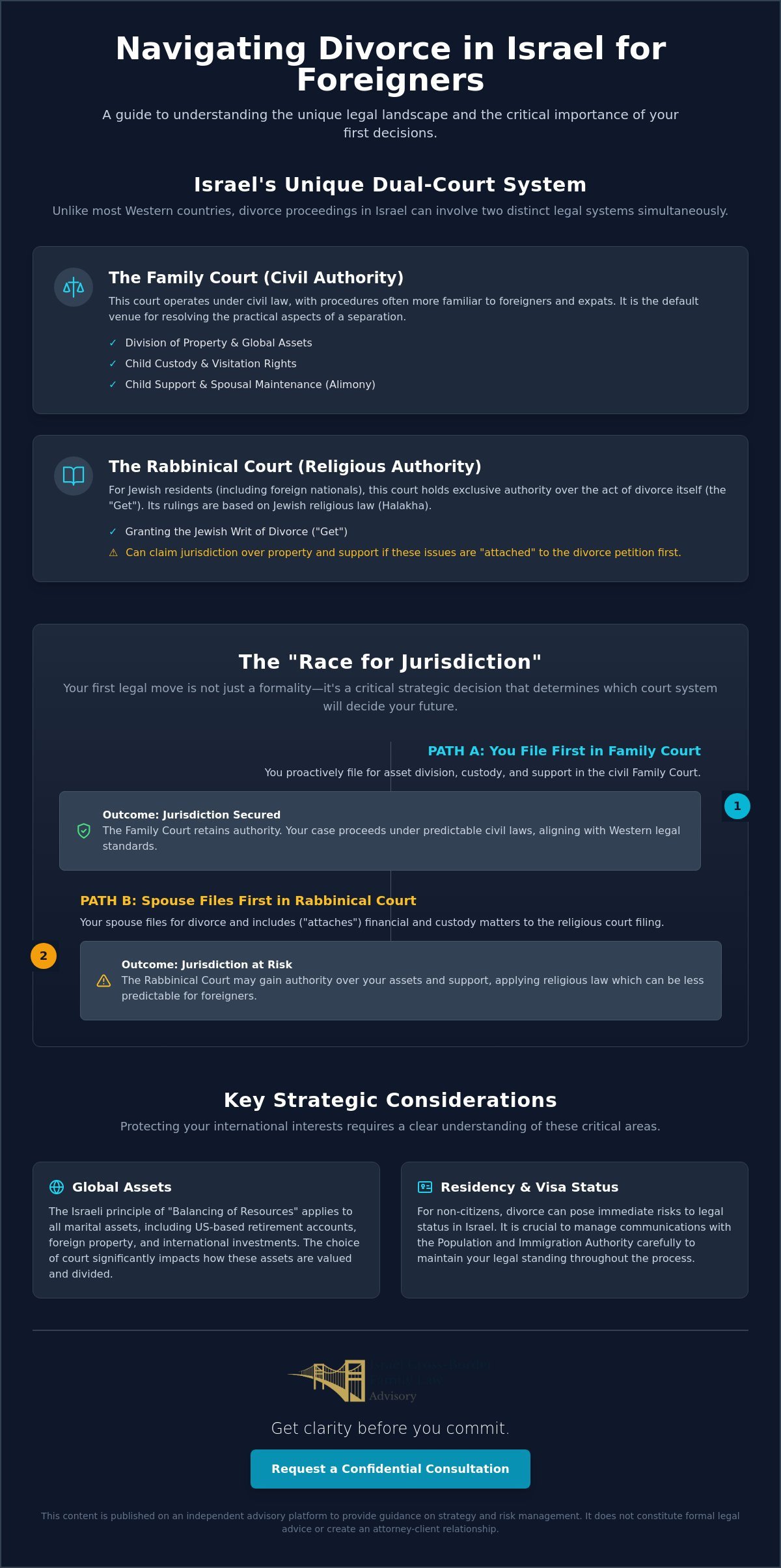
Israel’s legal framework for domestic relations is unique and often surprises those from Western jurisdictions. Unlike many nations, there is no civil marriage performed within the country. This creates a complex overlap between religious vs. civil authority in Israel. For those getting a divorce in israel as a foreigner, this means your case may be heard in two different types of courts simultaneously, each operating under distinct legal philosophies.
It’s vital to clarify that throughout this guide and all related legal documentation, “IL” refers exclusively to the State of Israel. This content is published on an independent advisory platform and focuses on strategy and risk management rather than an attorney-client relationship. Whether you were married in a religious ceremony or a civil one abroad, the Israeli system will categorize you based on your recognized religious affiliation. This categorization determines which court has the power to dissolve the marriage bond itself.
To better understand this concept, watch this helpful video:
When the Rabbinical Court Takes Jurisdiction
The Rabbinical Court holds exclusive authority over the marriage and divorce of Jewish residents in IL, including foreign nationals. Even if you were married in a civil ceremony in Las Vegas or London, the Rabbinical Court may still claim jurisdiction over the “Get” (the Jewish writ of divorce) if both parties are Jewish and reside in Israel. For non-Jewish foreigners, similar authority rests with their respective religious courts, such as the Sharia courts for Muslims or recognized Christian ecclesiastical courts. This religious authority focuses primarily on the status of the marriage itself rather than the financial split.
The Family Court: A Civil Alternative
While the religious courts handle the “divorce” in a spiritual sense, the Family Court serves as the civil alternative for practical matters. Foreigners often find the Family Court more approachable because its procedural norms align more closely with Western legal systems. This court manages issues such as:
- Child custody and visitation rights.
- Child support and spousal maintenance.
- The division of property and international assets.
Because of this dual structure, it’s common for different parts of the same divorce to be handled by different courts. For more information on how this affects specific populations, you can read more about our services for expats and foreign nationals. Seeking clarity on which court will handle which issue is the first step in getting a divorce in israel as a foreigner while protecting your international interests.
The “Race for Jurisdiction”: Why Your First Move is Critical
In the Israeli legal landscape, the timing and location of your initial filing aren’t merely administrative details; they are decisive strategic choices. This phenomenon is known as the “Race for Jurisdiction,” or Meroz Samchuyot. When getting a divorce in israel as a foreigner, you must understand that the first court to be “seized” of a specific issue typically retains the exclusive authority to decide on it. If your spouse files a divorce petition in the Rabbinical Court and explicitly includes (or “attaches”) matters like property division or alimony, that religious court may gain the right to rule on those issues according to religious law.
Conversely, if you file for those same civil matters in the Family Court first, the civil system maintains jurisdiction. Waiting for your spouse to act can leave you vulnerable to a court system whose traditional values or procedural norms may not align with your expectations or international interests. However, speed shouldn’t lead to haste. Strategic clarity is paramount because once a court is seized of an issue, moving it to another jurisdiction is extremely difficult and costly. This article is published on an independent advisory platform and focuses on strategic decision-making rather than formal legal advice.
Tactical Filing in the Family Court
For many foreign nationals, the Family Court is the preferred venue for managing the practical fallout of a marriage breakdown. This civil court operates under principles that often mirror Western legal standards, particularly regarding child support and the equitable division of international assets. By filing first in the Family Court, you can secure civil oversight for complex financial interests, such as US-based 401(k) plans or European real estate. You can effectively “attach” these related issues to your primary claim, ensuring they are decided through a lens of civil law rather than religious doctrine. This proactive approach prevents the religious court from deciding on matters they may view through a more traditional or restrictive lens.
When the Rabbinical Court is Strategically Advantageous
While many expats lean toward civil courts, there are specific scenarios where the Rabbinical Court might offer a more favorable framework for certain property or support issues. The religious system also places significant weight on the “Get” (the Jewish writ of divorce), which can sometimes serve as a point of leverage during broader negotiations. Deciding between these two paths requires a nuanced understanding of how each court views your specific marital history and assets. Consulting a cross-border family lawyer can help you weigh these options before any documents are signed or commitments are made.
Because every case involves unique risks to your residency and global wealth, it’s helpful to request a confidential case review to understand your specific standing before taking action. Early decisions in IL carry significant weight, and obtaining clarity on the “how” is often more important than the speed of the “action” itself.
Financial Implications: Managing Cross-Border Assets and Alimony
The financial resolution of a marriage in IL is primarily governed by the Spouses’ Property Relations Law, 1973. This statute establishes a default “Balancing of Resources” principle, which dictates that assets acquired during the marriage are generally divided equally upon dissolution. When you’re getting a divorce in israel as a foreigner, this includes not just local bank accounts, but also international holdings such as US-based real estate, European investment portfolios, and global business interests. This article is published on an independent advisory platform and provides strategic guidance on managing these multi-jurisdictional complexities.
One of the most significant risks for international families is the potential for “double dipping.” This occurs when one spouse attempts to litigate the same asset in two different countries, leading to conflicting judgments and massive legal expenses. Israeli courts have the authority to include foreign assets in the balancing process, yet enforcing these orders abroad requires a sophisticated understanding of international treaties. Drafting a comprehensive divorce agreement that a court in your home country will actually recognize is a critical step in protecting your long-term financial interests.
Alimony and Child Support Across Borders
In the Israeli system, spousal support is often categorized as “Wife Alimony” (Mezonot Isha), a concept rooted in religious law that typically lasts only until the final divorce decree is issued. This differs significantly from the long-term spousal maintenance common in many Western countries. Child support, however, has seen a major shift toward gender-neutral obligations. The courts now place greater emphasis on the relative income of both parents and the actual time the children spend in each household. For those with income or assets in the US, understanding child support cross-border enforcement is essential to ensure that payments remain fair and enforceable across different legal systems.
Protecting Foreign Pensions and Business Interests
Valuing a foreign business or a specialized retirement account, such as a 401(k) or a high-tech stock option plan, presents unique challenges for an Israeli court. There is a growing trend in 2026 for family law practitioners to utilize specialized asset valuation methods for future rights and career assets. You should be cautious about early financial disclosure; while transparency is required, doing so without a clear strategy for how those assets are characterized can lead to an inequitable split. If you have a prenuptial or postnuptial agreement from another country, its validity in IL must be carefully examined to see if it can serve as a shield for your pre-marital wealth. Obtaining clarity on these financial risks before making formal court commitments is the most effective way to safeguard your global estate.
Residency and Visa Status: The Foreigner’s Dilemma
For many, getting a divorce in israel as a foreigner carries a risk far beyond financial loss: the potential loss of legal residency. Most foreign spouses reside in IL under the “Graduated Procedure” (Shlag), a multi-year process intended to lead to permanent residency or citizenship. When the marriage bond dissolves, the legal basis for your stay often dissolves with it. This article is published on an independent advisory platform and focuses on the strategic risks to your status rather than providing formal legal representation.
Divorce typically triggers an immediate review of your file by the Population and Immigration Authority (Misrad HaPnim). You’re legally required to notify them of your separation. While this notification can feel like a step toward deportation, failing to report a change in status can be viewed as bad faith or even fraud. Such a mistake complicates any future applications for status. Maintaining legal status while the divorce is pending in court requires a proactive strategy that balances your family law case with immigration requirements.
Steps to Regularize Status After Divorce
Regularizing your status requires a methodical approach that prioritizes transparency and timing. You’ll need to follow these specific steps to protect your standing:
- Formal notification: You must inform the immigration authority of the separation as soon as it occurs.
- Eligibility assessment: Evaluate your standing based on the length of your residency in IL or the presence of children who are citizens.
- Humanitarian application: Prepare a detailed petition for the Inter-Ministerial Committee, which reviews cases on humanitarian grounds.
Impact of Children on Residency Rights
The presence of children who are Israeli citizens fundamentally changes the humanitarian outlook. The state generally recognizes the importance of a child maintaining a relationship with both parents within the country. Decisions regarding international custody and relocation often play a pivotal role here. If a court rules that the children must remain in Israel, your argument for staying to co-parent becomes much stronger. You’ll need to provide “center of life” evidence, such as employment records, tax documents, and social ties, to prove your integration into Israeli society.
If you’re concerned about how your change in marital status will impact your right to remain in IL, it’s wise to speak with an advisor about your residency options before your current visa expires.
Strategic Decision-Making: Protecting Your Future
Approaching the end of a marriage while living abroad requires a shift in perspective. You shouldn’t view the process as a standard legal procedure, but rather as a high-stakes strategy game. When you’re getting a divorce in israel as a foreigner, the decisions you make in the first 30 days often dictate your financial and personal standing for the next decade. Success in this environment isn’t about being the most aggressive party in the room. Instead, it’s about obtaining total clarity on “The How” before you take “The Action.”
This content is published on an independent advisory platform and is designed for educational purposes. It does not constitute an attorney-client relationship, and formal legal services are only provided by licensed practitioners under a separate engagement. For those who prefer a visual breakdown of these complex jurisdictional rules, we encourage you to view the detailed explanations available on our YouTube channel: https://www.youtube.com/@IsraelFamilyLaw. Seeing these concepts mapped out can help demystify the intersection of religious and civil law.
Avoiding Common Pitfalls for Anglos
Many expats from the US, UK, or Canada fall into the trap of applying “Western” logic to the Israeli legal theater. You might expect a “no-fault” system or standardized alimony formulas that simply don’t exist here in the same way. A common and dangerous pitfall is signing a “simple” divorce agreement to “just get it over with.” These documents often lack the sophisticated language required to satisfy foreign tax authorities or pension administrators. If an agreement isn’t drafted with cross-border review, you may find that your Israeli decree is unenforceable regarding your assets back home.
Another risk involves the Rabbinical court. Once a religious court issues a ruling on a matter you’ve consented to, reversing that decision in a civil court is nearly impossible. You must understand the finality of these proceedings before you walk into the courtroom. The Israeli system rewards those who are prepared and punishes those who assume the rules of their home country will apply in IL.
Next Steps: Getting Clarity
Your path forward should begin with a structured assessment of your specific risks and opportunities. You can prepare for this by requesting a confidential case review to map out your jurisdictional standing. Understanding the pricing and process of international legal advisory will also help you budget for the complexities ahead. While the road is undoubtedly challenging, you don’t have to navigate this complexity alone. With the right strategic roadmap, you can protect your global interests and secure your future in IL or wherever your next chapter begins.
Get clarity before you commit. Request a confidential consultation.
Securing Your Global Interests in the Israeli System
Successfully managing the end of a marriage in IL requires a sophisticated understanding of how local religious and civil authorities interact with your international life. We’ve addressed the critical importance of the “Race for Jurisdiction” and the unique risks that residency status poses to foreign spouses. When getting a divorce in israel as a foreigner, your strategy must account for the valuation of global assets and the enforcement of support orders across borders. This independent advisory platform focuses on providing the Anglo community with calm, authoritative guidance on these high-stakes issues.
By seeking clarity on the differences between the Family Court and the Rabbinical Court before you file, you can better protect your US-based pensions and real estate interests. Specialized expertise in US-Israel family law is essential for navigating the inherent complexity of cross-border litigation. Get clarity before you commit. Request a confidential consultation to evaluate your options. While this transition is undoubtedly challenging, an informed and strategic approach allows you to secure your financial future and personal peace of mind.
Frequently Asked Questions
This FAQ section is provided by an independent advisory platform and does not constitute formal legal advice or an attorney-client relationship. It is designed to help you understand the strategic landscape of the Israeli legal system.
Can I get a divorce in Israel if I am not a citizen?
Yes, you can proceed with a divorce in IL even if you aren’t a citizen. The Israeli court system holds jurisdiction over anyone who is a legal resident of the country at the time of filing. When getting a divorce in israel as a foreigner, you’ll navigate the same dual-court system as citizens. This involves either the civil Family Court or a religious court based on your specific affiliation. Your residency, not your passport, determines the court’s authority.
What happens to my B/1 or A/5 visa if I divorce my Israeli spouse?
Your residency status is directly tied to your marriage through the “Graduated Procedure.” Once the marriage ends, the legal basis for your B/1 or A/5 visa typically expires. You must notify the Population and Immigration Authority of your separation immediately to avoid claims of bad faith. To remain in IL, you’ll likely need to submit an application to the Inter-Ministerial Committee for humanitarian cases, especially if you have children who are citizens.
Does the Rabbinical Court have authority over me if I am not Jewish?
The Rabbinical Court only has exclusive jurisdiction over the marriage and divorce of Jewish couples. If you aren’t Jewish, your divorce will be handled by your specific religious court, such as a Sharia or Christian ecclesiastical court. If you have no recognized religious affiliation in IL, or if you are in a mixed-religion marriage, the civil Family Court typically handles the dissolution. Understanding which court holds authority over your status is a critical first step.
How is property divided in Israel if it was purchased before the marriage?
Under the Spouses’ Property Relations Law of 1973, property owned before the marriage is generally considered separate and is not divided. However, if that property was “assimilated” into the joint marital estate, a court might rule it should be shared. This often happens with a family home where both spouses lived and contributed to the mortgage. This is a complex area where early strategic decisions regarding asset disclosure and characterization are vital for protecting your wealth.
Can I move back to my home country with my children after an Israeli divorce?
You cannot legally relocate children abroad without the written consent of the other parent or a specific order from the Family Court. Israel has been a party to the Hague Convention on International Child Abduction since 1991. Taking a child out of IL without authorization is considered international abduction. You must obtain a relocation ruling that proves the move is in the child’s best interest before leaving. These cases require significant evidence of your “center of life.”
Is a US prenuptial agreement valid in an Israeli divorce?
A US prenuptial agreement may be recognized in IL, but it must meet specific criteria to be enforceable. Israeli law requires that such agreements be “validated” by a court or a notary to ensure both parties understood the terms and signed freely. If your agreement wasn’t properly validated in IL, its terms might be challenged during property division proceedings. Seeking a cross-border review of your foreign documents is highly recommended to ensure your international interests remain protected.
How long does the divorce process typically take for foreigners in Israel?
The timeline depends heavily on whether the divorce is contested or consensual. An uncontested divorce, where both parties agree on all terms, is typically finalized within 3 to 6 months. In contrast, a contested case involving complex property division or custody disputes can take between 2 to 5 years to resolve. Getting a divorce in israel as a foreigner requires patience and a clear roadmap to manage these varying timelines and the mandatory 60-day dispute resolution period.

Article by
Gabriel Lior
A Personal Journey That Became a Mission
The advisory was founded by an American father Gabriel Lior, LLB, MBA , global entrepreneur, and cross-border advisor who spent more than a decade navigating the Israeli family court system firsthand and now lives in Singapore with his son.
As a divorced parent in a cross-border family, Gabriel faced nearly every legal challenge a foreign parent can encounter in Israel — including child custody disputes, child support proceedings, property matters in Israel and abroad, false accusations, and complex immigration and relocation proceedings.
Over the years, he learned the hard way how difficult it is for non-Israeli parents to understand the system, identify the right legal strategy, and choose the right legal representation — especially when language, culture, and jurisdictional differences are involved. He also witnessed how foreign parents and new immigrants are often disadvantaged or taken advantage of by service providers and institutions simply because they lack local knowledge or fluency.
From Client to Advisor
To truly understand — and survive — the system, Gabriel pursued formal legal education in Israel, completing two Israeli law degrees, alongside a BA and MBA earned in the United States. This was never about becoming a practicing attorney, but about gaining a deep, structural understanding of how the system works — and where it breaks down for foreign parents.
This rare combination of:
Firsthand client experience
Israeli legal and US business education
International business and negotiation training
Decades of commercial execution
created a unique perspective – one that understands both sides of the table.
After years of litigation, persistence, and at times self-representation, he ultimately succeeded in securing custody of his son and relocating abroad through a rare legal victory in the Israeli Supreme Court — becoming one of the first fathers in Israel to do so under these circumstances.
Disclaimer
Important Disclaimer:
The information provided on this website and in its content is for general informational and educational purposes only and does not constitute legal advice, legal opinion, or legal representation.
Gabriel Lior is not licensed to practice law in Israel (nor is he interested in doing so) and does not provide legal services, despite having completed 2 Law Degrees. The services offered are advisory in nature and are intended to provide general guidance, strategic insight, and information regarding cross-border family law considerations.
No attorney-client relationship is formed by accessing this website, reading its content, or communicating with us.
Any decisions made based on this information are at your own discretion and risk. For legal advice specific to your situation, you should consult a licensed attorney in the relevant jurisdiction.
Where appropriate, we may refer clients to independent, licensed attorneys or professionals. Such referrals do not constitute legal representation and no liability is assumed for services provided by third parties.