What if the ultimate outcome of your financial future depends less on the merits of your case and more on which court building you enter first? For members of the US expat community, the intersection of American and Israeli law often creates a sense of profound uncertainty, especially when religious and civil jurisdictions collide. You likely recognize that the “race to court” in Israel isn’t just a legal theory; it’s a high-stakes reality that demands immediate strategic clarity. Understanding the nuances of israeli spousal support for us residents requires more than just a basic translation of laws. It requires a bridge between two distinct legal cultures and a clear-eyed look at the risks involved.
This article provides a comprehensive roadmap for addressing these complexities with the guidance of Anastasia Fux. Published on an independent advisory platform, this guide focuses on strategy and risk management rather than formal legal representation. We’ll examine the eligibility requirements for spousal support, the challenges of enforcing US support orders within the Israeli system, and the strategic advantages of mediation. By the end of this guide, you’ll have a clearer perspective on how to protect your assets and maintain control over your transition. This ensures your decisions are grounded in expert advisory rather than fear.
Key Takeaways
- Learn how Anastasia Fux leverages 21 years of litigation experience to guide US expats through the “race to court” and complex jurisdictional overlaps.
- Understand the critical differences between Israeli Mezonot Ishah and US alimony, focusing on how israeli spousal support for us residents is influenced by personal status.
- Identify why the mandatory mediation process in Israel is a vital opportunity to resolve disputes before they escalate into high-risk litigation.
- Gain a strategic roadmap for managing the complexities of enforcing cross-border support orders and navigating Israeli financial reporting requirements.
- Discover how to evaluate legal counsel based on their ability to act as a bridge between the Israeli legal landscape and the specific needs of international families.
Who is Anastasia Fux? An Overview of Her Cross-Border Practice
Esther Anastasia Fux operates as a dedicated legal bridge in Tel Aviv, specifically for individuals caught between different legal systems. She is licensed by the Israel Bar Association and brings over 21 years of litigation experience to her practice. Her work isn’t limited to a single niche; she maintains a multidisciplinary focus that includes family, corporate, and real estate law. This broad perspective is essential when handling israeli spousal support for us residents, as financial support often intersects with complex property and business interests.
Navigating the Israeli legal landscape requires more than just knowing the rules. It requires a strategic understanding of how those rules apply to international families. Anastasia Fux has established her practice as an advisory resource for the English, Hebrew, and Russian-speaking communities, ensuring that language is never a barrier to clarity.
To better understand the fundamentals of support and divorce in this jurisdiction, watch this helpful video:
Professional Credentials and Experience
Anastasia Fux is admitted to the Israel Bar with a concentrated focus on civil and family litigation. Her experience spans both the secular Family Courts and the religious Rabbinical Courts, a dual system that often confuses those accustomed to US legal structures. This deep familiarity with both jurisdictions allows her to guide clients through the “race to court” complexity. As a certified mediator, she prioritizes alternative dispute resolution to help clients maintain control over their outcomes. This is particularly relevant for matters involving the Hague Convention on International Recovery of Child Support, which governs how support orders are recognized and enforced between Israel and the United States. Her background ensures that every case is handled with a view toward long-term stability.
The Multilingual Advantage for US Residents
For US expats, direct communication in English is a necessity. Anastasia Fux provides this direct line, eliminating the risks associated with third-party translators who may miss legal subtleties. Her practice is built on a foundational understanding of the cultural nuances that US nationals bring to the table. She works to bridge the gap between American legal expectations and the specific jurisdictional realities of the Israeli system. By providing a clear roadmap, she helps international families navigate these differences without the added stress of a language barrier. For more information on how this process works, you can read more about the advisory. This culturally aware approach allows for a more nuanced strategy when addressing israeli spousal support for us residents and other sensitive family matters.
Israeli Spousal Support for US Residents: Key Legal Concepts
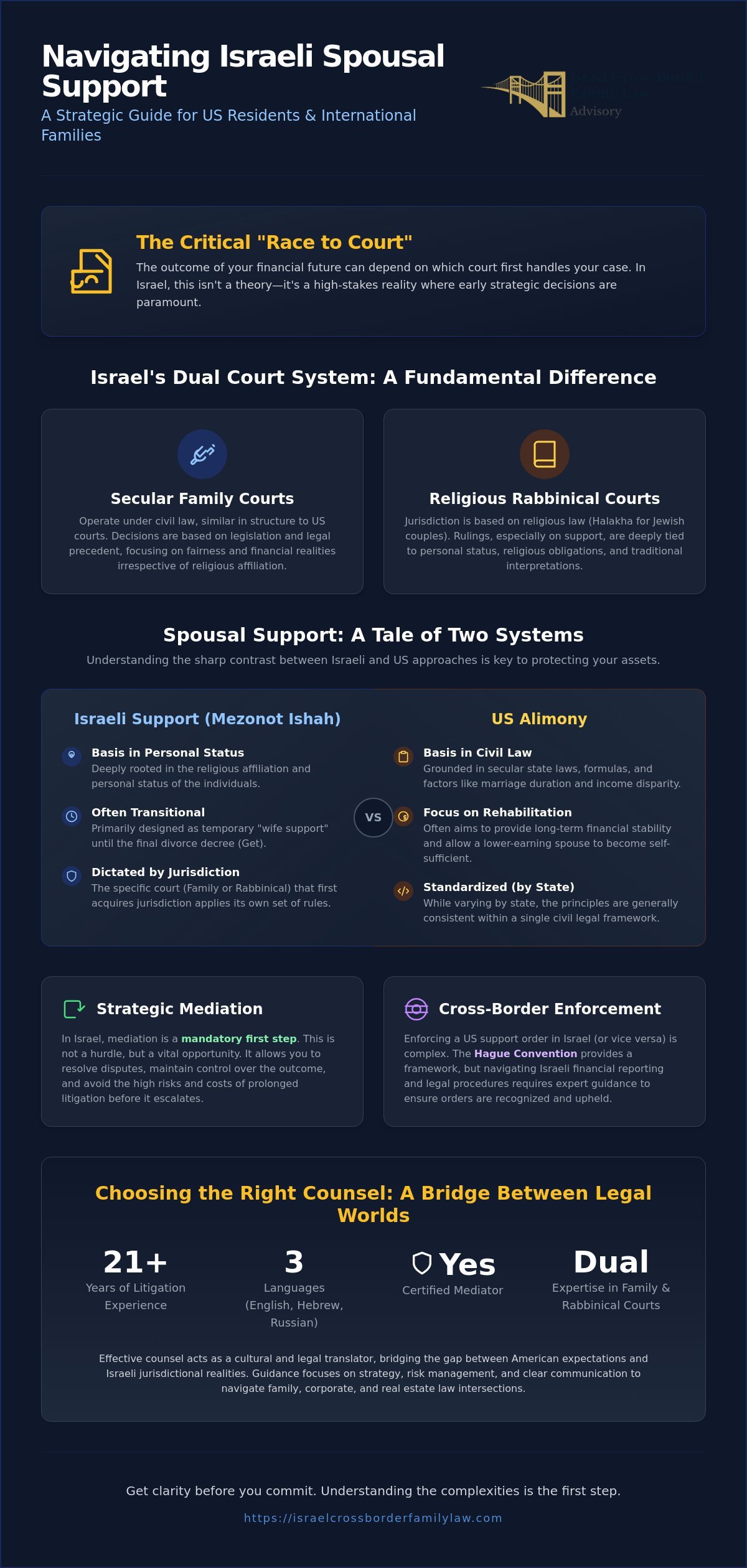
Understanding israeli spousal support for us residents requires a departure from the familiar framework of American alimony. In Israel, the concept is primarily defined as Mezonot Ishah, which translates to “wife support.” Unlike many US jurisdictions where alimony is designed to provide long-term financial rehabilitation, Israeli support is often transitional. It’s deeply rooted in the personal status of the individuals involved. This means that a person’s religious affiliation and the specific court that first acquires jurisdiction will fundamentally dictate the legal standards applied to the case.
Mezonot Ishah vs. US Alimony
The duration and eligibility for support under Israeli law differ sharply from US standards. While US alimony might last for years or even indefinitely based on the length of the marriage, Mezonot Ishah is generally tied to the duration of the legal marriage itself. It typically terminates upon the finalization of the divorce or the granting of the Get (religious divorce decree). This creates a high-stakes environment known as the “race to court,” or Marotz Hasmuchuyot. In this scenario, the party who files first in either the Family Court or the Rabbinical Court can lock in a jurisdictional advantage that impacts the support calculation. For those living abroad or maintaining ties to multiple countries, seeking specialized guidance for expats and foreign nationals is a critical step in managing these early, high-weight decisions.
Cross-Border Asset Considerations
For US residents, the financial picture is rarely confined to a single country. Israeli courts must often consider property located in the US, such as 401(k) plans, real estate, or corporate interests, when determining support and asset balancing. Anastasia Fux provides strategic analysis on how these international assets influence support outcomes. Protecting these interests often involves the use of a Heskem Mamon, or Financial Agreement, which serves as a pre- or post-nuptial contract recognized by Israeli law. These agreements are vital for ensuring that US-based income and assets are not unfairly weighted in local proceedings. Additionally, the U.S.-Israel Support Enforcement Agreement provides a formal framework for how these obligations are recognized across borders. The interplay of the US-Israel Tax Treaty also plays a significant role, as it can influence the net value of support payments received or paid across jurisdictions. If you have questions about how your specific financial profile might be assessed, you may find it helpful to request a confidential consultation to review your options.
The Strategic Importance of Mediation in Support Disputes
In Israel, the path to resolving family disputes often begins long before a judge hears the case. The legal system mandates a preliminary phase known as Mahut (Information, Coordination, and Success Meetings). For those navigating israeli spousal support for us residents, this mandatory mediation period serves as a critical strategic window. Rather than a mere procedural formality, these meetings provide an opportunity to de-escalate tensions before the formal “race to court” reaches a point of no return. Anastasia Fux leverages her 21 years of experience to transform these sessions into a platform for protecting international assets and maintaining control over the final outcome.
Litigation in Israel can be rigid, particularly when religious and civil jurisdictions overlap. By choosing mediation, cross-border families avoid the risk of having a court impose a standard ruling that may not account for the complexities of a US-based financial profile. Successful mediation prevents the enforcement of generic support orders that fail to consider the nuances of international tax treaties or foreign-sourced income. It’s a method that prioritizes long-term stability over short-term legal victories.
Why Mediation Works for International Families
International litigation is notoriously expensive and emotionally draining. Multi-year disputes across two legal systems can deplete marital assets significantly. Mediation offers a more efficient alternative. It allows for the creation of customized support solutions that an Israeli court might not traditionally provide, such as specific arrangements for US retirement accounts or education funds. For English speakers, conducting these discussions in their native language ensures that every financial detail is fully understood. This transparency is essential for reaching a stable agreement that both parties can realistically uphold. It’s about finding clarity before making commitments that last a lifetime.
Avoiding the Race to Court Strategy
The “race to court” (Marotz Hasmuchuyot) often forces spouses into aggressive filings in either the Rabbinical or Family Court. As detailed by the Israeli Ministry of Justice on Alimony, the choice of court can fundamentally alter the support calculation. Early strategic decisions in this area carry immense weight. A skilled mediator helps parties step back from this adversarial posture. By focusing on mutual interests rather than jurisdictional warfare, families can reach settlements that respect both Israeli law and their American legal expectations. This collaborative approach is often the most effective way to preserve family relationships and financial resources during a cross-border transition. If you’re unsure which path fits your situation, it’s wise to learn more about how the advisory works.
Navigating Cross-Border Enforcement and Jurisdiction
Managing israeli spousal support for us residents requires a level of foresight that extends far beyond local statutes. When a family’s life is split between two nations, the legal reality often becomes fragmented. This results in what international law experts call a “limping marriage” or “limping divorce.” This occurs when a couple is considered legally divorced in the United States but remains married under Israeli law, or vice versa. Anastasia Fux assists clients in resolving these discrepancies, ensuring that their legal status is consistent across both jurisdictions. This coordination is essential for preventing conflicting support obligations and protecting long-term financial interests.
Success in these matters rarely happens in isolation. It often requires seamless collaboration with foreign counsel in the United States. By acting as a local anchor in Tel Aviv, Anastasia Fux ensures that the strategy used in Israel aligns with the legal proceedings occurring in the US. This unified approach prevents contradictory rulings and ensures that all cross-border elements are accounted for. It’s about creating a cohesive plan that respects the rules of both nations.
Enforcement of US Support Orders in Israel
Making a US support order enforceable within the Israeli system is a technical process that requires specific validation. Israeli courts don’t automatically adopt foreign judgments; they must be officially recognized through a formal process. This is particularly challenging when dealing with foreign prenuptial agreements. While a US court might find a contract valid, an Israeli court will scrutinize it to ensure it meets local standards of fairness and public policy. Navigating these hurdles is a key part of managing child support cross-border enforcement and spousal maintenance. Without this formal recognition, a US resident may find themselves unable to collect support or, conversely, facing unexpected claims in an Israeli court.
International Custody and the Hague Convention
When support disputes involve minor children, the complexity increases significantly. Relocation between the US and Israel is a high-stakes decision that often triggers the Hague Convention on the Civil Aspects of International Child Abduction. This international treaty provides a framework for the prompt return of children who have been wrongfully removed or retained. Anastasia Fux provides guidance on navigating these legal hurdles, especially when a parent wishes to move for professional or personal reasons. For a deeper look at these risks, understanding international custody and relocation is vital before making any physical move. Misinterpreting these rules can lead to severe legal consequences, including court-ordered returns and the loss of custody rights.
If you are facing a situation where support or custody orders must cross borders, it’s essential to act with precision. You can contact us to discuss your cross-border strategy and ensure your international interests are fully protected.
Choosing the Right Counsel: Is This Practice a Fit for You?
Selecting an attorney in Israel is a decision with profound long-term consequences. For anyone managing israeli spousal support for us residents, the choice isn’t just about finding a local lawyer. It’s about securing a practitioner who understands the friction between two entirely different legal cultures. Anastasia Fux offers this specific cross-border fluency, having spent over 21 years navigating the Israeli court system. Her practice is built on transparency and strategic foresight, ensuring that clients aren’t just represented, but are also fully informed about the risks and opportunities of their case.
Evaluating a firm’s regional proficiency is a critical step in this process. You should consider how the practice handles the integrated professional environments required for US-Israel matters. Does the firm offer a physical presence in the target market while maintaining a global perspective? Trust is built on clear communication and a shared understanding of both commercial and personal goals. It’s essential that you feel heard, understood, and respected throughout the engagement.
Questions to Ask During a Consultation
A consultation is your opportunity to assess whether a practice aligns with your specific needs. You should feel comfortable asking direct questions about their experience and operational style. Consider including these points in your discussion:
- Case Volume: Ask about the specific volume of US-Israel cross-border cases handled in the last two years. Experience with international families is a distinct specialty.
- Strategic Preference: Does the practitioner favor aggressive litigation or a structured mediation approach? Understanding this early helps you manage your expectations.
- Operational Logistics: Confirm how communication is managed across the seven to ten-hour time difference between the US and Israel.
- Fee Structures: Transparency regarding pricing and costs is vital for establishing a reliable professional relationship.
The Value of Early Strategic Clarity
Waiting to seek counsel is one of the most common mistakes made by expats and international families. In the Israeli system, early decisions carry immense weight and can dictate the trajectory of the entire case. A delay can lead to irreversible jurisdictional errors, such as losing the “race to court” or failing to properly disclose international assets. Seeking strategic clarity before taking any formal action is the most effective way to mitigate these risks. This often begins with a confidential case review to map out potential outcomes. This process is designed to give you a clear roadmap of how israeli spousal support for us residents will be calculated and enforced. Clarity isn’t just a goal; it’s the first essential step toward a resolution. Get clarity before you commit. Request a confidential consultation.
Securing Your Financial Future Across Borders
Navigating the intersection of two legal systems requires more than just technical knowledge; it demands a proactive, strategic approach. You’ve seen how the “race to court” and the differences between civil and religious jurisdictions can fundamentally shift the outcome of your case. By prioritizing mediation and seeking early clarity, you can maintain control over your transition and protect your international assets from rigid court rulings. Understanding israeli spousal support for us residents is the first step toward achieving a stable resolution that respects both your American expectations and Israeli legal realities.
Anastasia Fux brings over 21 years of Israeli litigation experience to every case, serving as a multilingual bridge for the expat community. As a certified mediator specializing in cross-border family disputes, she provides the authoritative guidance needed to navigate these complex waters in English, Hebrew, and Russian. This expertise ensures that your voice is heard and your interests are defended with precision. Get clarity before you commit. Request a confidential consultation to begin your journey toward a secure future. You don’t have to face these challenges alone.
Frequently Asked Questions
Is Anastasia Fux licensed to practice law in the United States?
Anastasia Fux is an Israeli attorney licensed by the Israel Bar Association; she is not licensed to practice law in the United States. She functions as a specialized local anchor in Tel Aviv, collaborating with your US counsel to ensure a unified strategy across both jurisdictions. This coordination is vital for maintaining legal consistency between your American interests and the Israeli system, preventing the “limping divorce” phenomenon.
Does the firm handle spousal support for non-Jewish US residents in Israel?
Yes, she provides advisory services for non-Jewish individuals and interfaith couples. In these cases, israeli spousal support for us residents is governed by civil law in the Family Courts rather than religious statutes. This ensures that support eligibility is determined by neutral, civil standards that may be more familiar to those coming from a US legal background, providing a predictable framework for financial transitions.
Can she help with the enforcement of a US child support order in Tel Aviv?
She assists in the technical process of making US support orders enforceable within Israel. This involves navigating the US-Israel Support Enforcement Agreement to ensure that foreign judgments are recognized by local authorities. Without this formal validation, enforcing a US order in Tel Aviv can be nearly impossible. Her role is to guide you through the validation process to ensure your American support orders are respected locally.
What is the typical process for a cross-border financial agreement in her office?
The process begins with a comprehensive analysis of your global financial profile, including US-based assets, property, and retirement accounts. We then move to drafting a Financial Agreement, or Heskem Mamon, which serves to protect your interests in both countries. This document must be approved by an Israeli court to be legally binding. This ensures that your cross-border assets are not unfairly weighted in local support or property balancing proceedings.
Does she represent clients in the Rabbinical Courts or only Family Courts?
She maintains a robust presence in both the secular Family Courts and the religious Rabbinical Courts. This dual expertise is critical because the first court to acquire jurisdiction often dictates the legal standards for the entire case. Her experience in both systems allows her to guide you through the “race to court” with confidence. This ensures your strategy is optimized regardless of which court eventually hears your case.
Can I consult with her remotely if I am currently in the US?
Remote consultations are a standard part of her practice for clients still located in the United States. This early engagement is essential for establishing a clear strategy before you commit to a move or a formal filing in Israel. It’s the most effective way to avoid common jurisdictional mistakes that can be difficult to correct once the Israeli legal process has begun.
How does her mediation process differ from standard Israeli court-ordered mediation?
Her mediation approach focuses specifically on the multi-jurisdictional complexity inherent in expat divorces. While standard Israeli court-ordered mediation is often procedural, her process addresses the interplay of the US-Israel Tax Treaty and the valuation of foreign assets. This ensures that israeli spousal support for us residents is calculated using a customized framework. This approach prioritizes long-term financial stability over the rigid rulings often found in litigation.
What are the main risks of not having a Hebrew-speaking lawyer for a support claim in Israel?
The risks include significant misunderstandings of court proceedings and the accidental waiving of critical legal rights. Israeli courts operate exclusively in Hebrew; relying on third-party translators can lead to the loss of subtle but important legal details. Having a lawyer who is fluent in both Hebrew and English ensures that your strategy is communicated with absolute precision. This protects you from signing documents that carry unintended financial consequences.

Article by
Gabriel Lior
A Personal Journey That Became a Mission
The advisory was founded by an American father Gabriel Lior, LLB, MBA , global entrepreneur, and cross-border advisor who spent more than a decade navigating the Israeli family court system firsthand and now lives in Singapore with his son.
As a divorced parent in a cross-border family, Gabriel faced nearly every legal challenge a foreign parent can encounter in Israel — including child custody disputes, child support proceedings, property matters in Israel and abroad, false accusations, and complex immigration and relocation proceedings.
Over the years, he learned the hard way how difficult it is for non-Israeli parents to understand the system, identify the right legal strategy, and choose the right legal representation — especially when language, culture, and jurisdictional differences are involved. He also witnessed how foreign parents and new immigrants are often disadvantaged or taken advantage of by service providers and institutions simply because they lack local knowledge or fluency.
From Client to Advisor
To truly understand — and survive — the system, Gabriel pursued formal legal education in Israel, completing two Israeli law degrees, alongside a BA and MBA earned in the United States. This was never about becoming a practicing attorney, but about gaining a deep, structural understanding of how the system works — and where it breaks down for foreign parents.
This rare combination of:
Firsthand client experience
Israeli legal and US business education
International business and negotiation training
Decades of commercial execution
created a unique perspective – one that understands both sides of the table.
After years of litigation, persistence, and at times self-representation, he ultimately succeeded in securing custody of his son and relocating abroad through a rare legal victory in the Israeli Supreme Court — becoming one of the first fathers in Israel to do so under these circumstances.
Disclaimer
Important Disclaimer:
The information provided on this website and in its content is for general informational and educational purposes only and does not constitute legal advice, legal opinion, or legal representation.
Gabriel Lior is not licensed to practice law in Israel (nor is he interested in doing so) and does not provide legal services, despite having completed 2 Law Degrees. The services offered are advisory in nature and are intended to provide general guidance, strategic insight, and information regarding cross-border family law considerations.
No attorney-client relationship is formed by accessing this website, reading its content, or communicating with us.
Any decisions made based on this information are at your own discretion and risk. For legal advice specific to your situation, you should consult a licensed attorney in the relevant jurisdiction.
Where appropriate, we may refer clients to independent, licensed attorneys or professionals. Such referrals do not constitute legal representation and no liability is assumed for services provided by third parties.