This article is published on an independent advisory platform and does not constitute legal representation or an attorney-client relationship. Legal services are only provided by licensed attorneys under a separate engagement.
Minimizing trauma for children in custody disputes is not a byproduct of luck; it’s a deliberate legal and personal strategy that prioritizes the child’s reality over the parents’ dispute. You likely feel an overwhelming sense of guilt or fear that your child will be used as a pawn, especially when navigating the sharp differences between the Israeli legal system and U.S. standards. It’s natural to feel confused by the complexity of cross-border relocations, but you don’t have to manage these transitions without a structured plan.
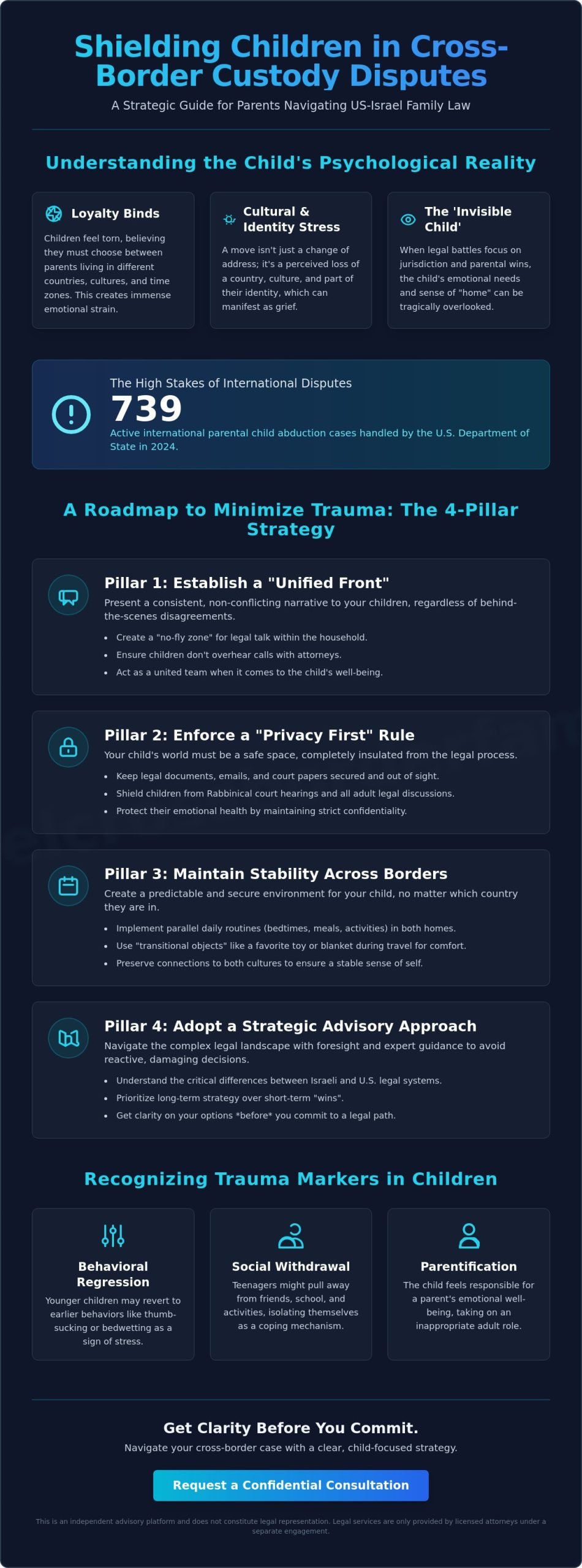
You’ll learn practical, strategy-based methods to shield your children from emotional distress during complex international transitions. This guide provides a clear roadmap for communication and stability, helping you keep adult legal matters away from your child’s daily life. We’ll preview how to handle multi-jurisdictional challenges, including insights into the 739 active abduction cases handled by the U.S. Department of State in 2024. For more information, you can view resources on the Israel Family Law YouTube channel. Get clarity before you commit. Request a confidential consultation.
Key Takeaways
- Identify how loyalty binds and the perceived loss of cultural identity impact children during international relocations.
- Establish a “Unified Front” communication protocol to focus on minimizing trauma for children in custody disputes.
- Maintain stability across borders by implementing parallel daily routines and using transitional objects during international travel.
- Protect your child’s emotional health by enforcing a “Privacy First” rule that keeps legal documents and Rabbinical court hearings strictly confidential.
- Adopt a strategic advisory approach to navigate the complex differences between the Israeli and U.S. legal systems before making commitments.
This article is published on an independent advisory platform and does not constitute legal representation or an attorney-client relationship. Legal services are only provided by licensed attorneys under a separate engagement.
Understanding the Psychological Impact of International Custody Disputes
International custody cases introduce a specific type of emotional strain known as “loyalty binds.” In these situations, a child feels they must choose between two parents who live in entirely different countries, cultures, and time zones. For the Anglo expat community in IL, this pressure is often magnified by the physical distance from extended family in the U.S. and the stark differences between Israeli and American social norms. When parents focus on jurisdictional victories, the child’s emotional needs can become secondary to the legal battle. Strategic planning is the most effective tool for minimizing trauma for children in custody disputes, as it allows parents to address these psychological risks before they become permanent scars.
To better understand the trauma-informed approach to these situations, watch this helpful video:
Parents should stay alert for specific trauma markers that often emerge during cross-border litigation. These include behavioral regression in younger children, social withdrawal in teenagers, or “parentification,” where a child feels responsible for the emotional well-being of a distressed parent. In extreme cases, the fear of being permanently separated from a parent or a familiar environment can lead to significant anxiety. This is particularly relevant in high-conflict scenarios involving international child abduction, where the child’s sense of safety is fundamentally compromised.
The Concept of the ‘Invisible Child’ in Legal Battles
Children often become “invisible” when the legal focus shifts entirely to which court has jurisdiction or which country provides a better lifestyle. Litigation-induced trauma differs from standard divorce stress because it involves a total upheaval of the child’s world. Preserving the child’s sense of “home” is vital, regardless of where the final residence is established. You can learn more about how these dynamics play out in our guide to international custody and relocation.
Cultural and Linguistic Identity Stress
For international families, a move between the U.S. and IL isn’t just a change of address; it’s a change of identity. Children often feel the “loss” of a country or culture as a personal grief. It’s common for parents to inadvertently use their children as translators or cultural bridges in Israel, which places an inappropriate burden on the child. Cultural continuity is a protective factor where parents actively maintain the child’s connection to both their Israeli and American heritage to ensure a stable sense of self. Get clarity before you commit. Request a confidential consultation.
This article is published on an independent advisory platform and does not constitute legal representation or an attorney-client relationship. Legal services are only provided by licensed attorneys under a separate engagement.
Shielding the Child: Strategic Communication for Parents
The “Unified Front” protocol is a foundational strategy for minimizing trauma for children in custody disputes. This approach requires parents to present a consistent, non-conflicting narrative to their children, even when complex legal disagreements are active in the background. In cross-border cases, where the psychological stakes are high, parents must establish a “no-fly zone” for legal discussions within the household. This means ensuring children don’t overhear phone calls with attorneys or view sensitive court documents. According to the U.S. Department of State, which handled 739 active abduction cases in 2024, the presence of high conflict is a significant risk factor for children. By removing the child from the “line of fire” of litigation, parents can preserve a sense of normalcy despite the multi-jurisdictional complexities of their situation.
Sophisticated co-parenting applications and digital tools are essential for managing parent communication away from the child’s eyes. These platforms allow for the exchange of logistical information regarding travel dates, school schedules in IL, and visitation without the need for direct, potentially tense verbal interactions. Using technology in this way helps maintain a professional, business-like relationship between parents, which is vital for the child’s emotional stability. If you’re struggling to establish these boundaries, it’s helpful to review strategies for international families early in the process.
The ‘Script’ for International Transitions
Children in cross-border disputes often ask difficult questions about their future. A strategic approach avoids the “messenger” trap, where children are forced to carry information or demands between parents. Instead, provide neutral, age-appropriate answers. Consider these guidelines for your “script”:
- When asked “Where will I live?”: Respond with, “We’re working with professionals to make sure you have a safe and happy home in both IL and the U.S.”
- When asked about court: Say, “The judges are helping us make the best plan for our family so we can all be okay.”
- Validating feelings: Use phrases like, “I hear you’re feeling worried, and it’s okay to feel that way. We’re taking care of the big stuff.”
Digital Communication Etiquette
Video calls are a primary tool for maintaining bonds across time zones, but they must be handled with care to avoid becoming “interrogations.” Parents should set clear boundaries for screen time that allow the child to connect with the distant parent without feeling monitored or pressured for information. You can find visual guides on managing these delicate interactions on the @IsraelFamilyLaw YouTube channel. If you’re feeling overwhelmed by the communication demands of your case, you can get clarity on your options through a confidential review.
This article is published on an independent advisory platform and does not constitute legal representation or an attorney-client relationship. Legal services are only provided by licensed attorneys under a separate engagement.
Maintaining Stability Across Borders and Time Zones
Maintaining a sense of equilibrium is exceptionally difficult when a child’s life is split between IL and the U.S. Success in minimizing trauma for children in custody disputes often depends on the creation of “Parallel Routines.” This strategy involves parents agreeing on foundational daily structures, such as sleep schedules or homework habits, that remain consistent regardless of which country the child is in. While physical environments change, the predictability of the day provides a psychological anchor. Synchronizing school calendars and extracurricular updates via shared digital platforms ensures that both parents remain active participants in the child’s progress. This reduces the feeling that one parent is a “visitor” while the other is the “primary” caregiver.
Transitional objects play a vital role in international travel. A specific toy, blanket, or even a digital photo frame that moves between households acts as a bridge between two worlds. These items help mitigate “re-entry shock,” the period of emotional volatility that often follows a long-distance flight. By allowing the child time to decompress without immediate pressure to share details of their trip, parents can facilitate a smoother transition. Consistency in these small details helps the child feel that they aren’t losing one life when they travel to another. It’s about preserving the child’s internal world even as their external geography shifts.
The Importance of Rituals in Two Countries
Consistent rituals, such as a specific Friday night meal or a Sunday morning call with grandparents, provide a deep sense of safety. In the Anglo-Israeli context, managing holidays like Pesach and Thanksgiving requires careful coordination to avoid “holiday competition.” Instead of fighting over specific dates, parents can focus on creating meaningful, separate celebrations that honor the child’s dual heritage. You can find more structured advice on these transitions in our guide to International Custody & Relocation.
Logistical Calm: Managing Travel Stress
The airport experience is often a flashpoint for anxiety. Airport goodbyes should be kept short, calm, and routine to prevent the child from absorbing parental distress. Preparing for the long-haul flight involves more than just packing; it requires setting expectations for the journey so the child feels in control. The security of the familiar in cross-border logistics is found when travel becomes a predictable process rather than a traumatic event. Get clarity before you commit. Request a confidential consultation.
This article is published on an independent advisory platform and does not constitute legal representation or an attorney-client relationship. Legal services are only provided by licensed attorneys under a separate engagement.
Managing the Legal Process Without Involving the Child
The “Privacy First” rule is the most critical boundary a parent can establish during a multi-jurisdictional dispute. It dictates that all legal documents, attorney-client communications, and litigation strategies remain strictly confidential and out of the child’s reach. In the high-stakes environment of cross-border litigation, children often sense tension even if they don’t see the paperwork. However, directly exposing them to the mechanics of the law, such as bringing them to an Israeli Family Court or a Rabbinical hearing, is demonstrably harmful. These environments are designed for adult disputes and often force children into impossible positions where they feel their words will betray one parent. Focusing on minimizing trauma for children in custody disputes requires a firm commitment to keeping the legal process invisible to the child.
In the US-Israel context, “Child Specialists” or “Parent Coordinators” serve as vital buffers. These professionals help parents manage disagreements over travel or schooling without returning to court. For high-conflict situations, “Parallel Parenting” offers a viable alternative to traditional co-parenting. It allows parents to remain involved in the child’s life while minimizing direct contact, thereby reducing the opportunities for conflict to erupt in front of the child. This is particularly important when dealing with the 15 countries cited by the U.S. Department of State in 2025 for patterns of non-compliance with the Hague Convention, as these cases often involve prolonged and stressful legal maneuvers.
Choosing Strategy Over Conflict
The decisions made in the first 60 days of a case often dictate the child’s long-term adjustment. There’s a significant difference between “fighting for rights” and “finding a solution” that preserves the family’s future. For those navigating these waters, understanding the nuances of divorce for international families is the first step toward a more stable outcome. Strategy-based decision-making ensures that the child’s emotional safety isn’t sacrificed for a short-term legal win.
The Risk of ‘Legal Abuse’
Litigation can sometimes transform into a tool for harassment, a phenomenon known as legal abuse. This occurs when one party uses the legal system to exert control or cause distress rather than to resolve a legitimate dispute. De-escalating these situations requires a firm strategic hand and a refusal to use the child as a lever in negotiations. Before making commitments in the Israeli legal system, it’s essential to request a confidential case review to ensure your strategy prioritizes your child’s well-being and provides the clarity needed to move forward safely.
This article is published on an independent advisory platform and does not constitute legal representation or an attorney-client relationship. Legal services are only provided by licensed attorneys under a separate engagement.
The Advisory Approach: Strategy-Based Decision Making
International custody cases demand more than just a lawyer; they require a sophisticated, cross-border advisory mindset that spans both legal and cultural boundaries. Success in minimizing trauma for children in custody disputes relies on the parent’s ability to navigate the significant differences between the Israeli and American legal systems without making impulsive, emotionally driven choices. As of May 2026, there are 103 parties to the Hague Convention, yet the application of these rules varies wildly between jurisdictions. Parents must understand how the Israeli “Start-up Nation” culture and its specific family court structures interact with U.S. standards like the UCCJEA. Adopting a risk-based decision-making model allows you to evaluate how a single legal motion in IL might affect your standing in a U.S. court months later.
Building a robust support team is a logistical necessity for international families. This team should ideally include bicultural and bilingual attorneys who are qualified to practice in both Israel and the U.S., alongside psychological experts who understand the unique stressors of the expat experience. By focusing on the “big picture” rather than immediate emotional reactions, you can ensure your strategy remains collaborative and established. This established approach is designed to provide a “seamless Israeli/U.S. professional home” for your family’s legal needs, grounding abstract legal concepts in concrete expertise and established history.
Seeking Clarity Before Commitment
The choice of jurisdiction—where your case is heard—is one of the most impactful decisions you’ll make. A “win” in a courtroom that alienates the other parent or ignores the child’s cultural identity can lead to a long-term loss of the child’s trust. Understanding How the Advisory Works helps parents see the strategic value in finding a solution that prioritizes stability over conflict. Early decisions regarding residency and visitation set a precedent that can be difficult to change once the legal process is in motion.
Requesting a Confidential Review
A strategy session that looks at the big picture is essential for navigating the complex multi-jurisdictional landscape. These sessions focus on achieving business-like objectives for your family’s future while protecting the child’s emotional health. Get clarity before you commit. Request a confidential consultation.
This article is published on an independent advisory platform and does not imply an attorney-client relationship.
This article is published on an independent advisory platform and does not constitute legal representation or an attorney-client relationship. Legal services are only provided by licensed attorneys under a separate engagement.
Building a Secure Foundation for Your Family’s Future
Navigating a cross-border dispute between IL and the U.S. requires a shift from emotional reaction to strategic management. By prioritizing the “Privacy First” rule and establishing parallel routines, you create a buffer that protects your children from the friction of multi-jurisdictional litigation. Minimizing trauma for children in custody disputes is achievable when parents choose to act as a bridge between cultures rather than a source of conflict. Our specialized focus on US-Israel cross-border families ensures a deep understanding of the unique Anglo experience in Israel. This strategy-based approach is designed to minimize litigation risk while providing the stability your children deserve during complex transitions. You have the power to shape a healthier narrative for your family’s next chapter.
Get clarity before you commit. Request a confidential consultation. You don’t have to navigate this complex path alone.
This article is published on an independent advisory platform and does not constitute legal representation or an attorney-client relationship. Legal services are only provided by licensed attorneys under a separate engagement.
Frequently Asked Questions
How do I explain an international custody dispute to a toddler?
Explaining transitions to a toddler requires using concrete, physical language rather than abstract legal concepts. You should focus on the consistency of your love and the physical safety of their two homes. Use simple stories to describe the travel process; this helps them visualize the routine. Maintaining a calm, authoritative tone during these talks prevents the child from absorbing adult anxieties about the relocation.
Can I stop the other parent from talking about the court case to our children?
You can include specific “non-disparagement” and “confidentiality” clauses in your parenting plan to legally restrict the other parent from discussing litigation with the children. Israeli courts (IL) can issue orders that prohibit parents from exposing children to legal documents or court-related stress. Enforcing these boundaries is a primary step in minimizing trauma for children in custody disputes. It’s often helpful to use a neutral third party to monitor communication if conflict remains high.
What happens if my child doesn’t want to travel for visitation?
If a child refuses to travel, you must first determine if the resistance is based on temporary anxiety or a deeper psychological issue. Legally, you are usually required to comply with the existing court order; however, forcing a distressed child onto a long-haul flight can be counterproductive. Strategy-based decision-making involves using a “Child Specialist” to facilitate the transition. This professional helps the child feel secure while ensuring the parent’s visitation rights are respected.
How do Israeli courts (IL) handle the psychological well-being of children?
Israeli courts prioritize the “best interests of the child” principle through the involvement of the “Social Services Review” (Tazkir). These professionals evaluate the child’s living conditions and psychological state to provide recommendations to the judge. This process is designed to be protective; however, the cultural differences between IL and the U.S. can lead to misunderstandings if not managed by a bicultural advisory team with a team on the ground.
Is it better to settle out of court to reduce child trauma?
Settling out of court is generally the most effective method for minimizing trauma for children in custody disputes because it allows parents to retain control over the outcome. Litigation in multi-jurisdictional cases can be unpredictable and prolonged; the U.S. Department of State reported handling 739 active abduction cases in 2024 alone. A negotiated agreement provides a “Privacy First” environment that keeps children away from the adversarial nature of the courtroom.
How can I maintain a bond with my child while living in a different country?
Maintaining a bond from a different country requires a commitment to “digital presence” and high-quality, routine interaction. Use video calls to participate in daily rituals like bedtime stories or homework help rather than just asking about their day. Consistency is more important than the length of the call. Setting these “Parallel Routines” ensures the child feels your presence in IL or the U.S. regardless of the physical distance.
What should I do if I suspect the other parent is ‘alienating’ the child?
Suspected parental alienation requires a sophisticated, forensic approach rather than an emotional confrontation. You should document specific instances where the child’s behavior changes or where the other parent interferes with communication. In IL, courts may appoint a guardian ad litem or a psychological expert to investigate the family dynamics. Early intervention is critical because the impact of alienation can become more difficult to reverse as the litigation progresses.
Are US custody orders automatically recognized in Israel?
U.S. custody orders are not automatically recognized in Israel and must be validated through a formal legal process under the Enforcement of Foreign Judgments Law (1958). This procedure, often called “Klitat Psek Din,” ensures the order is compatible with Israeli law and public policy. Without this formal recognition, an order from a U.S. court may not be enforceable by Israeli police or social services. Always seek clarity on recognition before making international travel commitments.

Article by
Gabriel Lior
A Personal Journey That Became a Mission
The advisory was founded by an American father Gabriel Lior, LLB, MBA , global entrepreneur, and cross-border advisor who spent more than a decade navigating the Israeli family court system firsthand and now lives in Singapore with his son.
As a divorced parent in a cross-border family, Gabriel faced nearly every legal challenge a foreign parent can encounter in Israel — including child custody disputes, child support proceedings, property matters in Israel and abroad, false accusations, and complex immigration and relocation proceedings.
Over the years, he learned the hard way how difficult it is for non-Israeli parents to understand the system, identify the right legal strategy, and choose the right legal representation — especially when language, culture, and jurisdictional differences are involved. He also witnessed how foreign parents and new immigrants are often disadvantaged or taken advantage of by service providers and institutions simply because they lack local knowledge or fluency.
From Client to Advisor
To truly understand — and survive — the system, Gabriel pursued formal legal education in Israel, completing two Israeli law degrees, alongside a BA and MBA earned in the United States. This was never about becoming a practicing attorney, but about gaining a deep, structural understanding of how the system works — and where it breaks down for foreign parents.
This rare combination of:
Firsthand client experience
Israeli legal and US business education
International business and negotiation training
Decades of commercial execution
created a unique perspective – one that understands both sides of the table.
After years of litigation, persistence, and at times self-representation, he ultimately succeeded in securing custody of his son and relocating abroad through a rare legal victory in the Israeli Supreme Court — becoming one of the first fathers in Israel to do so under these circumstances.
Disclaimer
Important Disclaimer:
The information provided on this website and in its content is for general informational and educational purposes only and does not constitute legal advice, legal opinion, or legal representation.
Gabriel Lior is not licensed to practice law in Israel (nor is he interested in doing so) and does not provide legal services, despite having completed 2 Law Degrees. The services offered are advisory in nature and are intended to provide general guidance, strategic insight, and information regarding cross-border family law considerations.
No attorney-client relationship is formed by accessing this website, reading its content, or communicating with us.
Any decisions made based on this information are at your own discretion and risk. For legal advice specific to your situation, you should consult a licensed attorney in the relevant jurisdiction.
Where appropriate, we may refer clients to independent, licensed attorneys or professionals. Such referrals do not constitute legal representation and no liability is assumed for services provided by third parties.