The discovery of a last will and testament that feels unjust or raises serious suspicion can be a profoundly distressing experience, particularly for beneficiaries residing overseas. Navigating the sophisticated Israeli legal system from the United States or another country presents a formidable cross-border challenge. The complex process of contesting a will in Israel is governed by specific statutes and strict, unyielding deadlines, which can feel overwhelming for international heirs uncertain of their rights and the viability of their claim without expert legal counsel. This comprehensive guide is engineered to provide clarity and confidence in these challenging circumstances. We will provide a detailed roadmap of the valid legal grounds for challenging a will under Israeli law, from lack of testamentary capacity to undue influence. You will gain a clear understanding of the step-by-step procedural requirements, critical filing deadlines, and the strategic considerations essential for protecting your inheritance. Our objective is to equip you with the foundational knowledge required to assess your position and take decisive, informed action to safeguard your rights.
Understanding the Foundations: What It Means to Contest a Will in Israel
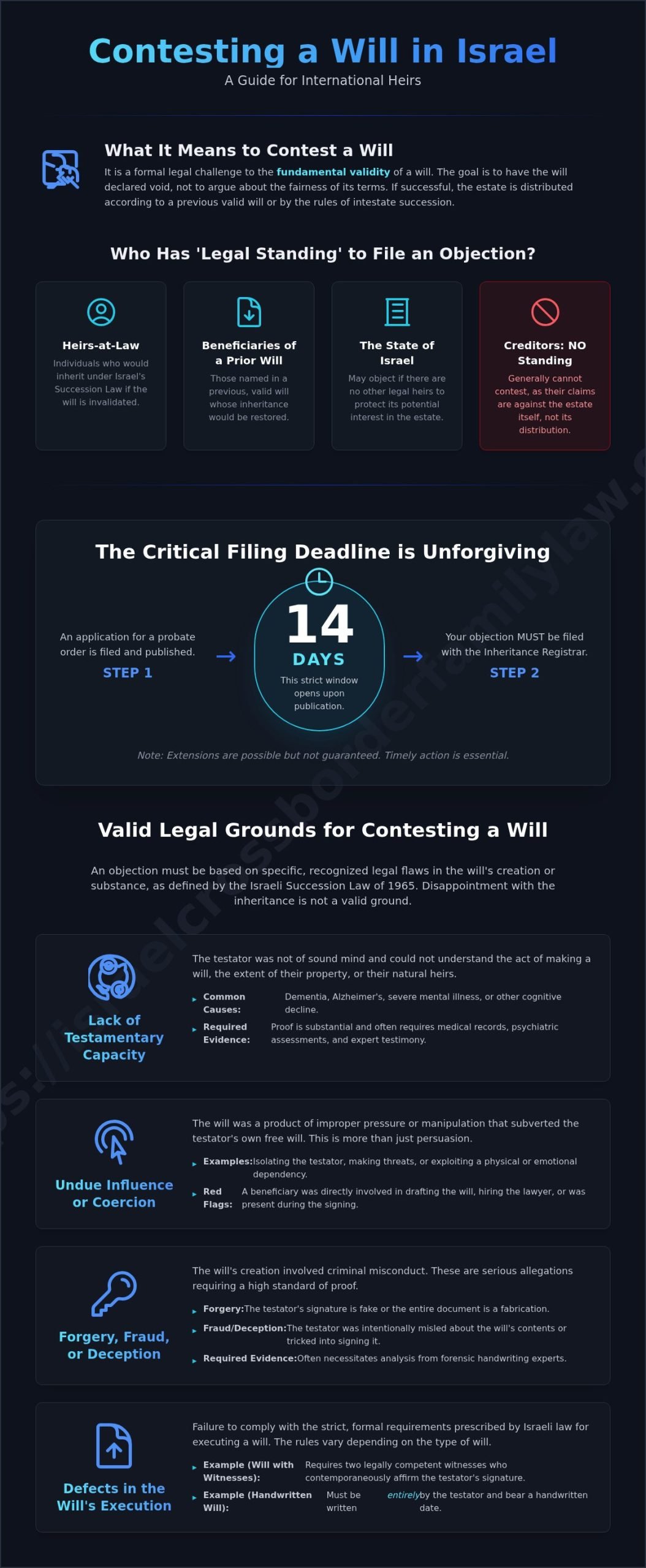
Contesting a will in Israel is a formal legal proceeding initiated to challenge the fundamental validity of a testamentary document. This is not a dispute over the interpretation of specific clauses or the fairness of bequests; rather, it is a direct objection arguing that the will itself is legally flawed and should be set aside by the court. The ultimate objective is to have the will declared void, which would typically result in the deceased’s estate being distributed according to the rules of intestate succession or the terms of a previous, valid will. Navigating the complex process of contesting a will israel requires a sophisticated understanding of the Israeli legal system and its specific statutes governing inheritance. To provide a clearer overview of the core concepts involved, the following video offers a helpful explanation:
Who Has ‘Legal Standing’ to File an Objection?
Not everyone can initiate the process of contesting a will in Israel. The law requires an objector to have ‘legal standing’ (zchut omida), meaning a direct and tangible interest in the outcome of the case. This is a critical threshold that prevents frivolous claims. The primary parties with standing include:
- Heirs-at-law: Individuals who would inherit from the estate under Israel’s Succession Law if the will were invalidated.
- Beneficiaries of a prior will: Persons named as beneficiaries in a previous, valid will of the deceased whose inheritance would be restored if the current will is set aside.
- The State of Israel: In circumstances where there are no other legal heirs, the state may file an objection to protect its potential interest in the estate.
It is important to note that creditors of the estate are generally not granted standing to contest a will, as their claims are against the estate itself, regardless of how it is distributed.
Critical Deadlines for Filing a Will Contest
The procedural timeline for contesting a will israel is stringent and unforgiving. An objection cannot be filed preemptively; it must be submitted to the Inheritance Registrar after an application for a probate order (tzav kiyum tzava’a) has been filed by the will’s executor or a beneficiary. Once this application is published, a strict deadline is triggered. An objection must be filed within 14 days of the publication date. This narrow window underscores the necessity of acting with decisive speed. While it is possible to request an extension from the court in specific, justifiable circumstances, such extensions are not guaranteed, making timely action essential for anyone contesting a will israel.
Valid Legal Grounds for Contesting a Will Under Israeli Law
Successfully contesting a will in Israel requires more than a belief that its terms are unfair or inequitable. The Israeli legal system, governed by the Succession Law of 1965, mandates that any challenge must be founded upon specific, recognized legal grounds. An objection based solely on disappointment with the inheritance distribution will not be sustained by the court. A valid claim must demonstrate a fundamental flaw in the will’s creation or substance. It is a common and often effective legal strategy to argue multiple grounds simultaneously to construct a comprehensive and robust case for invalidating the document.
Lack of Testamentary Capacity
A cornerstone of a valid will is that the testator possessed the requisite testamentary capacity at the moment of its execution. This means they were of sound mind, capable of understanding the act of making a will, comprehending the extent of their property, and recognizing the natural heirs to their estate. This ground is often invoked in cases involving testators with cognitive decline from conditions such as dementia, Alzheimer’s, or severe mental illness. Proving incapacity requires substantial evidence, typically including medical records, psychiatric assessments, and expert testimony.
Undue Influence, Coercion, or Duress
A will can be invalidated if it was the product of undue influence, where another individual’s improper pressure or manipulation subverted the testator’s own free will. This goes beyond mere persuasion and involves conduct that dominates the testator’s intentions. Examples include isolating the testator from other family members, making threats, or exploiting a dependency. The court will closely scrutinize circumstances where a beneficiary was directly involved in the will’s drafting, procurement of a lawyer, or was present during the signing.
Forgery, Fraud, or Deception
This category addresses claims of outright criminal misconduct in the will’s creation. The challenge can be based on several premises:
- Forgery: The signature on the will is not the testator’s, or the entire document is a fabrication.
- Fraud or Deception: The testator was intentionally misled about the content of the will or was deceived into believing they were signing a different type of document entirely.
These are serious allegations that demand a high standard of proof, often necessitating the professional analysis of forensic handwriting experts to establish their veracity.
Defects in the Will’s Execution
Israeli law prescribes strict formal requirements for a will’s execution, which differ depending on the type of will. A failure to comply with these statutory formalities can render the entire document void. For instance, a will made with witnesses requires the presence of two legally competent witnesses who contemporaneously affirm the testator’s signature. A handwritten will, by contrast, must be written entirely by the testator and bear a handwritten date. Any deviation from these precise legal protocols presents a clear basis for contesting a will in Israel.
The Legal Process: A Step-by-Step Guide to the Court Proceedings
Initiating a challenge to a will is not merely an expression of disagreement; it is the commencement of a formal judicial proceeding. The process of contesting a will in Israel is governed by a structured legal framework that demands rigorous evidence and skilled legal representation to navigate effectively. Understanding this chronological journey is essential for any potential objector to set realistic expectations and prepare a robust case. The entire procedure is designed to ensure that the court has a complete and fact-based picture before ruling on the ultimate validity of a testamentary document.
Step 1: Filing the Formal Objection
The first formal step is to file a Statement of Objection with the Inheritance Registrar (Rasham HaYerushot). This is a comprehensive legal document, which must be accompanied by a sworn affidavit. This affidavit must meticulously detail the specific legal grounds for the contest-such as lack of testamentary capacity, undue influence, or improper execution-and be supported by all available initial evidence, including medical records, correspondence, or preliminary witness statements.
Step 2: Case Transfer to the Family Court
Upon the successful filing of an objection, the Inheritance Registrar’s administrative role concludes, and the matter is automatically transferred to the jurisdiction of the Family Court (Beit HaMishpat Le’Inyanei Mishpacha). This transfer marks a critical transition from an administrative procedure to a full-fledged judicial proceeding. The Family Court is vested with the authority to hear complex arguments, weigh sophisticated evidence, and render a binding decision on the will’s validity.
Step 3: Discovery, Evidence, and Witness Testimony
This phase constitutes the core of the litigation. Both sides engage in a ‘discovery’ process, a formal exchange of all relevant documents and information. This is where each party builds its case by gathering evidence to support its claims. The proceedings may involve calling witnesses to provide testimony under oath, including family members, caregivers, and expert witnesses such as geriatric psychiatrists or forensic document examiners, who can offer professional opinions on the testator’s state of mind or the authenticity of a signature.
Step 4: The Court’s Ruling and Potential Outcomes
Following the presentation of all evidence and arguments, the judge will issue a final ruling. The court’s decision will result in one of two primary outcomes:
- The Will is Upheld: The court dismisses the objection and issues a probate order, allowing the executor to distribute the estate according to the will’s terms.
- The Will is Invalidated: The court rules in favor of the objector, setting the will aside. The estate is then distributed according to the terms of a previous, valid will or, if none exists, in accordance with Israel’s laws of intestate succession.
Successfully managing these intricate stages is paramount to achieving a favorable outcome. Our advisory explains how we navigate these complex proceedings to protect our clients’ interests.
Special Considerations for US Residents and Foreign Nationals
For US residents and other foreign nationals, the process of contesting a will in Israel presents a unique set of multi-jurisdictional challenges. The complexities of distance, time zones, and differing legal procedures can seem daunting. However, with strategic legal counsel experienced in cross-border inheritance law, these obstacles are entirely surmountable, and your rights can be effectively protected from abroad.
Gathering Evidence Across Jurisdictions
A significant hurdle involves gathering and presenting evidence from another country. For instance, obtaining US-based medical records to prove a testator’s lack of capacity or securing sworn affidavits from witnesses in America requires a deep understanding of both US and Israeli evidentiary standards. All foreign documents, from birth certificates to expert reports, must be properly authenticated, typically via an Apostille, to be admissible in an Israeli court.
Navigating Israeli Courts from Afar
Managing litigation from overseas requires a trusted representative on the ground in Israel. By granting a power of attorney to a local Israeli lawyer, you empower them to file motions, attend hearings, and represent your interests without requiring your constant physical presence. This arrangement allows the legal process to advance efficiently while you remain in your home country. Learn about our dedicated services for expats and foreign nationals, designed to navigate these precise challenges.
The Importance of a Specialized Cross-Border Team
Success in a cross-border inheritance dispute hinges on the expertise of your legal team. It is not enough to have a lawyer in Israel; you need a firm with a sophisticated understanding of both US and Israeli legal cultures and regulations. Our bilingual attorneys act as a seamless bridge, ensuring that critical nuances in testimony and documentation are not ‘lost in translation.’ This unified approach is essential when pursuing a will contest from abroad, safeguarding your interests with precision and authority.
Preparing Your Case: Practical First Steps and Strategy
Successfully contesting a will in Israel requires more than suspicion; it demands a meticulously prepared and strategically sound case. Before initiating formal legal proceedings, a preparatory phase focused on evidence gathering and objective assessment is critical. This disciplined approach not only strengthens your position but also provides the clarity necessary to navigate the complexities of Israeli inheritance law. Thorough preparation is the foundation upon which a compelling legal challenge is built.
Gathering Essential Documents and Information
The first practical step is to systematically compile all relevant evidence. This process transforms abstract concerns into a concrete, reviewable file. Your objective is to create a comprehensive record that tells a clear story. Key documents to assemble include:
- Copies of the will being contested, along with any previous wills to demonstrate changes in testamentary intent.
- Relevant medical records, particularly those from geriatric specialists or psychologists that speak to the testator’s mental capacity around the time the will was signed.
- Financial statements, bank records, and property deeds that may reveal unusual transactions or the influence of another party.
- Personal correspondence, such as emails, letters, or digital messages, that could serve as evidence of undue influence or the testator’s true wishes.
Organizing this information into a detailed timeline of events is an invaluable tool for structuring your claim.
Assessing the Strength of Your Claim
With your documents organized, the next step is a candid evaluation of your case’s merits. You must honestly measure your evidence against the established legal grounds for a will contest, such as lack of testamentary capacity, undue influence, or improper execution. Identify key witnesses-family members, caregivers, or financial advisors-and determine precisely what they can testify to. Critically, you must also consider the potential counterarguments the estate’s beneficiaries might raise, allowing you to anticipate challenges and fortify your strategy.
Why a Confidential Case Review is Your Best First Move
Navigating the nuances of contesting a will in Israel without expert legal guidance presents significant risks. An initial, confidential case review with a specialist in cross-border inheritance law is the most crucial move you can make. This professional assessment provides an objective determination of your claim’s viability, an understanding of the potential costs and timelines involved, and a clear, strategic roadmap forward. It manages expectations and ensures you commit to legal action from a position of strength and clarity. To understand the specific merits of your situation and explore your legal pathways, we invite you to request a confidential case review to assess your legal options.
Navigating Complex Inheritance Disputes with Strategic Counsel
Successfully challenging a testamentary disposition in Israel hinges upon a sophisticated understanding of the valid legal grounds, from lack of testamentary capacity to undue influence. The process is a structured legal proceeding that requires strategic foresight, particularly for US residents and foreign nationals facing multi-jurisdictional challenges. Navigating the procedural intricacies of contesting a will israel demands a nuanced grasp of Israeli inheritance law and its complex cross-border implications. When your rightful inheritance is at stake, the guidance of a legal team with specialized expertise is paramount. Our firm is uniquely positioned to handle these sophisticated matters, offering decades of combined experience directly within the Israeli Family Courts. Our bilingual legal team is fluent in the nuances of both the US and Israeli legal systems, providing a seamless and effective bridge for our international clients. To protect your rights and explore your legal options with clarity and confidence, we invite you to Schedule a Confidential Case Review with our US-Israel Inheritance Team. Taking decisive action with experienced counsel is the first step toward securing the legacy you are entitled to.
Frequently Asked Questions About Contesting a Will in Israel
How much does it cost to contest a will in Israel?
The costs for contesting a will in Israel are multifaceted, comprising court filing fees, legal counsel, and potential expert witness costs. While initial court fees are modest, often under ₪1,000, the primary expense is legal representation. Depending on the complexity of the case and the law firm’s fee structure, comprehensive legal support can range from ₪20,000 to over ₪100,000. This investment is critical for navigating the sophisticated arguments required for a successful challenge.
Can I contest a will if I was completely written out of it?
Yes, being disinherited does not legally bar you from challenging a will. To initiate proceedings, you must have legal standing as an “interested party,” such as a direct heir under Israel’s intestacy laws. The success of your claim will depend not on your exclusion, but on your ability to prove valid legal grounds for invalidation. These grounds include the testator’s lack of testamentary capacity, the presence of undue influence or fraud, or a defect in the will’s formal execution.
What happens to the estate if a will is successfully contested and declared invalid?
Upon the successful invalidation of a will by the Israeli Family Court, the disposition of the estate proceeds in one of two ways. If a prior, valid will exists, its terms are reinstated to govern the distribution of assets. In the absence of any other valid will, the estate is deemed intestate. Consequently, the assets are distributed among the deceased’s legal heirs according to the default statutory hierarchy outlined in Israel’s Inheritance Law, 1965.
How long does the process of contesting a will typically take in Israel?
The timeline for resolving a will contest is highly variable and contingent on the legal complexity, the court’s docket, and the level of dispute between parties. A relatively straightforward case might be resolved within 12 to 18 months. However, more complex, multi-jurisdictional disputes involving substantial evidence and multiple hearings can extend for several years. Engaging experienced counsel is paramount to navigating these proceedings efficiently and mitigating unnecessary delays in the administration of the estate.
Do I need to travel to Israel in person to contest a will?
For our international clients, physical presence in Israel is generally not required for the majority of the legal process. Through a notarized and apostilled Power of Attorney, our firm can represent your interests, file all necessary court documents, and attend hearings on your behalf. While your testimony may eventually be required, Israeli courts often permit this to be conducted via video conference, facilitating a seamless and effective cross-border legal strategy without the burden of international travel.
What is the difference between contesting a will and filing for inheritance rights?
These are fundamentally distinct legal actions. The process of contesting a will in Israel is an adversarial challenge aimed at proving the will itself is invalid based on specific legal deficiencies. Conversely, filing for inheritance rights is a procedural matter. It involves petitioning the Inheritance Registrar for a Probate Order to legally execute a valid will, or for a Succession Order to distribute assets according to statute when no will exists. One is a challenge to validity; the other is the execution of rights.

Article by
Gabriel Lior
A Personal Journey That Became a Mission The advisory was founded by an American father Gabriel Lior, LLB, MBA , global entrepreneur, and cross-border advisor who spent more than a decade navigating the Israeli family court system firsthand and now lives in Singapore with his son.
As a divorced parent in a cross-border family, Gabriel faced nearly every legal challenge a foreign parent can encounter in Israel — including child custody disputes, child support proceedings, property matters in Israel and abroad, false accusations, and complex immigration and relocation proceedings. Over the years, he learned the hard way how difficult it is for non-Israeli parents to understand the system, identify the right legal strategy, and choose the right legal representation — especially when language, culture, and jurisdictional differences are involved. He also witnessed how foreign parents and new immigrants are often disadvantaged or taken advantage of by service providers and institutions simply because they lack local knowledge or fluency. From Client to Advisor To truly understand — and survive — the system, Gabriel pursued formal legal education in Israel, completing two Israeli law degrees, alongside a BA and MBA earned in the United States. This was never about becoming a practicing attorney, but about gaining a deep, structural understanding of how the system works — and where it breaks down for foreign parents. This rare combination of: Firsthand client experience Israeli legal and US business education International business and negotiation training Decades of commercial execution created a unique perspective – one that understands both sides of the table. After years of litigation, persistence, and at times self-representation, he ultimately succeeded in securing custody of his son and relocating abroad through a rare legal victory in the Israeli Supreme Court — becoming one of the first fathers in Israel to do so under these circumstances.
Disclaimer
Important Disclaimer: The information provided on this website and in its content is for general informational and educational purposes only and does not constitute legal advice, legal opinion, or legal representation. Gabriel Lior is not licensed to practice law in Israel (nor is he interested in doing so) and does not provide legal services, despite having completed 2 Law Degrees. The services offered are advisory in nature and are intended to provide general guidance, strategic insight, and information regarding cross-border family law considerations. No attorney-client relationship is formed by accessing this website, reading its content, or communicating with us. Any decisions made based on this information are at your own discretion and risk. For legal advice specific to your situation, you should consult a licensed attorney in the relevant jurisdiction. Where appropriate, we may refer clients to independent, licensed attorneys or professionals. Such referrals do not constitute legal representation and no liability is assumed for services provided by third parties.