What if the legal strategy that works in a US court actually puts your future at risk once it reaches Israel? Many expats and international families realize too late that what’s standard in one country can be completely foreign in another. If you’re managing family or estate matters across borders, you’ve likely felt the stress of trying to find a clear path through two very different systems. This is where firms like the Sklarz-Tiroche Law Firm provide essential support, acting as a professional bridge for those who need a nuanced understanding of both jurisdictions.
It’s natural to feel overwhelmed when you can’t find clear English-language information about Israeli law firms or how they operate. You want to feel secure that your next legal step is the right one. In this guide, you’ll gain clarity on the specialized services provided by firms with cross-border expertise and learn how to evaluate counsel for US-Israel matters. We’ll examine the importance of multi-jurisdictional knowledge in divorce, wills, and estate planning to help you move forward with confidence.
Please note that this content is published on an independent advisory platform and is not a law firm. This information focuses on strategy, risks, and decision-making guidance rather than an attorney-client relationship. Legal services are only provided by licensed attorneys under a separate engagement.
Key Takeaways
- Understand the reputation of the Sklarz-Tiroche Law Firm and its specialized focus on handling complex family law and inheritance matters within the Israeli legal market.
- Learn why early decisions in US-Israel cross-border cases carry significant weight and how to navigate the fundamental differences between these two legal systems.
- Identify the essential qualifications to look for when choosing an international legal partner, including dual-licensing and specific experience with the needs of expats and international families.
- Gain a clear framework for evaluating legal risks before making formal commitments, ensuring you have a strategy that accounts for both US and Israeli regulations.
- Discover how an independent advisory platform helps you coordinate between different legal teams to protect your interests and provide clarity across borders.
Who is the Sklarz-Tiroche Law Firm? An Overview of the Practice
The Sklarz-Tiroche Law Firm occupies a distinct niche within the Israeli legal landscape, serving as a primary point of contact for international families and expats. Its reputation is built on a foundation of handling sensitive domestic issues with a global perspective. This is a critical requirement for clients who find themselves caught between two different legal cultures. Liat Sklarz Horowitz has been a central figure in defining this cross-border identity, ensuring that the firm’s services address the specific anxieties of English-speaking clients who are often unfamiliar with the local system.
Before exploring the firm’s history, it’s important to clarify the nature of this information. This content is published on an independent advisory platform and does not constitute legal advice or an attorney-client relationship. We focus on providing strategy and risk guidance to help you understand your options. Formal legal representation is only available through a direct engagement with a licensed attorney.
To better understand the practical side of legal representation and how professional fees are structured, watch this helpful video:
The History and Evolution of the Practice
The firm’s standing is reflected in its consistent presence within Israeli legal directories like BDiCODE. These rankings are not just accolades; they represent a firm’s longevity and its ability to handle complex litigation within the Israeli court system. Over several decades, the practice has adapted to the shifting needs of the “Anglo” community, which includes immigrants from the US, UK, and Canada. This evolution has made the Sklarz-Tiroche Law Firm a familiar name for those searching for English-language summaries of Israeli legal services. Longevity in this market is an indicator of a firm’s ability to navigate the unique bureaucratic and procedural hurdles that exist in Israel.
Core Jurisdictions: Israel and Beyond
While the firm maintains a significant physical presence in Tel Aviv, its reach extends far beyond the borders of Israel. It frequently manages the intersection of Israeli law with international standards, particularly in matters of international matrimonial law. This geographic reach is essential for clients who have assets or family members in both Tel Aviv and New York. The firm often works in tandem with US-based legal professionals to create a unified strategy. Such collaboration ensures that a divorce decree or a will executed in one jurisdiction will be recognized and enforceable in the other. For more information on how these strategies are built, you can read more about the advisory and our approach to cross-border risks.
Key Practice Areas: From Family Law to Corporate Strategy
The Sklarz-Tiroche Law Firm focuses on legal matters that cross the threshold of a single nation’s borders. While many local firms handle domestic disputes, this firm specializes in the multi-layered complexities of family and inheritance law involving international parties. This work often involves the intersection of corporate law and private wealth management. When a family business or an international investment portfolio is part of the marital estate, the legal strategy must account for corporate structuring and regulatory compliance in both Israel and the US.
Cross-border litigation differs significantly from local Israeli disputes because it requires a deep understanding of how different legal systems interact. Mediation often plays a vital role in these scenarios. It allows parties to resolve complex international cases without the prolonged stress and expense of multi-jurisdictional court battles. By prioritizing strategic negotiation over aggressive litigation, families can find a path that protects their long-term financial interests and personal well-being.
US-Israel Family Law and Divorce
Navigating a divorce as a US citizen living in Israel introduces unique procedural challenges. One of the most critical factors is the dual court system in Israel. Both the Family Court and the Rabbinical Court may have jurisdiction over different aspects of a case, such as child support or the division of property. This often leads to a “race for jurisdiction,” where the first party to file can significantly influence which legal framework is applied to the proceedings.
It’s also essential to consider how an Israeli ruling will be viewed by US authorities. Ensuring the recognition of a foreign divorce is a primary concern for many expats. Without proper planning, you might find yourself legally divorced in one country but still married in another, which creates complications for taxes and future remarriage. Learn more about our approach to international custody and relocation to understand how these early decisions impact your family’s future.
Cross-Border Wills and Estate Planning
Managing assets in multiple jurisdictions requires more than just a standard will. A document that is valid in Tel Aviv might not effectively cover real estate or retirement accounts located in New York or California. For dual citizens, the stakes are even higher due to the need for tax-aware estate planning that considers both Israeli and US tax obligations.
Israeli inheritance laws and US probate processes operate on very different principles. Failing to account for these differences can result in unexpected tax liabilities or significant delays for your heirs. To ensure your global assets are protected across both systems, it’s helpful to seek a confidential review of your current estate plan before complications arise.
The Complexity of Cross-Border Legal Systems
The legal friction between the United States and Israel is often underestimated by those who haven’t yet faced a cross-border dispute. While both systems are sophisticated, they operate on fundamentally different principles. In the US, the legal culture is strictly adversarial, whereas the Israeli system often involves a more interventionist approach from the bench. This is particularly evident in family law, where the Sklarz-Tiroche Law Firm provides guidance to those caught between these two worlds. Understanding that legal jargon doesn’t always translate is the first step toward a successful outcome. For instance, a “trust” or “joint custody” arrangement drafted in New York may not be recognized or enforced in Tel Aviv without specific adjustments to meet local requirements.
Early decisions in international litigation carry immense weight. Choosing where to file first or which court to approach can determine the legal framework of your case for years to come. In Israel, the race for jurisdiction between the Family Court and the Rabbinical Court adds a layer of strategy that is absent in most US proceedings. Seeking clarity before making binding legal commitments is not just a recommendation; it’s a necessity to avoid permanent financial or personal setbacks. This is especially true in sensitive cases involving international parental child abduction, where the Hague Convention’s application requires immediate and precise action.
This information is published on an independent advisory platform and is not a law firm. Our focus remains on strategy and risk guidance. Legal representation is only provided by licensed attorneys under a separate engagement.
Regulatory and Compliance Hurdles
For individuals and businesses, the US-Israel Tax Treaty is a cornerstone of cross-border operations. It’s designed to prevent double taxation, yet its application requires a deep understanding of how residency and income are defined in both nations. Compliance for Israeli companies operating in the US involves meeting rigorous federal and state requirements that can be alien to those only familiar with the local market. For those managing corporate interests alongside family matters, Navigating US-Israel M&A: Your Comprehensive Guide provides further insights into these complex transitions.
Cultural Nuances in the Israeli Courtroom
The Israeli courtroom experience can be a culture shock for those used to the predictable rhythm of US courts. Timelines are often fluid, and the informal nature of some proceedings can be misinterpreted by expats as a lack of seriousness. Having an English-speaking guide who understands both systems is vital for managing expectations. This guide helps you understand why a case might take longer than expected or why a judge is taking a particular interest in a specific family detail. Bridging this cultural gap ensures you aren’t just a spectator in your own legal process but an informed participant who understands the risks and opportunities at every stage.
How to Evaluate an International Legal Partner
Selecting a firm like the Sklarz-Tiroche Law Firm is a significant decision that goes beyond looking at a directory ranking. While historical longevity and local recognition are important, they don’t always tell you if a firm is the right fit for your specific international needs. You need a partner who acts as a bridge between two distinct legal systems. This requires more than just legal knowledge; it requires an understanding of how a decision in an Israeli court will ripple across your life in the United States. Start by checking for dual-licensing. Lawyers who are qualified to practice in both jurisdictions possess a unique perspective on the friction points that local attorneys might overlook.
Experience with the expat community is another critical factor. International families face challenges that a standard domestic practice rarely encounters. Whether it’s managing property across borders or understanding the tax implications of a settlement, your legal partner must have a track record of handling similar situations. Evaluation should also focus on communication. If a firm uses heavy legal jargon without explaining it in plain English, it’s difficult to gain the clarity you need. A collaborative approach is also essential. Your Israeli counsel should be willing to work seamlessly with your existing US legal team to ensure a unified strategy.
Questions to Ask During a Consultation
When you speak with a potential firm, don’t be afraid to ask direct questions. You want to know how many cases involving your specific US state they’ve managed. Laws in California differ from those in New York, and these differences matter in cross-border litigation. Ask how they handle communication across different time zones. You don’t want to wait days for an answer to an urgent question. Finally, ask them to explain the risks of your current strategy in simple terms. If they can’t describe the potential downsides clearly, you may not have all the information necessary to make a secure decision.
Understanding Fee Structures and Pricing
Pricing is often a source of confusion for those transitioning from the US system to the Israeli one. In Israel, many firms use global fees, which are flat rates for an entire case or specific stages of it. This contrasts with the hourly billing common in the US. Transparency in these structures is vital for building trust. You should know exactly what is included in your fee and what might incur extra costs. Before you move forward, Review our advisory pricing and process to understand how strategy and risk guidance are structured. If you’re ready to discuss your specific needs, request a confidential consultation to begin building your cross-border strategy.
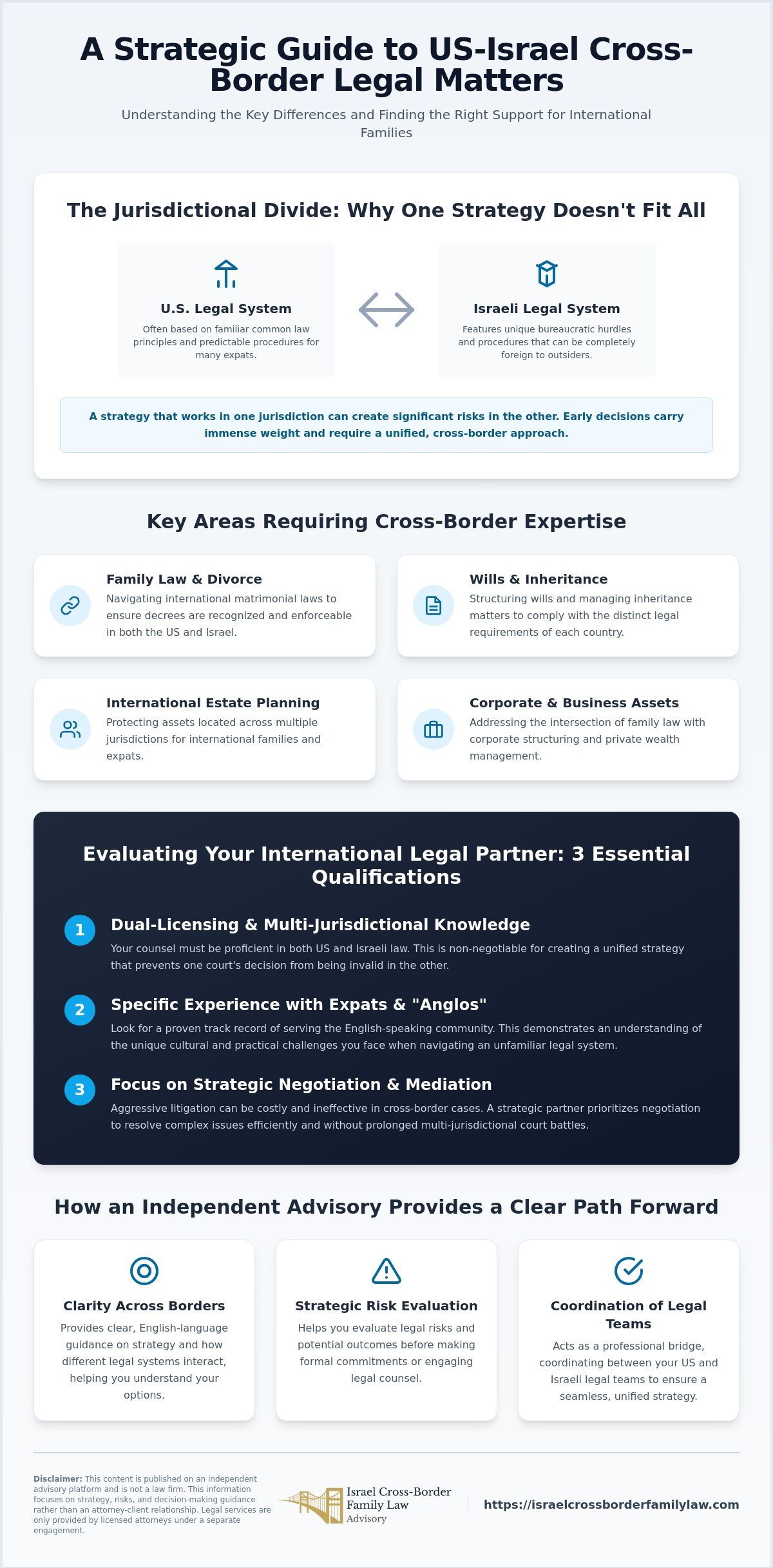
Navigating Your Case with Israel Cross Border Advisory
The first step in any US-Israel legal matter isn’t necessarily filing a document; it’s building a comprehensive strategy. This is where an independent advisory platform provides essential value. By focusing on risk identification and strategic planning before you formally engage a firm like the Sklarz-Tiroche Law Firm, you ensure that your legal path aligns with your long-term goals. This approach is especially important when bridging the gap between Israel’s modern innovation hubs and the established global markets of the United States. Understanding the cultural and regulatory differences between these two environments is the only way to protect your interests effectively.
A confidential case review helps you identify hidden risks that might not be obvious at first glance. These could include unexpected tax liabilities under the US-Israel treaty or jurisdictional traps within the Israeli court system. Getting this clarity early on saves time. It prevents costly mistakes. By the time you sit down with the Sklarz-Tiroche Law Firm or any other legal team, you’ll have a clear framework for what you need to achieve and the potential hurdles you’ll face along the way.
Our Strategic Approach for Expats and Foreign Nationals
For those living outside their home country, legal issues are rarely just about the paperwork. They are about making life-altering decisions that affect residency, global assets, and family dynamics. We provide decision-making guidance that looks at the big picture rather than just the immediate legal filing. You can access specialized resources for expats and foreign nationals to better understand these unique challenges. Our advisory works alongside established practices to ensure that the strategy we build together is executed accurately by your chosen practitioners.
Educational Resources and Clarity
We believe that an informed client is a secure client. To help you visualize the Israeli legal process, we recommend exploring the Israel Family Law YouTube channel at @IsraelFamilyLaw. These videos provide a clear, visual guide to the concepts we discuss in our advisory sessions. Seeking an independent perspective on your legal matter allows you to evaluate your options without the pressure of immediate litigation. This independence is what allows for an honest assessment of your case’s strengths and weaknesses.
Get clarity before you commit. Request a confidential consultation to find the right path forward for your cross-border needs.
Please be aware that the content provided here is strictly informational and advisory. Israel Cross Border Law Firm acts as an independent advisory platform focusing on strategy and risk guidance. It is not a law firm. Legal services are only provided by licensed attorneys under a separate engagement.
Secure Your Future Across Borders
Navigating the intersection of US and Israeli legal systems requires more than just local knowledge; it demands a strategic bridge between two distinct cultures. We’ve explored the importance of understanding jurisdictional nuances and the value of firms like the Sklarz-Tiroche Law Firm in managing these complexities. By prioritizing clarity before making binding commitments, you protect your assets and your family’s well-being from the risks of multi-jurisdictional litigation. This proactive approach ensures that early decisions don’t lead to long-term complications in divorce, inheritance, or estate planning.
Our independent advisory platform offers decades of collective experience in US-Israel law, maintaining a physical presence in both Tel Aviv and New York to provide local engagement where it matters most. We focus on strategy and risk guidance, ensuring you have a comprehensive roadmap before you engage formal representation. It’s important to remember that legal services are provided by licensed attorneys under separate engagement, but the strategy you build now is the foundation of your success.
Get clarity before you commit. Request a confidential consultation today. You don’t have to face these complexities alone; with the right guidance, you can move forward with confidence and security.
Frequently Asked Questions
Is Sklarz-Tiroche a leading firm for US-Israel family law?
The Sklarz-Tiroche Law Firm is widely regarded as a prominent practice in the Israeli legal market, specifically for its work in family and inheritance law. Their consistent ranking in professional directories like BDiCODE reflects an established presence in Tel Aviv. For international families, their reputation is built on managing the specific complexities that arise when sensitive personal matters intersect with cross-border assets and regulations.
Do I need a lawyer licensed in both the US and Israel for my divorce?
You aren’t legally required to have a dual-licensed attorney, but having counsel who understands both jurisdictions is a significant advantage. A lawyer familiar with both US and Israeli systems can anticipate how a decision in one country will affect your legal standing in the other. This cross-cultural expertise helps you avoid procedural errors that often occur when a practitioner only understands a single legal framework.
How does the Israeli legal system handle assets located in the United States?
Israeli courts generally have the authority to include foreign assets in a marital estate if they have jurisdiction over the parties involved. However, actually enforcing an Israeli ruling on property located in the US usually requires a separate legal process in the relevant US state. This is why a coordinated strategy between your Israeli and US legal teams is essential to ensure your global interests are protected.
Can I enforce a US court order in Israel through a firm like Sklarz-Tiroche?
You can enforce a US court order in Israel, provided the judgment meets specific legal criteria under the Foreign Judgments Enforcement Law. A practice like the Sklarz-Tiroche Law Firm can assist in navigating this procedural path to ensure a US decree is recognized by Israeli authorities. This process is vital for matters like child support enforcement or the transfer of titled assets across borders.
What should I look for in an international probate lawyer in Tel Aviv?
When searching for a probate lawyer in Tel Aviv, prioritize those with a deep understanding of the US-Israel Tax Treaty. Inheritance laws differ significantly between the two countries, especially regarding how trusts and real estate are handled. You should look for a professional who communicates clearly in English and has a proven track record of managing estates for dual citizens or expats.
How long does a typical cross-border legal case take in Israel?
Cross-border cases in Israel often take longer than domestic ones due to the added layers of international service of process and document translation. While every situation is unique, complex litigation frequently lasts between 12 and 24 months. It’s important to manage your expectations, as the Israeli court calendar can be fluid and influenced by various procedural delays that are standard in the local system.
What is the difference between a law firm and a cross-border legal advisory?
A law firm provides formal legal representation and files documents in court, while a cross-border legal advisory focuses on strategy and risk identification. An advisory platform acts as your first step, helping you build a roadmap and evaluate potential firms before you commit to representation. This distinction ensures you have an independent perspective on your case’s strengths and weaknesses before entering formal litigation.

Article by
Gabriel Lior
A Personal Journey That Became a Mission
The advisory was founded by an American father Gabriel Lior, LLB, MBA , global entrepreneur, and cross-border advisor who spent more than a decade navigating the Israeli family court system firsthand and now lives in Singapore with his son.
As a divorced parent in a cross-border family, Gabriel faced nearly every legal challenge a foreign parent can encounter in Israel — including child custody disputes, child support proceedings, property matters in Israel and abroad, false accusations, and complex immigration and relocation proceedings.
Over the years, he learned the hard way how difficult it is for non-Israeli parents to understand the system, identify the right legal strategy, and choose the right legal representation — especially when language, culture, and jurisdictional differences are involved. He also witnessed how foreign parents and new immigrants are often disadvantaged or taken advantage of by service providers and institutions simply because they lack local knowledge or fluency.
From Client to Advisor
To truly understand — and survive — the system, Gabriel pursued formal legal education in Israel, completing two Israeli law degrees, alongside a BA and MBA earned in the United States. This was never about becoming a practicing attorney, but about gaining a deep, structural understanding of how the system works — and where it breaks down for foreign parents.
This rare combination of:
Firsthand client experience
Israeli legal and US business education
International business and negotiation training
Decades of commercial execution
created a unique perspective – one that understands both sides of the table.
After years of litigation, persistence, and at times self-representation, he ultimately succeeded in securing custody of his son and relocating abroad through a rare legal victory in the Israeli Supreme Court — becoming one of the first fathers in Israel to do so under these circumstances.
Disclaimer
Important Disclaimer:
The information provided on this website and in its content is for general informational and educational purposes only and does not constitute legal advice, legal opinion, or legal representation.
Gabriel Lior is not licensed to practice law in Israel (nor is he interested in doing so) and does not provide legal services, despite having completed 2 Law Degrees. The services offered are advisory in nature and are intended to provide general guidance, strategic insight, and information regarding cross-border family law considerations.
No attorney-client relationship is formed by accessing this website, reading its content, or communicating with us.
Any decisions made based on this information are at your own discretion and risk. For legal advice specific to your situation, you should consult a licensed attorney in the relevant jurisdiction.
Where appropriate, we may refer clients to independent, licensed attorneys or professionals. Such referrals do not constitute legal representation and no liability is assumed for services provided by third parties.