Executing a successful cross-border transaction between the U.S. and Israel’s dynamic ‘start-up nation’ requires navigating a sophisticated landscape of multi-jurisdictional regulations, complex valuation models, and the critical challenge of identifying strategic local partners. For corporate leaders and investors, the path to a successful partnership can be fraught with uncertainty. This definitive guide is engineered to provide the clarity and confidence essential for navigating the intricate world of us israel m&a.
Here, we provide a comprehensive overview of the entire process, from initial due diligence and regulatory compliance to final integration. You will discover the critical legal and financial frameworks governing these deals, gain insights into current market trends shaping valuations, and learn how to establish successful partnerships. Our objective is to equip you with the strategic knowledge necessary to transform complexity into opportunity, ensuring your cross-border venture achieves its maximum commercial potential.
Understanding Cross-Border M&A Between the US and Israel
Cross-border mergers and acquisitions (M&A) represent a sophisticated class of corporate transactions where the acquiring and target companies are based in different countries. In the context of the United States and Israel, these deals are a powerful engine for economic growth and technological advancement, bridging the world’s largest market with the innovation hub known as the “start-up nation.” The strategic significance of us israel m&a lies in the symbiotic relationship it fosters: US corporations gain access to cutting-edge Israeli technology and talent, while Israeli companies achieve global scale and market penetration otherwise unattainable.
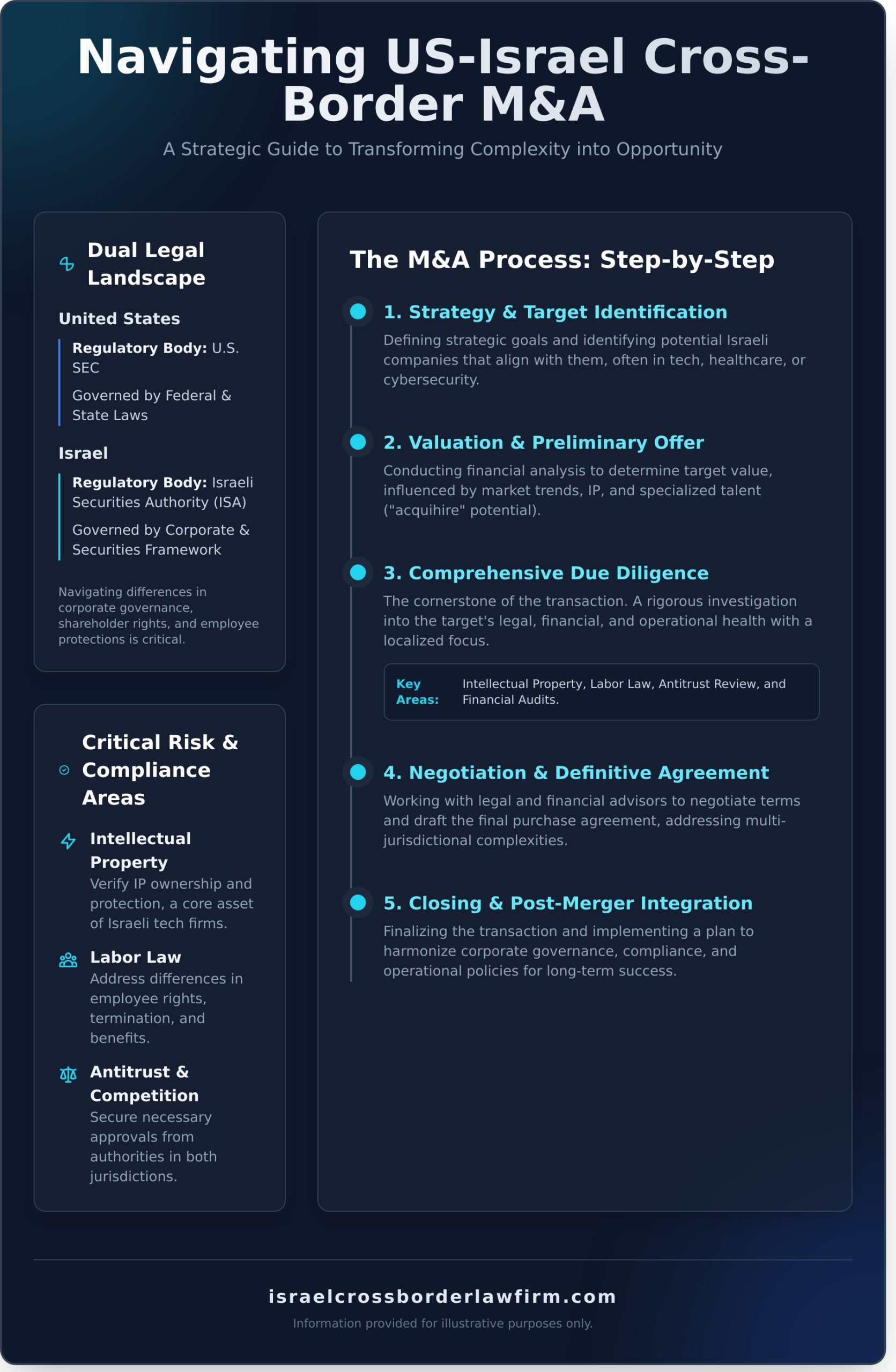
To better understand this complex and dynamic landscape, the following overview provides key insights:
The M&A activity is predominantly driven by Israel’s world-renowned technology, healthcare, and cybersecurity sectors. US-based multinational corporations are consistently seeking to acquire Israeli firms to integrate their advanced intellectual property, from AI and machine learning algorithms to next-generation medical devices and sophisticated defense technologies. This trend is significantly facilitated by a robust venture capital ecosystem that nurtures startups from inception to exit, maturing them into attractive targets for multi-billion shekel acquisitions.
Market Trends and Insights
Looking toward 2025, the M&A market, while influenced by global economic conditions such as fluctuating interest rates and market volatility, is expected to remain resilient. Future trends point toward an increase in strategic acquisitions focused on specific technological capabilities rather than broad market consolidation. We anticipate a continued focus on “acquihire” transactions, where the primary asset being acquired is the target company’s specialized engineering and research talent, a hallmark of the Israeli tech scene.
Key Players in the M&A Landscape
The successful execution of a complex us israel m&a transaction depends on a network of highly specialized players. A review of prominent Israeli M&A Case Studies reveals the critical involvement of global law firms, investment banks, and boutique advisory services. These advisors navigate the multi-jurisdictional legal and regulatory frameworks. For US entities, establishing strong local partnerships is not merely advantageous; it is essential for due diligence, cultural integration, and achieving long-term transactional success.
Legal Framework Governing US-Israel M&A
Navigating the legal landscape of a cross-border transaction requires a deep understanding of two distinct, sophisticated regulatory systems. The successful execution of any us israel m&a deal is fundamentally reliant on meticulous adherence to both U.S. federal and state laws and the Israeli corporate and securities framework. The commercial relationship is bolstered by foundational agreements, such as the U.S.-Israel Trade Enhancement Act, which facilitate trade but do not eliminate the complexities of multi-jurisdictional legal compliance. Key differences in corporate governance, shareholder rights, and employee protections demand strategic legal guidance from the outset.
Regulatory Bodies and Their Roles
For Israeli companies, particularly those listed on U.S. exchanges or being acquired by a U.S. public entity, the regulations of the U.S. Securities and Exchange Commission (SEC) are paramount. Concurrently, the Israeli Securities Authority (ISA) governs transactions involving Israeli public companies, imposing its own stringent disclosure and approval requirements. Navigating these parallel authorities is a complex undertaking where experienced, bicultural legal counsel becomes indispensable. A local team on the ground is critical for advising on ISA regulations while coordinating with U.S. counsel on SEC compliance.
Compliance and Risk Management
Identifying and mitigating potential legal risks early in the M&A process is essential for a successful outcome. Proactive due diligence is the cornerstone of effective risk management in a us israel m&a transaction, uncovering potential liabilities in areas such as:
- Intellectual Property: Ensuring clear ownership and protection of IP, a key asset for Israeli technology firms.
- Labor Law: Addressing differences in employee rights, termination procedures, and benefits between the U.S. and Israel.
- Antitrust and Competition: Securing approvals from relevant authorities in both jurisdictions.
Best practices demand a comprehensive compliance strategy that extends beyond closing. A well-defined post-merger integration plan is vital for harmonizing corporate governance, compliance protocols, and operational policies, ensuring the long-term strategic and commercial success of the newly combined entity.
The M&A Process: Step-by-Step Guide
Navigating the multi-jurisdictional complexities of a merger or acquisition demands a rigorous, phased approach. A successful transaction is built upon a foundation of meticulous planning, from initial strategic alignment and target identification to comprehensive valuation. For any party entering the dynamic us israel m&a landscape, understanding this structured process is fundamental to mitigating risk and achieving strategic commercial objectives.
Conducting Due Diligence
The due diligence phase is the cornerstone of any sophisticated transaction, serving as a comprehensive investigation into the target company’s legal, financial, and operational health. In the context of an Israeli target, particularly within the technology sector, this process requires a deep, localized understanding. Key areas of review must include:
- Intellectual Property: Verifying the ownership, scope, and enforceability of patents, trademarks, and source code, including a thorough review of any encumbrances or obligations related to grants from the Israel Innovation Authority (IIA).
- Corporate & Securities: A detailed analysis of capitalization tables, shareholder agreements, corporate governance records, and compliance with the Israeli Companies Law.
- Financial & Tax: Scrutinizing audited financial statements, tax structures, and potential liabilities under Israeli law.
- Regulatory & Employment: Assessing compliance with industry-specific regulations and Israel’s distinct labor and employee benefits laws.
A common pitfall is underestimating the impact of IIA restrictions on the transfer of IP outside of Israel. Engaging experienced Israeli counsel and financial advisors is not merely advisable but essential to navigating these complex evaluations and avoiding costly oversights.
Negotiation Strategies
Effective negotiation in a cross-border deal hinges on a clear framework and cultural fluency. A comprehensive Letter of Intent (LOI) or Term Sheet is critical to outlining the core commercial terms and guiding the negotiation of definitive agreements. Parties must appreciate the cultural nuances at play; Israeli negotiation styles are often characterized as direct, pragmatic, and fast-paced-a “dugri” (straight-talk) approach that values efficiency. US counterparts should be prepared for this candor, as it is a hallmark of the Israeli business environment. Structuring the deal to create mutual benefit, such as through carefully crafted earn-out provisions or tax-efficient equity rollovers, is a powerful strategy for aligning interests and ensuring a successful long-term partnership.
The final stage involves the meticulous drafting of definitive legal documents, such as the Share Purchase Agreement (SPA), and securing all necessary regulatory approvals from authorities like the Israel Competition Authority. The closing is the formal consummation of the transaction, where consideration is exchanged and the legal transfer of ownership is finalized. The successful execution of these final, complex steps is paramount to realizing the full strategic value of any us israel m&a deal.
Challenges and Solutions in US-Israel M&A
Successfully executing a cross-border transaction requires more than financial acumen; it demands a sophisticated understanding of the multifaceted challenges inherent in the process. For parties engaged in us israel m&a, navigating the distinct cultural and regulatory landscapes is paramount to mitigating risk and achieving strategic objectives. Proactive planning and expert guidance are the cornerstones of transforming potential obstacles into opportunities for successful integration and long-term value creation.
Cultural Considerations
The cultural gap between American and Israeli business practices can significantly impact negotiations. Israeli business culture, often described as “dugri” (direct), values straightforward communication and robust debate, which can be misinterpreted by American counterparts accustomed to more indirect, diplomatic language. Building trust is crucial and often relies on developing personal rapport beyond the boardroom. A nuanced understanding of these dynamics, often provided by bicultural advisors, is essential for fostering a collaborative environment.
Navigating Regulatory Challenges
The regulatory framework governing complex transactions is multi-jurisdictional and requires meticulous attention. Key areas demanding diligent oversight in Israel include:
- Antitrust approvals from the Israel Competition Authority (ICA).
- Compliance with the Israel Innovation Authority (IIA) regarding technology developed with government funding.
- Adherence to both Israeli and U.S. securities laws for publicly traded entities.
Engaging legal advisors with deep, on-the-ground experience is not merely advisable; it is a critical component of risk mitigation and ensuring seamless compliance throughout the us israel m&a lifecycle.
Effective market entry and post-merger integration strategies are built upon this foundation of cultural and regulatory awareness. By anticipating these challenges, companies can structure deals that are not only legally sound but also culturally synergistic. Guiding clients through these complexities is the core of our practice. For a comprehensive consultation on your specific transaction, contact our cross-border legal team.
Case Studies: Successful US-Israel M&A Transactions
Analyzing landmark transactions provides invaluable insight into the strategic components that define successful cross-border acquisitions. The corridor between the United States and Israel’s “start-up nation” is paved with high-profile deals that underscore the immense value created when U.S. market leadership merges with Israeli technological innovation. These cases offer a blueprint for navigating the complexities of international M&A.
Success Stories in Technology
A preeminent example of a successful us israel m&a transaction is Intel’s acquisition of Mobileye for over $15 billion USD. This deal was not merely a financial transaction but a strategic integration of complementary strengths. Intel’s global manufacturing scale and market access were combined with Mobileye’s sophisticated computer vision technology. Success was significantly driven by cultural synergy; Intel’s long-standing presence and deep R&D roots in Israel facilitated a smoother integration, respecting Mobileye’s agile and innovative culture while providing the resources for global expansion.
Healthcare Sector M&A Examples
In the life sciences and medical device sector, Medtronic’s acquisition of Mazor Robotics stands out. This complex transaction required navigating the multi-jurisdictional regulatory frameworks of both the U.S. Food and Drug Administration (FDA) and Israel’s Ministry of Health. The parties overcame these hurdles through a phased acquisition strategy that began with a strategic partnership, aligning corporate objectives and streamlining regulatory submissions. The long-term benefit was clear: Medtronic solidified its leadership in robotic-assisted surgery, while Mazor’s groundbreaking technology achieved a global clinical footprint.
These sophisticated transactions reveal several key factors that consistently contribute to successful outcomes. A deep understanding of these elements is critical for any entity contemplating a cross-border deal.
- Strategic Alignment: Ensuring the target’s technology and talent directly enhance the acquirer’s long-term strategic goals.
- Cultural Due Diligence: Moving beyond financials to assess and plan for the integration of distinct corporate cultures, particularly the direct, fast-paced Israeli style with more hierarchical U.S. structures.
- Regulatory Expertise: Proactively managing the intricate web of securities, intellectual property, and industry-specific regulations in both jurisdictions.
Successfully navigating the unique challenges and opportunities inherent in the us israel m&a landscape requires experienced counsel. For guidance on structuring your next cross-border transaction, our team provides comprehensive legal and strategic advisory services.
Bridging the Divide: Finalizing Your US-Israel M&A Strategy
The synergy between US capital markets and Israeli innovation creates unparalleled opportunities, yet success hinges on skillfully navigating distinct legal and cultural frameworks. As we have explored, a comprehensive understanding of the regulatory environment and a meticulously planned M&A process are non-negotiable for mitigating risk. The landscape of us israel m&a is dynamic, demanding both strategic foresight and flawless execution to transform complex challenges into significant value.
Successfully closing these sophisticated cross-border transactions requires a partner with deep-rooted, bicultural understanding. Our firm offers just that, with a bicultural and bilingual legal team bringing decades of experience and a proven success in facilitating high-value M&A deals. We provide the strategic, commercially-aware counsel necessary to achieve your objectives. Contact us for expert guidance on US-Israel M&A transactions! Let us be the bridge that connects your ambition to market-leading success in this vibrant transatlantic corridor.
Frequently Asked Questions About US-Israel M&A
What are the key steps in a US-Israel M&A transaction?
A successful US-Israel M&A transaction involves several critical stages. It commences with comprehensive due diligence, covering legal, financial, and technological aspects. This is followed by the negotiation and execution of a letter of intent or term sheet. Subsequently, parties draft and finalize definitive agreements, such as the share purchase agreement. The final phases involve securing necessary regulatory approvals from authorities in both jurisdictions and proceeding to the closing, where the transfer of ownership is formally completed.
How can I ensure compliance with US and Israeli laws during M&A?
Ensuring multi-jurisdictional compliance requires engaging sophisticated legal counsel with deep experience in both US and Israeli law. Key considerations include adhering to regulations from the Israel Competition Authority and the Israel Securities Authority, alongside US requirements like potential CFIUS review for national security implications. Expert advisors navigate these complex frameworks, advising on corporate governance, intellectual property transfer, and employment law to mitigate regulatory risk and ensure a seamless, compliant transaction from inception to closing.
What are common pitfalls to avoid in cross-border M&A?
Common pitfalls in cross-border transactions often stem from inadequate due diligence and cultural misalignment. Parties may underestimate the complexities of protecting and transferring intellectual property rights under different legal systems. Another frequent error is overlooking post-merger integration planning, leading to operational friction. Failing to properly account for differences in valuation methodologies and labor law obligations can also create significant, unforeseen liabilities that jeopardize the commercial objectives of the acquisition.
How does cultural understanding impact M&A negotiations?
Cultural understanding is paramount in US-Israel M&A negotiations. The Israeli business culture is often characterized by direct, fast-paced communication, a stark contrast to the more formal, process-oriented American approach. Misinterpreting this directness as aggression can derail negotiations. A bicultural legal team acts as a crucial bridge, facilitating effective communication, building trust, and navigating these nuanced differences to ensure that negotiations proceed smoothly toward a mutually beneficial agreement.
What role do legal advisors play in the M&A process?
The role of legal advisors in a sophisticated M&A transaction extends far beyond drafting contracts. They serve as strategic partners, structuring the deal to optimize tax efficiency and minimize cross-border liabilities. Counsel leads the complex legal due diligence process to identify risks, navigates the multi-jurisdictional regulatory approval landscape, and provides critical guidance during high-stakes negotiations. Their primary function is to protect the client’s interests while facilitating the achievement of strategic business objectives.
What are the recent trends in US-Israel M&A activity?
Recent trends in us israel m&a activity demonstrate a continued, robust focus on Israel’s high-technology sectors, including cybersecurity, artificial intelligence, and life sciences. We are observing sustained interest from both US-based strategic acquirers seeking to integrate innovative technologies and private equity firms looking for high-growth opportunities. Despite global economic shifts, the “start-up nation’s” dynamic ecosystem continues to generate a strong pipeline of sophisticated, high-value cross-border transactions.

Article by
Gabriel Lior
A Personal Journey That Became a Mission
The advisory was founded by an American father Gabriel Lior, LLB, MBA , global entrepreneur, and cross-border advisor who spent more than a decade navigating the Israeli family court system firsthand and now lives in Singapore with his son.
As a divorced parent in a cross-border family, Gabriel faced nearly every legal challenge a foreign parent can encounter in Israel — including child custody disputes, child support proceedings, property matters in Israel and abroad, false accusations, and complex immigration and relocation proceedings.
Over the years, he learned the hard way how difficult it is for non-Israeli parents to understand the system, identify the right legal strategy, and choose the right legal representation — especially when language, culture, and jurisdictional differences are involved. He also witnessed how foreign parents and new immigrants are often disadvantaged or taken advantage of by service providers and institutions simply because they lack local knowledge or fluency.
From Client to Advisor
To truly understand — and survive — the system, Gabriel pursued formal legal education in Israel, completing two Israeli law degrees, alongside a BA and MBA earned in the United States. This was never about becoming a practicing attorney, but about gaining a deep, structural understanding of how the system works — and where it breaks down for foreign parents.
This rare combination of:
Firsthand client experience
Israeli legal and US business education
International business and negotiation training
Decades of commercial execution
created a unique perspective – one that understands both sides of the table.
After years of litigation, persistence, and at times self-representation, he ultimately succeeded in securing custody of his son and relocating abroad through a rare legal victory in the Israeli Supreme Court — becoming one of the first fathers in Israel to do so under these circumstances.
Disclaimer
Important Disclaimer:
The information provided on this website and in its content is for general informational and educational purposes only and does not constitute legal advice, legal opinion, or legal representation.
Gabriel Lior is not licensed to practice law in Israel (nor is he interested in doing so) and does not provide legal services, despite having completed 2 Law Degrees. The services offered are advisory in nature and are intended to provide general guidance, strategic insight, and information regarding cross-border family law considerations.
No attorney-client relationship is formed by accessing this website, reading its content, or communicating with us.
Any decisions made based on this information are at your own discretion and risk. For legal advice specific to your situation, you should consult a licensed attorney in the relevant jurisdiction.
Where appropriate, we may refer clients to independent, licensed attorneys or professionals. Such referrals do not constitute legal representation and no liability is assumed for services provided by third parties.